Remote control – AI and hybrid working

This decade is likely to see the biggest transformation of the workplace since the widespread adoption of the personal computer. Hybrid and remote working patterns adopted during the pandemic appear to be sticking, and a wave of disruption from artificial intelligence (AI) and large language models (LLMs) is following rapidly behind.

London is at the epicentre of these twin “workquakes”. The capital has persistently had the highest levels of home-working in the UK, with two thirds of Londoners saying they worked at home at least one day a week last summer. This reflects hybrid working’s dominance among professional and managerial staff, who make up 63 per cent of London’s resident workers, compared to 50 per cent of all England’s.

These people enjoy the flexibility, work-life balance and personal productivity that working from home can offer, though the impact on organisational or inter-organisational productivity is more contested. Nonetheless, speakers at a London Assembly meeting last week said that the era of “five days a week in the office” had gone for good, and that the task was to adapt central London to new ways of living, working and playing.

The accelerating pace of AI adoption looks likely to add turbulence. A recent UK government report found that workers in London were twice as exposed to AI as the UK average. This was not because of LLMs’ appetite for the diversity and vitality of the capital, but (like the prevalence of home-working) is largely a result of London’s occupational make-up. Unlike previous waves of automation, which affected manufacturing and routine clerical work, AI is coming for the professionals.

The report suggests that the most affected occupations include management consultants, financial managers, psychologists, economists, lawyers, project managers, market researchers, public relations professionals, authors and, perhaps surprisingly, clergy. The “safest” are jobs are those of such as sports professionals, roofers, plasterers, gardeners and car valets. The former occupations are over-represented in London, the latter are not.

However, before soft-handed metropolitan knowledge workers like me rush to retrain, ignoring our lack of aptitude, there are some caveats. The first is that the government report’s projections make no distinction between jobs that are augmented (those where workers can deploy AI to dramatically enhance their productivity), and those that are likely to be substituted (replaced, sooner or later, by new technology).

The second is that the analysis takes no account of the new jobs that will be created. We can see those that are at risk, but it is harder to identify the opportunities that will arise. A year ago, few people had any idea what a “prompt engineer” was. Today, demand for them is booming. And we can be re-assured by historical experience: the majority of jobs that Americans do today did not exist in 1940.

In any case, most professional jobs involve more than one activity, which is where the interaction between working from home and AI gets interesting. A management consultant, for example, may spend time meeting clients, preparing pitches, interviewing workers, analysing data, workshopping ideas and writing reports. A PR professional may write press releases, manage staff, research markets, pitch to clients and journalists, develop concepts, devise guest lists, plan and host events.

Some of these tasks are intrinsically social and best undertaken face-to-face. Others are more easily undertaken remotely, away from distraction and other people. Those in the latter group are also those that can be most easily supported by AI.

From this perspective, AI adoption and hybrid working will complement each other. Hybrid working has already accustomed us to working remotely with less social interaction; AI can provide a sounding board for ideas and be an orchestrator of collaboration, without the hassle and cost of a commute. Similarly, intelligent use of AI can boost productivity, improve co-ordination and reduce the “digital overload” of online meetings, emails and collaboration spaces that built up during lockdown.

But there may be a sting in the tail. Over time, people working remotely with AI support may find themselves edged out by their machine collaborators. Cost-conscious employers are already exploring whether some jobs undertaken remotely might be outsourced internationally. A task that can be completed in Leamington Spa rather than London can also be exported to Lisbon or Kuala Lumpur. Over time, it may also be undertaken by an AI.

Oxford University professors Michael Osborne and Carl-Benedikt Frey, who published a highly influential analysis of the potential impact of automation on the workforce in 2013, recently wrote a (very readable) update reflecting on the explosive growth in AI and how it may affect their original projections.

In 2013, they argued that tasks requiring social intelligence were unlikely to be automated. Now, they write, AI has challenged that “bottleneck” to automation: “If a task can be done remotely, it can also be potentially automated.” However, for sensitive tasks and relationships, face-to-face would retain primacy:

“The simple reason is that in-person interactions remain valuable, and such interactions cannot be readily substituted for: LLMs don’t have bodies. Indeed, in a world where AI excels in the virtual space, the art of performing in-person will be a particularly valuable skill across a host of managerial, professional and customer-facing occupations. People who can make their presence felt in a room, that have the capacity to forge relationships, to motivate, and to convince, are the people that will thrive in the age of AI. If AI writes your love letters, just like everybody else’s, you better do well when you meet on the first date.”

What does this all mean for cities like London? To start with, while we do not know precisely what new jobs will be created by the AI revolution, London is already one of a handful of hotspots for AI start-ups, so it is likely to be the location for many of the new jobs too. The capital is already home to Google Deepmind and many other high growth AI firms, and OpenAI have announced plans for their first international outpost in London.

The combination of AI and hybrid working may ironically strengthen London’s role as one of a few genuine global centres for face-to-face interaction. If remote work is increasingly dispersed or automated and in-person workers with social skills remain in demand, then diverse, globally-accessible, sociable cities such as London will provide the ideal setting for their relationships and collaborations.

There is a bigger picture too. A recent paper by Richard Florida and others talked of the rise of “metacities” based on long-distance networks of collaboration and intermittent commuting. This identified London and New York as the world’s two leading “superstar” hubs, sitting at the heart of networks of talent and interaction. London’s network, as measured by talent flows, includes Manchester, Birmingham, Edinburgh and Bristol, but also Dublin, Paris, Lagos and Bengaluru.

Florida and colleagues argue that the constellation of satellite cities will shift over time, but the importance of superstar cities will persist. This suggests that in coming years London will need to plan for growth in housing, in offices and in new forms of collaborative and social spaces.

The city will also need to be open and welcoming to global talent while helping local workers adapt to change, and to work more closely with its satellite cities to ensure that economic transformation can deliver prosperity and economic growth across the UK.

This is likely to be a turbulent decade for London’s economy, but it could also be one in which the capital’s national and global profile increase.

First published by OnLondon.

A terrible beauty is torn

I’ve been thinking about The Pogues quite a lot since Shane MacGowan’s death last week. Though I listen to them more rarely now, I was a huge fan in the 1980s and 1990s. They were a gateway drug to Irish folk music – Christy Moore, the Chieftans, the Dubliners – and a guttering light by which I started to explore my Irish heritage and adolescent rebel politics (I relished the rage of one schoolteacher who seethed that I was “the sort of person who probably thinks the Birmingham Six are innocent”).

Some MacGowan obituaries have inevitably focused on his lifestyle, which certainly threw out some meaty anecdotes, but most have also acknowledged the sheer quality of his songwriting at the Pogues’ peak. His literary and hellraising sensibilities slug it out in songs like Streams of Whiskey and the Sickbed of Cuchulainn; his sympathy for the oppressed shines through in The Old Main Drag, and his woosy romanticism gleams in Rainy Night in Soho and Fairytale of New York. He shifts perspective and tone – the estranged lovers in Fairytale, the old and young man in Pair of Brown Eyes, memories and narrative in The Broad Majestic Shannon – smoothly and artfully.

His is a London-Irish perspective. His view of the UK capital is brutally and raucously realist (staggering in Transmetropolitan “from a 5 pound bet in William Hills to a Soho sex-shop dream, From a fried egg in Valtaro’s to a Tottenham Court Road ice cream”). But his Ireland is romantic, pre-lapsarian, the land that his mother’s family talked of in his early years in Tipperary. The images in the Broad Majestic Shannon – “the cards being dealt and the rosary called, and the fiddle playing Sean Dun Na Ngall” – are out of time, and intentionally so. MacGowan’s Ireland has its own ghosts – “the best place on earth, but it’s dark and it’s old”, as Sit Down by The Fire has it – but its devils are all imported, mainly from Britain (the soldiers in Gentleman Soldier and The Recruiting Sergeant; the accursed “judges, coppers and screws who tortured the innocent” in Birmingham Six).

It may seem churlish so soon after MacGowan’s death, but it’s interesting to contrast his perspective with Philip Chevron’s. Chevron, the Pogues’ lead guitarist who died ten years ago, was Irish-born and -raised. His songs have a more ambivalent attitude to his country, its priest-ridden past and its underachieving present. In Thousands are Sailing, he observes the irony of the Irish diaspora: “wherever we go we celebrate the land that made us refugees, from fear of priests with empty plates, from guilt and weeping effigies.”

You can hear the disappointment in what the Republic had let itself become in the tumbling imagery of Faithful Departed (which gives this blog post its punning title), written by Chevron for his punk band The Radiators from Space but perhaps less dated-sounding in this version by Christy Moore. Like Thousands are Sailing, the song starts in dialogue with ghosts, but this time they are literary heroes (Yeats, Joyce, Brecht, Behan) rather than nameless Famine victims, as the song picks apart the “made to measure history” of the “grey, post-DeValera Ireland of the 1970s”, to quote Chevron’s own exposition of the song (allegedly from a Pogues blog, though I can’t find the original).

When I first heard the Pogues, I had never been to Ireland (just as, incidentally, MacGowan had never been to New York when he wrote The Pogues’ biggest hit). If the Ireland I imagined was MacGowan’s, the Ireland I found when I did start visiting in the 1990s was more like Chevron’s (though rapidly becoming less so). The magic of the Pogues is the way these perspectives played off each other, in a band blessed with two extraordinarly gifted singwriters.

Talkin’ about AI Generation

A year after OpenAI’s ChatGPT was launched, we are starting to see the outlines of generative artificial intelligence’s potential impact on our lives.

While the recent Bletchley Park Summit focused on existential risk and misuse by extremists, debate in universities has focused both on technocratic issues (such as automated marking and plagiarism) and more recently on the potential of AI to transform and enhance learning and research – see, for example, the recently published Russell Group principles on the use of generative AI in education.

But there’s a more fundamental question for universities too. How will AI change our economy, and what will this mean for the role played by universities in readying the workforce of the future? The AI Generation: How universities can prepare students for the changing world, a new report for Demos and University of London, draws together what we know about how universities support students’ employability today, and speculates about how this might change as technology advances.

Within our GRASP

The good news is that there is a reasonably strong consensus about the critical employability skills needed today. As computer use and the internet have transformed the knowledge economy, it is not specific technical skills that are most prized. More important are the broader skills of listening to and persuading clients and colleagues, analysing and communicating information to solve problems, and having the ability to manage your own workload, your career and your professional development – the GRASP (general, relational, analytical, social and personal) skills.

Most of these skills are expected to rise in importance in coming years and will remain important in working with AI. Even if generative AI can produce text and images, workers will need critical and ethical judgement to assess what it produces and what it is asked to produce, as well as the relational and social skills to intermediate between technology and humans. So, it appears that the GRASP skillset, with adjustments, will still be relevant.

The less good news is that there is not much evidence on how well universities help students acquire these skills even now, how well these translate into good employability outcomes, or even precisely how they should be defined. Based on a review of academic and policy literature, The AI generation finds that generic “employability” content is unpopular and largely ineffective for students, but material tailored to subject matter and likely career paths much more valued. Active learning approaches – project assignments, collaborative work, peer assessment – seem to work better in developing most employability skills as well as leading to better outcomes, than traditional lecture-based learning.

But it is what happens outside the classroom – work experience, placements, membership of clubs and societies, studying overseas – that has the most impact, whether based on students’ self-assessments, or longitudinal studies looking at graduate employment rates and types. The complication is that these activities are not available to or taken up by all students equally. Students from poorer backgrounds are less likely to participate – partly a matter of cost, but also a matter of feeling, or being made to feel, that you don’t belong. In this way, there is a risk that the very activities that best boost employability are least accessible to those who need them most.

Murky paths

Growing use of AI may intensify some of these risks. At the moment, a degree still acts as a minimum entry requirement for many personally and financially fulfilling careers. Early studies suggest that AI can particularly help less competent workers achieve better outcomes in standardised professional services tests, suggesting that degree holders may need to do even more to stand out from the crowd than they do at the moment, and that lower-level cognitive work may be automated first and fastest.

This also makes the pathway into graduate careers less clear. Currently students who want to pursue careers in most professions have a clear path ahead of them, with employers keen to diversify traineeship schemes. But AI may quickly automate some of the basic trainee tasks – preparing pitch decks and presentations, summarising arguments, working up architectural details, researching legal precedent – calling into question our whole model of professional development.

These are big societal issues, and universities cannot solve them alone. The AI generation recommends research and analysis of what works best in developing employability skills and a more systematic and fair approach to career-boosting activity such as work placements. But universities can also take the lead as civic institutions, convening government, employers, professional bodies and civil society organisations, to consider what AI will mean for our working lives, and what education and training future generations will need in order to thrive.

First published by WonkHE.

Flea->rat->horse->sex scandal

For tiny critters, fleas have had a disproportionate impact on British history. The fleas that spread Black Death in the 14th Century were responsible for the biggest social and economic disruption of the Middle Ages (as well killing one in four of the population). The insect that gives its name to the play The Flea, running at The Yard Theatre in Hackney Wick, initiates a chain of events that threatens a comparable upheaval five centuries later.

The year is 1889, four years after the moral panic-inspired criminalisation of “gross indecency” between men and six years before Oscar Wilde’s disastrous libel suit against the Marquess of Queensbury. The play opens with Emily Swinscow (Norah Lopez Holden) explaining the circumstances that led to her tanner husband’s death – a flea bit a rat, which startled a horse, which kicked out and killed him. Turning away from the audience, she despairs of her safety if she cannot pay the rent.

Her son, London Telegram messenger Charlie (Séamus McLean Ross), finds new ways of earning extra money – “lying down for gentlemen” at a house in Fitzrovia. Until, that is, he is accused of stealing from his official place of work and foolishly spills the beans about his other source of income.

Written by James Fritz and directed by Jay Miller, The Flea is a rumbustiously fun romp through late Victorian society. It is very loosely based on the Cleveland Street scandal, which resulted from a police raid on a male brothel at 19 Cleveland Street (the house has since been demolished to make way for the Middlesex Hospital redevelopment). Several aristocrats were accused of being patrons, and there were also rumours of visits by “Eddie”, Duke of Clarence and second in line to the throne – a shadowy masked figure in the play, only glimpsed flitting in the disco shadows.

As the police – a keen constable (Sonny Poon Tip) and a detective struggling to save his reputation (Scott Karim) – pursue their enquiries, whispers of scandal stalk up the echelons of society until they reach its zenith, Queen Victoria herself. The small spaces of The Yard are transformed: the split stage allows scenes to run in parallel, and the hierarchy of Victorian society is wittily made real, as aristocrats ascend the back wall of the set, with poor Charlie imprisoned behind the rungs of their ladder.

Each of the actors plays two or more roles, and they swap their Steampunk-Steptoe costumes at lighting speed. Holden excels as the two mothers at the heart of the drama – Swinscow and Victoria. As the former, she switches fluently back and forth between narrator and player, drawing the audience into her story but also standing back from it. As the latter, wearing what looks like a dead cassowary on her head, she is the only character who faces a real moral dilemma as she ponders whether or not to put her family and the monarchy itself above the law.

Everyone else seems trapped, their behaviour constrained by circumstance and class. That is not to say the characters are unsubtle or caricatures. Connor Finch makes you feel for Lord Arthur Somerset, who naively believes that the young man he falls for at the brothel reciprocates his feelings, even as his more discreet friend Henry FitzRoy, Earl of Euston (also played by Tip) urges caution and uses his influence to help his pal out. The only wholly unsympathetic characters are the sulphurous brothel keeper Charles Hammond (Karim) and the Prince of Wales, played by Ross with a monstrous mix of buffoonery and brutality.

The story moves fast as events gather momentum. The script and directing is tight and the acting lively, with a carnivalesque relish that belies the bleak subject matter. After Victoria makes the decision on which the whole play pivots, the second half feels slightly slower paced. However, I can understand why Fritz and Miller want to take the time to mirror the first half, as the consequences of the Queen’s decision come cascading down through society. Consequences for some, that is. I don’t think it’s a spoiler or a surprise to say that we end with impunity for the privileged and judicial violence for the victims of sexual exploitation.

And after all that, we end up right where we started, with Emily and Charlie Swinscow scraping by, and a flea.

First published by OnLondon.

The last of England?

Nowadays, it can feel as if you are never more than ten minutes away from someone declaring that “London is not an English city any more”. Sometimes, the trope is rolled out by right-wing social media personalities like Laurence Fox, most recently in the wake of the Peckham Hair and Cosmetics incident. Sometimes it pops up in below-the-line comments on London news stories, usually posted by someone like “BromleyBoy365” from his base in Benalmadena.

Earlier this month, former UKIP mayoral candidate and London Assembly member Peter Whittle dedicated a 35-minute video to the theme under the aegis of the New Culture Forum, a Tufton Street think tank focused on “challenging the orthodoxies dominant in our institutions, public life and wider culture”. I watched it so you don’t have to (though something like 388,000 other people have at the time of writing).

Whittle’s opening statement, delivered while wearing a brass-buttoned waistcoat that makes you wonder if he is going to burst into a Michael Bublé medley for the early-bird diners, sets out his stall:

“London has changed. Not just in the organic way that history usually demands but drastically, irrevocably and in the space of a generation. It is not really a British city, much less an English one. Unprecedented demographic change has seen to that. And its character, its very essence, once based on centuries of shared history and experience, is now defined by what are called its “values”, a set of modern beliefs to which the modern Londoner should sign up.”

There are four elements to his argument: that London has experienced unprecedented demographic change in recent decades; that this has stopped the city being British; that it has also diluted London’s character and shared history; and that Londoners are now being required to sign up to an alternative set of values. At least three of them are nonsense.

To begin on Whittle’s strongest ground, London has undoubtedly seen dramatic population growth in recent decades, partly driven by international migration at a time when migration has risen across the world. Since 2001, the proportion of Londoners born in the UK has fallen from 73 to 59 per cent.

By way of comparison, if you go back to 1901, a previous high point of global connectivity, London had 135,000 “foreign-born” citizens. These represented just three per cent of its population, yet that was almost ten times the proportion living in the rest of England and Wales. If you add people born in Ireland and the colonies of the British Empire, the proportion of people we would now regard as “foreign-born” rises to about five per cent.

So, while London’s international population was far smaller at the start of the 20th Century than it is today, it was also much larger than in the rest of the country and had been growing fast in previous decades. London has always had the global character of a port city. And it has always had people who disliked that character. The 12th Century chronicler (and antisemite) Richard of Devizes wrote disdainfully of the capital: “All sorts of men crowd together there from every country under the heavens. Each race brings its own vices and its own customs to the city.”

Has more recent immigration stopped London being British? From the first few minutes of the film, Whittle and his interviewees, Rafe Heydel-Mankoo, a New Culture Forum “senior fellow” whose website describes him as “one of North America’s leading royal commentators”, and Alp Mehmet, chairman of Migration Watch UK and a former UK Ambassador to Iceland, chuck around terms like “British”, “foreign-born” and “white British”, as if they are interchangeable.

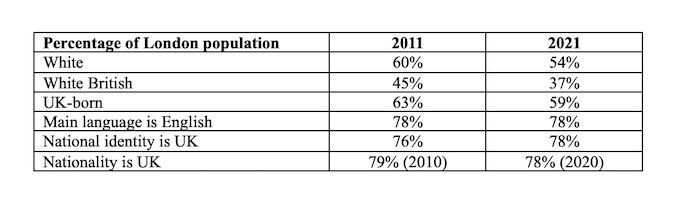
They clearly are not, as even a brief look at recent population data show. The figures below are from the 2021 Census (helpfully presented in one place here) and the Office for National Statistics Annual Population Survey for nationality.

Screenshot 2023 09 20 at 10.39.50

The terms used in this context matter. So when Peter Whittle speaks of a decline in the ‘indigenous’ population when referring to ‘White British’ people, or talks of “the people who celebrate the lack of British or English people in London” when around four out of five Londoners are UK nationals, he is eliding concepts in a pretty inflammatory manner.

Mehmet worries that, unlike previous immigrants, these new arrivals don’t speak English. But, in fact, only around four per cent of Londoners don’t speak English well, according to the Census. He also says they don’t assimilate, contrasting them, hilariously, with British expats who apparently “do learn the language, by and large, and mix with the locals”. Whittle picks up this theme, saying “to have a strong identity, a city has to continue to pass on not just its particular traditions and shared history, but also the culture, language and multitude of nuances that make it unique”.

The 1901 Census report shows how mythic this Golden Age of a perfectly homogeneous London is. In some parts of the city, the impact of immigration was acute and disruptive. For example, in Stepney the foreign-born population rose from six to 18 per cent between 1881 and 1901. The Census report notes the conclusion of a Royal Commission on Alien Immigration, “that the greatest evils produced by the presence of the Alien Immigrants here are the overcrowding caused by them in certain districts of London, and the consequent displacement of the native Population”.

Challenges with assimilation can also be seen in the extraordinary efforts made in 1901 to enable recently-arrived Jewish refugees, whose persecution in Tsarist Russia made them understandably suspicious of officialdom, to participate in the Census: there were leaflets in Yiddish and German, outreach workers to help fill in the forms and statements read out in synagogues.

Furthermore, international migration was only one part of the story. Migration from within the UK was a powerful force in London’s growth in the 19th Century. In 1901, one third of Londoners had been born outside the city. In 1851, the proportion had been 40 per cent. A Victorian dock-worker might have found he had no more in common with a Sussex peasant than with a Russian tailor in terms of shared history and experience.

It is also very unclear what the common culture Whittle claims is so threatened by immigration might have actually been. The film intersperses talking heads with archive footage of royal occasions, Winston Churchill and old buses swinging around Piccadilly Circus. But while Mehmet pours scorn on glib markers of Britishness such as “fish and chips, warm beer, cricket, adhering to justice”, Whittle’s film never quite says what it believes London’s lost “communal customs, practices and culture” are.

What they most certainly are not, Mehmet argues, are “the values that Sadiq Khan tells us we must sign up to in order to be a Londoner”. Except I don’t think the Mayor has ever said anything of the sort. Khan has talked of London’s values, but in descriptive rather than prescriptive terms. Whittle is particularly exercised by the Mayor’s often-repeated statements about London’s diversity, such as:

“For generations, London has served as a shining example of how people from different countries, cultures and classes can live side-by-side and prosper together. That’s because, by and large, Londoners don’t just tolerate each other’s differences, they respect, embrace and celebrate them – recognising that our diversity is not simply an added extra but one of our most valuable assets.”

I happen to think this slightly hyperbolic, though harmlessly so: yes, thronged streets for Pride and Carnival show that many Londoners do actively celebrate diversity, but many others are happy just to rub along with a variety of their fellow citizens. But more importantly, Khan is not saying what the city should be but what it is. Representing the capital in this way, to itself as well as to national government and the world, seems central to the Mayor of London’s role – and the theme of diversity has been emphasised by all three mayors to date.

For Whittle and his interviewees, however, diversity is not something to be celebrated. “Diversity is weakness,” Mehmet asserts, “if you are talking about communities holding together.” But no evidence for this is cited. And a cursory look at studies of the issue reveals mixed findings, with some arguing that diversity actually increases social cohesion as long as segregation between different groups doesn’t reverse this beneficial effect.

The film moves on from diversity to attack a predictable litany of liberal articles of faith: belief in the climate crisis and support for “the war on motorists”, Black Lives Matter and “decolonisation” of statues, on which subject Whittle shows footage of himself as an Assembly member berating a bored-looking Sadiq Khan. It is the “white middle-class liberals” (the wrong sort of “White British”) who sign up to these, Whittle says, who will ensure Khan is re-elected.

By the end, it all feels a bit sad and sour. These people don’t really like London or Londoners. They don’t even give the impression that they been in the city recently. Heydel-Mankoo says you never see people chatting in its streets or shops any longer and that Londoners’ trust in other people they encounter has declined. In fact, levels of trust are around the UK average in London and higher than in most other countries.

Of course, London has its tensions and injustices, as all big cities do. But the city of suspicion and segregation Whittle’s film portrays seems a world away from my own experience and others’. Look at the thousands of people mixing on football terraces, in pubs and nightclubs every weekend; the lively conversations of elderly Irish and Jamaican shoppers in Brixton market; the brief moments of connection on late-night tubes and buses.

Whittle ends by referring to a Roman Polanski quote: “Los Angeles is the most beautiful city in the world, as long as seen at night and from a distance.” As with LA and Polanski, I suspect London will be happy for Whittle to keep his distance.

A version of this was first published by OnLondon.

We got it bad; we don’t know how bad we got it

The Office for National Statistics (ONS) is something of a national treasure – independent, rigorous and accessible, and always ready to speak up when statistics are bent out of shape by politicians.

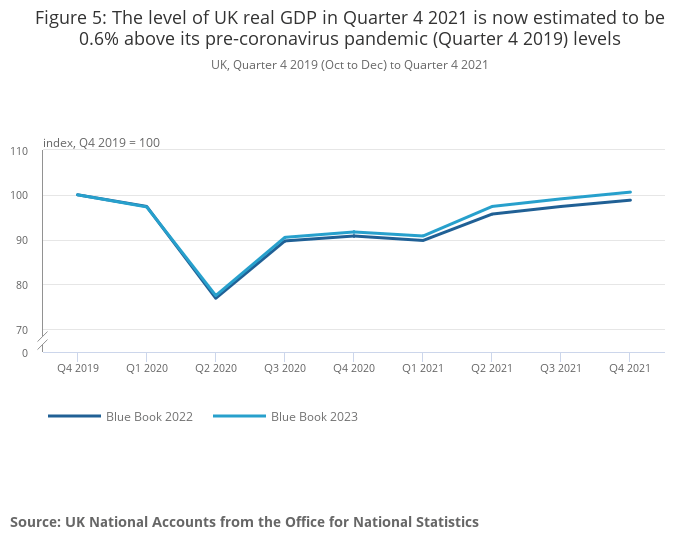
It is also ready to hold up its hand when it gets things wrong. It did so last week, when it revealed that it seemed to have been undercounting GDP growth since the pandemic. The changes meant that UK economic output had bounced back above its pre-pandemic level by the end of 2021, rather than remaining below it. More significantly, this put the UK in the middle of the pack of G7 countries (above Germany, level with France, and below the US, Japan and Italy), rather than languishing below them – though ONS does warn that these countries too may revise their calculations.

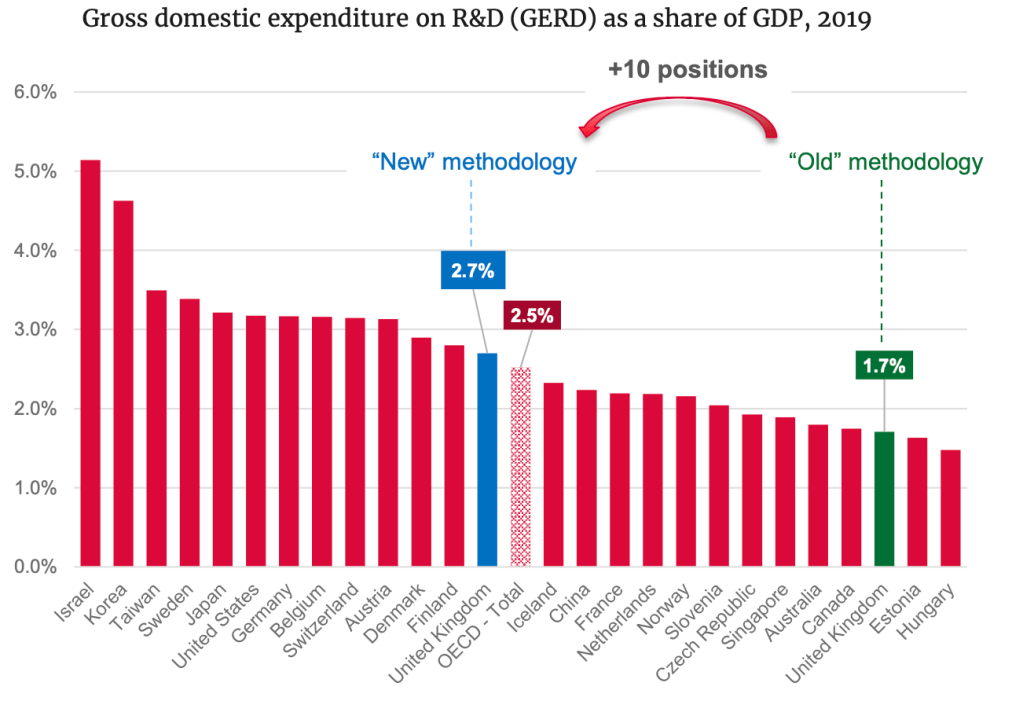
I came across a similar correction recently, when comparing UK expenditure on research and development (R&D) to other countries’. When the UK Government’s Innovation Strategy was published in 2021, it made much of the fact that we were only spending around 1.7 per cent of GDP on R&D, well below the OECD average. A target was set to raise expenditure to 2.4 per cent of GDP by 2027.

Last autumn, the ONS reviewed how small business expenditure on R&D was being assessed, and revised its figures. UK expenditure on R&D in 2019 rose from 1.7 per cent to 2.7 per cent, bringing it above the OECD average, and putting the UK ahead of China as well as many of our European neighbours. By 2021, we had moved further up the table, spending 2.9 per cent of GDP on R&D, against an OECD average of 2.7 per cent.

Source: UK Innovation Report 2023

These numbers too may change again, and the changes are an illustration of the difficulties of measuring something as complex as an economy, particularly in the wholly exceptional global circumstances of the past few years. I’m really not qualified to say whether such dramatic revisions call for a review of how statistics are compiled. However, as Tim Leunig has stated in arguing for such a review, these changes matter because low GDP and low R&D investment matter. They are the basis for changes in policy (including, I suspect, the repeated expansion and extension of the UK’s R&D tax credits regime), so if the data are wrong, then policy may be wrong too.

But I am struck by how ready I was – and I suspect I am not alone in this – to accept as a simple fact something that actually seems to have been very wide of the mark. Of course the UK is underperforming most other advanced economies, I thought, Of course it is. It’s ‘sickmanism’, our reclamation of the dubious accolade that seeemed ours by right in the 1970s, a return to the “orderly management of decline” that permeates John Le Carré’s novels of that time.

It’s not surprising that many of us are ready to believe the worst. After seeing public services and social infrastructure stripped to the bone over a ten year period, the ever-deeper impoverishment of society’s most vulnerable, a needless and needlessly harsh split from our closest allies and trading partners, and a succession of political leaders who seem to treat politics like a fairground card trick, I can forgive my own cynicism.

The annoying thing, of course, is that our frankly middling performance (playing catch-up with Italy?) will now be hailed as a triumphant vindication of Brexit and the sound economic governance that recent administrations have been known for. Chancellor Jeremy Hunt has already said that it disproves the “declinist narrative about Britain and its long-term prospects”.

But beyond the political ping-pong, perhaps there’s a lesson too: it is not to flip from doomster to booster, but to treat assertions of the UK’s global decline as cautiously as those of its triumph. Maybe Britain can make it after all.

Heaven is a place on earth

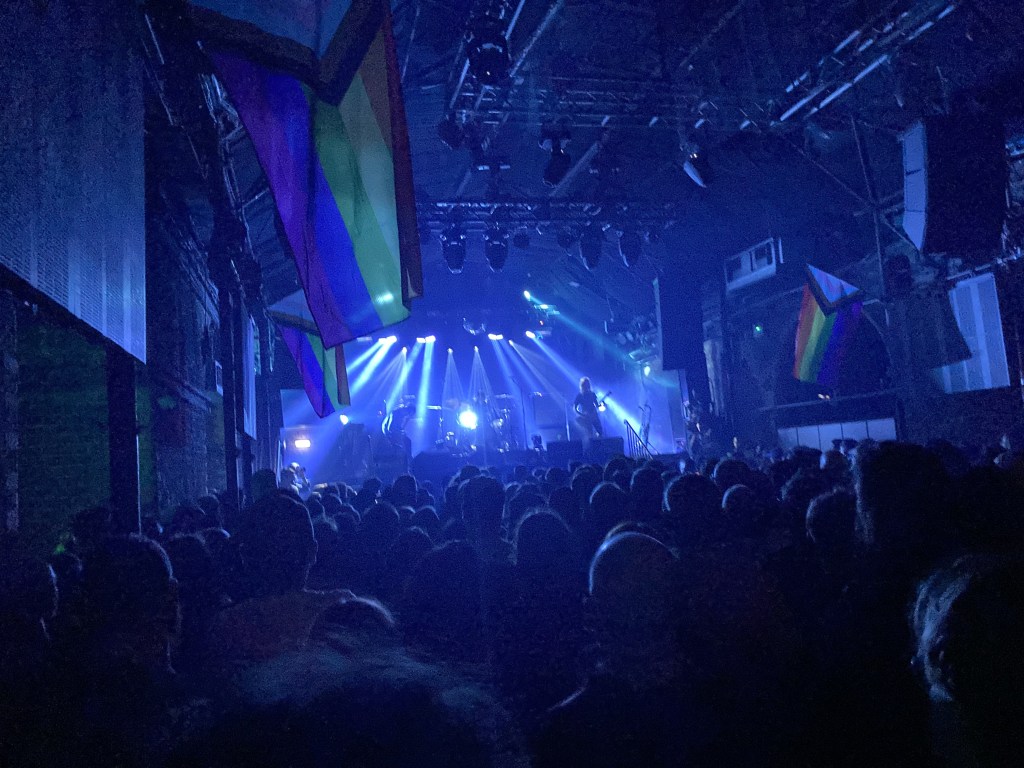
Band playing in Heaven

Is it “black metal” or “death metal”? I am never quite sure of the difference, but the air thrums with blast-beat drumming as we descend into Heaven. Tonight we’re here for the metal, but as we pass the security staff, I am briefly transported back to my 1990s, when optimism and alcoholic lemonade fuelled countless nights of terrible dancing and occasionally-effective eye-catching under the arches of Charing Cross.

Heaven is now a venerable London institution. The club, buried in the vaults under the station concourse, was a gay clubbing trailblazer when it opened in 1979. It was established by Jeremy Norman – entrepreneur, wine merchant and chairman of Burke’s Peerage – drawing on his experiences at New York’s The Saint and Studio 54. Through the Eighties and Nineties, Heaven hosted iconic gay nights such as Fruit Machine, alongside pioneering techno clubs like Paul Oakenfold’s Rage and gigs by everyone from New Order to Throbbing Gristle to Stereolab.

Owned today by Jeremy Joseph, promoter of G-A-Y, Heaven continues to mix it up. The cavernous vaults, which hold 1,000 people, have rainbow flags fluttering in the strobe lights as Flemish trio Wiegedood blast the crowd. The thing about death metal (or black metal) is you need to lean into it, like a stage diver trusting in the mosh pit.

Immerse yourself in the propulsive sound and let the melodies emerge – chiming chord progressions like Keith Levene’s on early Public Image Limited, or angular shreds of Sonic Youth noise. The lyrics are screamed in classic black metal (or death metal) style. Are they even in English or are they Flemish? It’s hard to tell, but given the band’s pledge, on their website, that their new album “focuses on the filthiest and most disgusting parts of human nature”, this may be a blessing.

As I buy a couple of cans of Red Stripe in between acts (a very fair £5.45 each, but decanted into disposable plastic glasses – boo!), Wiegedood bassist Levy Synaeve chats amiably with fans. For all the decibels and corpse-paint, metal audiences are some of the friendliest you could meet. The fashion may be divergent, the headbanging heavier and the flirting dialled down, but metal gigs can create the same euphoric sense of community and celebration as gay clubs.

Chicago’s Russian Circles are the headline act. They are “post-metal”, which seems to mean no vocals – probably a good thing, for reasons already stated – and  their music builds from languid harmonies, to motorik krautrock rhythms, to thundering slabs of guitar. It’s loud for sure, and Heaven’s sound system lets the bass re-arrange your internal organs without losing clarity and force higher in the register. But there is a lightness of touch to Russian Circles that eludes bellowing leviathans like Metallica. Their performance is captivating and enthralling.

Let’s be honest: I doubt anything I write will convert you to black (or death) metal, or post-metal, if you are not already a fan. But Heaven is place that bears (re)visiting, whether you prefer your repetitive beats from a DJ’s decks or a hairy Belgian’s drum-kit. It has the atmosphere and heritage absent from most purpose-built venues, but clean toilets, friendly staff and reasonably-priced drinks too.

After a fierce hour, Russian Circles leave the stage and the house lights come up. Heaven has to freshen up, apply lippy and re-open for its Monday stalwart, Popcorn. As we leave, I am almost tempted to turn round and join the queue to go back in. But I have a train to catch, and I’m not 25 any more.

Originally published by OnLondon

Spare us the cutter

To misquote Hunter S Thompson, “Levelling up is hard to know because of all the hired bullshit”. Is “levelling up” about the north-side divide, about regional infrastructure, about social inequality or about “London-centrism”? The concept is so slippery that there is plenty of space to pick your own perspective. So it’s a relief when the august Institute for Fiscal Studies (IFS) sheds some light on how money is being spent around the country.

Its report on public spending, published this week, looks at allocations for health services, police, local government, public health and schools across England – in total, around £245 billion in 2022/23. This is where the real money is. Spending on these services dwarves, for example, the £3 billion of Levelling Up Funds provided to England in the first two rounds.

The report breaks down spending by 150 local authority areas (with an interactive map), analysing expenditure per head but also as measured against need. At first glance, the capital’s boroughs fare relatively well, with six in inner London – Camden, Hackney, Islington, Kensington & Chelsea, Southwark and Westminster – among the ten highest-funded areas, each receiving more than £5,000 per head alongside Blackpool, Knowsley, Liverpool and Middlesbrough.

There are, of course, good reasons why spending in London is higher. For a start, wages, which make up around 45 per cent of NHS spending, 50 per cent of local government spending and around 75 per cent of police spending, reflect the city’s higher living costs. London weightings added to wages (seven per cent for police, 2-20 per cent for NHS workers, and 3-18 per cent for council staff) are set accordingly. So, you would expect higher costs in London for equivalent staffing and service levels elsewhere.

There’s a bigger issue too: the figures are based on 2021 population estimates. We know that London saw a sharp fall in population during the pandemic, and this was particularly acute in central London. The IFS shows how different spending per head would be if the calculation used 2020 estimates instead (which would also be more in line with the estimates used to allocate funding). It would fall by an average of £160 per head across London boroughs, and by more than £1,000 per head in Camden and Westminster. Mid-year estimates for 2022, due out next month, will give us some indication of how far London’s population has rebounded.

All that said, it’s no great surprise that urban areas in general spend more: they have higher levels of deprivation and higher levels of need (with a few countervailing areas such bin collections, where rural authorities spend more). This is why central government funding is allocated according to complex formulas intended to reflect need (and the cost of delivering services) as well as population levels. The IFS team has updated these formulas – the government has not done so for ten years – and compared them to spending per head.

Here the picture is a lot more mixed for London. The capital receives slightly higher funding relative to need for NHS services, though this is largely attributed to the differences between the GP registrations used to allocate NHS funding and the much lower 2021 ONS population estimates. Funding for the police is slightly lower than need, but not as low as it is in other large urban areas. But London’s local government looks very under-funded. Nine out of the ten councils with the biggest relative funding gaps are in London, forming an arc stretching from Barking & Dagenham to Hounslow.

Defunding deprived urban areas is at least partly the result of political choice. As Centre for London and the IFS have explored, cuts in central government funding for councils during the 2010s were applied as fixed percentages, which hit urban areas – with higher need and more dependency on grants rather than Council Tax – particularly hard. As the IFS report observes, needs assessments for local government have not been updated for a decade. But this too is a political choice.

You could conceivably argue that urban areas, which tend to vote Labour, have been over-funded in the past. The Prime Minister hinted at this at an event in Kent (funding eight per cent above relative need) last year when running for the Conservative Party leadership. In fact, the IFS report shows a swathe of well-funded local authorities in the Conservatives’ deep blue Home Counties and midlands heartlands.

Whether this is the result of reasonable policy or low politics is a matter of opinion. But you have to ask if it makes sense in the light of the government’s own proclaimed policy of building in city centres, including London’s. Cutting back public services in city centres, while seeking to grow their populations, does not seem like a sustainable approach to growth, let alone to “levelling up”.

First published by OnLondon

You Gove to see it?

In the sense that the only thing worse than being talked about is not being talked about, Michael Gove’s big housing speech had some grains of good news for London and Sadiq Khan.

Sure, there was a slightly formulaic spot of Khan-bashing – the allegation that “the Mayor’s failure on housing, like his failure on crime and his failure on transport, undermines the vitality and attractiveness of our capital.” We are coming up to an election and presenting Khan’s mayoralty as a cautionary example of Labour’s inability to deliver was clearly just too tempting, especially in the wake of the Uxbridge & South Ruislip by-election.

But alternately attacking and ignoring London and its Mayor have been a consistent government theme in recent years. Gove’s predecessor Robert Jenrick took more than a year to agree Khan’s 2020 London Plan, describing his housing delivery as “deeply disappointing”, demanding he water down protections for the Green Belt, open spaces and industrial sites, and allow lower densities and more car parking in suburban locations. And two years ago, in articulating his “levelling up” agenda, London’s previous Mayor, the then Prime Minister Boris Johnson, spoke of the capital only as the engine for an overheated housing market and as a drain on talent in the rest of the country.

So, while Gove may have been stating the obvious when he said making the most of the capital’s potential is “critical to the nation’s success”, the statement was nonetheless welcome. What’s more, the Secretary of State committed to working with the Mayor to “unlock all the potential of London’s urban centre, while preserving the precious low-rise and richly green character of its suburbs such as Barnet and Bromley”.

There’s quite a lot going on there, both lofty principles and low politics. At one level, Gove’s was a classic urban renaissance prescription: focusing new development in highly accessible central locations, where infrastructure such as school places is already present. But there was also electoral calculation. Ever since Johnson ran for Mayor in 2008, pledging to save the suburbs from the encroachment of high-rise apartment buildings, protecting the suburbs – and London’s safest Conservative seats – from new development has been at the heart of Conservative policy.

To unlock potential, Gove proclaimed the launch of “Docklands 2.0”, invoking Michael Heseltine, the patron saint of urban renaissance (who lost the Conservative whip in 2017 as a result of his opposition to Brexit). This “mission of national importance” would see 65,000 homes built in east London’s riverside, from Beckton and Silvertown to Charlton and Thamesmead.

Such plans have a rich heritage as part of the original Heseltine vision for the East Thames Corridor, as the heart of London Thames Gateway, and as the focus for the City East scheme developed by my former colleagues in Mayor Ken Livingstone’s architecture and urbanism unit.

Current London Plan targets already suggest that 65,000 homes are achievable in these “opportunity areas”, but realising that potential has been slow. Many sites lack the infrastructure needed to develop at scale, or need investment in remediation to make them suitable for housing. In that respect, Gove’s commitment to look at the transport investments needed, and to invest government money where it can make a difference, will be welcomed.

There is a catch, though. Gove offered the carrot of working with Khan, but also issued an explicit threat in bellicose terms: “I reserve the right to step in to reshape the London Plan if necessary and consider every tool in our armoury – including development corporations.” It doesn’t sound as if these would be mayoral development corporations, such as those set up by Johnson to oversee the Olympic Park and Old Oak projects, but 1980s-style impositions from Whitehall.

Gove’s political jabs at the Mayor have been reciprocated. Tom Copley, Deputy Mayor for Housing, has defended Khan’s record and described the government’s commitments as “thin gruel”, with funding decisions for vital infrastructure lost in the long grass of Treasury tactics. London Councils housing lead Darren Rodwell, also leader of east London borough Barking & Dagenham, has called for more funding for affordable housing and a permanent relaxation of rules on using Right-to-Buy receipts.

But behind the point-scoring and alongside genuine arguments about resource allocation, the Secretary of State’s speech does seem to mark a dawning awareness that ignoring the UK’s capital when seeking to grow the nation’s economy is a dead end. If Gove can back his vision for Docklands 2.0 with funds and facilitation, and can resist the temptation to take over and micro-manage, he may find himself in an awkward alliance with Khan, even as general and mayoral elections approach.

First published by OnLondon

(I can’t get no) NHS satisfaction

Ask British people what they are proud of, and the National Health Service (NHS) will come near the top of the list. But, as the NHS celebrates its 75th birthday, it does not seem to be in the best of health.

The National Centre for Social Research (NatCen)’s British Social Attitudes survey, supported by the King’s Fund and Nuffield Trust, has been asking about public satisfaction with the NHS for almost 40 years. Our 2022 survey, conducted last autumn, found the lowest levels of satisfaction since 1983. Only 29 per cent of people were ‘very’ or ‘quite’ satisfied with the NHS, and 51 per cent were ‘very’ or ‘quite’ dissatisfied.

More than two thirds of those expressing dissatisfaction cited the time taken to get a GP or hospital appointment as one of their main concerns. This reflects the worsening waiting list situation: nearly 2.9 million people had been on hospital waiting lists for longer than the Government’s 18-week target when the survey was undertaken in September 2022, four times as many as in September 2019 and nearly a million more than in September 2021. Other widespread reasons for dissatisfaction were the NHS not having enough staff and government not spending enough money on the NHS (mentioned by 55 and 50 per cent of people respectively).

Satisfaction levels have fallen across all services – general practice, inpatient and outpatient services, NHS dentists, and accident and emergency – but in most cases satisfaction was higher for those who had recent use of or contact with the service in question. One exception was social care (generally provided by local authorities rather than the NHS), where those who had used the service were far more likely to express dissatisfaction.

Faced with these deteriorations in performance and public perception, with the challenge of an ageing population, and with the opportunities presented by rapid medical advances, it is no surprise that the NHS is at the forefront of political debate. Cutting NHS waiting lists is one of the Prime Minister’s five priorities, and the Labour leader has pledged to “fix [the NHS’s] fundamentals, renew its purpose and make it fit for the future.”

But what public appetite is there for fundamental reform? Despite declining satisfaction, support for the founding principles of the NHS remains strong. 75 per cent of people said that the principle of the NHS being free at the point of use should still apply, while 69 per cent supported the NHS being available to everyone, and 51 per cent backed the NHS being funded primarily through taxes. There was majority support for each of these principles from supporters of the three main national parties, with some convergence: Labour supporters used to be much more supportive of funding through taxes, but their support for this principle fell from 68 to 55 per cent between 2021 and 2022, while Conservative support rose from 48 to 52 per cent.

There was widespread acknowledgement that the NHS has a funding problem, with 85 per cent of people describing this as ‘major’ or ‘severe’, but there was little agreement on how this should be tackled. When asked what policies would be acceptable if the NHS needed more money, the most popular response (chosen by 28 per cent) was to say that the NHS needed to live within its means, up from 15 per cent five years earlier.

Support for more taxes remains substantial but not overwhelming: 23 per cent and 20 per cent respectively support new ring-fenced taxes and an increase in general taxes; in both cases support has dropped since 2017. These responses may reflect the Government’s announcement of a health and social care levy (now shelved) in autumn 2021, and a feeling that funding had been ‘sorted’, but they do not show huge backing for higher taxes.

But nor is there much support for charging patients for GP visits, as suggested by former health secretary Sajid Javid and as implemented in countries such as France and Ireland. Just 13 per cent of respondents endorsed this idea, with even fewer backing accommodation charges for hospital stays, or rethinking current exemptions such as free prescriptions for some patients.

Public opinions on the NHS are contradictory. People love and are proud of it, but are deeply frustrated with how it is working at the moment. People want to see more staff and shorter waiting times, but they do not want to pay more taxes or to see new charges introduced. And they attach a higher priority to taking on more staff and getting waiting times down, than they do to helping people to stay healthy, which is at the heart of the Government’s long-term plan for the NHS.

But the challenges facing the NHS are too urgent to allow politicians the luxury of having their cake and eating it, of avoiding or postponing difficult debates and decisions. They need to talk to voters about how money can be spent most effectively, and about which funding systems, reforms, investments, and initiatives will promote national health and wellbeing, at a time of rapid technological and demographic change.

First published by NatCen