Baby bust and boomer boom – first thoughts on the 2021 census

The 2021 census, conducted in March last year, will forever be a strange record of a strange time – hard to interpret but fascinating for what it doesn’t tell us as much as for what it does. The first results, covering broad population figures, came out in June, and further detail will emerge in the coming months and years, with more expected in the autumn.

The census was already the subject of intense political debate because, as On London has reported, census figures underpin funding formulas for everything from schools to fire services. Undercounting London’s population may rob our public services of resources even as the cost of living crisis deepens.

Past censuses have been criticised for missing many Londoners, for example undocumented migrants who may be unwilling or unable to complete official forms. In 2021 there was the added impact of the pandemic: city-flighters, students stuck at home, hopeful immigrants and emigrants stymied by travel restrictions.

So we should be cautious when looking at London’s census results. But what do they tell us about how London is changing – from cradle to care home – compared to the rest of the country and compared to previous decades?

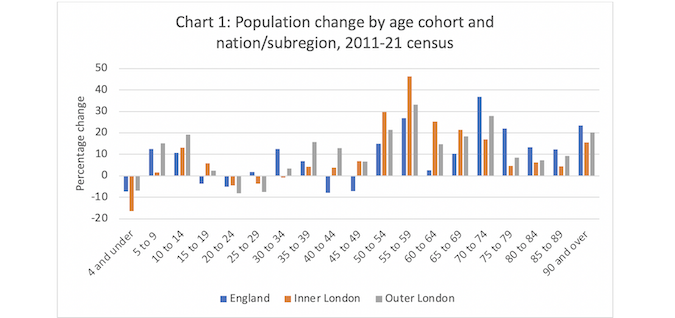
The two charts below summarise the numbers. The first compares the 2011-21 population changes for inner London, outer London and for England as a whole.
Screenshot 2022 08 16 at 19.03.09

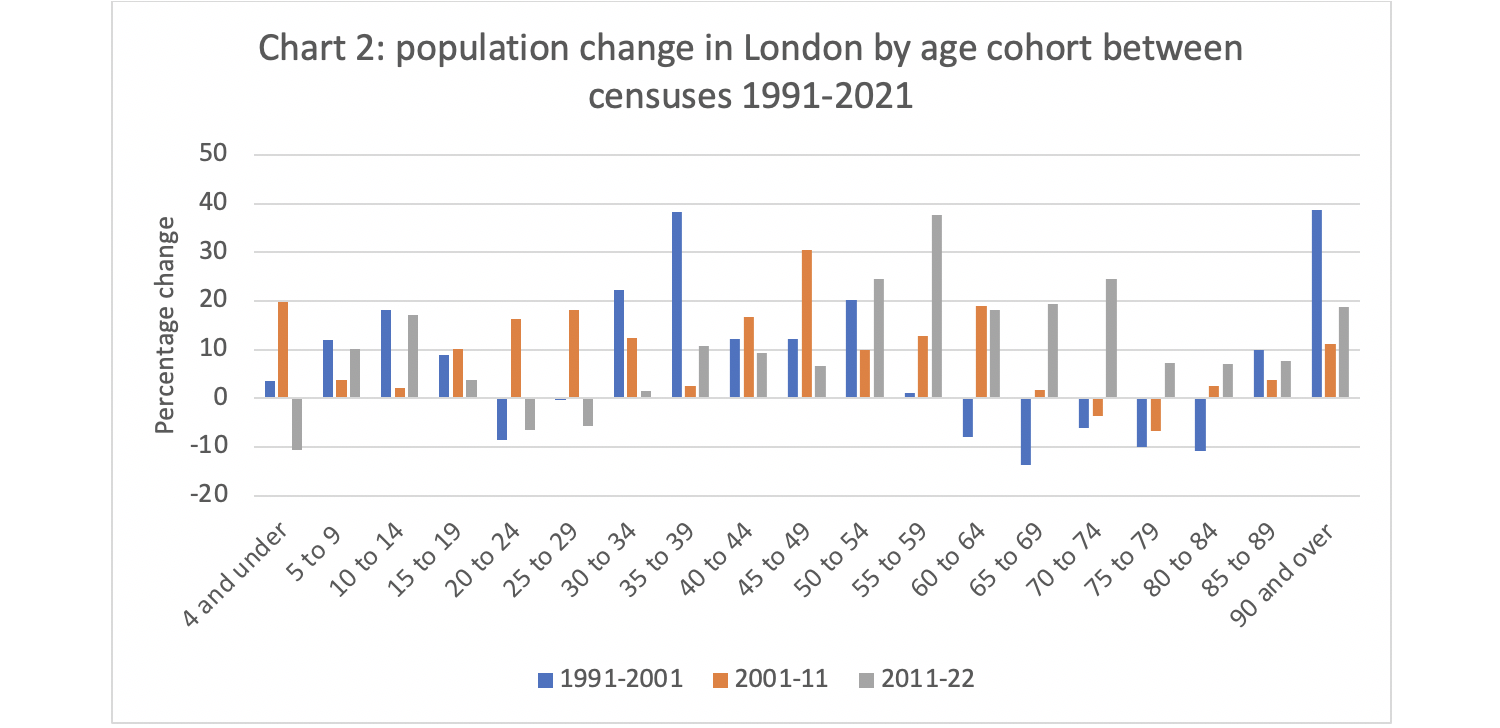
The second puts these changes in context by comparing the last decade in London with the findings for the capital of the previous two censuses.
Screenshot 2022 08 16 at 19.05.34

Here are five conclusions that can be drawn.

One: Baby boom and bust spells turbulence for education authorities

London had a baby boom between 2001 and 2011, adding more than 100,000 under-fives (a 24% rise in the age cohort). This was reversed in 2011-21, with the numbers of under-fives dropping particularly fast – by 16% in inner London.

Some of this change may be the result of young families moving out temporarily during the pandemic but, as  Greater London Authority demographers have explored, the birth rate more or less peaked around the time Boris Johnson started boasting of a London 2012 conception bonanza and has fallen back since then.

This makes planning school places fiendishly complicated: while demand for primary places fell in most of inner London, the outer H-boroughs (Harrow, Hillingdon and Hounslow) saw some of England’s highest growth rates for primary age children. And as the 2000s baby boom fed through, the secondary school cohort has grown much faster: Barking & Dagenham’s 10-to-14-year-old numbers grew by 43%, the fastest in England, with Hounslow, Richmond and Tower Hamlets close behind.

Two: London’s loss of young people was rural counties’ gain – at least temporarily

Between 2001 and 2011, 15 to 30-year-olds accounted for a net growth of around 300,000 people (around a third of London’s total net growth), reflecting the city’s magnetic pull for young people seeking to study, work or simply enjoy their lives. This contrasts with the overall stagnation in that population group in the previous census period spanning 1991 and 2001 and what looks like an almost comical reversal of the early century trend between 2011 and 2021. Rather than flocking to London, twenty-somethings seem to have headed down some deep country roads. For example, Test Valley, East Devon, Maldon and Harborough have seen the biggest rises in their numbers of 25 to 29-year-olds.

Some of this probably does reflect long-term relocation to new hipster heartlands of the West Country and the Kent and Sussex coasts, driven by soaring London rents and the ever-wider availability of flat whites. But I suspect that much more of this apparent exodus has already reversed, as young people who moved back to parental homes during the pandemic or began their university studies online have returned to larger towns and cities. The GLA’s helpful guide to the census uses payroll data to show just how many early-twenties workers left the capital during the pandemic and came back in autumn 2021.

Three: London’s boomers are booming

London’s middle-aged population (yes, including “Gen X”-types as well as “Boomers”) has soared, seeing some of the highest growth rates in England. The number of 55 to 59-year-olds in inner London grew by more than 45%, including by around 60% in Southwark, Lewisham and Lambeth. This contrasts sharply with England as a whole, where this age group grew by a more modest 27%. The London growth is also much faster than in previous decades: the 55 to 59-year-old population increased by 13% between 2001 and 2011, and by a negligible 1% the previous decade.

Some of this probably has its roots in London’s rapid growth of 35 to 39-year-olds in the 1990s, though of course there will have been plenty of churn between the census years. But it is interesting to consider why this generation may have chosen to stay in the city – and in inner London in particular – a rather than moving to the suburbs or a Home Counties village.

This was a generation that was able to benefit from relatively low house prices in the early 1990s following the property crash at the start of the decade. As mortgages are paid off, properties that were bought for tens of thousands of pounds are now valued at ten times as much. At the same time, since the pandemic, there has been a nationwide fall in the number of over 50s in the labour market.

It’s too early to join the dots convincingly between these trends – to say confidently why the numbers of middle-aged people have risen so fast in inner London boroughs. But we can speculate. Is this a “boomer belt” of reasonably well-off homeowners? People who may have stopped working and don’t feel the same financial pressures as younger Londoners in precarious housing, some of whom don’t see any great urgency in building more houses in established neighbourhoods? Interestingly, Brighton and Hove, which has similarly high housing demand and constrained supply, has seen a very similar demographic shift over the past decade.

Such stability makes for liveable neighbourhoods and lively local shops, cafes and restaurants. But at what price? If high prices and low supply squeeze younger and poorer people out of the inner city neighbourhoods, or even block them from moving there in the first place, stability may be at the cost of vitality and – in the longer term – economic productivity.

Four: London is ageing, even though not as fast as we thought

If London’s boomers stay in the city we will also see a big bulge in the older population when we come to review the 2031 census. Over the past ten years, London’s sixtysomething population has grown a lot faster than the English average. Among the over 70s, growth has been slower, though boroughs such as Waltham Forest and Redbridge have been closer to the national average.

As the GLA predicted, the census figures showed that previous estimates had over-done the size of London’s elderly population. However, growth is coming, and as today’s 60-year olds enter their seventies around the time of the next census, there will be a corresponding growth in demand for health and care services, making their currently dysfunctional funding and management an ever more urgent issue for London. It will also bring into sharp focus the issues of specialist housing for older people that were explored by my former Centre for London colleagues last year.

Five: Something was happening in 2021, but we don’t yet know what it is

The pandemic was probably more disruptive for London than any event since the Second World War (when no census took place). While its impacts were not as cataclysmic for city living as some predicted, we still don’t know what the long-term effects will be on working patterns or on how and where people choose to live. Nor do we know how new immigration arrangements, political change and the looming recession will affect the capital.

There may be a case for a mid-term census in 2026, as suggested by economic geographer Danny Dorling. But London will undoubtedly need to draw on data from the latest census and beyond to understand the city, who it is working for, and how it is changing.

First published by OnLondon.

Bringing it all back home

London has had a rough two years since the pandemic started. The capital has been at the forefront of successive waves of Covid, commuters and tourists have stayed away, and Transport for London seems to be being kept alive by government in much the same way that a mouse is kept alive by a bored but malevolent cat.

In some of the city’s bleaker moments commentators have wondered whether it will ever recover – some doing little to disguise their glee. At the beginning of last year, decline enthusiasts seized on an analysis of Labour Force Survey stats, which estimated that London’s population might have declined by 700,000 – nearly eight per cent – since the beginning of the pandemic, mainly as a result of foreign workers leaving the capital. Would these workers ever come back? Would the city ever recover?

New statistics out this week from the Office for National Statistics suggest that, while employment of foreign workers in London has fallen, any exodus has been a trickle rather than a flood. Between June 2019 and June 2021, payroll employment fell by around 110,000 in London. Broken down by nationality, employment fell by 40,000 for UK nationals and by 85,000 for European Union nationals, but rose by 15,000 for other foreign nationals.

The chart below tracks employment numbers compared to June 2019. Across the country, UK and EU employment has fallen while employment of people from the rest of the world has risen. The switch from EU to broader international immigration reflects the UK’s new immigration regime, introduced at the beginning of 2020, which gives EU citizens the same status as people from other countries.

Screenshot 2022 03 03 at 16.29.29

The trends are similar in London to the rest of England, but the falls were deeper and steeper in the capital and recovery has been slower, as industries such as hospitality have struggled to emerge from the pandemic. But the changes are much less dramatic than previous estimates suggested. Even in the first year of the pandemic only 100,000 European workers left employment, and by spring 2021 the trends were being reversed for all groups. EU worker employment increased by 20,000 between January and June 2021.

There are some striking differences between sectors too, some more surprising than others. The sector with the steepest job losses, hospitality, saw a reduction of 30 per cent in employment of EU workers. It remains to be seen how far these numbers will rise again as London’s commuters and tourists return, and whether new jobs will be taken by UK, European or other overseas workers. Towards the end of last year a staffing crisis hit hospitality, but the government has ignored calls to make work permits available for more roles in the sector.

Other areas with sharp EU job losses included administration and arts, entertainment and recreation. In construction, on the other hand, the EU workforce grew by 12 per cent between 2019 and 2021, and the number of other international workers by 15 per cent, while the UK national workforce remained unchanged.

We should not place too much store by these figures. They estimate the number of people employed using HMRC payroll data, so they are not precisely equivalent to job numbers, still less to population numbers. But they do give an indication of the direction and scale of change.

Can we conclude anything about population numbers? At a push. If we take UK nationals out of the picture and make the (fairly bold) assumption that the ratio of population to payroll employment for the EU and international workers was roughly the same in 2021 as it was in 2019, it looks like London’s foreign national population might have dropped by around 100,000 in the two years to June 2021. That is a big drop in a city used to net international immigration of 80-100,000 people every year, but it is a lot a lot less than some estimates and it looks as if London is already well on the way to making up lost ground.

Two years ago, I suggested that the shift to non-EU immigration would favour London, all other things being equal. All other things have certainly not been equal, but London’s loss of overseas workers to date has been in line with the colossal international disruption we have seen over the past two years. As we recover and our global connections re-open, London’s growth may once again be turbo-charged by international migration.

Does London really have the lowest cases and lowest vaccination rates?

As autumn sets in and Covid case numbers drift upwards, there is some good news for Londoners. Having been hit hardest by the first wave of infections, the capital now has some of the lowest case numbers. On 18 October, out of 315 English lower tier (unitary and district) councils, the ten with the lowest case rates were all London boroughs (except where indicated, all data in this article have been downloaded from the excellent Government dashboard).

This isn’t to downplay the terrible effect Covid has had on London. The disease has already killed more than 20,000 people in the capital, and has had a particularly brutal impact on poorer and disadvantaged communities. However, unlike March 2020, when cases shot up in the city and widespread urban flight was predicted, today you are safer from Covid living in Inner London than almost anywhere else in the UK.

This is good news, but it’s not immediately clear why London cases are so low. While the capital has the highest levels of antibodies according to the latest Office for National Statistics (ONS) survey, it also appears to have the lowest vaccination rates. The ten English lower tier authorities with the lowest vaccination rates by 14 October were all in London, and are many of the same boroughs that also have low infection rates. I’ve been wondering how we can account for this, without making spurious assertions about vaccine effectiveness.

Vaccination is not the only way to acquire immunity, so Londoners’ early exposure to the virus will have made a difference. London’s cumulative case numbers are equivalent to around 12.5 per cent of the population, which is higher than the other southern English regions, but lower than the Midlands and North. But in the early days of the pandemic, most cases were untested and unreported unless people became seriously ill, so London’s total cases have almost certainly been underestimated. By July 2020, 13 per cent of working age Londoners were already estimated to have been exposed to the virus, twice the national average.

However, there are also issues about how vaccination rates are calculated. Most Covid statistics use the 2020 mid-year population estimates as their denominator, but vaccination rates use the National Immunisation Management Service (NIMS) database. Reputable commentators have suggested that this database, which has been credited for supporting the rapid roll-out of vaccines, tends to overestimate populations of working age adults – particularly young adults and students, who are most mobile. Using ONS mid-year estimates for 2020 rather than NIMS figures makes a big difference to vaccination rates in London, as shown in the chart below, which shows the position as of 12 October.

Richard 2

(A side note: might the ONS mid-year estimates from 2020 also be wrong? They probably are. Most commentators believe London has lost population over the last year, though estimates vary wildly, from Professor Jonathan Portes’ estimate that around 700,000 people may have left the capital, to the GLA’s more cautious projection that around 100,000 people have done so. If we reduced London’s population by a pretty extreme ten per cent, or around 900,000 people, both vaccination and case rates would be higher, but not dramatically so – though the effect would be greater if population loss was concentrated in the Inner London boroughs.)

What does this all tell us? The first thing, which many of us have learnt over the past 18 months, is to be careful to interrogate statistics, asking what story they are being made to tell and whether there are other stories that might also fit, particularly where there seem to be dramatic differences between places. 

The second is to ask why local vaccination rates are being published in ways that seem to make take-up look artificially low in places with younger populations. This might seem trivial, or even a useful nudge for the young and for people in vaccine-hesitant communities to get their jabs, but using questionable data for righteous ends can be toxic. There are enough scurrilous rumours about vaccination effectiveness circulating without allowing people to draw hasty conclusions from the fact that the places with the lowest case rates are also those that appear to have the largest proportions of unvaccinated people.

The figures for deaths in council areas are seven day case rates by date reported, and the deaths attributed to Covid in the capital are defined as those where Covid has been mentioned on the death certificate, as of 14 October. 

Originally published by OnLondon.

Commuting again, cheek-to-cheek?

People are starting to come back to Central London, even if caution about rising case numbers, new variants and the onset of summer holidays mean the recovery is slow burn rather than big bang.

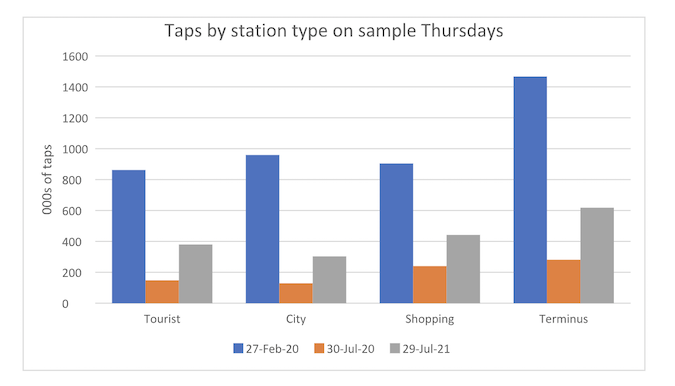
The graph below compares Transport for London (TfL) data on use of contactless and Oyster cards to tap in and out of stations on three sample days, according to different types of station (more detailed data and the station typology can be seen here). The days, chosen by me, are the last Thursday in July this year and last year, and the last Thursday in February last year. 

Screenshot 2021 08 12 at 14.14.00

The change between July 2020 and July 2021 is striking. Each group of stations saw around twice as many taps at the end of last month compared to the previous July, when restrictions were similarly relaxed, with a slightly stronger recovery for ‘City’ and ‘Tourist’ destinations, though ‘City’ station usage (which includes Canary Wharf, Holborn and Clerkenwell) remains only a third of pre-pandemic levels.

Comparisons with February 2020 show we are still a long way from business as usual, and it will be interesting to see whether change accelerates in September. But the overall picture looks positive for those who want to see people – the lifeblood of Central London – return to its streets, and is in line with the “organic” return to cities that James Forsyth wrote about in The Times last week.  

However, there could be bumps in the track ahead. One relates to human behaviour. Like many people, I have found my recent train and Tube trips a pretty pleasant experience. I’ve had a seat and not been too close to other people, even if wearing a mask is a minor spec-fogging inconvenience.

The closer we get to pre-pandemic levels of loading, however, the closer we will get to crowding levels that we find uncomfortable. It’s hard to say in advance what these will be – standing room only, shoulder-to-shoulder, armpit-to-nostril? – and tolerances will vary, but I suspect each of us could reach a tipping point where we no longer feel so happy using the Tube, however low Covid cases may be. 

More staggered commuting hours may mitigate crowding. And we can expect some reduction in demand from increased working from home, though if everyone works from home on Monday and Friday it will do little to ameliorate crowding midweek. But I suspect there will be a self-regulating brake on levels of Tube usage over the next few years at least, and that brake will apply itself at a lower level than before the pandemic.

The problem will become a whole lot worse if Transport for London’s funding deal, still being thrashed out with government, forces cuts in service frequency and capacity, as government has suggested it might. A recent national poll suggested that 23 per cent of people anticipate using public transport less, with most of those expecting to use cars more. In London, congestion, the soon-to-be enlarged Ultra Low Emission Zone and parking charges may make that less of an option. But squeezing services could increase crowding, and in turn drive more people away from public transport – maybe to walk or cycle, but maybe just to stay away from Central London altogether.

TfL needs a funding deal that recognises how precarious London’s recovery could be, and how easily service cutbacks could push the Tube into spiral of overcrowding, falling passenger numbers and falling revenues. This means looking beyond reliance on fares for the next few years at least, to run the system as a vital amenity for urban recovery, rather than a commercial service to customers. If the government wants people to come back into London and other city centres, it needs to support public transport systems that marry environmental sustainability with economic vitality.

First published by OnLondon.

A pretty bleak hope

I have a terrible admission. I suspect the Government has more or less made the right decision in relaxing restrictions from 19 July.

It’s clearly a fraught subject, but I can only take on trust what chief medical officers Chris Whitty said at the press conference yesterday (around 20 minutes in): whereas there was a strong scientific consensus for delay from 21 June, there is no such consensus now, and that there is “extremely wide agreement” that an ‘exit wave’ is inevitable, whenever restrictions are lifted. Those statements make it very hard to argue for continued imposition of some of the toughest government restrictions – on freedom of movement and assembly – that we have seen since World War 2.

The next few months will be bumpy, even if people take it as slowly as the Government is urging. Infection rates are falling in some places: the surge we saw in Brighton last month has subsided, but I suspect that this is a false dawn as students have dispersed (there have been similar slowdowns in other university cities). There have also been sharp drops in places like Blackburn, where this wave started, and peaked around a month ago. But I’d be surprised if cases didn’t go up again in coming months as people start deploying their new freedoms (though I get the impression that restrictions are already being ignored by some of the age groups who have seen most infections).

But I don’t think we’ll be going back into another full lockdown. I can’t see the point. In March to June last year, we didn’t really know what we were dealing with, how to treat it, how to test for it, whether we could inocculate against it. The lockdown bought us time. In January to April this year, we knew we had a vaccine that worked, so it would have been absurd not to seek to suppress cases of a deadly virus while the vaccine was deployed through the population.

Now, apart from younger people and refuseniks, we are as vaccinated as we are going to get. There is nothing new coming to save us. We need to get through the exit wave, and accept that there will be losses and damage (though scientists suggest that the difference will be one of timing rather than scale in response to different re-opening dates). And we need to hope – it’s a pretty bleak hope – that the NHS can cope and that we will be safer the other side. Despite the rhetoric, there have only ever been two strategies for dealing with covid: aquiring population immunity through infection and inocculation, or suppressing the disease. Suppression went out the window early on (and can’t really work long-term on an individual country basis), so we are left with managing the timing and route to population immunity.

The Government’s approach can easily look callous, however. The latest guidance for clinically vulnerable people more or less amounts to ‘Don’t get covid’, and we still lack adequate pay and protection for people forced to isolate because of the illness – particularly those in more exposed professions. I can see the case for replacing precautionary quarantine with a regime based on testing and symptoms, but it can’t make sense for people who know they have covid to be forced to go to work. These blindspots make the Government look at the very least careless about those who are clinically or economically vulnerable. I can’t understand why they don’t see this.

So I’m looking forward to standing near a bar again, to saying goodbye to bossy signage, QR codes and performative perspex, to returning to packed gigs in due course. But I’ll be wearing my mask on the train, and approaching the next phase of the pandemic with trepidation not celebration.

Some speculation…

In March 2020, UK office workers embarked on an unplanned and unprecedented experiment in home working. During 2020, home working rates were three times higher than before the pandemic; and four times higher for people employed in London. The experiment went pretty well, all things considered. The tech generally worked, even if the novelty of video meetings from cramped bedrooms quickly wore off, and productivity seems to have been sustained – at least in the short term.

A bigger and more complex experiment lies ahead. What will happen to ‘office jobs’ in the future, and what implications will this have for workers, for careers, for places – particularly places such as city centres?

This rather long article is an attempt to work through my thoughts on these questions, so is necessarily speculative (and at least in part inevitably wrong).

All in or all out?

Unlike the mandatory and largely uniform experiment of lockdown, the next experiment will see a variety of models, driven by shifting and varying patterns of government regulation, the needs and cultures of different industry sectors, and employer and worker preferences. With the exception of a few banks who still seem to be playing by Wall Street rules (“Lunch is for wimps” etc), it doesn’t look like many employers are ready to demand all staff are back in the office full time.

This would have felt like a regressive step even before the pandemic; home-working rates have been creeping up over the past ten years, encouraged by employers’ focus on ‘agility’, better technology for communication (and surveillance), and strengthened rights to work flexibly. Now that working habits and norms have caught up with the technology, reverting to the ‘nine to five’ presenteeism seems self-defeating as well as unfair – particularly for people looking after children (predominantly women) who would find themselves squeezed once again by childcare timetables.

At the other end of the spectrum, fully remote working coped during the crisis, but can this be sustained? Many workers felt that they were drawing down the reserves of social capital they had built with colleagues. Increases in task productivity are offset by more difficult team productivity. Online tools may help smooth collaboration and learning, particularly for younger ‘digital native’ workers, but in my last workplace, these were the very workers who wanted to be back in the office – to escape from parents and cramped flatshares, and to meet up with colleagues and peers.

Working away from the office may also make it harder for younger employees to learn the trick of the trade – how to behave in meetings, how to give and receive criticism, how to make a pitch, how to manage a difficult client – or for new employees to get to grips with all the unspoken aspects of corporate culture. All these can no doubt be taught formally, but for most of us they have been learned informally, even osmotically – by watching, listening and modelling.

Hybridities – beginning of a great adventure?

So, while most office workers are still at home, it is ‘hybrid working’ that is expected to dominate in the future, with people spending two or three days in the office and the rest working from home (or another remote workspace).

This could be entirely unstructured, allowing considerable discretion as to where and when employees work, and already is in many workplaces. But wider adoption could pose problems. First, most workers would choose to work from home on Mondays and Fridays, and in the office mid-week. If this approach was widely adopted it could lead to a sharp drop in demand for city centre services but would make it hard for firms to cut costs by reducing floorspace. Perhaps more seriously, it would risk reinstating a divide between those who were willing and able to be in the office more (principally men without caring responsibilities), and those who worked from home more (often women with caring responsibilities). The former have tended to do better in terms of career progression, even when the latter are more productive.

If these and other advantages are sustained, you could quite easily see a tipping point, as workers find it easier to collaborate, but also to compete, by being in the office. Hybrid working could remain permitted in theory, but become increasingly rare in practice,

Alternatively, management could decide who came in on which days. But this isn’t problem free either. Do you bring whole teams in together, or do you mix them up? Do shift patterns change so everybody gets some Mondays and Fridays at home? Can online tools work as well for informal as well as formal collaboration, when some people are in the office and others are at home? Is it really fair to force workers – particularly those for whom home working is difficult – to stay away?

But – to step back for a moment – why do we go into an office at all? We office worker types risk not only thinking everyone else is an office worker, but also that everybody’s office job is like our own. In fact, ‘office jobs’ contain multitudes – from conceptualising, designing and selling products, to talking to clients and collaborators, to analysing data, writing reports and coding, to monitoring service delivery, to managing staff, to maligning management and gossiping about Love Island. In varying proportions, even highly-skilled ‘knowledge economy’ jobs involve ‘relational’ work (essentially talking to other people) and more task-focused ‘programmable’ work.

There are some jobs dominated by ‘programmable’ work that can be carried out almost entirely autonomously, they are a minority. (And as a recent report argued such ‘work anywhere’ jobs can as easily move overseas as they can move out of UK city centres.) For the rest of us, adapting our workflows so that we can concentrate more ‘programmable’ work into days away from the office may require the type of flexibility that is hard to align with a structured approach to hybrid working.

In the short-term, therefore, I think we will see a period of experimentation. Different firms will try out different models of office, hybrid and remote working, testing out their impact on staff morale, retention and productivity. In an increasingly fluid labour market, you could see some employers targeting packages at younger workers, and some offering a deal that better suits people with children. It could be quite tumultuous.

But my hunch is that office and remote working models will begin to dominate in the medium term, because they have a coherence and support a common culture with which hybrid models struggle. Firms will reach tipping points where almost everyone is in all week, or almost nobody is; one of those will become the dominant model for particular firms or whole sectors, and decisions on leases and employment terms will reflect that. Neither model will be entirely pure: office-based jobs will probably allow more flexible working than before the pandemic, and remote-working employers will still bring staff together for structured collaboration sessions. But my guess is that working patterns will be 90:10 rather than 60:40.

Cities and centres – inertia counts

So, what does this all mean for our cities, and for London in particular? I suspect there are three scenarios: decline, dispersal and doubling down. Cities could see their centres decline in absolute and relative terms, losing jobs and population – particularly wealthier people, who can afford choice and are less tied to lower-paid service sector jobs. This would be disastrous in economic and environmental terms, as car-dependent sprawl spread through the countryside, and the problems of poverty and dereliction increased in cities. However, while there are some signs of ‘de-urbanisation’ in recent UK population figures, this feels the least likely option, not only because of the continuing appetite for some office working discussed above, but also because of the polutical risks involved in allowing this to happen.

A less dramatic variant would be dispersed patterns of working in and around core cities – perhaps realising the ‘fifteen-minute city’ vision that has caught the imagination of many city planners. I can see this taking hold, particularly for some sectors and some job types. More ‘relational’ jobs (consulting and advisory services, advertising, publishing) may stay in the city, benefitting from all the visible and invisible spillovers of agglomeration, while more ‘programmable’ jobs (coders, technicians, web designers) move out (or, as mentioned earlier, maybe even go offshore).

A recent OECD report suggested corporations would seek to relocate offices out of city centres. But how much would an employer gain by moving out of a city such as London (or Birmingham, or Manchester) with highly developed radial public transport systems and ecosystems of business services. Moving from London to Colchester, Crawley or Cranfield would inconvenience many more workers than it would help, at a time when businesses follow talent rather than vice versa. Inertia has an impact. So I suspect that most firms that retain office-based working will remain in city centres, and that the savings to be made from reducing footprints will be limited – though you can expect tenants to negotiate hard when leases come up.

There is still a longer-term question: will new start-ups see the value in city centre offices, or will they naturally adopt a more dispersed business model? Designing in dispersed working from the outset makes a lot more sense than trying to retrofit corporate structures, processes and cultures. But there’s a paradox here. The young people who work in such businesses are also the young people who are drawn to cities for the richness of professional and personal opportunity, for culture and recreation, and often to be with their peer group after university. If dispersed working is adopted by a new generation of firms, it may be dispersal within rather than dispersal from big cities.

The ‘doubling down’ scenario, where city centre working intensifies, seems the least likely at first glance. The co-incidence of a pandemic and technological change has created both a driver and an enabler for more dispersed working. But in the long-term, policy will make a difference and policy should be favouring urban growth (despite the electoral politics of ‘levelling up’).

We know that cities are more efficient than sprawl in terms of their carbon impact, and we know that government policy is refocusing new housing into cities, after a flirtation with more dispersed settlement. We can also expect business travel by air to decline, as carbon targets bite. All of these factors suggest that economic growth may concentrate in a few densely-mixed urban centres, well connected by lower carbon transport, rather than being spread through a network of offices within a country or a global region. The role of these cities and of offices within them will change – with extended commuting patterns, less generic retail, and offices that are platforms for collaboration and meeting rather than for routine administration – but they have successfully changed before.

The UK’s cities have borne the brunt of the health and economic harms arising from a pandemic. They will face the steepest road to recovery, and some may struggle to get back on their feet. But over time, I think our sociable natures will combine with the continuing strength of agglomeration, the inertia of infrastructure and the growing urgency of climate action, to enable cities to bounce back. It will be a choppy few years. Businesses need to be ready to experiment and adapt, without betting the house prematurely on any particular model. Governments need to respond with the policies and investments to make this recovery economically dynamic, socially just and environmentally sustainable.

Ten years after

Making the case for London has been complicated during the pandemic. It risks conflict with the ‘metropolitan elite’ myths so fondly fostered by government (and so ably skewered by my former colleague Jack Brown on Monday’s Start the Week). And, like many civic leaders, Sadiq Khan has been trying to tell a story of devastating impact to a seemingly indifferent government, but also to entice workers and tourists back into a renascent capital by reminding them of all London has to offer.

The pandemic has indeed had a particularly brutal impact on London’s citizens and economy, but recent figures suggest that the tide may be beginning to turn. Tube and bus ridership is higher than any time since March 2020, though still up to 50 per cent below pre-pandemic levels. Google mobility data also shows a slight return to central London, though more for retail and recreation than for work (which accords with higher public transport use at weekends).

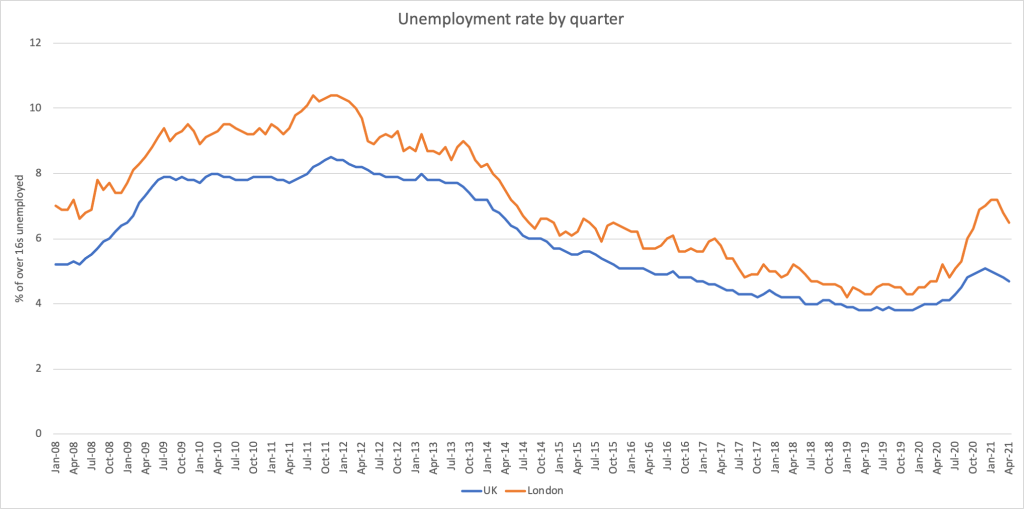
And, according to the latest ONS figures, London’s unemployment rate has also dropped, falling from 7.5 per cent in the three months to January, to 6.5 per cent in the three months to April. Unemployment is still higher than any other region’s, London boroughs still have some of the highest claimant counts and furlough rates in the country, and the economic impact of coronavirus has hit specific demographic groups hardest, but there are glimmers of hope.

So, it’s worth looking back to the last recession and recovery when London has hit hardest but recovered fastest. Could history repeat itself? As the chart below shows, London’s unemployment rate rose sharply ten years ago, and was more than two points higher than the UK’s in mid-2011, but then fell much more quickly, roughly tracking the national rate from 2014. A similar gap opened up last year, but has begun to narrow since January.

Unfortunately for London there were specific features of the 2011/12 recovery that favoured the capital. Quantitative easing, Government’s response to the financial crisis, diverted investment into booming equity and housing markets. And the London 2012 Olympic and Paralympic Games may have had a minimal direct impact on spending (most of the construction was complete by 2012, and Olympic Games years displace normal tourism expenditure), but were a powerful showcase for the UK internationally, and for London in particular.

Added to this, ten years ago, Boris Johnson (then Mayor of London) was keen to make the case for the capital, and able to persuade the Coalition Government that starving London of cash was no way to help the rest of the country, so projects such as Crossrail and the Olympic Park legacy development went ahead.

None of these factors are present today. Rather than being boosted by cheap money, financial services have been sidelined in Brexit negotiations in favour of more picturesque and politically salient (but far less productive) industries like fisheries. Big infrastructure projects, such as the redevelopment of Euston Station for HS2, are being squeezed, hopes of a swift return to international travel are receding, and the narrative of ‘levelling up’ looks pretty hostile to London and its nine million citizens.

At the G7 Summit last weekend, Boris Johnson warned against repeating the mistakes of the ten years ago, when (as he didn’t quite say) austerity extended and deepened the impact of the recession for many people and places. This is right, but the correct lesson is to extend support wherever it is needed to ‘level up’ the prosperity and life chances of citizens and communities, not to stall the UK’s economic engine in pursuit of headlines or electoral advantage.

Inner city life, inner city pressure

As the weather improves and lockdown restrictions are relaxed, life is ebbing back onto the streets of central London. People who were commuting in daily just over a year ago are beginning to revisit a city centre that is both familiar and utterly transformed. And to think about its future.

There are still more questions than answers about that future. How much remote working will persist, and how will much-discussed models of ‘hybrid working’ play out? Will employers reduce their demands for workspace, and will any surplus space be picked up by new arrivals attracted by lower rents? How quickly can tourist and international student numbers recover, and how will shops, pubs and restaurants cope if both commuting and tourism remain suppressed?

These uncertainties are likely to persist for some months, but some slackening in demand for office and retail space is widely expected, as working and consumption patterns change, and employers rethink their needs. Some premises might be adapted by cultural and community organisations, for experimental pop-ups and meanwhile uses, but it is likely that new residential development will play a part too.

This could actually help build the city’s resilience. As Centre for London set out just before the pandemic bit, central London’s population has been growing fast over the past decade, but the city centre is still less densely populated than Paris or New York. So when coronavirus brought commuting and tourism to a standstill, central London and its businesses were particularly hard hit by the loss of trade, and have continued to struggle as restrictions have been successively relaxed, re-imposed and relaxed again.

So more people living in the city centre is not only likely but desirable, as was underlined in Arup’s recent report for the Greater London Authority on the future of the Central Activities Zone (CAZ):

“A higher CAZ residential population, to offer more sustainable lifestyles, resilience, increased vibrancy and ‘stewardship’ of the CAZ’s resources for others, and bringing London more into line with its global rivals.”

But allowing more residential development or conversion in central London is not straightforward. The current London Plan and borough planning documents give the CAZ and Canary Wharf special status, to protect the clustering and density of ‘strategic functions’ (for example global commerce, education, culture, government and tourism) and give these uses priority over housing. This protection, the argument goes, preserves the essential character of central London as a truly global city centre and the economic powerhouse of the UK.

How could more housing be brought into the mix without diluting these qualities and this global draw? Should new build and conversions be pepper-potted through the CAZ, or focused in a few neighbourhoods? And can office and retail conversions retain flexibility, or is any switch to housing a permanent change?

Some parts of central London and some building types look a lot more inhabitable than others. Big open-plan offices, as found in the heart of the City and Canary Wharf, are unlikely to be adapted as easily as older buildings in the West End, Clerkenwell, Bloomsbury and the South Bank, which have switched from houses to flats to offices and now perhaps back to housing over the years.

There are also issues of management and services. How would potential disputes between residents and businesses be resolved over night-time deliveries, late-night crowds leaving bars and nightclubs, parking and vehicle access? And where will health services and schools be located, as well as everyday shops?

All of these factors suggest that a remixing of London’s city centre will need to be carefully managed, not left to the free-for-all of ‘permitted development’ from office to residential uses that government is proposing – and which has led to some truly atrocious conversions of commercial buildings. Central London currently has exemptions from permitted development, but these expire in summer 2022, and London’s boroughs will soon need to start making the case for renewing them.

Central London is a dynamic and creative place. As we emerge from the pandemic into a world that is still being reshaped, Centre for London hopes to explore how we can apply that dynamism and creativity to refresh its mix of uses, as well as to support the national recovery.

[Published by Centre for London, 26 May 2021]

Now is time for a TfL deal

Transport for London (TfL) is the seat of the Mayor of London’s most significant power and responsibility. Welded together in 2000 from an assortment of public corporations, government agencies and joint committees, TfL spends more than £10 billion every year and employs more than 25,000 people. While London’s Mayor is underpowered in many respects, their control of this integrated transport authority is envied by many other cities in the UK and beyond.

Right now, transport is also Sadiq Khan’s biggest headache and biggest priority. TfL’s revenues collapsed during the pandemic, as passengers stayed home, and the network has only been saved from bankruptcy by government support packages, repeatedly agreed at the last minute and accompanied by terms and conditions that have nibbled away at the Mayor’s authority.

The latest support package is due to expire on 18 May, so the next cliff-edge is approaching fast. TfL have been arguing for a longer-term settlement, and their scenario planning predicts suppressed income till 2024/25 in almost any conceivable future. With neither mayoral or general elections scheduled till 2024, and the pandemic in what we all hope is irreversible retreat, obstacles towards striking a longer-term deal should now be surmountable.

Doing the right deal will require radical thinking from the mayor and government alike. Pushed to find new sources of funding for infrastructure investment as well as operations, Sadiq Khan has argued that TfL should receive the £500 million that Londoners pay in vehicle excise duty (VED), which is currently ring-fenced to pay for road repairs outside the capital. Alternatively, there have been discussions of a charge for people driving into London from outside.

Neither proposal bears much scrutiny: the VED settlement is indeed unfair to London, but is a declining revenue source, and allocating more to London would mean allocating less outside the capital (or government making up the balance). A boundary charge would be another way of making those who live outside the capital pay towards the services that they use, but would likely have a negative effect on people living and working around the edge of London, and could generate more hostility to the capital at a time when it needs support and visitors.

A more equitable approach would be London-wide road user charging, to replace the increasingly complex hierarchy of charging zones and fees, as recommended in Centre for London’s 2019 report, Green Light. A pay-by-the-mile scheme, which reflected congestion, pollution and the availability of public transport alternatives, could raise substantial sums. For example, an average charge of 5p/mile for cars and light goods vehicles, and 50p/mile for HGVs, could raise as much as £1.5 billion every year – twice as much as is currently raised by the congestion charge.

Such a scheme would also make policy sense. It creates incentives for lower carbon transport options, rather than using public transport revenues to cross-subsidise highways maintenance, as is currently the case. The Green and Lib Dem candidates both argued the case for road user charging during the mayoral election campaign, but Sadiq Khan was more cautious, committing only to “ask TfL to consider other ways of raising income to make up for the loss of VED” if the Government refuses to pay up. And you can see why – the politics of restrictions on car use have become a hot button issue in this election. But now, at the beginning of a three-year term, is the time to make the case for bolder action.

But if transport funding is the elephant sat solidly in Sadiq Khan’s in-tray, it should have at least one foot planted in Government’s. Under a deal negotiated with Boris Johnson, when he was Mayor, central government grant support for TfL was phased out, with business rates and fares plugging the gap. All very well when London’s economy was booming, but even the most optimistic scenarios see business rate revenues and fares alike suppressed in the short- to medium-term.

London’s transport system could be allowed to decline, and this is one the scenarios explored by TfL, but this would be a hugely retrograde step, which would deal a substantial blow to the capital’s chances of recovery and of achieving zero carbon targets, and to tax revenues from London supporting public services across the country.

Government knows this, so they know how costly it could be to starve London’s transport system of resources. If the Mayor can show he has the vision to transform London’s public transport funding model, the Government should make available the funding to support him during an economic crisis that has hit London particularly hard.

[First published by Centre for London, 10 May 2021]

Fork out to eat out to help out

As London’s pubs and restaurants make the first tentative steps towards re-opening after a disastrous year, with excited punters booking weeks in advance for chilly pavement tables, reports suggest they are struggling to find staff.

Restaurants, bars and hotels were having difficulty recruiting and retaining even before Covid, as Centre for London revealed in its 2019 report into kitchen jobs. Since then, the implementation of tougher immigration rules has combined with an exodus of overseas workers (estimated at anywhere between 35,000 and 700,000) from the capital during the pandemic to turn the crisis acute.

As the UK’s borders open up, some foreign workers will return, though the exclusion of many hospitality jobs from the “shortage occupation lists” that allow mid-skilled workers to obtain work visas will make replacing those who choose not to come back more difficult.

Home Secretary Priti Patel said last summer that “the new points-based system will encourage employers to invest in the domestic UK workforce, rather than simply relying on labour from abroad.” Given that more than 50 per cent of hospitality and food workers are foreign nationals, this approach may be tested sooner than she had planned.

Can the domestic workforce plug the gap for London’s hotels, restaurants and bars? With unemployment in the capital higher than in any other region (nearly 10 per cent of the workforce were claiming unemployment benefits in February), there’s a deceptively neat answer to the recruitment challenge.

But jobs in hospitality can be a tough sell. Despite the camaraderie and fun many experience, the work can be tough, with antisocial hours and limited opportunities for advancement. Right now, unemployed Londoners may be worried about exposure to the virus as customers return. They could also hesitate before seeking employment in a sector that will be first in line for closure if the government’s “irreversible” lifting of Covid restrictions results in the brakes being slammed on again.

And there are deeper issues of pay and conditions. In 2020, around one million people worked in hospitality (“accommodation and food services”) in London, according to government surveys. Almost 25 per cent of those workers were paid less than the National Living Wage of £8.20 per hour (for 21-24 year olds), and 75 per cent were paid less than the London Living Wage (designed to reflect the actual cost of living in the capital) of £10.75 per hour.

Can employers afford to pay more? Ingredient costs have been rising as a result of Brexit, and business rates in London penalise enterprises that take up space, such as the places people meet to eat, drink, dance and sleep. Business rates payable by restaurants in London increased by a third in the 2016 revaluation. On top of this, many hospitality businesses that have struggled to survive lockdown now face a precarious future, as social distancing persists even as tourists and commuters start to trickle back. It is a lot to ask the sector to shoulder the burden of raising wages on its own.

The government could do more, by extending business rate holidays in the short term and reforming business rates in the longer term. Landlords should show restraint when negotiating rents. But we also need to ask whether we are paying enough when we go out to eat and drink. Londoners eat out more frequently than people in other parts of the country, and the capital has restaurants that offer great value alongside the glittering palaces of oligarch-baiting excess.

Many Londoners celebrating the emergence of hospitality from its enforced hibernation and reflecting on how much they value eating out will have built up a stockpile of cash during the lockdown periods. Perhaps this is the moment to re-appraise the prices we pay, so that essential and skilled tasks such as taking orders, cooking food and washing plates are well enough rewarded to attract people with the skills the sector needs, both from the rest of the world and London itself.

[First published by OnLondon, 7 May 2021]