Back to work

Londoners have been slow to get back to their desks compared to workers in other large cities, according to Return to the Office, the latest report from think tank Centre for Cities. Why is that, does it matter and what can be done?

The report’s polling, carried out in June, finds that central London office workers are spending an average of 2.7 days per week in the office, less than their counterparts in Paris, New York and Singapore, though pretty similar to those in Sydney and Toronto. As in  those other cities, their office days are concentrated in the middle of the week, with London showing the sharpest drop-off on Fridays, when just 40 per cent are traveling in to work.

London’s sluggish return is explained by two main factors, the report suggests. On the management side, London bosses seem more reluctant than those in other cities to specify when workers need to be in. And while workers and bosses alike value the chance to develop relationships and collaborate in person, London’s workers particularly also appreciate the cost savings and time flexibility offered by working from home – more than those in other cities.

The Centre for Cities findings reflect those of the King’s College Policy Institute’s London Returning survey of 2022. This found that most London workers felt positive about being in the office, but that 80 per cent said that avoiding the commute, its costs and its time demands was a good reason to continue working from home.

London government has sought to address this issue through the “Off Peak Friday” trial that ran from March until May on Underground, Overground, DLR, Elizabeth line and some National Rail services. It led to a modest increase in commuting on Fridays, but awareness and take-up was limited. Speaking at the Centre for Cities launch event on Tuesday evening, Deputy Mayor for Business Howard Dawber said City Hall was still mulling the outcomes of the trial.

However, while London commuting costs are high compared to most of the other cities in the study, I suspect the bigger problem lies outside the capital. On commuter lines beyond Sadiq Khan’s control, both expense – despite the paltry savings offered by flexi season tickets – and chaotic performance, worsened by rolling strikes in recent years, make a trip to London a pricey roll of the dice.

These costs and inconveniences may explain one area where London bucks the trend: in London, unlike the other cities, younger workers were spending most days in the office and saying they work most effectively there. They are also the workers most likely to live in London, while many older ones commute in from the Home Counties – a trend that was accentuated during the pandemic – or at least used to. Anyone who has joined an online call with younger workers balancing laptops on washbasins in shared flats with iffy WiFi while older workers dial in from their immaculately-restored half-timber country cottage may understand why the former are keener than the latter to get back.

At the launch event, panel members Dawber, Kat Hanna (Managing Director at Avison Young) and David Wreford (Partner at Mercer) agreed that the return to the office seemed to have plateaued in London, and that the pandemic had accelerated and intensified trends towards more flexibility. But there was less consensus among panellists and audience members on whether this was a good thing, and about what if anything could be done about it.

A fundamental question was, against the backdrop of government’s “Growth Mission”, how does hybrid working affect productivity? Intriguingly, Return to the Office finds that most workers could see individual productivity benefits from working at home, but were concerned about the long-term impacts on skills, pay and promotion prospects, all of which affect organisational productivity. The skills gap could particularly affect younger workers, unable to learn from working alongside more experienced staff, if the latter continued to stay home for most of the week.

The evidence on productivity is still emerging and tentative, though face-to-face interactions and proximity are the lifeblood of the agglomeration benefits that cities offer – even if these apply more for some teams and some sectors than for others. The report recommends that more research be done on the productivity impacts of hybrid working, but the risk is that we will only know the impacts when looking in the rear-view mirror; that we won’t know what we’ve got till it’s gone. So we need to make some informed judgement calls and watch for early signs of long-term effects.

In the meantime, more flexible working patterns were transforming working life for people with caring responsibilities – generally women, who the London Returning survey found were more positive about working from home and more reluctant to be told to work more days in the office. Reduce flexibility and these workers might once again be excluded from the workforce. The Mercer research confirmed this, Wreford added: women were most likely to switch or stay in jobs as a result of flexible working incentives, while men were more likely to be motivated by financial rewards.

Furthermore, while parts of central London’s economy were struggling with new work patterns, suburban areas might be thriving (though ONS analysis suggests local spending patterns have returned to their pre-Covid levels). And Hanna observed that a broader shift to mixed use might strengthen central London’s offer as a place of leisure, as well as work: “It’s called the Central Activities Zone; that doesn’t tell you what those activities need to be.” While peak hours Tube use remains below 2019 levels, evening and weekend riderships are already higher, suggesting that London’s offer to visitors – short and long distance – is stronger than ever.

Finally, what, if anything, should be done to change the situation? Mayor Khan wants central London to be busy, Dawber said, but can only offer incentives and encouragement. British bosses are reluctant to impose tougher “back to the office” mandates according to the polling, and government policy is pointing in the direction of more flexibility, not less.

So, is this the much discussed “new normal” – neither citypocalypse nor a snap back to the heady days of February 2020? It may be an equilibrium for the moment, but perhaps not a stable one. As panellists noted, climate change and artificial intelligence may dramatically change where, how and by whom office work is performed in the future. We may be only at the beginning of a period of rapid change.

First published by OnLondon.

Remote control – AI and hybrid working

This decade is likely to see the biggest transformation of the workplace since the widespread adoption of the personal computer. Hybrid and remote working patterns adopted during the pandemic appear to be sticking, and a wave of disruption from artificial intelligence (AI) and large language models (LLMs) is following rapidly behind.

London is at the epicentre of these twin “workquakes”. The capital has persistently had the highest levels of home-working in the UK, with two thirds of Londoners saying they worked at home at least one day a week last summer. This reflects hybrid working’s dominance among professional and managerial staff, who make up 63 per cent of London’s resident workers, compared to 50 per cent of all England’s.

These people enjoy the flexibility, work-life balance and personal productivity that working from home can offer, though the impact on organisational or inter-organisational productivity is more contested. Nonetheless, speakers at a London Assembly meeting last week said that the era of “five days a week in the office” had gone for good, and that the task was to adapt central London to new ways of living, working and playing.

The accelerating pace of AI adoption looks likely to add turbulence. A recent UK government report found that workers in London were twice as exposed to AI as the UK average. This was not because of LLMs’ appetite for the diversity and vitality of the capital, but (like the prevalence of home-working) is largely a result of London’s occupational make-up. Unlike previous waves of automation, which affected manufacturing and routine clerical work, AI is coming for the professionals.

The report suggests that the most affected occupations include management consultants, financial managers, psychologists, economists, lawyers, project managers, market researchers, public relations professionals, authors and, perhaps surprisingly, clergy. The “safest” are jobs are those of such as sports professionals, roofers, plasterers, gardeners and car valets. The former occupations are over-represented in London, the latter are not.

However, before soft-handed metropolitan knowledge workers like me rush to retrain, ignoring our lack of aptitude, there are some caveats. The first is that the government report’s projections make no distinction between jobs that are augmented (those where workers can deploy AI to dramatically enhance their productivity), and those that are likely to be substituted (replaced, sooner or later, by new technology).

The second is that the analysis takes no account of the new jobs that will be created. We can see those that are at risk, but it is harder to identify the opportunities that will arise. A year ago, few people had any idea what a “prompt engineer” was. Today, demand for them is booming. And we can be re-assured by historical experience: the majority of jobs that Americans do today did not exist in 1940.

In any case, most professional jobs involve more than one activity, which is where the interaction between working from home and AI gets interesting. A management consultant, for example, may spend time meeting clients, preparing pitches, interviewing workers, analysing data, workshopping ideas and writing reports. A PR professional may write press releases, manage staff, research markets, pitch to clients and journalists, develop concepts, devise guest lists, plan and host events.

Some of these tasks are intrinsically social and best undertaken face-to-face. Others are more easily undertaken remotely, away from distraction and other people. Those in the latter group are also those that can be most easily supported by AI.

From this perspective, AI adoption and hybrid working will complement each other. Hybrid working has already accustomed us to working remotely with less social interaction; AI can provide a sounding board for ideas and be an orchestrator of collaboration, without the hassle and cost of a commute. Similarly, intelligent use of AI can boost productivity, improve co-ordination and reduce the “digital overload” of online meetings, emails and collaboration spaces that built up during lockdown.

But there may be a sting in the tail. Over time, people working remotely with AI support may find themselves edged out by their machine collaborators. Cost-conscious employers are already exploring whether some jobs undertaken remotely might be outsourced internationally. A task that can be completed in Leamington Spa rather than London can also be exported to Lisbon or Kuala Lumpur. Over time, it may also be undertaken by an AI.

Oxford University professors Michael Osborne and Carl-Benedikt Frey, who published a highly influential analysis of the potential impact of automation on the workforce in 2013, recently wrote a (very readable) update reflecting on the explosive growth in AI and how it may affect their original projections.

In 2013, they argued that tasks requiring social intelligence were unlikely to be automated. Now, they write, AI has challenged that “bottleneck” to automation: “If a task can be done remotely, it can also be potentially automated.” However, for sensitive tasks and relationships, face-to-face would retain primacy:

“The simple reason is that in-person interactions remain valuable, and such interactions cannot be readily substituted for: LLMs don’t have bodies. Indeed, in a world where AI excels in the virtual space, the art of performing in-person will be a particularly valuable skill across a host of managerial, professional and customer-facing occupations. People who can make their presence felt in a room, that have the capacity to forge relationships, to motivate, and to convince, are the people that will thrive in the age of AI. If AI writes your love letters, just like everybody else’s, you better do well when you meet on the first date.”

What does this all mean for cities like London? To start with, while we do not know precisely what new jobs will be created by the AI revolution, London is already one of a handful of hotspots for AI start-ups, so it is likely to be the location for many of the new jobs too. The capital is already home to Google Deepmind and many other high growth AI firms, and OpenAI have announced plans for their first international outpost in London.

The combination of AI and hybrid working may ironically strengthen London’s role as one of a few genuine global centres for face-to-face interaction. If remote work is increasingly dispersed or automated and in-person workers with social skills remain in demand, then diverse, globally-accessible, sociable cities such as London will provide the ideal setting for their relationships and collaborations.

There is a bigger picture too. A recent paper by Richard Florida and others talked of the rise of “metacities” based on long-distance networks of collaboration and intermittent commuting. This identified London and New York as the world’s two leading “superstar” hubs, sitting at the heart of networks of talent and interaction. London’s network, as measured by talent flows, includes Manchester, Birmingham, Edinburgh and Bristol, but also Dublin, Paris, Lagos and Bengaluru.

Florida and colleagues argue that the constellation of satellite cities will shift over time, but the importance of superstar cities will persist. This suggests that in coming years London will need to plan for growth in housing, in offices and in new forms of collaborative and social spaces.

The city will also need to be open and welcoming to global talent while helping local workers adapt to change, and to work more closely with its satellite cities to ensure that economic transformation can deliver prosperity and economic growth across the UK.

This is likely to be a turbulent decade for London’s economy, but it could also be one in which the capital’s national and global profile increase.

First published by OnLondon.

Talkin’ about AI Generation

A year after OpenAI’s ChatGPT was launched, we are starting to see the outlines of generative artificial intelligence’s potential impact on our lives.

While the recent Bletchley Park Summit focused on existential risk and misuse by extremists, debate in universities has focused both on technocratic issues (such as automated marking and plagiarism) and more recently on the potential of AI to transform and enhance learning and research – see, for example, the recently published Russell Group principles on the use of generative AI in education.

But there’s a more fundamental question for universities too. How will AI change our economy, and what will this mean for the role played by universities in readying the workforce of the future? The AI Generation: How universities can prepare students for the changing world, a new report for Demos and University of London, draws together what we know about how universities support students’ employability today, and speculates about how this might change as technology advances.

Within our GRASP

The good news is that there is a reasonably strong consensus about the critical employability skills needed today. As computer use and the internet have transformed the knowledge economy, it is not specific technical skills that are most prized. More important are the broader skills of listening to and persuading clients and colleagues, analysing and communicating information to solve problems, and having the ability to manage your own workload, your career and your professional development – the GRASP (general, relational, analytical, social and personal) skills.

Most of these skills are expected to rise in importance in coming years and will remain important in working with AI. Even if generative AI can produce text and images, workers will need critical and ethical judgement to assess what it produces and what it is asked to produce, as well as the relational and social skills to intermediate between technology and humans. So, it appears that the GRASP skillset, with adjustments, will still be relevant.

The less good news is that there is not much evidence on how well universities help students acquire these skills even now, how well these translate into good employability outcomes, or even precisely how they should be defined. Based on a review of academic and policy literature, The AI generation finds that generic “employability” content is unpopular and largely ineffective for students, but material tailored to subject matter and likely career paths much more valued. Active learning approaches – project assignments, collaborative work, peer assessment – seem to work better in developing most employability skills as well as leading to better outcomes, than traditional lecture-based learning.

But it is what happens outside the classroom – work experience, placements, membership of clubs and societies, studying overseas – that has the most impact, whether based on students’ self-assessments, or longitudinal studies looking at graduate employment rates and types. The complication is that these activities are not available to or taken up by all students equally. Students from poorer backgrounds are less likely to participate – partly a matter of cost, but also a matter of feeling, or being made to feel, that you don’t belong. In this way, there is a risk that the very activities that best boost employability are least accessible to those who need them most.

Murky paths

Growing use of AI may intensify some of these risks. At the moment, a degree still acts as a minimum entry requirement for many personally and financially fulfilling careers. Early studies suggest that AI can particularly help less competent workers achieve better outcomes in standardised professional services tests, suggesting that degree holders may need to do even more to stand out from the crowd than they do at the moment, and that lower-level cognitive work may be automated first and fastest.

This also makes the pathway into graduate careers less clear. Currently students who want to pursue careers in most professions have a clear path ahead of them, with employers keen to diversify traineeship schemes. But AI may quickly automate some of the basic trainee tasks – preparing pitch decks and presentations, summarising arguments, working up architectural details, researching legal precedent – calling into question our whole model of professional development.

These are big societal issues, and universities cannot solve them alone. The AI generation recommends research and analysis of what works best in developing employability skills and a more systematic and fair approach to career-boosting activity such as work placements. But universities can also take the lead as civic institutions, convening government, employers, professional bodies and civil society organisations, to consider what AI will mean for our working lives, and what education and training future generations will need in order to thrive.

First published by WonkHE.

We got it bad; we don’t know how bad we got it

The Office for National Statistics (ONS) is something of a national treasure – independent, rigorous and accessible, and always ready to speak up when statistics are bent out of shape by politicians.

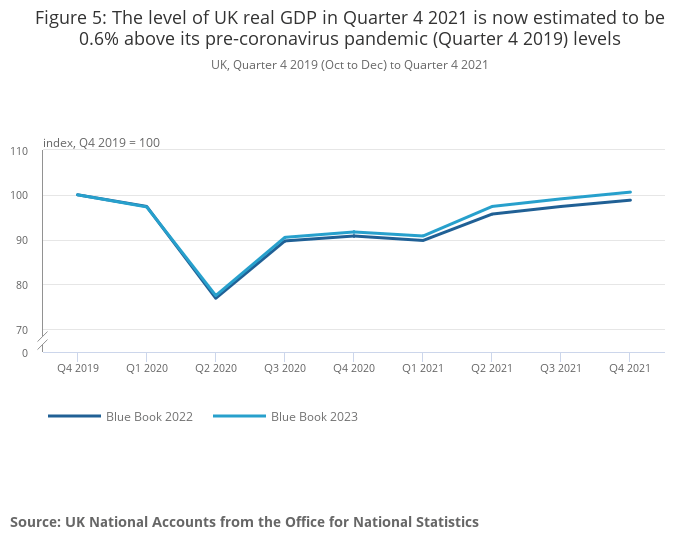
It is also ready to hold up its hand when it gets things wrong. It did so last week, when it revealed that it seemed to have been undercounting GDP growth since the pandemic. The changes meant that UK economic output had bounced back above its pre-pandemic level by the end of 2021, rather than remaining below it. More significantly, this put the UK in the middle of the pack of G7 countries (above Germany, level with France, and below the US, Japan and Italy), rather than languishing below them – though ONS does warn that these countries too may revise their calculations.

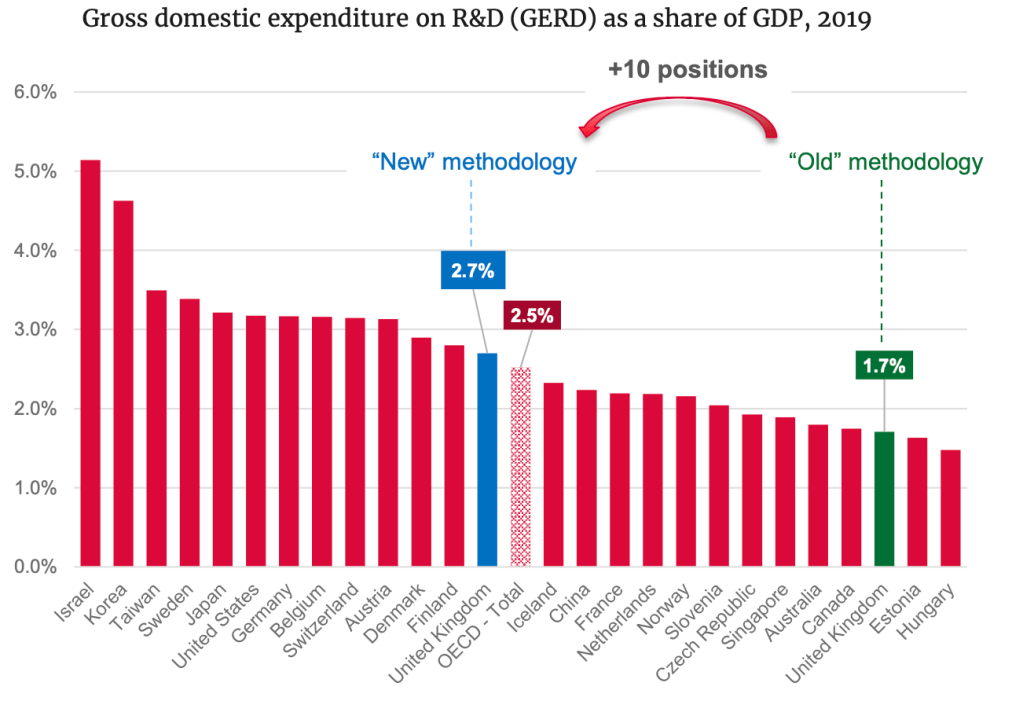
I came across a similar correction recently, when comparing UK expenditure on research and development (R&D) to other countries’. When the UK Government’s Innovation Strategy was published in 2021, it made much of the fact that we were only spending around 1.7 per cent of GDP on R&D, well below the OECD average. A target was set to raise expenditure to 2.4 per cent of GDP by 2027.

Last autumn, the ONS reviewed how small business expenditure on R&D was being assessed, and revised its figures. UK expenditure on R&D in 2019 rose from 1.7 per cent to 2.7 per cent, bringing it above the OECD average, and putting the UK ahead of China as well as many of our European neighbours. By 2021, we had moved further up the table, spending 2.9 per cent of GDP on R&D, against an OECD average of 2.7 per cent.

Source: UK Innovation Report 2023

These numbers too may change again, and the changes are an illustration of the difficulties of measuring something as complex as an economy, particularly in the wholly exceptional global circumstances of the past few years. I’m really not qualified to say whether such dramatic revisions call for a review of how statistics are compiled. However, as Tim Leunig has stated in arguing for such a review, these changes matter because low GDP and low R&D investment matter. They are the basis for changes in policy (including, I suspect, the repeated expansion and extension of the UK’s R&D tax credits regime), so if the data are wrong, then policy may be wrong too.

But I am struck by how ready I was – and I suspect I am not alone in this – to accept as a simple fact something that actually seems to have been very wide of the mark. Of course the UK is underperforming most other advanced economies, I thought, Of course it is. It’s ‘sickmanism’, our reclamation of the dubious accolade that seeemed ours by right in the 1970s, a return to the “orderly management of decline” that permeates John Le Carré’s novels of that time.

It’s not surprising that many of us are ready to believe the worst. After seeing public services and social infrastructure stripped to the bone over a ten year period, the ever-deeper impoverishment of society’s most vulnerable, a needless and needlessly harsh split from our closest allies and trading partners, and a succession of political leaders who seem to treat politics like a fairground card trick, I can forgive my own cynicism.

The annoying thing, of course, is that our frankly middling performance (playing catch-up with Italy?) will now be hailed as a triumphant vindication of Brexit and the sound economic governance that recent administrations have been known for. Chancellor Jeremy Hunt has already said that it disproves the “declinist narrative about Britain and its long-term prospects”.

But beyond the political ping-pong, perhaps there’s a lesson too: it is not to flip from doomster to booster, but to treat assertions of the UK’s global decline as cautiously as those of its triumph. Maybe Britain can make it after all.

Talking to the taxman about demographics

Recent figures suggest that London may already be bouncing back from the twin shocks of Brexit and the pandemic. The figures, based on pay-as-you-earn (PAYE) tax data, suggest that the number of working people living in London increased by just over three per cent between December 2019 and December 2022, an increase of around 138,000.

Tagged as “experimental statistics” by the Office for National Statistics (ONS), they count the “payroll population” – that is, the number of people on payroll, including those on furlough or sick leave, based on their home address. Therefore, they do not show the number of jobs in London (some of these people will commute out, while others commute in) nor do they show the whole population (they exclude self-employed people and people who are not working for whatever reason).

All that said, they provide another strong indication that whatever population exodus London saw during the first year of the pandemic has since gone into reverse. The chart below shows the trajectory of this change. March 2021, the month of the 2021 Census, is at the lowest point of the dip.

Screenshot 2023 04 18 at 19.56.13

The composition of London’s payroll population has changed over this period, reflecting the implementation of Brexit in 2020 and new immigration rules in 2021. London’s EU worker population has shrunk by about ten per cent (80,000 people), while its non-EU worker population grew by around 20 per cent (150,000 people). The UK national workforce fell by about five per cent during the pandemic, and is now two per cent higher than it was in late 2019. The chart below shows how the three populations have changed.

Screenshot 2023 04 18 at 19.58.48

The rest of England also saw growth in its non-EU workforce. Though this growth was largest in numerical terms in London, the proportionate increase in North East and North West England was much sharper: the number of non-EU workers living in these regions increased by 65 and 47 per cent respectively (and the number of EU workers fell less). This largely accounts for faster payroll population growth rates in these regions, as shown in the chart below. London’s growth is just above the English average, but higher than its southern neighbours’.

Screenshot 2023 04 18 at 20.02.25

At the moment, the rise in the number of workers from outside the EU has been spread across the country, reflecting the fact that growth has been sharpest in “nationwide” sectors such as health, construction and transport. As the economy recovers, that trend may continue or else immigration will become more concentrated in London (as suggested in a previous article).

What does this tell us? Despite their limitations, these ONS figures suggest that London has begun to adapt to and recover from the double whammy of the pandemic and Brexit. And they confirm the need for caution urged by the Greater London Authority and others over using the Census figures to argue against investing the capital’s services – 2021 was a very odd year.

First published by OnLondon

AI: reshaping the knowledge economy

Since their earliest days technology has shaped cities. The industrial revolution founded the great manufacturing centres of the 19th Century; trains fuelled London’s growth, replacing market gardens with metro-land; and global information and communication technology networks founded a network of global cities in the late 20th Century.

Right now, social media are clamorous with hype about artificial intelligence (AI), and the pace of change seems dizzying. Anyone who has played with “generative” AI tools such as OpenAI’s ChatGPT, Google’s Bard, or Midjourney’s image generators will have experienced the uneasy feeling that they are dealing with something sentient, however much they know that these systems merely aggregate and recombine information.

Prompt engineering is not straightforward, as this Midjourney representation of ‘futuristic London’ illustrates.

What impact is this wave of innovation likely to have in London, and on London’s economy in particular? In recent weeks, a few academic and commercial studies considering the labour market impact of generative AI have been published. This article tries to weave together some of their threads.

One piece of positive news is that London is the leading European city for AI. A 2021 survey by the government’s Digital Catapult identified the UK as the third most important centre for it after the USA and China, with more than 70 per cent of UK AI firms and – judging by 2020 job postings – around a third of all new advertised AI jobs based in London.

London’s tech sector has grown fast and is estimated to employ around 900,000 people. But the impact of generative AI is likely to extend beyond the capital’s silicon centres and suburbs. One team of researchers, Tyna Eloundou and colleagues, have looked at detailed task descriptions for US occupations to estimate the impact that generative AI technologies could have. Overall, they estimate that 80 per cent of the USA workforce could be affected by them, with around 20 per cent being heavily affected. The impact would be greatest for higher paid jobs and those held by graduates.

The research team has not published details of its analysis, but does summarise the impact on different industries. At the top of the list, with more than 40 per cent of tasks affected, are various financial services and IT subsectors, as well as a publishing and broadcasting (non-internet), and professional, technical and scientific services.

A Goldman Sachs report reaches similar conclusions. It argues that the impact of generative AI will be greatest in advanced western and far eastern economies. In Europe, it suggests the greatest impact will be on professionals, associate professionals, clerical support workers and managers, with legal service and office administration likely to be affected most heavily.

These findings map pretty squarely onto the three categories of professional services which dominate the London economy: information and communications; finance and insurance; and professional, scientific and technical services. These sectors have grown in importance in the capital. They made up 31 per cent of jobs in London in 2022 compared to 27 per cent in 2012. They are also concentrated in the capital, accounting for almost twice the proportion of jobs as across the UK as a whole.

Saying that these “knowledge economy” sectors are those most exposed to the impact of generative AI is more or less the precise opposite to what Centre for London colleagues and I found five years ago in our report on disruption to the capital’s labour market. Based on an analysis of how “automatable” different occupations were, we argued that London’s information and communications and its professional, scientific and technical services had the lowest automation potential (finance and insurance was slightly higher).

Why the difference? Were we wrong? Are these new analyses wrong? What has changed? Without re-running our analysis, I suspect part of the difference lies in occupational mix. Many London workers undertake more specialised and knowledge intensive tasks within particular industries. Underwriting risk at Lloyds of London is very different from working in a claims call centre.

But I think our expectations have shifted too. Generative AI is a qualitative change. When we wrote the Centre for London report, we were generally talking about the scope for specialised algorithms to automate specific routine tasks. These new technologies go further: they can draw on huge databases to generate new content. They can respond to simple user requests, writing and refining algorithms on demand. They can draft summaries, presentations, poems and speeches. They are creating visualisations. They are even being deployed in therapy. This is extending their reach much further into professional services than we envisaged.

Will this change destroy jobs? The traditional response is to say, “No! Every other technology has created jobs. This will too.” I think that is certainly right in the short term. The measure of impact used by the Eloundou study is whether generative AI could theoretically speed up tasks by more than half. A recent empirical study found that AI-enabled workers took an average of a third less time to complete certain standardised tasks and produced a better graded submission at the end. Workers also expressed more job satisfaction, spending more time coming up with ideas and editing, and less time drafting.

This sounds like a potential boost to productivity for London’s service sectors – one the capital and country urgently need. Productivity gains can, of course, be realised by cuts in wage bills, but that is only part of the story. AI may also unleash supply of and demand for new products and services. Economics blogger Noah Smith has compared its impact to that of machine tools, which displaced craft manufacture but led to ever increasing demand for goods and employment in manufacturing – at least for a century or so.

London is perfectly positioned to catch this wave of opportunity, creating new software to meet new demands and launching a new wave of hybrid services, following in the path of fintech and medtech. But the impact may go deeper still. Eloundou and colleagues argue that generative AI is already showing signs of being a “general purpose technology” like printing or steam engines, characterised by “widespread proliferation, continuous improvement, and the generation of complementary innovations”. If that is the case, AI will change our world in ways that we cannot yet comprehend.

All this is wildly speculative. At the extremes, London could be left unaffected by AI, though I fear that would be the stagnation option. Or AI may destroy humanity, making predictions moot. Between these poles, job destruction is by no means certain and if AI allows more leisure time alongside more equitably shared prosperity, that might not be a bad thing. But disruption probably is. London could be in for an exciting but choppy few years.

First published by OnLondon

Working it out

Local and regional employment statistics from the 2021 Census were released this week, giving a snapshot of who is working in London and how this compares with the rest of the country. There are caveats, given that the Census was undertaken in March 2021 at the end of the last Covid 19 lockdown when some Londoners had moved out of the city. Also, these figures are about residents’ economic activity as distinct from the jobs in London’s workplaces. Nevertheless, here are four observations about how Londoners are working, from a brief review of the data.

Employment rates are high in London, but partly for demographic reasons

At first glance, London boroughs are hives of economic activity. There are 331 English and Welsh local authority districts and five of the ten with the highest employment rates were in London. Wandsworth, Lambeth and the City of London took the top three slots, with Southwark and Merton not far behind. All had 65 per cent employment rates or higher.

But these numbers are skewed. Firstly, the headline Census figures look at the entire population over 16 years old, including those above retirement age. London has a younger population than the England and Wales average, and young people tend to work more than older people.

By this measure, therefore, you would expect to find higher employment rates in London. But if you look at employment rates only for those aged 16-64, London boroughs are towards the middle or bottom of the table.

The second factor that seems to have affected London’s figures surprised me. In addition to the effect of having a younger population, older Londoners are much more likely to be working than counterparts elsewhere.

Overall, 14 per cent of people in the capital aged 65 and over are still working, and London boroughs account for eight of the ten districts with the highest employment levels nationally.

The City of London, Kensington & Chelsea, Camden and Westminster all have more than 20 per cent of their older residents in work. London is not so much the city that never sleeps as the city that never retires.

There’s a big employment gap for disabled Londoners, but fewer are economically inactive than in other regions

The employment rate for disabled people over 16 living in London is just under 30 per cent. This is higher than in other regions, though there is a stark gap between employment for disabled and non-disabled people: the employment rate for the former group is 38 per cent lower than for the latter.

There is also a relatively high proportion of disabled Londoners who do not have a job but are looking for one. However, fewer disabled Londoners are economically inactive (ie, not in work, but not seeking work either) than in other regions.

Whether this pattern is because London’s labour market can work well for disabled people, or because economic circumstances and sanctions force more of them to keep looking for work in the capital, is not clear from these figures. Trust for London and other organisations have done extensive work on the subject.

Women’s employment rates are relatively high, but the gender employment gap varies markedly across the city

The employment rate for women in London aged 16 and over was around 57 per cent. That’s higher than in any other English region. Eight inner London boroughs had rates of above 60 per cent.

At the same time, and in common with every other English and Welsh local authority district, employment rates in London boroughs were higher for men than for women. However, there is a very mixed picture across the city.

Newham, Redbridge, Tower Hamlets, Harrow and Barking & Dagenham are five of the eight English and Welsh districts with employment gender gaps of more than 12 per cent, while Hackney, Lambeth and Lewisham have gaps of five per cent or less, which are some of the lowest.

This may partly result from demographics: the boroughs with low employment gaps have many young, single (or newly-coupled) professional people, while the boroughs with wider gender gaps have some of the highest birthrates in London and include communities in which, for cultural reasons, women may be less likely to work.

Worker growth is outstripping general population growth in East London

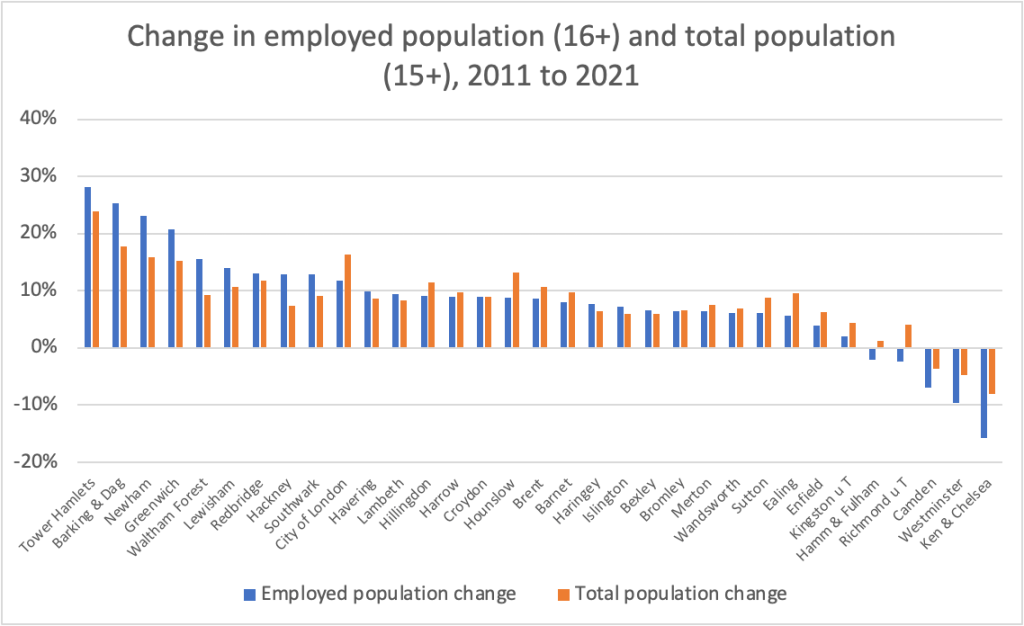
Between 2011 and 2021 London’s working adult population aged 16 and over and its total population aged 15 and over both rose by around 8.5 per cent. But growth was very unevenly distributed (see chart below).

The east London boroughs have seen rapid increases and in most cases their working population growth has outstripped their general population growth. Other boroughs, particularly in other parts of north and west outer London, have seen their working population grow more slowly than their overall population, and a handful of west-central boroughs have seen a decline in both groups.

Taken together, these figures suggest that London continues to contain extremes of employment and worklessness. Zooming into the ONS’s detailed map, you can find blocks where 15 per cent or more of people aged over 16 are unemployed and looking for work within boroughs that have grown their workforce by 25 per cent over the past ten years.

Londoners are unquestionably working hard. More women, more older people and more disabled people are in the workforce. To what extent this is a result of making positive choices and the general industriousness of urban life, and how far it is driven by the exorbitant costs of living in the capital is another question.

Originally published by OnLondon.

Drifting back

After the turbulence of recent months, many Londoners will be hoping for a return to normality, albeit under the shadow of a cost-of-living crisis and a looming recession. But is the city’s office economy returning to pre-pandemic patterns of commuting and working, or have we settled into a “new normal” of hybrid working, empty office blocks and diminished city centre businesses?

London’s streets certainly seem busier, and on the days that they are running, so do London’s tube trains. This is borne out by Transport for London data: trip volumes have been increasing since the summer and now average around 80% of pre-pandemic levels. There are some spikes and dips to this trend, (such as Jubilee celebrations and bank holidays elevating usage, and strikes and heat waves reducing it), but Tube use is now just 20% below pre-pandemic levels.

Screenshot 2022 11 13 at 22.06.03

There is a persistent rhythm emerging too. Weekends are still busiest, with nearly 90% of pre-pandemic trips. Monday, Tuesdays and Fridays are quieter with averages of 65-70%, and Wednesdays and Thursdays slightly busier with averages of 70-75%. However, since the beginning of September, the recovery in trip numbers has been particularly sharp around the City of London and Canary Wharf, suggesting that an increasing proportion of passengers are office workers, as opposed to leisure visitors or workers in other sectors.

Other figures confirm the impression of a gradual return to offices. Remit Consulting have been collecting data on office occupancy throughout the pandemic, based on access control systems (swipe cards and so on) from a sample of around 150 large office buildings in the UK. After advice to work from home was lifted at the end of January, office occupancy figures rose quickly to around 25% and stayed at that level throughout the summer, but since the beginning of October have climbed above 30%.

Screenshot 2022 11 13 at 22.08.27

Remit estimate that “normal” office occupancy levels were 60-80 % before the pandemic, so 30% occupancy in fact equates to offices being around “half full” on the average day. Remit also have a more detailed breakdown by London office ‘submarket’ which shows West End offices back to around 42% average occupancy in October, with City and Docklands offices lagging behind.

Further west, in the SW1 corridors of power, offices are busier. When Jacob Rees-Mogg told civil servants to return to their desks in April, there was an immediate, but amusingly short-lived, effect on behaviour. Office occupancy leapt up from a departmental average of less than 50% of capacity, hitting 65% in mid-May, but had fallen back again by the end of that month.

Jubilee celebrations, summer holidays and industrial action kept numbers low over the summer, but occupancy has been back above 65% since the beginning of October. This is not far off pre-pandemic levels – though to be fair there have been an awful lot of ministers to clap in and out of Whitehall offices over the past few weeks.

While the higher levels of civil service return may reflect a tougher line from ministers, it seems that the return to offices has in fact gathered pace just as politicians and newspapers stopped demanding it. But it remains a trickle rather than a surge. Where do we go from here?

Many workers welcomed more flexible working, and are keen to retain its benefits. The survey commissioned by Kings College London this spring as part of their Work/Place project (on which I worked) found London workers embracing hybrid working patterns enthusiastically: 61% reported hybrid working, defined as working from home at least one day a week (compared to less than 20% before the pandemic). A further 13% worked only from home.

Workers expected the changes to stick too: 75% said they were “never going back” to a five-day week in the workplace, with three days a week at home the most popular option. The results of a second phase of the King’s survey (undertaken in the summer) are due to be launched at a joint event with Central London Forward next week, so we will have some idea of whether these views have shifted over time.

But there is a big difference between these workers’ expectations and those of employers. The UK-wide Business Insights and Conditions Survey found that the proportion of employers (weighted by employee numbers) planning to use home-working as a permanent part of their business model rose from 16% in October 2021 to 24% in May 2022. It was much higher in the ‘office-based’ sectors (professional, scientific and technical services, and information and communications) that account for around one in five London jobs.

However, in the latest wave of the survey (August 2022) that proportion appears to have started to fall across the board, suggesting that bosses may be becoming cooler about long-term home-working (a finding which seems to be mirrored in trends tracked by the WFH Project, a consortium of north American universities).

Screenshot 2022 11 13 at 22.10.53

This gap between employer and employee expectations suggests that we have not yet reached equilibrium. Hybrid working certainly poses challenges – both for planned communication within and between organisations, and the “watercooler moments” of serendipity and casual interaction that form the foundations for corporate culture. Mixing digital and real-life interaction is tougher in many ways than the world of universal home-working during the pandemic.

Over time, new ways of working may diminish or overcome these challenges – through enhanced technology, or changes in culture or behaviour. Managers may tighten rules to ensure that teams can meet effectively and to prevent working from home becoming a perk for those with the privilege of controlling their own workflow (at the moment, it is overwhelmingly concentrated in more senior managerial and professional roles), or conversely to prevent a culture of office attendance and preferential treatment for those (mainly male) workers without caring responsibilities.

But as the recession bites, employers may feel emboldened to push for more presence in the office. There are already stories of companies such as Meta (formerly known as Facebook) retreating from the highly permissive approach they took during the pandemic, and some bosses may share Elon Musk’s views about home-working if not his cack-handed approach to employee relations. Even if returning to the office is not mandated, the threat of redundancy may boost presenteeism although, alternatively, tighter economic times may push employers to seek savings on property costs.

There may also be some polarisation: primarily remote working may become the norm in some sectors or companies, while being in the office becomes more established in others. The King’s College research showed that the biggest increase in home-working was among those who were already working from home at least one day a week before the pandemic.

Where more people are in the office, “fear of missing out” – on advancement, on collaboration, on gossip – may draw even more people in. Conversely, where online meeting and collaboration tools are the norm (perhaps augmented by periodic spells of intense in-person collaboration), employees will respond accordingly – not just in their daily habits, but in long-term decisions about where they live.

London’s office economy has not yet returned to its pre-pandemic state, but nor do I think it has settled into a “new normal”. Huge challenges for the real estate sector and the ecosystem of city-serving businesses remain, and some of these will be discussed at the King’s College/CLF event next week. But the future looks less bleak than it did during the pandemic, and any case for stripping back transport seems much weaker than it might have done even a few months ago. The debate about Crossrail 2 even seems to have restarted. Reports of London’s demise look to have been premature at best.

Originally published by OnLondon.

Spend spend spend!

The Chancellor of the Exchequer, Jeremy Hunt, is finalising his Autumn Statement against the backdrop of what Prime Minister Rishi Sunak has called a “profound economic crisis”. As the two men prepare to take decisions that will shape fiscal and spending policy for the rest of this Parliament and beyond, what are the public’s priorities on taxation, welfare and public spending, and how have these changed in recent years?

The National Centre for Social Research (NatCen)’s flagship British Social Attitudes survey has tracked views on public expenditure priorities since 1983. Cutbacks in taxes and spending have never been popular, but opinion has see-sawed between wanting to keep taxation and expenditure stable, and seeking an increase in both (see Figure 1 below). After the years of austerity, which saw cuts to many public services, the balance tilted towards increased tax and spending in 2016. While the gap has narrowed since 2017, this remains the majority position.

 Figure 1 – Attitudes towards taxation and public spending, 1983-2021

BSA AUTUMN STATEMENT Fig1

These attitudes are reasonably consistent across the main political parties. Conservative Party supporters are more likely to favour keeping tax and spending as it is now, but there is very limited appetite for cutting both taxes and spending from any major party’s supporters. There is also a degree of consensus between different income levels, although modest and higher earners (those with a pre-tax household income of £30,000 or more) are those who – perhaps surprisingly – express most support for increased taxes and expenditure.

However, there are more striking differences between age groups (see Figure 2 below). Younger and older adults, who may be beneficiaries of higher spending on services such as education and health, are more likely to favour higher taxes and expenditure. In contrast, people aged between 25 and 54, who may be more exposed to higher taxes, narrowly favour maintaining current levels of taxes and expenditure.

 Figure 2 – Attitudes towards taxation and public spending, by age group, 2021

BSA AUTUMN STATEMENT Fig2

The BSA survey does not specifically ask views about which public services could be cut, but has regularly asked about priorities for increased expenditure (see Figure 3 below, which shows only the most popular options). Education and health have consistently topped the list. The relative importance assigned to these services was perhaps reflected in government commitments to ‘ring-fence’ them from spending cutbacks in the years after 2010.

Figure 3 – Priorities for increased public spending, top 5, 1983-2021

Figure 3.1

This perceived protection may also explain why other services became a higher priority for survey participants in recent years – though support for more spending on health bounced back during the pandemic. The priority attached to more spending on police and social security benefits has increased in the past five years, and support for more spending on housing has trebled since 2000.

There are also party-political differences in priorities. Education and health are prioritised across the spectrum, but sharper differences can be seen in relation to other services (see Figure 4 below). Conservative Party supporters favour increased spending on police and prisons, support for industry, roads and defence, while Labour Party supporters focus on housing, social security, public transport and overseas aid.

Figure 4 – Top ten priorities for increased spending, 2021

Figure 4.B

There has also been a noticeable shift in which social benefits people prioritise (though our survey only asks this question every two years, so our most recent data in the Figure 5 below is from 2020). In 2005, 80 per cent of the population prioritised an increase in state pensions; in 2020 this had fallen to 55 per cent; this may partly be explained by the “triple lock”, which has meant increases in line with or above inflation in pensions since 2010. More recently, between 2018 and 2020, there was a rise in relative support for increasing child benefits and unemployment benefits, while support for increased disability benefits, which had risen sharply in the previous ten years, also fell back.

Figure 5 – Priorities for increased spending on benefits, 1983-2020

Figure 5.B

The Chancellor has described the preparations for the Autumn Statement as “decisions of eye-watering difficulty”. Our survey was undertaken towards the end of last year, before Russia’s invasion of Ukraine precipitated the current cost-of-living crisis. At that stage, survey participants expressed no more appetite for public spending cuts than they have in nearly four decades of the BSA survey.

On the contrary, our figures suggest that public opinion has noted the relative protection of old age pensions, education and health budgets over the past decade, and wants this extended to other services and benefits in the future – though precisely which other services and benefits should be prioritised is a matter for considerable debate.

Written for NatCen and first published on their blog.

Housing risks are multiplying

Fiscal, political and financial events are coming at us pretty fast right now, so it is easy to feel disorientated. But as the screech of U-turns fades and the smoke of burning policies clears, we already seem to be in a world that has fundamentally shifted from the stability of more than a decade of low interest rates.

Bank of England base rates, which have been below 1% for nearly 15 years, are already above 2% and some forecast they will rise as high as 6% next year (though expectations may be starting to fall, following the Chancellor’s latest statement). Mortgage rates have shot up too, with fixed-rate offers already jumping from 2% to more than 6%.

It is true that interest rate rises were already expected, but the chaos following the previous Chancellor’s “fiscal event” in late September means rises have been faster and sharper than most anticipated. What does this mean for the capital?

There’s not much good news, I’m afraid. Firstly, according to the Resolution Foundation, costs will rise sharply for those households whose fixed rate deals come to an end soon. A total of 5.1 million households nationwide – around 60% of all households with mortgages – have deals that run out before the end of 2024.

Londoners in this group will face the steepest rises, with average annual costs rising by £8,000. The capital has the lowest proportion of households with mortgages in England, but even so, there were around 1,000,000 mortgaged households in London in 2020, so around 600,000 of those could be facing a huge hike in the costs of their mortgages, assuming exit from fixed rate deals mirrors the national pattern. The impact will be selective but brutal.

At the same time, house prices are widely expected to fall – and to fall faster in London than elsewhere – as rising mortgage costs delay purchases or even force some sales. The top of the market is still booming, but there are dark clouds on the horizon. Some analysts have predicted London prices falling by as much as 12% by the end of 2024.

At first sight, this looks like it could be good news – at least for first-time-buyers, who paid an average of £440,000 for London properties last year. If those predictions of a 12% price drop were borne out across the market, this figure would fall to £387,000 by the end of 2024 and imply a (10%) deposit of £39,000 rather than £44,000. Together with the impact of Stamp Duty reductions announced in the ill-fated “mini-budget” – still standing at the time of writing, but anything could happen – this would reduce cash move-in costs by around £10,000.

But the impact of this possible saving would be rapidly wiped out by higher mortgage costs. The monthly cost of a 90% mortgage on a £440,000 property is around £1,777 on the basis of a 2.5% interest rate. If and when rates rise to 5%, even a £387,000 property would cost £2,036 per month – £250 more than now, and around two thirds of take-home pay for someone earning £50,000 a year.

For those buyers lacking the family wealth or savings to afford a deposit, falling prices and stamp duty cuts may help a first tentative foot onto the ladder. But the burden of those higher mortgage costs will soon wipe out those savings. Behind every silver lining, another cloud.

With a sharp fall in property values comes the threat of “negative equity”, a thoroughly unwelcome revival from the tail end of the last century. Negative equity – a term to describe when the value of a home is lower than the mortgage secured against it – was estimated to have hit around 40% of properties in London in the early 1990s.

A recent report by property analyst Neal Hudson suggests that a 20% fall in property prices would put 10% of London mortgages in the red. Again, the figure is higher than for other regions because prices in the capital have grown relatively slowly over the past five years, meaning recent buyers have had less chance to build up a buffer of equity.

Although negative equity is unpleasant and unsettling, it only becomes an acute issue if you are seeking to sell or remortgage a property. However, rising mortgage costs could force some sellers’ hands, particularly London’s newest buyers, who are those most stretched in terms of affordability and least cushioned by historically rising prices.

Private sector renters have it tough as well: rents are surging as landlords seek to pass on rising borrowing costs and as competition for properties intensifies, partly driven by a post-pandemic bounce. Some central London letting agencies already report more than 80 enquiries for each rental property, up from 16 in September 2019. As people delay purchases or – in a worst case scenario – see mortgaged properties repossessed, demand for rentals is likely to increase.

Something, you feel, will have to give. There will come a point when landlords will be unable to pass rising costs on to tenants or tenants will simply be unable to pay. Landlords may be forced to sell, as will some first-time buyers, which could feed a spiral of declining property values. Again, this has its attractions but raises the question of who will be able to buy when interest rates remain high?

London property prices may be overdue a correction (that is, a fall), but while interest rates continue to rise, it will be London’s private renters and first time buyers who will be most at risk of losing their home. Sadiq Khan has already renewed calls for rent controls and more funding for affordable housing as market supply stalls.

After the 2008/09 financial crisis a “mortgage rescue scheme”, administered in London by the previous Mayor, allowed housing associations to take a stake in properties to avoid repossessions. It had limited take-up in London and was closed early. But in a city that already has four times the national rate of homelessness, government action may again be needed to soften the blow.

Originally published by OnLondon.