It’s lunchtime in London, and I’m in a thronged and anxious Trafalgar Square, watching the big screens broadcasting from Singapore, where it is early evening; a smaller crowd is gathered in Stratford, the hub of London’s bid for the 2012 Olympic and Paralympic Games. London and Paris are the final two cities in the running; reflecting a thousand years of rivalry and friendship.
In Singapore, International Olympic Committee (IOC) President Jacques Rogge steps to the podium, and grim-faced IOC members stand to attention as the interminable Olympic anthem is played, like politburo members reviewing a Mayday parade.
Finally, an envelope is brought forward and Rogge opens it: “The International Olympic Committee is proud to announce that the Games of the 30th Olympiad in 2012 are awarded to the city of…London.”
In Singapore, the euphoria hits the London delegation before the city’s name has left Rogge’s lips. Tessa Jowell is cheering and waving her arms in the air, Denise Lewis is airborne, David Beckham is embracing anyone within reach, Ken Livingstone looks slightly bemused but then breaks into a broad grin.
In London, Trafalgar Square erupts; Stratford erupts. People are hugging; I think I might be crying, though I’m not entirely sure why. People rush to share their excitement at our win. Some of them have been doing everything they can to scupper the bid, but still. We’re going to need all the allies we can get now. Rosanna Lawes from the London Development Agency (LDA) has tears in her eyes too. “Now we’ve got to deliver it,” she says.
With Heather Small’s booming voice asking what I have done today to make her feel proud (I really don’t know, Heather, I feel scared more than anything), I pick my way through the jubilant crowd. I join some Greater London Authority (GLA) colleagues in a hotel overlooking the Square for a beer, then announce rather piously that I have to go back to work. I’m leading transition planning for the GLA and Government, and this is it. The Department for Culture Media and Sport (DCMS) is a few moments away, and I’m soon back inside, sending out tender documents (by post, how quaint!) for headhunters to find a chief executive for the Olympic Delivery Authority, an organisation that doesn’t even exist.
The DCMS Bill Team are there too, readying the legislation that will be introduced into Parliament in a matter of days. I have a conversation with Tony Winterbottom from the LDA: he needs authorisation to let contracts for tunnelling works in the Olympic Park, to enable high voltage power lines to be buried, to enable construction of the 80,000 seat stadium that the world will be watching in July 2012. Timings are tight and budgeting is complicated by government rules. It can’t be done; it must be done. I’m feeling elated, but also slightly sick; it’s going to be a busy summer.
7 July 2005
I’m up early, and scoop up all the newspapers at Stockwell station on my way into the office. I want to remember this moment, when the bid was hailed as a triumph, before delivery becomes vilified as a disaster. We had been told by people involved in Sydney 2000 that the celebratory moment would be fleeting.
By 10am, we are hearing rumours. Major transport disruption. An ongoing incident. Bombs on buses and in crowded rush hour tube trains. Mobile phones stop working; nobody knows what is happening. We worry about people who are not in the office. Are they running late or in trouble?
I step outside, despite security guards trying to dissuade me, my need for a cigarette overcoming their caution. Cockspur Street is almost silent. No buses. Hardly any cars. Very few people. Sirens in the distance. For all its urgency, work is desultory suddenly, incidental.
By early afternoon, I’m speaking to Jeff Jacobs, my DCMS boss. He is in Singapore with the London contingent. Someone has told them that Thelma Stober, one of the LDA’s principal lawyers, has been injured in the bombing, but nobody is clear how badly. A stunned Ken Livingstone makes a powerfully defiant speech in Singapore before boarding a plane back to London.
I leave work early, joining subdued crowds walking home, across St James’s Park, down a traffic-free Vauxhall Bridge Road to the river. I wonder whether to stop in at the White Swan for a drink. Surely that’s what we do; we carry on as if everything is normal, even though it very clearly is not?
“Gentrification” is always front and centre of debates about the impact on east London of the London 2012 Olympic and Paralympic Games. Legacy sceptics claim the “regeneration” of the Lower Lea Valley has resulted only in long-established working-class communities being driven out of their own neighbourhoods by more affluent incomers. Its champions take a different view, pointing to new amenities, a better environment, more jobs and homes, and rising educational attainment.
Yet Census and other data suggest that neither of these sharply opposed positions reflects the complex realities of rapid demographic and social change in this part of the capital.
To declare my interest, I worked on the project – mainly the “legacy” elements of the Queen Elizabeth Olympic Park, as it was renamed – from around 2004 to 2014. What interested me at the time was the idea of the project achieving the “regeneration of the area for the direct benefit of everyone that lives there”, in the wording of the aims agreed between the government, the Mayor of London and the event organisers.
Some commentators consider that promise to have been comprehensively betrayed. They argue that Park facilities have done nothing for local communities, with homes, workplaces and leisure centres being built for middle-class newcomers, while accelerating the displacement and victimisation of locals.
But there is a potentially positive story to be told too. In 2009, the four boroughs around the Olympic Park – Tower Hamlets, Newham, Waltham Forest and Hackney, plus Greenwich and, at a later stage Barking & Dagenham, set out a plan for “convergence”. Their aim was that on a range of indicators – from school attainment to employment to crime – these six “growth boroughs” would stop underperforming the London average.
Achieving this deceptively modest-sounding goal would be a big deal. It would involve disrupting patterns of migration that have operated for decades, if not centuries. As successive waves of new arrivals have moved into east London, its population has changed. But when newcomers prospered, they tended to move on and out, often further east, meaning that patterns of disadvantage persisted. East London saw displacement, but without gentrification.
Could this be reversed? Could the area around the Olympic Park experience a more inclusive process of change that enabled local people to stay and succeed – “gentrification from within”, as I glibly termed it when working for the London Legacy Development Corporation (LLDC)?
There has certainly been change. As OnLondon has previously reported, many of the 2020 convergence targets were met well ahead of schedule. Surprisingly, beyond saying the Growth Borough Partnership was “put into hibernation” in 2018, the website is quiet about this progress. This is unusual, as it is normally when targets are likely to be missed that they are quietly dropped by government bodies, rather that when they are on course to being achieved.
Perhaps one reason “convergence” has been sidelined is that it is too blunt-edged a metric, measured at too wide a scale. Lower unemployment, for example, could be achieved by displacing and replacing communities, instead of by helping them flourish. Nor does convergence distinguish between the impact of the London 2012 Games and other grand projects, including the London Overground extension and the completion of Crossrail, let alone wider socio-economic changes such as the impact of austerity across London.
The 2021 Census makes a more granular exploration of change possible. It has flaws, not least because it took place when many Londoners were temporarily out of town as a result of the pandemic. Furthermore, the data only captures aggregate rather than individual outcomes, and does not look back to 2001-11, when anticipation of and preparations for the 2012 Games were already having an impact. However, datasets comparing the 2021 results with those from 2011 do allow us to look in a greater level of detail at how the area round the Olympic Park has changed (the comparison datasets are collected here).
What follows first looks at the extent of population change around the Queen Elizabeth Olympic Park and then explores what we can infer about the components of that change – and specifically whether it represents a displacement of or an addition to existing communities. The “Olympic Park and Fringe” is defined by the following “middle-layer super output areas” (census tracts with a population of 2,000-6,000 people):
*Not included in some comparisons as no 2011 data available.
A decade of population growth and churn
The sheer pace of population change is striking. Between 2011 and 2021, London’s population grew by around eight per cent (though many inner London areas saw a fall, largely attributable to the temporary impact of the pandemic). Growth in the Olympic Park and Fringe was around 25 per cent, concentrated in Bromley-by-Bow and Fish Island to the west (34 and 36 per cent), in Stratford New Town and Carpenters, and in Mills Meads to the east and south (71 and 73 per cent).
The Census figures only show net change – the combined impact of myriad arrivals and departures over a ten-year period. Another data source, the Residential Mobility Index, which draws on sources such as electoral registers and land registry, estimates population “churn” – the proportion of households that have changed over a period of time. For the average London borough, around 50 per cent of households changed between 2011 and 2023. Hackney and Newham saw similar levels, while Tower Hamlets had a 76 per cent change and Waltham Forest a 43 per cent change.
But the areas immediately around the Olympic Park experienced more dramatic change, with over 90 per cent churn around Fish Island, East Village and Carpenters. Perhaps this should not be surprising, given the comprehensive redevelopment of these areas during and since the 2012 Games. As you move further east in Waltham Forest and Newham, and further west in Hackney, the degree of churn falls quite sharply: areas such as Leytonstone, Maryland, West Ham, Clapton Park and Homerton saw churn at or below the London average. Tower Hamlets is a notable exception: there was extensive population churn across the borough, with rates of 70 per cent or more all along Mile End Road and even higher around Whitechapel and Bethnal Green.
So, population growth has been intense in the immediate hinterland of the Olympic Park, though not that much higher than in other “regeneration” areas, such as Elephant and Castle, Kings Cross and Wembley. However, both growth and churn have been much more limited as you move further away from the park.
Qualifications and occupations
The harder question to answer is whether population growth and churn represent a replacement of or an addition to existing communities, in particular a displacement of working-class people and communities by more middle-class ones. Census data doesn’t really address class, but we can try to paint a picture using some proxy indicators, and by looking at the actual changes in numbers of people with particular characteristics, rather than the change in the mix. Has growth in one community been accompanied by another becoming smaller, both in itself and in comparison to trends across London?
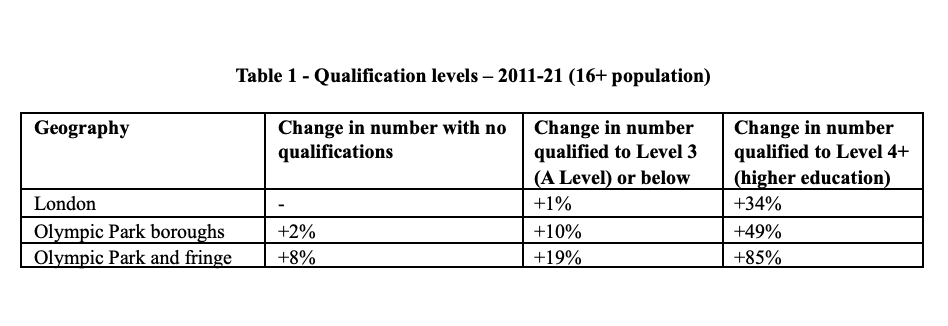
The first proxy indicator is qualification levels. The past decade has seen a rapid increase in the proportion of Londoners who have degrees or other higher education qualifications. This has risen from 38 to 47 per cent of the 16+ population across the city, and from 34 to 49 per cent in the Olympic Park and Fringe. The number of higher-qualified residents in these areas increased by 85 per cent and doubled around Stratford High Street, Stratford Town Centre, Bromley-by-Bow and Fish Island.
However the number of people without any qualifications has also increased, suggesting that in this case the change has been one of addition rather than substitution. Even if low-qualified people have moved out, other low-qualified people have moved in. The exceptions are the areas to the west of the Park – Bow, Fish Island, Hackney Wick and Hackney Marshes – where the number of low qualified people has fallen over time, suggesting a more permanent displacement.
A similar analysis has been undertaken by Duncan Smith at CityGeographics, looking at changes in occupational mix. He finds that the Lower (and Upper) Lea Valley has been at the forefront of change: the proportion of workers in managerial, professional and associate professional jobs in Waltham Forest rose from 40 to 51 per cent between 2011 and 2021, the most rapid change in England, and in Newham from 32 to 42 per cent. Analysis of numbers rather than proportions is not available by borough, but across London the number of people working in lower status occupations has not changed, suggesting that changes are additional not substitutional.
Housing tenure
Housing is another proxy: do tenure changes indicate gentrification and displacement? The Olympic Park and Fringe bucks London trends on housing tenure, with a sharp rise in owner-occupation (mortgaged and owned outright) particularly concentrated in Mill Meads, Stratford New Town and Carpenters, Bow and Fish Island, where new construction has been intense. So far, so gentrifying.
However, perhaps counter-intuitively, the number of households in social rented accommodation has also grown in the Olympic Park and Fringe, and at a faster than the London or local borough average. If social tenants around the Park have been displaced – and estate redevelopment projects in locations such as the Carpenters Estate have been highly controversial – they have also been replaced with more social tenants. Meanwhile, private renting has grown as it has across London. It is now the most widespread tenure in the Olympic Park and Fringe.
Ethnic diversity and employment
Another lens for examining change in and around the Olympic Park is ethnicity, which has a strong overlap with poverty and intersects with class disadvantage. The areas around the Olympic Park have always been some of London’s most diverse, with a non-white population of around 57 per cent in 2021, compared to 46 per cent across the capital.
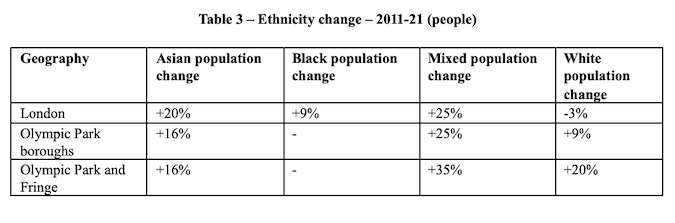
As the table below shows, compared to London as a whole the Olympic Park boroughs and the Olympic Park and Fringe areas saw faster growth in their white and mixed-race populations, slightly slower growth in their Asian population and almost no net change in their black population. Black and Asian populations fell in Waltham Forest’s fringe areas, and all populations grew fastest in Tower Hamlets’ fringes, along Stratford High Street and into the Town Centre. This suggests that even if rapid growth in white and mixed-race populations around the Park did not actually lead directly to displacement of people from Asian and black populations, it may have constrained growth in those populations to lower levels than in other parts of London.
Another perspective on ethnicity can be seen in employment rates. In the Olympic Park boroughs these rose from 59 to 62 per cent of people aged 16+ over the decade, bringing them above the London average. The rise has been sharper still in the Olympic Park and Fringe, with rates rising from 60 to 65 per cent of the population. But, while employment rates have improved for all groups relative to the London average, employment has risen fastest for white people, while it changed much less for black and Asian people, widening the employment gap between these communities.
Unfinished evolution
Taken together, these figures suggest that the London 2012 programme has had varying and complex impacts on the local area. While there have been some signs of displacement of existing populations, particularly to the west where legacy has butted up against “Hoxtonisation”, the more widespread pattern seems to have been one of densification enabling the arrival of new and different communities. These demographic changes, along with the programmes run by the Olympic Park boroughs and LLDC, have driven convergence in employment rates, in tenure, and in occupational and educational profile.
That said, the differences in improvement in employment rates, alongside recent depressing news about falling life expectancy, suggests that structural disadvantage continues to hit some east London communities hard. Twenty years after London was awarded the Games and as the boroughs, the Mayor of London and the LLDC develop inclusive economy plans, London 2012’s legacy is an unfinished evolution.
The wonderful Tim Williams, who I have known for about 25 years, invited me to be on the podcast that he presents for Grimshaw. We had a great chat. Here it is.
July 2012 was an odd time for me. I was working at London Legacy Development Corporation (LLDC) in offices minutes away from the Olympic Park, but as the London 2012 Games drew closer, it was clear there was nothing much for me to do. Not being a big sports fan I hadn’t bought any tickets, so a couple of days after the opening ceremony I flew to a small Greek island, where cheers from the local bar were the only indicator of London’s growing medal tally.
The LLDC itself had only been established a few months earlier. After years of wrangling between the Mayor of London and government, planning and delivering London’s Olympic legacy would be wholly in Boris Johnson’s hands.
You can probably guess what happens next. You expect chaotic bumbling, classical allusions, questionable personal morals, sound and fury signifying nothing. Boris Johnson’s behaviour has so tarnished his reputation in recent weeks and months that it is hard to even entertain the thought that good things came out of his mayoralty. But some did – and most of them are in the Queen Elizabeth Olympic Park.
Early signs were not auspicious. Following his election in 2008, one of Johnson’s first moves was characteristically whimsical. After a chance meeting with steel tycoon Lakshmi Mittal, he launched a competition for an “Olympic tower” as a landmark within the Olympic Park, which resulted in the tortuous steel folly that is the ArcelorMittal Orbit.
Apart from this, the Mayor more or left the construction programme for the Games – well advanced by 2008 – to run its course. Instead he looked to legacy, re-opening the issue of getting a football club into the stadium (a saga in itself, and one extensively covered in Dave Hill’s excellent Olympic Park book), backing the establishment in 2009 of the Olympic Park Legacy Company (an uneasy joint venture between the government and the Mayor), and working with David Cameron’s government to convert this into what became the LLDC – a mayoral development corporation with more powers over planning and singular accountability to the Mayor’s office.
He also cast a wary eye over the plans for the legacy development that would follow the Games. A new masterplanning team, comprising Allies and Morrison and EDAW, who had worked on the Olympics masterplan alongside the Dutch firm KCAP, had been appointed just before Johnson was elected. Their plans for the Park included large scale urban blocks – like those eventually built in the athletes village – filling in the space between the retained venues and parkland.
These would have made a striking contrast with surrounding neighbourhoods of terraced housing – not necessarily a bad thing, but not to the incoming Mayor’s taste. I want Georgian terraces, he told the design team at one meeting. Yes, they replied, we need to reinvent the terraced townhouse as a 21st Century typology. No, he insisted, I wantGeorgian terraces...
Beneath squabbles over architectural and urban form were deeper issues of money. The government had pushed for a design and delivery schedule that could generate enough capital receipts to repay debt that had been incurred in buying up land and borrowings from the National Lottery to pay for the Games. Denser development would yield higher returns, and house prices growing at 10 per cent a year would make later phases of development particularly valuable – at least on spreadsheets.
As the Mayor and his advisors began to engage with the plans in the expectation of control shifting from Whitehall to City Hall, the Legacy Masterplan Framework was reinvented as the Legacy Communities Scheme, launched in 2010. Gone were most of the giant “European” perimeter blocks, as forms shifted to something reflecting what design advisor Ricky Burdett talked of as “London’s DNA”– terraces, townhouses and dense streets (with a few neo-Georgian flourishes to please the Mayor in the computer-generated images). We reworked the spreadsheets to show that debt could still be repaid, but this began to feel like an incidental, rather than central, objective for the legacy plan.
More change came in 2012, when Margaret Ford was replaced as LLDC chair first by Johnson’s idiosyncratic deputy Daniel Moylan, and then – after only a few months – by the Mayor himself, supported by Neale Coleman as deputy chair. Dennis Hone moved over from the Olympic Delivery Authority to replace Andrew Altman as chief executive and was asked to accelerate construction: the development corporation should act as a public body, not as a commercial developer; it should build housing, not bank its land while house price inflation stored up treasure in the future.
A further dent in the spreadsheets came when Boris Johnson decided that Queen Elizabeth Olympic Park needed more than sports venues, mid-scale housing and a beautiful park. The success of the 2012 Games had piqued the interest of museums and universities, who had previously regarded the Park as a potential location for student housing but not much else. Boris Johnson became a cheerleader for a new cultural and educational district, dubbed Olympicopolis – a nod to the “Albertopolis” legacy from the 1851 Great Exhibition in South Kensington (and now renamed by his successor as East Bank, itself a reference to the 1951 Festival of Britain’s legacy).
The only problem with the plan – enthusiastically promoted by the Mayor as transformational to the global image of east London – was that it involved filling Stratford Waterfront, the most valuable site in the Park, with development that would require investment rather than generating receipts. Nevertheless, the Mayor pushed the plans forward, shepherding the Victoria and Albert Museum, University College London, Sadler’s Wells dance theatre and the London College of Fashion to agreement, securing capital investment from George Osborne’s increasingly-austere Treasury, and – less successfully – establishing a charity to fill the funding gap.
It is, of course, quite possible that another Mayor of London would have pushed back on spreadsheet architecture, and reshaped the Olympic Park plans to look “more like London”as Johnson did. It is possible too that another would have captured the imagination and commitment of Olympicopolis partners. But these changes in emphasis were distinctly Johnsonian in their chutzpah, their ambition and their grandiose historicism – even if accompanied by an equally characteristic blitheness about affordable housing and capital receipts. Ten years on, if the planning of the Games was Ken Livingstone’s, the shape of legacy is Johnson’s.
Making the case for London has been complicated during the pandemic. It risks conflict with the ‘metropolitan elite’ myths so fondly fostered by government (and so ably skewered by my former colleague Jack Brown on Monday’s Start the Week). And, like many civic leaders, Sadiq Khan has been trying to tell a story of devastating impact to a seemingly indifferent government, but also to entice workers and tourists back into a renascent capital by reminding them of all London has to offer.
The pandemic has indeed had a particularly brutal impact on London’s citizens and economy, but recent figures suggest that the tide may be beginning to turn. Tube and bus ridership is higher than any time since March 2020, though still up to 50 per cent below pre-pandemic levels. Google mobility data also shows a slight return to central London, though more for retail and recreation than for work (which accords with higher public transport use at weekends).
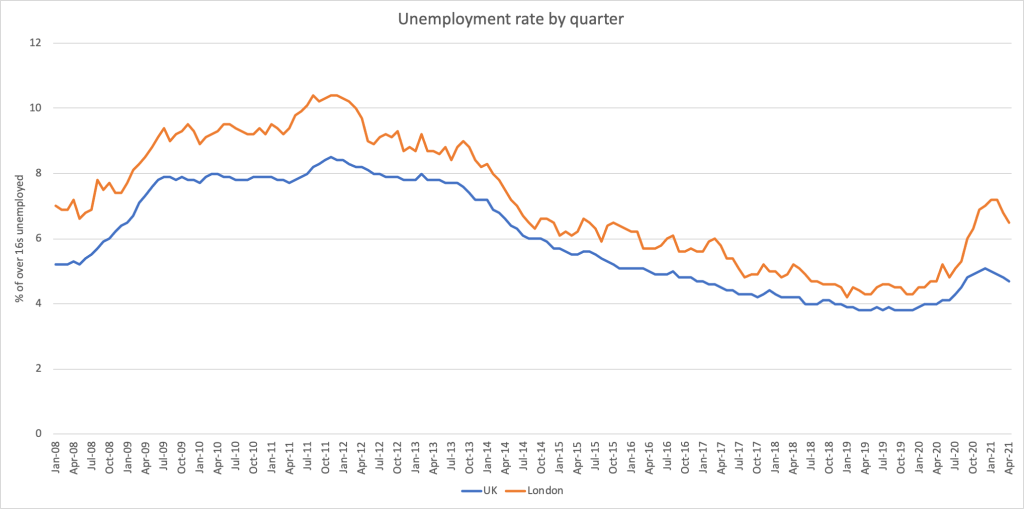
And, according to the latest ONS figures, London’s unemployment rate has also dropped, falling from 7.5 per cent in the three months to January, to 6.5 per cent in the three months to April. Unemployment is still higher than any other region’s, London boroughs still have some of the highest claimant counts and furlough rates in the country, and the economic impact of coronavirus has hit specific demographic groups hardest, but there are glimmers of hope.
So, it’s worth looking back to the last recession and recovery when London has hit hardest but recovered fastest. Could history repeat itself? As the chart below shows, London’s unemployment rate rose sharply ten years ago, and was more than two points higher than the UK’s in mid-2011, but then fell much more quickly, roughly tracking the national rate from 2014. A similar gap opened up last year, but has begun to narrow since January.
Unfortunately for London there were specific features of the 2011/12 recovery that favoured the capital. Quantitative easing, Government’s response to the financial crisis, diverted investment into booming equity and housing markets. And the London 2012 Olympic and Paralympic Games may have had a minimal direct impact on spending (most of the construction was complete by 2012, and Olympic Games years displace normal tourism expenditure), but were a powerful showcase for the UK internationally, and for London in particular.
Added to this, ten years ago, Boris Johnson (then Mayor of London) was keen to make the case for the capital, and able to persuade the Coalition Government that starving London of cash was no way to help the rest of the country, so projects such as Crossrail and the Olympic Park legacy development went ahead.
None of these factors are present today. Rather than being boosted by cheap money, financial services have been sidelined in Brexit negotiations in favour of more picturesque and politically salient (but far less productive) industries like fisheries. Big infrastructure projects, such as the redevelopment of Euston Station for HS2, are being squeezed, hopes of a swift return to international travel are receding, and the narrative of ‘levelling up’ looks pretty hostile to London and its nine million citizens.
At the G7 Summit last weekend, Boris Johnson warned against repeating the mistakes of the ten years ago, when (as he didn’t quite say) austerity extended and deepened the impact of the recession for many people and places. This is right, but the correct lesson is to extend support wherever it is needed to ‘level up’ the prosperity and life chances of citizens and communities, not to stall the UK’s economic engine in pursuit of headlines or electoral advantage.
26 July, 2012 was a warm evening. I arrived to meet a friend at a pub in Brighton, which was hosting its annual visit from the Chanctonbury Ring Morris. As we sat outside, and the dancers whirled, jingled and clacked, I took a photo and tweeted – very drolly I thought – “Beat that, Danny Boyle.”
The next night, by common consent, he did. And how. After a slightly iffy handover in Beijing in 2008, featuring double-decker buses, bowler hats and a bemused-looking Boris Johnson, the London 2012 opening ceremony was a spectacular. It took in Brunel, Blake, Berners-Lee and Beckham; dancing nurses, lesbian kisses, and parachuting monarchs, Shakespeare and smokestacks. A nervous nation breathed a sigh of relief, and began to tell itself that maybe, just maybe, the London Olympic and Paralympic Games would go okay.
Seven years later, the lavish performance is still memorable, a very modern celebration of patriotism and pride, unity and diversity. But its meaning is now freighted with awareness of what followed, of the divisions that were triggered or laid bare by Brexit. We re-watch it through our fingers, like the opening scenes of a film where unsuspecting teens arrive for a party at a beautiful, isolated, cabin in the woods.
For many Remainers the ceremony stands for everything that Brexit threatens to destroy. Writing just after the EU referendum, Frank Cottrell-Boyce (who co-created the event with Boyle) made the contrast explicit: “The nation we saw in the opening ceremony and the nation we saw in the referendum are both real. They’re two parts of diptych. One holds out the possibility of inclusion and ease. The other might be seen as a kind of scream of pain and fury that tells us how it feels to be excluded from that ease.”
Similar sentiments are easily found on Twitter:
“The opening ceremony was the best of our gods, Brexit is the worst of our demons.”
“The optimism, pride and celebration of multiculturalism woven into that marvellous opening ceremony should have been a launchpad. Instead we made it a diving board.”
“On the night before Brexit I will be watching the 2012 London Olympics opening ceremony and wondering what the fuck went wrong…”
For some Leavers, on the other hand, the opening ceremony’s celebratory optimism remains a reminder of Britain’s potential, of what Brexit can recapture if only the nation would re-unite. In the recent words of Liz Truss: “We need to revive the Olympic 2012 spirit – a modern, patriotic, enterprising vision of Britain and we need to use Brexit to achieve that.” In 2016 – a few days after the referendum – Johnson wrote pointedly of the “gloomy predictions that were banished” by London 2012.
But not everyone is convinced. Writing in the Guardian this week, Dawn Foster identified the “false premises” underpinning “centrist thinking”; one was “that the 2012 London Olympic ceremony represented an idyllic high-point of culture and unity in the UK, rather than occurring amid the brutal onslaught of austerity, with food bank use growing and the bedroom tax ruining lives”.
Others have argued that the ceremony’s reprise of a rosy national story fostered a sense of “Britain can make it” nostalgia that stoked anti-EU sentiment. Conversely – and as hinted by Cottrell-Boyce – its inclusive vision has been seen as deepening the resentment of those who felt alienated from the multicultural zeitgeist – a resentment which would later find expression in some Brexit votes.
Certainly the ceremony’s narrative – The internet! The NHS! Britpop! – can sound like a Tony Blair conference speech, but with better dancing and more verbs. And the golden glow of our memories can blind us to what else was happening in the early years of this decade: the first austerity budgets, recession, riots on the streets of London, divisions that were perhaps as deep as they are today but less visible.
But fact that the meaning and significance of a sport festival’s opening ceremony is still so keenly contested is a tribute to its persisting power – as a symbol of what we are losing, as a reminder of what we could be, or simply as a powerful piece of propaganda for a national unity that was always illusory.
In 2016, scheduled “four years on” reflections on the opening ceremony collided with the disruptive shock of the EU referendum result. I suspect we will still be debating both on 24 July next year, as Tokyo 2020 gets underway.
Listening to Alison Munro, chief executive of the High Speed 2 rail project, protesting that costs hadn\’t risen on the radio this morning, I had a faint sense of deja vu. In between assuring us that \”there is no blank cheque\” (which usually means that the numbers involved have too many zeroes to even fit on a cheque), Ms Munro gave a masterclass in the popular sport of capital project obfuscation. Here are some of the most elegant gambits:
\’The previous costs didn\’t give the full picture\’. Who on earth would expect the bill for a railway project to include trains? Or an Olympic budget to include policing costs? Of course these items were always seen as extra, even if not explicitly, so their inclusion does not represent a cost increase. Of course.
\’The increase is in contingency\’. The apparent increase in the budget is therefore the result of prudence, not prodigality. Ministers have wisely allocated additional funding, sometimes squirelled away in departmental budgets, to allow for any cost overruns, whether from unforeseen circumstances, changes in specification or lax cost control.
At the beginning of a project, these contingency allowances are \’very unlikely\’ to be spent. As the project continues, they gradually shift and slide to form part of the budget, below which the project will therefore be delivered. In 2007, the revised Olympic budget of £9.3 billion included more than £2 billion contingency. In 2013, the Government announced that the eventual cost of £8.8 billion was £500 million under budget. (This explains, by the way, why Government is so reluctant to pass this saving to the National Lottery.)
\’The original budget didn\’t include provision for Value Added Tax\’. Some government entities have VAT exemptions; others have to pay VAT but cannot reclaim it like businesses would, as they are not selling goods and services to the public. But surely, you might say, this is just a matter of one government agency adding 20 per cent to costs, so they can pass the money straight back to HM Treasury (who gave them the money in the first place)? Is this a budget change, is it sleight of hand? God (and the Chancellor) only know.
\’The original figures were nominal values\’. Public bodies (and many private bodies too) initially present project costs in the prices that would theoretically have been paid had the whole project been built and paid for in a single year (2011 in the case of HS2) rather than over the actual period of time taken to build it, during which costs would inflate. The use of nominal values helps comparison of different proposals that would be delivered at different times, and revenues should inflate as much as costs do, but outturn costs that are double the nominal costs originally stated nonetheless add to confusion.
The net impact of these manoeuvres is that a project that was originally stated to cost less than £30 billion can rise to £42.6 billion through increases in contingency, add a further £7 billion for trains, and finally grow to £73 billion to take account of VAT and inflation. Each of these changes looks reasonable in itself, but taken together they make it look like Government is playing a game of fiscal Find-the-Lady, where virtually any number can be defined or redefined as the cost of a project. This probably does not do much to boost public confidence in politicians.
A few years ago, I visited one of the poorer districts of Sao Paulo. Not a chaotic favela, but a cluster of housing projects in an isolated location on the edge of town, as grim as a concrete structure can be under the blazing Brazilian sun.
The Paulistanos – architects, urbanists, social scientists etc – who were showing us round explained how areas like this suffered from very weak social capital, with few organisations in place apart from well-organised gangs like PCC. What about the huge buildings by the side of the highway? one of our party asked. Ah, they were just evangelical churches, we were told. There was a brief pause, and then the conversation moved on, avoiding any further mention of what are clearly some of the most powerful players in Brazil\’s civil society.
I remembered this a couple of days ago when I read, in Zoe Williams\’ comment piece in the Guardian, that London Citizens had been one of the few success stories in the Government\’s dismal Work Programme, getting 1,500 people into work. I have had dealings with London Citizens over the years; they are an effective community organising and campaigning organisation, which has been assiduous in securing solid commitments from local authoirities and other public bodies, by offering public adulation or denunciation.
But you\’d have to look reasonably closely at London Citizens\’ website to see that this is a group with deep roots in the churches and mosques of London. My first meetings with the group, almost ten years ago now, tended to involve an Muslim imam or two as well as a multi-denominational smorgasbord of Christian ministers (though one of my colleagues remarked sotto voce as their list of demands were read out, \”They\’re not priests, they\’re fucking Trotskyites\”).
These religious roots are politely ignored on all sides, not only because the unified front would fracture if theological matters were brought to the surface. There is a faint feeling of embarassement among secular middle class liberals (like those sitting the other side of the table in City Hall) when dealing with religion. The awkwardness increases when the religious belief is manifested fervently, as a central plank of identity, rather than as a private hobby that goes unmentioned in polite company.
But travel on any tube in east London, and you quite quickly see people (usually poorer, ethnic minority people) poring over their copies of the Qu\’ran, Bible or other religious text. And the big razzle dazzle evangelical churches (some, like UCKG, imported from Brazil) can pack out auditoria every weekend. So I\’m not surprised that London Citiens succeeded where private contractors have failed: they are reported to have preached the scheme in church and mosque and to have intervened directly (dressing unemployed people up, and driving them to job interviews).
However unsavoury some of their teachings to liberal ears, these \’faith communities\’ still seem to be able to touch the parts of society that the best-intentioned outreach programmes fail to get anywhere near. It seems perverse to ignore them, then to talk of \’hard to reach communities\’.
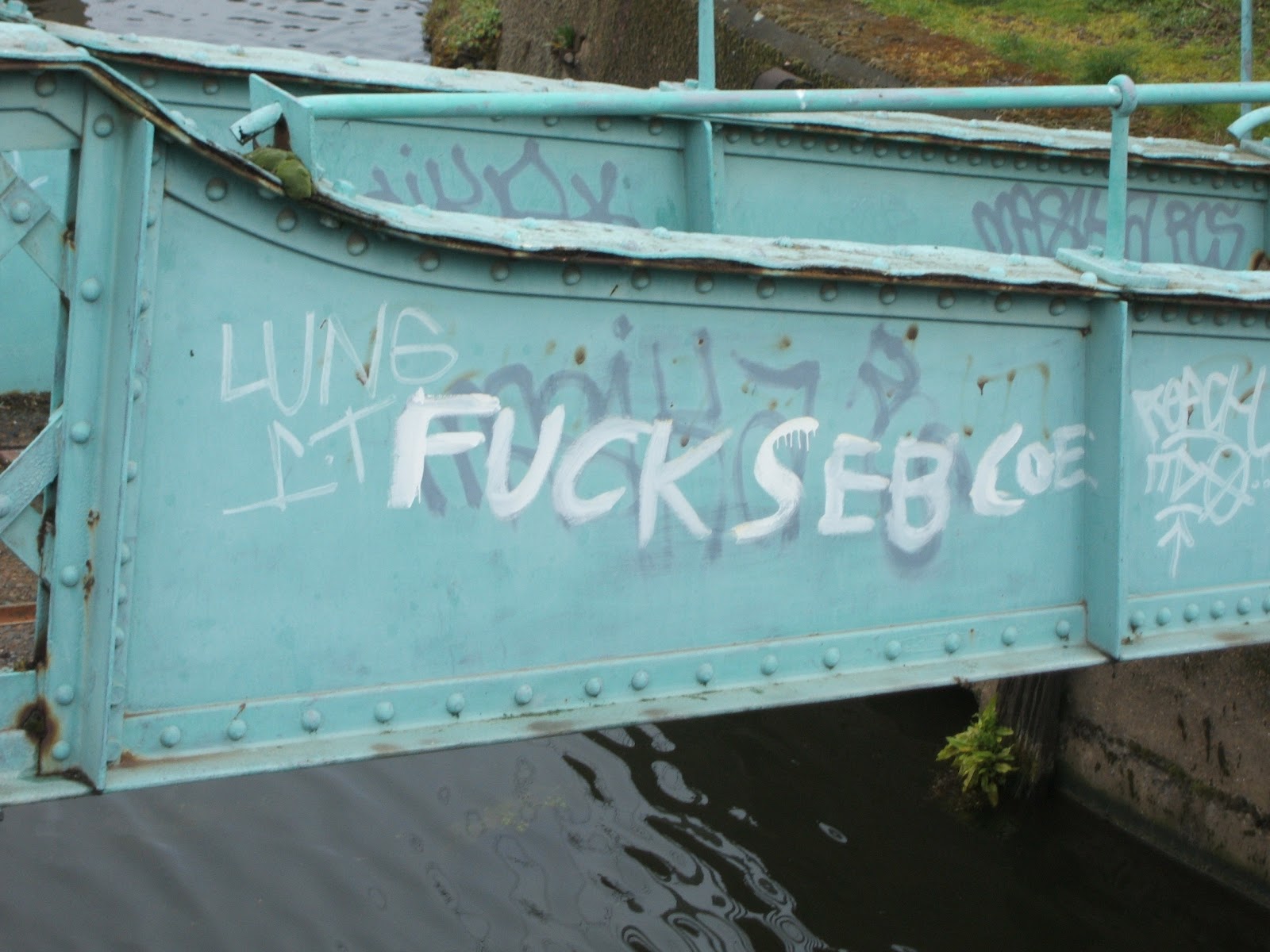
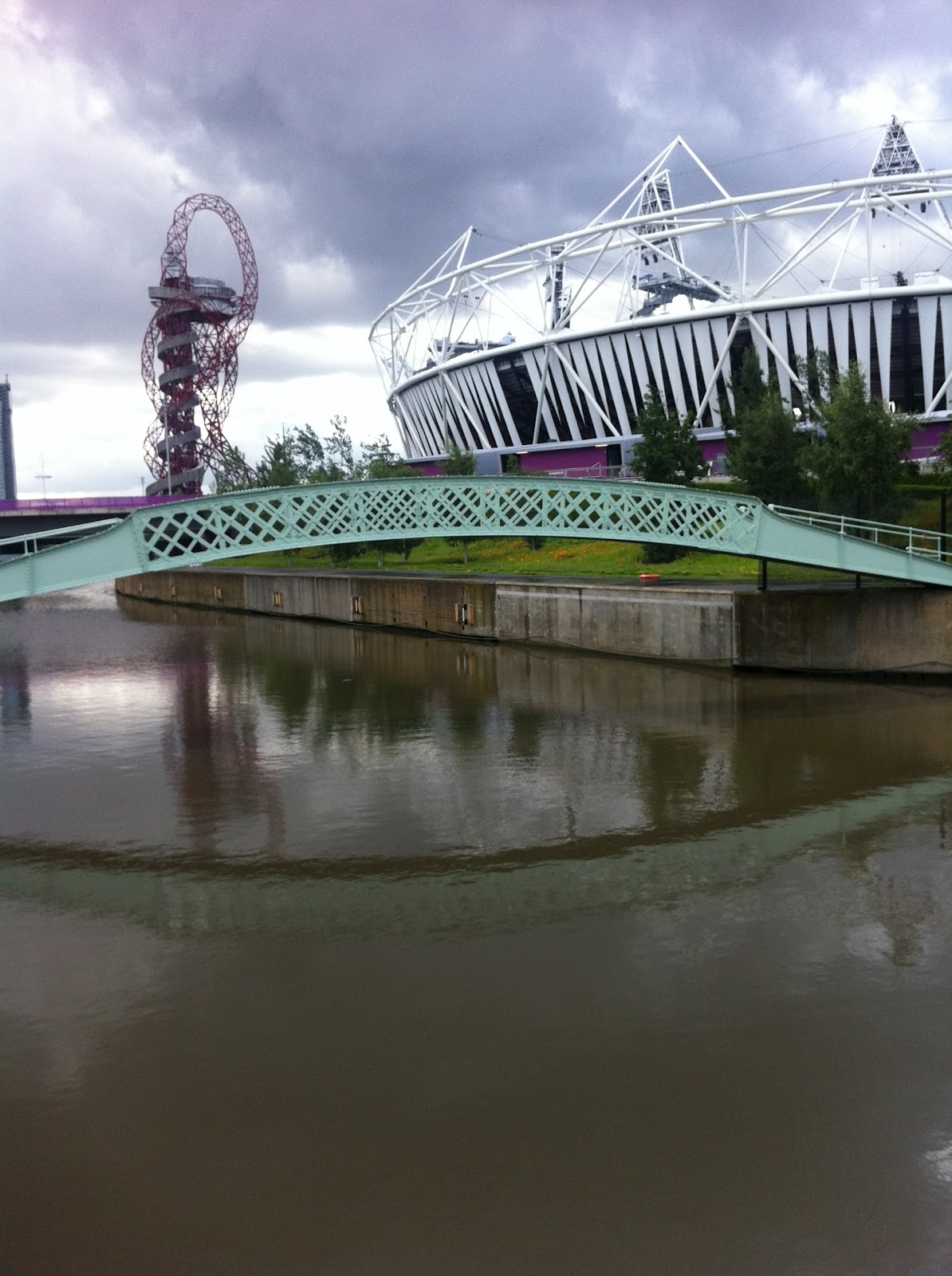
As I walked along the river bank past the bright flower beds, it was the pale green bridge that provoked a dizzy rush of rememberance, more flashback than madeleine. The bridge had been there in 2006, when we passed by on an Easter weekend walk up the Lee Navigation. Just past the \’Big Breakfast House\’ at Old Ford Lock, opposite blank-sided factories, a tributary ran down to a small green bridge, overgrown and inaccessible, on which someone had scrawled \’Fuck Seb Coe\’, in futile protest against the approaching Olympic juggernaut.
Seeing the bridge again, now cleansed of its off-message graffiti, made me remember how much had changed. Around this solitary remnant of the pre-Olympic Startford Marsh, hoardings had been erected and replaced by fences, now patrolled by soldiers on cycles. The waterways beneath it had been cleaned of their colonies of invasive crabs and knotweed. The roads that had woven between bus garages, factories, print works, fridge mountains, car breakers yards and evangelical churches had been uprooted, and the land levelled, creating a moonscape occupied by giant yellow construction vehicles, their manufacturers\’ logos obscured to satisfy the strictures of Olympic sponsors. On this boundless and bare terrain, sites had been pegged out, their labels (Handball Arena, Stadium) looking like an optimistic child\’s fantasy of a construction site.
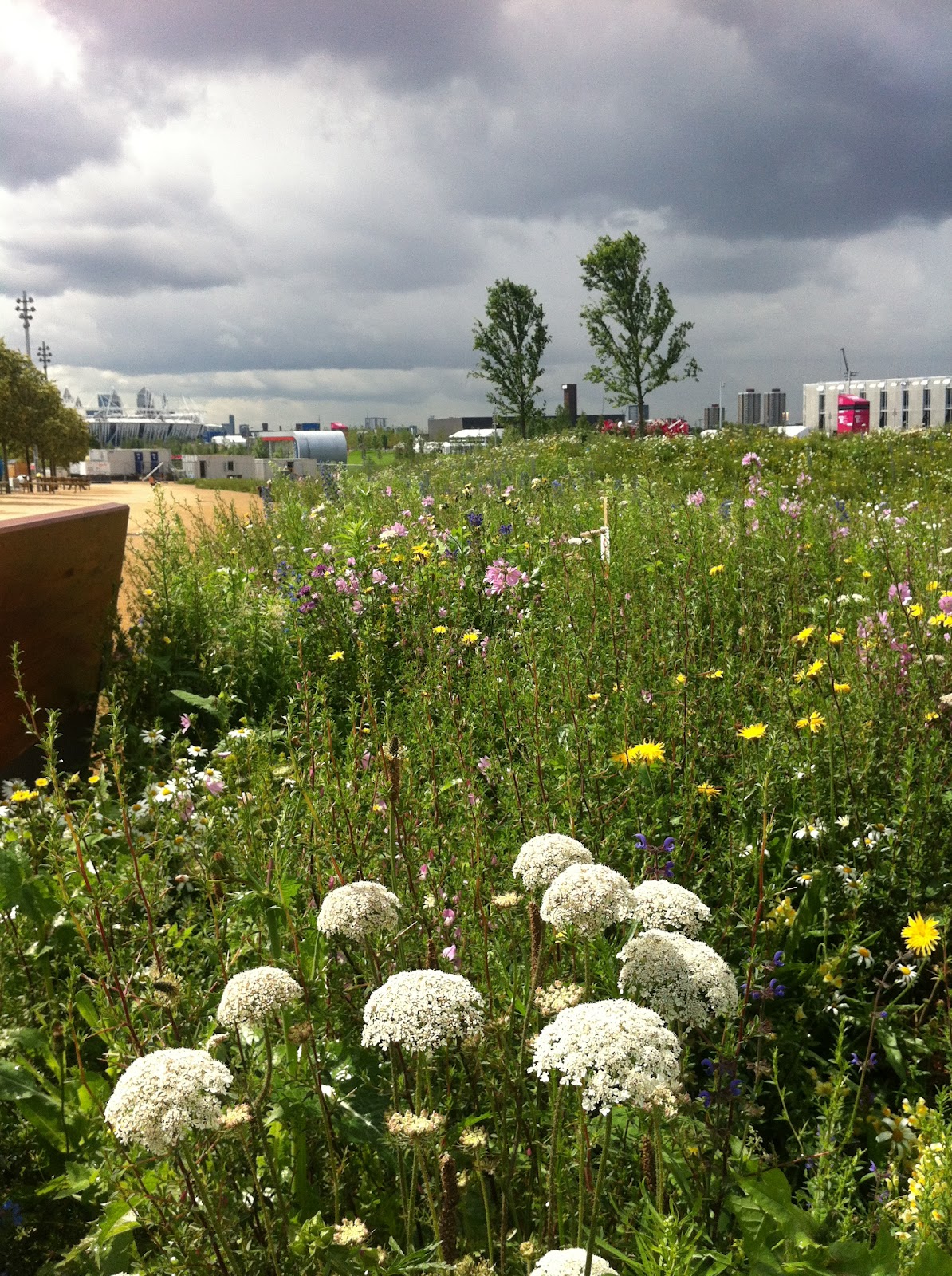
But the fantasy had quickly become real: earth had been cleaned and moved, piles were sunk, and slowly the uncanny structures of the Olympic Park venues had emerged from the mud. Now, days before the opening ceremony, I had the chance to walk again across the site, without hard hat or steel-toecapped boots, past venues familiar from countless bus tours. What is amazing, and delightful, is the verdant landscape.
Between the hard angular shapes of the venues, and the wide walkways and concourses, great banks of flowers have erupted: Ox-eye Daisy, Purple Loostrife, Ragged Robin, Cornflower, Corn Marigold, Star of The Veldt, Pot Marigold, Tickseed, Red-hot Pokers, to name a few identified on the website of Nigel Dunnett, consultant horticulturalist.
The flowers and lush green lawns – well-watered in our rainy season – soften the hard spaces of the Park, creating a genuinely beautiful landscape. It\’s idyllic, but slightly ersatz, in stark contrast to the gritty pictures of Stratford that the Daily Mail delights in publishing.
The title of this blog post refers to a Talking Heads\’ song, a satire on arcadian nostalgia, which I couldn\’t get out of my head as I wandered round:
\”There was a factory; now there are mountains and rivers…there was a shopping mall; now it\’s all covered with flowers…once there were parking lots, now it\’s a peaceful oasis; this was a Pizza Hut, now it\’s all covered with daises.\”
Nostalgia for the grubby Lower Lea Valley of six years ago is tempting, but would be foolish. The area was dirty, inaccessible and polluted, even though it hid secret jewels of natural beauty between car breakers, fridge mountains and other post-industrial drek. What has replaced it is extraordinary, alien even. Perhaps that is what makes for an uneasy feeling; this lurching contrast with the world \’outside\’.
After the Games, and the remodelling and construction work that follows, London Legacy Development Corporation (who I work for) hopes that the Olympic Park will be a jewel in east London, and a force for change in one of the poorest areas of London. But perhaps the traffic needs to be two-way, so that east London can also return to the Park, stretching to embrace it like tendrils of ivy, and blending the everyday and the extraordinary.
David Runciman\’s talk on the politics of three London Olympic Games at Queen Mary College last week was amusing and enlightening. In 1908, Anglo-American relations became strained – the English felt the American\’s habit of training was unsporting – and the organisers kept the prices high to deter dangerous crowds of the wrong sort of spectator.
In 1948, the tone was one of austerity (athletes had to hire towels if they didn\’t bring their own) and restraint. The malnourished English took a perverse pride in the fact that the national anthem was only heard five times (opening and closing ceremonies, and three gold medals), compared to Berlin in 1936, where Deutschland Uber Alles and Horst Wessel had rung out continuously.
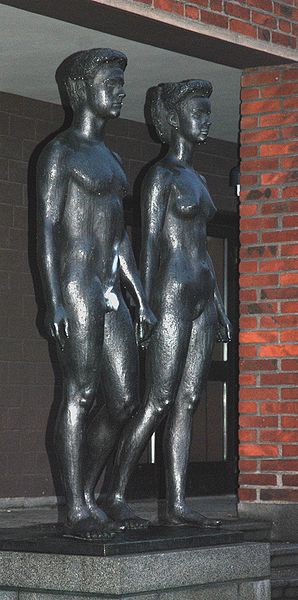
The 1948 Olympics were also the last Games where medals were awarded for artistic endeavour. The quality of entries was mixed, to put it politely: no medals were awarded for music, and the sculpture that won gold was a heroically anodyne piece by Gustav Nordahl called Homage to Life (photo, right, Bengt Oberger).
Runciman compared this inoffensive couple to the heroically striving ubermenschen whose representations triumphed in Berlin in 1936. A retreat to the bland was understandable if not inevitable given the horrors of the previous 12 years. Together with an irreparable fracturing of consensus on what constitutes \’good\’ art, nervousness about the appropriation of sporting iconography by fascists signalled the end of art as a competitive Olympic activity.
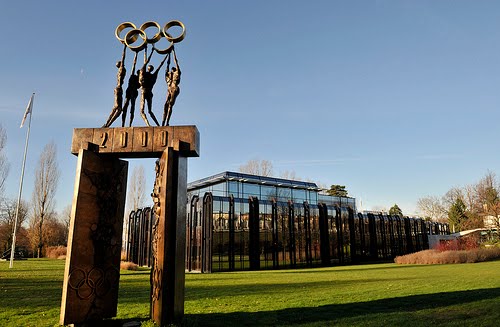
Even today, sport-inspired art tends either to the heroic or the apologetic, to the apotheosis of man and the spirit of \’36, or to mushy statements of universal brotherhood (see Invictus, though I doubt I will). The International Olympic Committee headquarters in Lausanne manages to combine both (photo, above left, IOC/Juillart). Leni Riefenstahl casts a long shadow.




 Richard Brown