Boomer Boom Bang-a-Bang

London’s population reached a historic high of 8,945,300 in the middle of last year, according to new estimates released by the Office for National Statistics. After slower growth at the end of the 2010s and a slight decline between 2019 and 2021, the number of people living in the city rose by 0.9 per cent – around 75,000 – between 2022 and 2023, the fastest growth rate since 2015-16.

Does this suggest that London has escaped the twin shadows of the Covid-19 pandemic and Brexit and is returning to its turbo-charged growth of the late 2000s and early 2010s? Well, maybe and up to a point.

Certainly, the capital has defied some of the more apocalyptic predictions that emerged during lockdown – of the age of cities stuttering out in an “urban doom loop”. But it is still growing more slowly than other UK regions and metropolitan areas, most of which grew by one per cent or more in 2022-23. London’s growth rate is in fact more like what other regions were experiencing ten years ago, when the capital’s population was surging by 100,000 or more every year – a growth rate of up to 1.4 per cent.

London is also growing a bit more slowly than experts forecast. The mid-2023 estimate is very slightly lower than that of the most cautious Greater London Authority (GLA) population projection, which was based on the 2021 Census and projecting forward the slower growth trends from 2017-21.

Borough patterns suggest a mixture of recovery and longer-term trends. In some places, the return to growth looks like a post-pandemic rebound. This is most notable in Camden, which saw one of the steepest declines in population at the beginning of the pandemic but has now more than recovered, with 2.9 per cent population growth between 2020 and 2023.

But there appear to be broader trends operating too. Hillingdon, Tower Hamlets and Newham have each shown persistent growth, adding at least four per cent to their populations between 2020 and 2023. On the other side of the equation, Lambeth, Lewisham, Haringey and Waltham Forest all have populations that remain two to three per cent below their pre-pandemic levels.

Even if London’s growth has slowed, its population dynamics remain distinct from those of other parts of England and Wales. The capital continues to see much higher international inward migration (around 154,000 in the year to mid-2023) and domestic outward migration (130,000 in the same year) than other regions.

The capital’s population is also buoyed by natural change – the surplus of births over deaths – which accounts for growth of 50,000 in the year to mid-2023. Meanwhile, across England and Wales this has dwindled to nothing or gone into reverse, with as many people dying as being born for the first time in 42 years.

London is still younger than average (both a factor in and a result of its natural growth rate): its median age is 35.9, compared to 40 or older in every other region in England and Wales. The age groups that have seen the fastest growth since the pandemic abated (2021) are people in their twenties and in their sixties. However, longer-term (since 2011) the twenty-something population has declined, and the fastest growth has been among Londoners in their fifties and sixties – maybe those who lucked out by buying property in the 1980s and 1990s.

International comparisons suggest that London is not alone in its population growth patterns. Slow recovery is the norm following Covid, and other large northern hemisphere cities were already seeing a slowdown before 2020. US Census Bureau estimates suggest that in 2023 New York City’s population was still six per cent below its April 2020 total, though population loss is slowing. Paris has also seen a long-term decline, largely as a result of falling birth rates, which accelerated during the pandemic.

Cities have not gone away, but their slow recovery perhaps reflects the unexpected “stickiness” of changes in working habits and a sedate return to international migration patterns. If that is so, London’s slow growth may just be a delayed bounce-back. Comparisons with the GLA projections suggest this might be the case: those projections modelled growth slowing in 2022-23, whereas in fact it speeded up.

It may also be that growth is constrained as the cost of living in the capital remains sky-high and London struggles to meet the London Plan’s housebuilding targets, let alone the more ambitious goals suggested by the last government and think tanks such as Centre for London.

This should be a cause for guarded optimism. If policy and delivery are constraining growth we can turn that round, adopting the “Get Britain Building” mantra of the new government. London can build its way back to sustainable growth as a liveable and exciting destination for UK citizens and international visitors – provided of course that other measures, such as arbitrary immigration restrictions, do not stifle the UK’s world city.

First published by @OnLondon.

Talking to the taxman about demographics

Recent figures suggest that London may already be bouncing back from the twin shocks of Brexit and the pandemic. The figures, based on pay-as-you-earn (PAYE) tax data, suggest that the number of working people living in London increased by just over three per cent between December 2019 and December 2022, an increase of around 138,000.

Tagged as “experimental statistics” by the Office for National Statistics (ONS), they count the “payroll population” – that is, the number of people on payroll, including those on furlough or sick leave, based on their home address. Therefore, they do not show the number of jobs in London (some of these people will commute out, while others commute in) nor do they show the whole population (they exclude self-employed people and people who are not working for whatever reason).

All that said, they provide another strong indication that whatever population exodus London saw during the first year of the pandemic has since gone into reverse. The chart below shows the trajectory of this change. March 2021, the month of the 2021 Census, is at the lowest point of the dip.

Screenshot 2023 04 18 at 19.56.13

The composition of London’s payroll population has changed over this period, reflecting the implementation of Brexit in 2020 and new immigration rules in 2021. London’s EU worker population has shrunk by about ten per cent (80,000 people), while its non-EU worker population grew by around 20 per cent (150,000 people). The UK national workforce fell by about five per cent during the pandemic, and is now two per cent higher than it was in late 2019. The chart below shows how the three populations have changed.

Screenshot 2023 04 18 at 19.58.48

The rest of England also saw growth in its non-EU workforce. Though this growth was largest in numerical terms in London, the proportionate increase in North East and North West England was much sharper: the number of non-EU workers living in these regions increased by 65 and 47 per cent respectively (and the number of EU workers fell less). This largely accounts for faster payroll population growth rates in these regions, as shown in the chart below. London’s growth is just above the English average, but higher than its southern neighbours’.

Screenshot 2023 04 18 at 20.02.25

At the moment, the rise in the number of workers from outside the EU has been spread across the country, reflecting the fact that growth has been sharpest in “nationwide” sectors such as health, construction and transport. As the economy recovers, that trend may continue or else immigration will become more concentrated in London (as suggested in a previous article).

What does this tell us? Despite their limitations, these ONS figures suggest that London has begun to adapt to and recover from the double whammy of the pandemic and Brexit. And they confirm the need for caution urged by the Greater London Authority and others over using the Census figures to argue against investing the capital’s services – 2021 was a very odd year.

First published by OnLondon

Baby bust and boomer boom – first thoughts on the 2021 census

The 2021 census, conducted in March last year, will forever be a strange record of a strange time – hard to interpret but fascinating for what it doesn’t tell us as much as for what it does. The first results, covering broad population figures, came out in June, and further detail will emerge in the coming months and years, with more expected in the autumn.

The census was already the subject of intense political debate because, as On London has reported, census figures underpin funding formulas for everything from schools to fire services. Undercounting London’s population may rob our public services of resources even as the cost of living crisis deepens.

Past censuses have been criticised for missing many Londoners, for example undocumented migrants who may be unwilling or unable to complete official forms. In 2021 there was the added impact of the pandemic: city-flighters, students stuck at home, hopeful immigrants and emigrants stymied by travel restrictions.

So we should be cautious when looking at London’s census results. But what do they tell us about how London is changing – from cradle to care home – compared to the rest of the country and compared to previous decades?

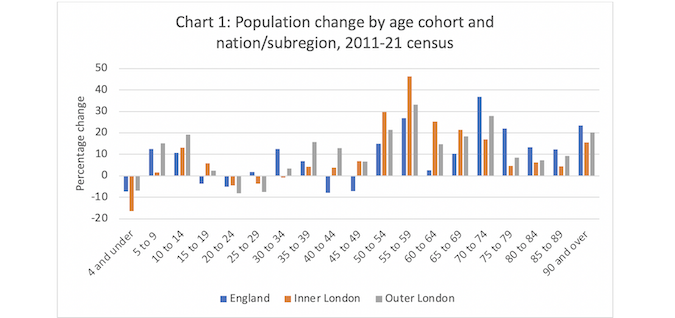
The two charts below summarise the numbers. The first compares the 2011-21 population changes for inner London, outer London and for England as a whole.

Screenshot 2022 08 16 at 19.03.09

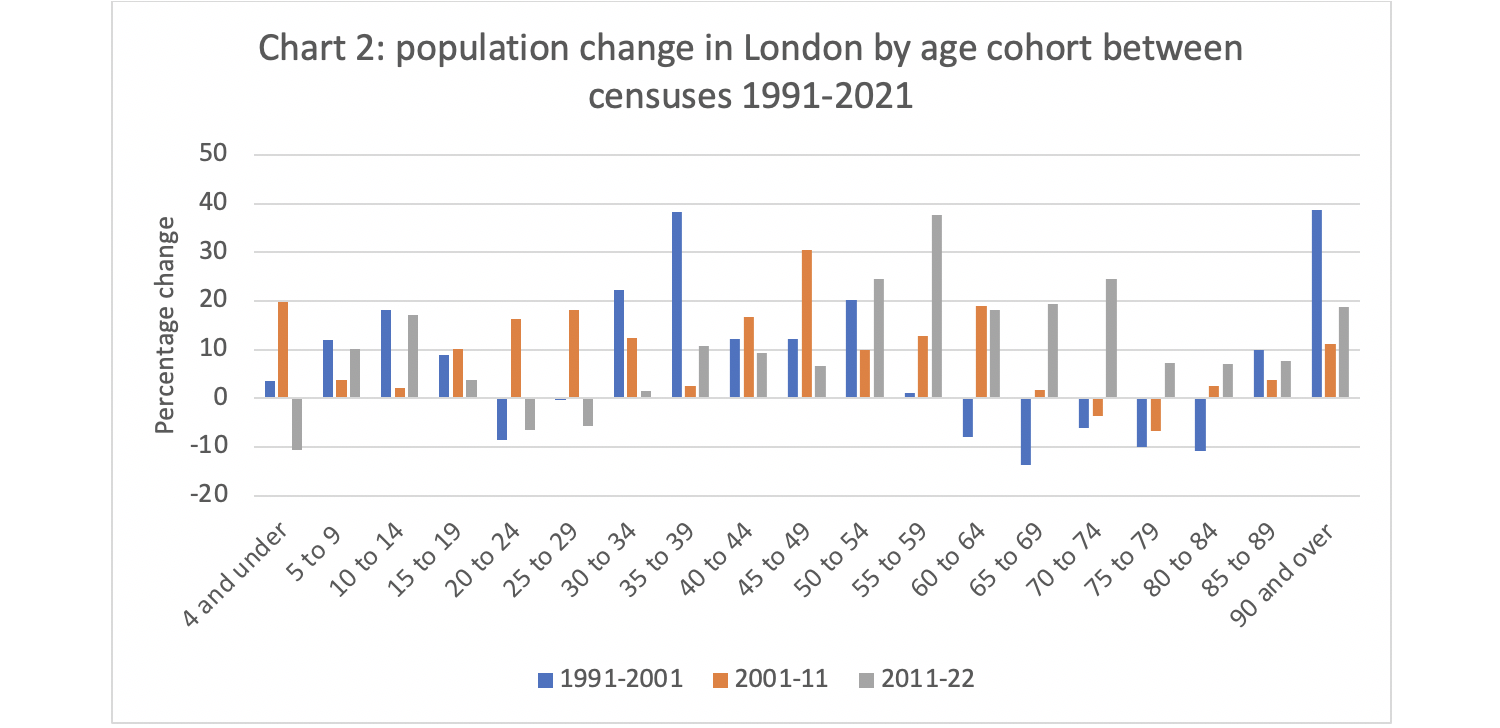
The second puts these changes in context by comparing the last decade in London with the findings for the capital of the previous two censuses.

Screenshot 2022 08 16 at 19.05.34

Here are five conclusions that can be drawn.

One: Baby boom and bust spells turbulence for education authorities

London had a baby boom between 2001 and 2011, adding more than 100,000 under-fives (a 24% rise in the age cohort). This was reversed in 2011-21, with the numbers of under-fives dropping particularly fast – by 16% in inner London.

Some of this change may be the result of young families moving out temporarily during the pandemic but, as  Greater London Authority demographers have explored, the birth rate more or less peaked around the time Boris Johnson started boasting of a London 2012 conception bonanza and has fallen back since then.

This makes planning school places fiendishly complicated: while demand for primary places fell in most of inner London, the outer H-boroughs (Harrow, Hillingdon and Hounslow) saw some of England’s highest growth rates for primary age children. And as the 2000s baby boom fed through, the secondary school cohort has grown much faster: Barking & Dagenham’s 10-to-14-year-old numbers grew by 43%, the fastest in England, with Hounslow, Richmond and Tower Hamlets close behind.

Two: London’s loss of young people was rural counties’ gain – at least temporarily

Between 2001 and 2011, 15 to 30-year-olds accounted for a net growth of around 300,000 people (around a third of London’s total net growth), reflecting the city’s magnetic pull for young people seeking to study, work or simply enjoy their lives. This contrasts with the overall stagnation in that population group in the previous census period spanning 1991 and 2001 and what looks like an almost comical reversal of the early century trend between 2011 and 2021. Rather than flocking to London, twenty-somethings seem to have headed down some deep country roads. For example, Test Valley, East Devon, Maldon and Harborough have seen the biggest rises in their numbers of 25 to 29-year-olds.

Some of this probably does reflect long-term relocation to new hipster heartlands of the West Country and the Kent and Sussex coasts, driven by soaring London rents and the ever-wider availability of flat whites. But I suspect that much more of this apparent exodus has already reversed, as young people who moved back to parental homes during the pandemic or began their university studies online have returned to larger towns and cities. The GLA’s helpful guide to the census uses payroll data to show just how many early-twenties workers left the capital during the pandemic and came back in autumn 2021.

Three: London’s boomers are booming

London’s middle-aged population (yes, including “Gen X”-types as well as “Boomers”) has soared, seeing some of the highest growth rates in England. The number of 55 to 59-year-olds in inner London grew by more than 45%, including by around 60% in Southwark, Lewisham and Lambeth. This contrasts sharply with England as a whole, where this age group grew by a more modest 27%. The London growth is also much faster than in previous decades: the 55 to 59-year-old population increased by 13% between 2001 and 2011, and by a negligible 1% the previous decade.

Some of this probably has its roots in London’s rapid growth of 35 to 39-year-olds in the 1990s, though of course there will have been plenty of churn between the census years. But it is interesting to consider why this generation may have chosen to stay in the city – and in inner London in particular – a rather than moving to the suburbs or a Home Counties village.

This was a generation that was able to benefit from relatively low house prices in the early 1990s following the property crash at the start of the decade. As mortgages are paid off, properties that were bought for tens of thousands of pounds are now valued at ten times as much. At the same time, since the pandemic, there has been a nationwide fall in the number of over 50s in the labour market.

It’s too early to join the dots convincingly between these trends – to say confidently why the numbers of middle-aged people have risen so fast in inner London boroughs. But we can speculate. Is this a “boomer belt” of reasonably well-off homeowners? People who may have stopped working and don’t feel the same financial pressures as younger Londoners in precarious housing, some of whom don’t see any great urgency in building more houses in established neighbourhoods? Interestingly, Brighton and Hove, which has similarly high housing demand and constrained supply, has seen a very similar demographic shift over the past decade.

Such stability makes for liveable neighbourhoods and lively local shops, cafes and restaurants. But at what price? If high prices and low supply squeeze younger and poorer people out of the inner city neighbourhoods, or even block them from moving there in the first place, stability may be at the cost of vitality and – in the longer term – economic productivity.

Four: London is ageing, even though not as fast as we thought

If London’s boomers stay in the city we will also see a big bulge in the older population when we come to review the 2031 census. Over the past ten years, London’s sixtysomething population has grown a lot faster than the English average. Among the over 70s, growth has been slower, though boroughs such as Waltham Forest and Redbridge have been closer to the national average.

As the GLA predicted, the census figures showed that previous estimates had over-done the size of London’s elderly population. However, growth is coming, and as today’s 60-year olds enter their seventies around the time of the next census, there will be a corresponding growth in demand for health and care services, making their currently dysfunctional funding and management an ever more urgent issue for London. It will also bring into sharp focus the issues of specialist housing for older people that were explored by my former Centre for London colleagues last year.

Five: Something was happening in 2021, but we don’t yet know what it is

The pandemic was probably more disruptive for London than any event since the Second World War (when no census took place). While its impacts were not as cataclysmic for city living as some predicted, we still don’t know what the long-term effects will be on working patterns or on how and where people choose to live. Nor do we know how new immigration arrangements, political change and the looming recession will affect the capital.

There may be a case for a mid-term census in 2026, as suggested by economic geographer Danny Dorling. But London will undoubtedly need to draw on data from the latest census and beyond to understand the city, who it is working for, and how it is changing.

First published by OnLondon.

Against declinism

Jointly with Mark Kleinman

[First published on Kings College London blog (also at Centre for London blog and OnLondon, w/e 24 January 2021]

London enters 2021 in a very different mood, not just to last year, but to much of the zeitgeist of the last 30. There were fireworks on the Thames on new year’s eve, but no crowds were watching in the streets and parks. The mood of the impressive light and sound show was one of resilience and solidarity, rather than unbridled confidence. As with the opening ceremony for the 2012 London Olympic Games, praise for the National Health Service took a central role, but the tone was less celebratory than seriously grateful.

London has suffered badly, both from the health and the economic impacts of the pandemic, as can be seen in The London Intelligence Economic Tracker. As we write, the NHS in London and throughout the UK is again straining under pressure. The emerging labour market evidence shows a particularly severe downturn in London. The Greater London Authority (GLA) Economics team report that the number of workforce jobs fell 3.8% (229,000) in the capital between March and September – a far greater fall than for the UK as a whole, at 1.8%. They go on to say that while in the earlier stages of the pandemic, there were only modest changes in headline labour market statistics relative to the large falls in activity, this has changed more recently, with large movements in London’s unemployment rate. In the three months to October, the unemployment rate rose a record 1.2 percentage points to 6.3% in London – the largest quarterly rise since the series began in 1992. Only the North East region has a higher current unemployment rate than London, at 6.6%.

As we hobble through the next few months, bigger questions are being asked about the future of cities and of London in particular. Will the “urban age” of big cities leading global trade and growth return? Or does the future lie in more dispersed and fractured economic activity, as globalisation falters, global travel slows and/or the benefits of agglomeration are outweighed by the convenience and safety of working from home?

The debate has been growing in recent years about whether we have reached “peak London”, whether the city’s phoenix-like recovery from post-war deconcentration and urban flight has run out of steam. Like waves of pandemic infections, the turning point of cities’ fortunes are more easily visible after the event: nobody really expected London to start growing again in the mid-1980s.

Population growth has been slowing in London over the past three years. Moreover, recent analysis of Labour Force Survey data by Michael O’Connor and Jonathan Portes suggests that London’s population could have fallen during the pandemic by as much as 700,000 – a huge turnround. And consultants PwC recently forecast a 300,000 person decline by the end of 2021. These are only estimates and projections, and of course much of this change might be temporary. Will 2020 prove to be a blip, reflecting the extraordinary circumstances of the pandemic, or will it be another inflection point like 1987?

The latest demographic projections issued by the GLA in November 2020 forecast a return to growth – though at a slower rate than the past decade, when London’s population grew by almost 90,000 every year. Their “central projections” anticipate growth of around 50-70,000 people per year instead, with the next two years at the lower end of this scale. This would lead to a potential population of around 11 million by 2050 (compared to just under 9 million in 2019).

Population growth is driven by two factors: migration and natural increase. In the year to mid-2019, London’s population was estimated to have increased by 54,000. This consisted of net of 77,000 people to London from overseas, net movement of 94,000 people from London to the rest of the UK, and a net increase of 71,000 people from the balance of births and deaths.

The GLA’s central projection assumes that international migration will be suppressed for the period to 2022, but will then bounce back to average 95,000 (net) every year. The GLA’s expert panel felt that on balance, future reductions in migration are more likely than increases. However, they advised against discounting the possibility of higher levels of international migration, pointing to the resilience of international migration; the possibility that new immigration rules may result in foreign nationals settling in London for longer, and potential reductions in emigration rates of UK nationals in post-Brexit Europe.. The projections also suggest that net domestic migration to the rest of the UK will return to around 100,000 per year by 2030. So most of the projected growth will be fuelled by resurgent natural change (births minus deaths), which has fallen since 2010 but is forecast to stabilise at around 60,000 per year. London will continue to see a rapid churn in population, but its growth will be fuelled from within.

Similarly, the GLA project continued economic growth over the longer term. Their economic projections anticipate contraction and jobs losses in 2021, followed by recovery in 2022, with economic output (GVA) exceeding the 2019 peak by 2022, and the number of jobs in 2022 just reaching the peak of three years earlier. Beyond that, the implication of GLA and other forecasters’ cyclical and trend analyses is for the London economy to resume previous levels of growth, both in output, and perhaps to a slightly lesser extent, employment.

How credible is this? London’s position as a leading global city has taken a hit from Brexit and the UK’s management of coronavirus, but the city is still in a potentially strong position, with strengths in tech, green innovation, financial and business services, education, arts and culture. London needs to remain open and inviting, through immigration policy but also through nurturing and restoring its wounded cultural and hospitality sectors – the “soft power” foundations of its global appeal. The UK as a whole will continue to need London, as a driver of economic growth, for its fiscal contribution and as its gateway to the world. Brexit, and the UK’s potential isolation outside the major trading and economic blocs, makes London’s role more rather than less important.

How much does the government understand this, and will it commit to the infrastructure and other support needed for London to continue to grow? The signals are mixed: national planning policy is now focused on concentrating growth in cities, and the government’s latest algorithm envisages London building more than 90,000 homes every year – many more than the Mayor’s London Plan proposes, the GLA’s projections would imply, or that London is actually building at the moment.

Given this expectation, and the economic importance of London and South East, you would expect the government to want to invest in the capital’s infrastructure. But worryingly, in the National Infrastructure Review last November, the government suspended support for Crossrail 2, the next phase of major transport infrastructure investment in London, beyond safeguarding work. As Alex Jan has commented, Crossrail 2 is “pretty integral” to the London Plan, though all major infrastructure projects have their ups and downs – Crossrail 1 was first mooted in the 1970s, with roots in the Abercrombie Plan of 1944. Government commitment to “levelling up” regional imbalances in the UK is welcome, but this should not happen by starving the capital of much-needed public investment.

We will not know for some time whether short-term population and economic decline are temporary diversions or longer-term redirections of London’s future. We do not know whether 700,000 people really have left London over the last year, or whether and how quickly they may come back. And we do not known how far recovery from the crisis could see some rebalancing of activity within London and the wider South East. We know, in short, that there are still a lot of unknowns.

But public policy should shape the future rather than just responding to it (a core proposition of Centre for London’s London Futures programme), and governments should be wary of drawing conclusions about long-term trends from short-term disruptions. London’s potential for growth should be nurtured so that the city can work better for all its current citizens, as well as the two million more who could arrive in the next 30 years, and so that the capital can support recovery across the UK.