London’s nightlife has been taking a pasting: a recent (not very scientific) survey suggested that the city has the worst nightlife in the UK; pubs and clubs are being closed down, their numbers falling by eight and 30 per cent respectively since 2010 according to UK business counts; industry bodies say that London is losing nightlife faster than other regions; and social media reports frequently bewail empty pubs, dead streets and early closing times.
What is to blame for this thinning out? There is a grim alignment of factors: changing drinking habits, higher prices and constrained wages, staff shortages following Brexit, changed working and commuting patterns following the pandemic, cautious licensing authorities and the rise in take-away (or delivery) culture.
Some critics point the finger at Amy Lamé (pictured, front left), the Night Czar appointed by Sadiq Khan in 2016. How, they ask, can her six-figure salary can be justified when London’s nightlife is crumbling? More recently, Conservative mayoral candidate Susan Hall has weighed in, presenting Lamé’s appointment as symptomatic of Khan’s “chumocracy” approach to administration and promising to bring in “real experts committed to reviving our city’s night economy” if she is elected.
Lamé has mounted a vigorous defence of her record, both in keeping venues open and making nightlife safer for all. And I don’t think it is fair to blame her every time the shutters roll down on another London venue (full disclosure: I don’t really know Lamé, but I did spend many 1990s Saturday nights at Duckie, the arty club night she co-founded). But there is a deeper problem too: neither she nor Khan have access to the levers that can keep venues open or close them.
This seems strange, given the wide-ranging remit of London’s Mayors. Nightlife is an essential part of a city’s economy and culture, but licensing late night entertainment and hospitality remains a local authority function.
Licenses are granted by the 33 local authorities in London and governed by central government policy objectives focused on preventing crime, nuisance and negative impacts on children or public health rather than on fostering cultural or economic vitality.
Furthermore, substantial areas of central London are subject to “cumulative impact” policies, which restrict the opening of new premises and extensions of opening hours in order to minimise strains on local infrastructure and the risks of disorder.
The deck is stacked against the hospitality industry. Some boroughs, such as Camden, have sought to relax policies in response to headwinds that have battered the sector since the pandemic, though this has been controversial. In many other cases, restrictions either haven’t been reviewed since 2020 or have been reaffirmed. At the heart of the issue is a balancing act. How does licensing weigh the concerns of local residents, who vote, against the interests of local businesses and visitors, who don’t, and the representations made by the police, who are in the front line when things go wrong?
There’s a similar challenge in town planning – balancing local community interests and the strategic needs of the city. This is why the Mayor was given powers to set policies on issues such as density and use mix, and to intervene in significant cases where local decisions might undermine those policies. Indeed, Khan has already used his planning powers to support London’s nightlife through the “agent of change principle”, which makes developers rather than pre-existing entertainment venues responsible for sound insulation and other mitigation measures.
Should London’s Mayors, who already have oversight of the capital’s police force, take a greater role in licensing, setting a framework for local decisions and perhaps intervening where there is a strategic case for doing so? Giving them more power in this area could take the heat out of local debates and allow for a more consistent and strategic approach to the capital’s night-time economy.
Such an extension of mayoral power might be restricted to central London, where nightlife serves capital city and world city functions, as well as the needs of local communities. Again, there’s a read-across to town planning: the Mayor already has an enhanced planning role in the Central Activities Zone, though interestingly many of London’s nightlife hotspots are distributed around its fringe.
All that said, licensing is difficult. I’m not sure whether the current Mayor or his successors would welcome responsibility for decisions that almost invariably annoy someone. But if we want London to be a successful, liveable and thriving 24-hour city, intelligent licensing has a vital part to play.
Russell Curtis, architect, On London contributor and one-man spatial think tank, published a new paper, Towards a Suburban Renaissance, on his blog last week. Reflecting on their generally low and static densities, Curtis argues that London’s suburbs could accommodate many more homes near stations, by gentle densification of existing residential streets – an upwards extension here, a replacement of a house with a low-rise block of flats there, a new build in a back garden there.
Without even encroaching on protected industrial land or open spaces, Curtis calculates that London could accommodate around 900,000 more homes in this way. Current completions are much lower than the current London Plan target of 52,000 homes a year, and both government ministers and London think tanks say that target should be set higher still. Realising even a small part of the potential that Curtis identifies would be a big boon.
You might think that in a city with a rampant housing crisis and record levels of homelessness, such a modest proposal would be enthusiastically debated by mayoral candidates in an election year. Or…you might not actually, because if you are the sort of person who reads On London, you are probably aware just how politically tricky suburban densification is in a contest where every Outer London vote counts.
Politics confounds any attempt to boost housing supply in the capital through suburban densification. The result is that any vacant site is developed to the max and everything else remains untouched, leading to a lumpy cityscape and eerie juxtapositions such as the transition from towers around East Croydon Station to the two-storey terraces of surrounding streets. Everybody can see the dysfunctional results of this approach, but the politics of changing tack are too tough: as Curtis has written for On London before, both the Mayor of London and Croydon Council have backed down from suburban density-friendly policies.
There are ways to open up the conversation, at least. The “Street Votes” proposal, developed by Policy Exchange and championed by the Nicholas Boys Smith, chair of government’s Office for Place, proposes empowering local communities to redevelop their own neighbourhoods, sharing in economic benefits and ensuring that redevelopment is seen locally as an enhancement rather than a blow to quality of place. A government consultation on making this idea a reality has recently closed, and Street Votes could make a difference where communities can see the potential benefits.
But I think there’s a bigger strategic issue too, about how we talk about density and amenity. I was thinking about this recently over lunch in a small village on the edge of London. Our hosts, heavily involved in the parish council, were discussing how they hoped to use tree preservation orders to scotch any danger of new homes being built on adjacent land.
Their other big campaign was to find a way of re-opening the local pub, which was shutting down owing to dwindling trade. They were prospective clients of my partner so I bit my lip, but in my mind’s eye I was shaking them by the lapels and shouting, “Don’t you see the connection? No more people means no more pub!” To which you might add, no more primary school, no more bus service, no more local shop…
When I look on borough planning consultation portals, I can always find an option to comment on loss of amenity from a development. It’s much harder to comment on loss of amenity from not developing. Across London’s and other cities’ suburban high streets, shops, restaurants and bars are struggling to survive in the face of changing consumer habits and constrained spending.
One answer to this is to shrug, feel a twinge of sadness and let the market find more economically viable uses for the space. Another is to try to make sure these services have enough customers to keep going. You don’t have to go to the pub every evening or ride the bus every day yourself, but you shouldn’t prevent the people who might do so from moving into the area and then complain when the landlord shuts up shop or Transport for London cuts service frequencies.
In urban areas we are all free riders, locked into relationships of mutual reliance on other citizens, and their use of public and private services. If we seal off our neighbourhoods from newcomers, we don’t preserve their character so much as undermine it. We need more homes in London to address the housing crisis for sure, but also to sustain the urban services, quality and vitality that bring people here in the first place. Density is the secret sauce of our cities. We need to sing its praises.
“Gentrification” is always front and centre of debates about the impact on east London of the London 2012 Olympic and Paralympic Games. Legacy sceptics claim the “regeneration” of the Lower Lea Valley has resulted only in long-established working-class communities being driven out of their own neighbourhoods by more affluent incomers. Its champions take a different view, pointing to new amenities, a better environment, more jobs and homes, and rising educational attainment.
Yet Census and other data suggest that neither of these sharply opposed positions reflects the complex realities of rapid demographic and social change in this part of the capital.
To declare my interest, I worked on the project – mainly the “legacy” elements of the Queen Elizabeth Olympic Park, as it was renamed – from around 2004 to 2014. What interested me at the time was the idea of the project achieving the “regeneration of the area for the direct benefit of everyone that lives there”, in the wording of the aims agreed between the government, the Mayor of London and the event organisers.
Some commentators consider that promise to have been comprehensively betrayed. They argue that Park facilities have done nothing for local communities, with homes, workplaces and leisure centres being built for middle-class newcomers, while accelerating the displacement and victimisation of locals.
But there is a potentially positive story to be told too. In 2009, the four boroughs around the Olympic Park – Tower Hamlets, Newham, Waltham Forest and Hackney, plus Greenwich and, at a later stage Barking & Dagenham, set out a plan for “convergence”. Their aim was that on a range of indicators – from school attainment to employment to crime – these six “growth boroughs” would stop underperforming the London average.
Achieving this deceptively modest-sounding goal would be a big deal. It would involve disrupting patterns of migration that have operated for decades, if not centuries. As successive waves of new arrivals have moved into east London, its population has changed. But when newcomers prospered, they tended to move on and out, often further east, meaning that patterns of disadvantage persisted. East London saw displacement, but without gentrification.
Could this be reversed? Could the area around the Olympic Park experience a more inclusive process of change that enabled local people to stay and succeed – “gentrification from within”, as I glibly termed it when working for the London Legacy Development Corporation (LLDC)?
There has certainly been change. As OnLondon has previously reported, many of the 2020 convergence targets were met well ahead of schedule. Surprisingly, beyond saying the Growth Borough Partnership was “put into hibernation” in 2018, the website is quiet about this progress. This is unusual, as it is normally when targets are likely to be missed that they are quietly dropped by government bodies, rather that when they are on course to being achieved.
Perhaps one reason “convergence” has been sidelined is that it is too blunt-edged a metric, measured at too wide a scale. Lower unemployment, for example, could be achieved by displacing and replacing communities, instead of by helping them flourish. Nor does convergence distinguish between the impact of the London 2012 Games and other grand projects, including the London Overground extension and the completion of Crossrail, let alone wider socio-economic changes such as the impact of austerity across London.
The 2021 Census makes a more granular exploration of change possible. It has flaws, not least because it took place when many Londoners were temporarily out of town as a result of the pandemic. Furthermore, the data only captures aggregate rather than individual outcomes, and does not look back to 2001-11, when anticipation of and preparations for the 2012 Games were already having an impact. However, datasets comparing the 2021 results with those from 2011 do allow us to look in a greater level of detail at how the area round the Olympic Park has changed (the comparison datasets are collected here).
What follows first looks at the extent of population change around the Queen Elizabeth Olympic Park and then explores what we can infer about the components of that change – and specifically whether it represents a displacement of or an addition to existing communities. The “Olympic Park and Fringe” is defined by the following “middle-layer super output areas” (census tracts with a population of 2,000-6,000 people):
*Not included in some comparisons as no 2011 data available.
A decade of population growth and churn
The sheer pace of population change is striking. Between 2011 and 2021, London’s population grew by around eight per cent (though many inner London areas saw a fall, largely attributable to the temporary impact of the pandemic). Growth in the Olympic Park and Fringe was around 25 per cent, concentrated in Bromley-by-Bow and Fish Island to the west (34 and 36 per cent), in Stratford New Town and Carpenters, and in Mills Meads to the east and south (71 and 73 per cent).
The Census figures only show net change – the combined impact of myriad arrivals and departures over a ten-year period. Another data source, the Residential Mobility Index, which draws on sources such as electoral registers and land registry, estimates population “churn” – the proportion of households that have changed over a period of time. For the average London borough, around 50 per cent of households changed between 2011 and 2023. Hackney and Newham saw similar levels, while Tower Hamlets had a 76 per cent change and Waltham Forest a 43 per cent change.
But the areas immediately around the Olympic Park experienced more dramatic change, with over 90 per cent churn around Fish Island, East Village and Carpenters. Perhaps this should not be surprising, given the comprehensive redevelopment of these areas during and since the 2012 Games. As you move further east in Waltham Forest and Newham, and further west in Hackney, the degree of churn falls quite sharply: areas such as Leytonstone, Maryland, West Ham, Clapton Park and Homerton saw churn at or below the London average. Tower Hamlets is a notable exception: there was extensive population churn across the borough, with rates of 70 per cent or more all along Mile End Road and even higher around Whitechapel and Bethnal Green.
So, population growth has been intense in the immediate hinterland of the Olympic Park, though not that much higher than in other “regeneration” areas, such as Elephant and Castle, Kings Cross and Wembley. However, both growth and churn have been much more limited as you move further away from the park.
Qualifications and occupations
The harder question to answer is whether population growth and churn represent a replacement of or an addition to existing communities, in particular a displacement of working-class people and communities by more middle-class ones. Census data doesn’t really address class, but we can try to paint a picture using some proxy indicators, and by looking at the actual changes in numbers of people with particular characteristics, rather than the change in the mix. Has growth in one community been accompanied by another becoming smaller, both in itself and in comparison to trends across London?
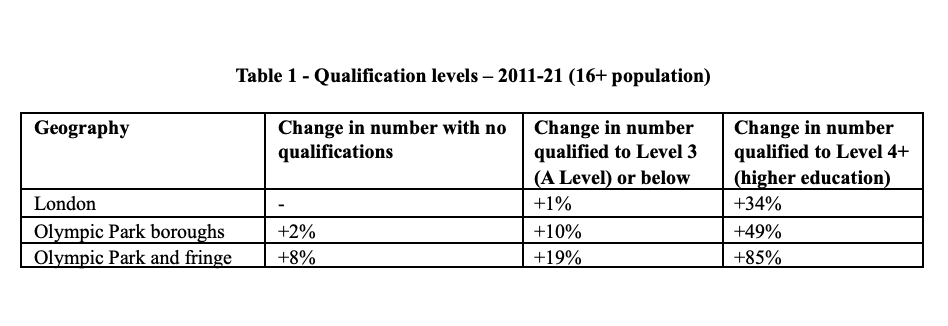
The first proxy indicator is qualification levels. The past decade has seen a rapid increase in the proportion of Londoners who have degrees or other higher education qualifications. This has risen from 38 to 47 per cent of the 16+ population across the city, and from 34 to 49 per cent in the Olympic Park and Fringe. The number of higher-qualified residents in these areas increased by 85 per cent and doubled around Stratford High Street, Stratford Town Centre, Bromley-by-Bow and Fish Island.
However the number of people without any qualifications has also increased, suggesting that in this case the change has been one of addition rather than substitution. Even if low-qualified people have moved out, other low-qualified people have moved in. The exceptions are the areas to the west of the Park – Bow, Fish Island, Hackney Wick and Hackney Marshes – where the number of low qualified people has fallen over time, suggesting a more permanent displacement.
A similar analysis has been undertaken by Duncan Smith at CityGeographics, looking at changes in occupational mix. He finds that the Lower (and Upper) Lea Valley has been at the forefront of change: the proportion of workers in managerial, professional and associate professional jobs in Waltham Forest rose from 40 to 51 per cent between 2011 and 2021, the most rapid change in England, and in Newham from 32 to 42 per cent. Analysis of numbers rather than proportions is not available by borough, but across London the number of people working in lower status occupations has not changed, suggesting that changes are additional not substitutional.
Housing tenure
Housing is another proxy: do tenure changes indicate gentrification and displacement? The Olympic Park and Fringe bucks London trends on housing tenure, with a sharp rise in owner-occupation (mortgaged and owned outright) particularly concentrated in Mill Meads, Stratford New Town and Carpenters, Bow and Fish Island, where new construction has been intense. So far, so gentrifying.
However, perhaps counter-intuitively, the number of households in social rented accommodation has also grown in the Olympic Park and Fringe, and at a faster than the London or local borough average. If social tenants around the Park have been displaced – and estate redevelopment projects in locations such as the Carpenters Estate have been highly controversial – they have also been replaced with more social tenants. Meanwhile, private renting has grown as it has across London. It is now the most widespread tenure in the Olympic Park and Fringe.
Ethnic diversity and employment
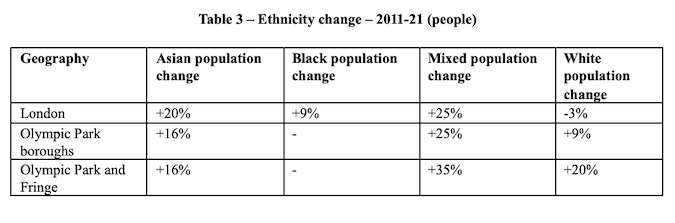
Another lens for examining change in and around the Olympic Park is ethnicity, which has a strong overlap with poverty and intersects with class disadvantage. The areas around the Olympic Park have always been some of London’s most diverse, with a non-white population of around 57 per cent in 2021, compared to 46 per cent across the capital.
As the table below shows, compared to London as a whole the Olympic Park boroughs and the Olympic Park and Fringe areas saw faster growth in their white and mixed-race populations, slightly slower growth in their Asian population and almost no net change in their black population. Black and Asian populations fell in Waltham Forest’s fringe areas, and all populations grew fastest in Tower Hamlets’ fringes, along Stratford High Street and into the Town Centre. This suggests that even if rapid growth in white and mixed-race populations around the Park did not actually lead directly to displacement of people from Asian and black populations, it may have constrained growth in those populations to lower levels than in other parts of London.
Another perspective on ethnicity can be seen in employment rates. In the Olympic Park boroughs these rose from 59 to 62 per cent of people aged 16+ over the decade, bringing them above the London average. The rise has been sharper still in the Olympic Park and Fringe, with rates rising from 60 to 65 per cent of the population. But, while employment rates have improved for all groups relative to the London average, employment has risen fastest for white people, while it changed much less for black and Asian people, widening the employment gap between these communities.
Unfinished evolution
Taken together, these figures suggest that the London 2012 programme has had varying and complex impacts on the local area. While there have been some signs of displacement of existing populations, particularly to the west where legacy has butted up against “Hoxtonisation”, the more widespread pattern seems to have been one of densification enabling the arrival of new and different communities. These demographic changes, along with the programmes run by the Olympic Park boroughs and LLDC, have driven convergence in employment rates, in tenure, and in occupational and educational profile.
That said, the differences in improvement in employment rates, alongside recent depressing news about falling life expectancy, suggests that structural disadvantage continues to hit some east London communities hard. Twenty years after London was awarded the Games and as the boroughs, the Mayor of London and the LLDC develop inclusive economy plans, London 2012’s legacy is an unfinished evolution.
Interviewed on Radio 4 for the launch of his re-election campaign on Monday, Sadiq Khan said this year offered “a moment of maximum opportunity for Londoners, for there’s the prospect not just of a Labour Mayor, but of a Labour government working together [with a Labour Mayor].”
Even if the tone was more bullish than the Labour leadership might like, Mayor Khan has a point. Since he was first elected in 2016, he has lived with a chaotic kaleidoscope of Conservative governments. When these have shown any interest in the capital, it has generally been to frame it as an overheated reservoir of “wokery”, or to attack Khan’s record on policing and planning – most recently through directing a review of industrial land and opportunity area policy, announced the day before the pre-election period formally began.
Khan’s predecessors were luckier. Ken Livingstone’s first term started with him politically homeless, expelled from Labour for running as an Independent against their official candidate, Frank Dobson. The early days, when I was working in the Mayor’s office, were notably scratchy: Livingstone’s first meeting with Deputy Prime Minister John Prescott was cryogenically chilly, his battle against the London Underground public private partnership poisoned relations with HM Treasury, and I remember the air turning blue as he offered London minister Keith Hill his frank thoughts on provisional spending settlements.
But Livingstone benefitted from coming to power when the public spending taps were being turned on, and when the Labour government led by Tony Blair wanted to show that its new devolutionary settlement was a success. By 2004, following back-channel discussions with Number 10 and a more publicly visible collaboration with culture secretary Tessa Jowell over the London 2012 Olympics bid, he was back in the party.
Buoyed by London’s unexpected success in winning the Games, Livingstone’s second term saw substantial public spending in London, government and parliamentary approval for Crossrail – today’s Elizabeth line – and new legislation that extended the Mayor’s powers on housing, planning, culture and waste.
Boris Johnson benefitted from this legacy following his election in 2008. And from 2010 Livingstone’s Conservative successor had the following winds of a Conservative-led coalition in his sails.
He too secured more powers, through the Localism Act and and the Police Reform and Social Responsibility Act, both passed in 2011. And although London boroughs’ budgets were cut heavily – as were those of other urban councils – the government was surprisingly generous in investing in the Olympic Park legacy, including Johnson’s pet project, Olympicopolis (now East Bank), perhaps aware that just as a successful Olympics can show off a city, a tumbleweed-strewn legacy can show it up.
The only initiative that failed to make any headway was the London Finance Commission, a deliberately non-partisan campaign for fiscal devolution, which was beached on the sands of Treasury insouciance in 2013, and again in 2017 when Khan had a second go.
Khan came to power in spring 2016, as the five years of public spending cuts started to take their toll and the European Union referendum campaign slouched to its self-harming conclusion. The years since have been dominated by a grim procession of crises – Brexit contortions, the Covid pandemic and spiralling inflation – which have seen the Mayor and the government on the opposite sides of arguments, with spending decisions marked by public spats and denunciations rather than the private haggling and public consensus that operates between political allies.
While the “metropolitan elites” of London became useful villains, “levelling up”, the regional policy boondoggle Johnson wielded in the 2019 general election campaign, has little to show by way of results apart from cancelled and delayed projects, funding and tax decisions that do down the capital, and occasional outbreaks of opportunistic culture war posturing.
So Mayor Khan can be forgiven for believing, in words that still carry a faint resonance from the 1990s, that “things can only get better” if he wins a historic third term. Labour have said little about their plans for devolution beyond a promise of legislation and speeches focused on bringing some consistency to the patchwork quilt of devo deals spread across England. Furthermore, the UK’s dismal fiscal outlook suggests that “turning on the taps” of public spending is still a distant prospect. But Labour’s economic growth mission cannot pass over the opportunities London offers.
There could be a golden moment ahead. By the end of the year, a Labour Mayor and a Labour Prime Minister could be simultaneously in post, short of cash but rich in political capital. Starmer and Khan have their differences – on relations with the EU and Green Belt development, for example – but must be able to agree a shopping list of measures that are cheap and capable of having a real impact on growth and prosperity, even if some are controversial.
Such measures might include selected urban extensions in the Green Belt, more fluid European work permit arrangements for young people, performers and professionals, rail devolution in London, and maybe one more push for a system of fiscal devolution that enables London (and other English cities) to manage local taxes and local development.
Sadiq Khan has been quick – on occasion too quick – to point the finger at central government for everything wrong in London. A double win in the capital this year would give Labour a chance to show just how much better the relationship between City Hall and Whitehall could work.
London’s universities are big players in the capital’s economy as well as a visible presence on its streets. They account for 85,000 jobs – more than in the advertising, and architecture and engineering sectors, and almost as many as in accountancy and law – and their economic impact has been valued at £27 billion every year.
Our leading universities are truly global institutions: University College London (UCL) and Imperial regularly feature in global “top ten” rankings, and foreign students make up a large proportion of London’s student population – a success in terms of exports and soft power.
But London’s universities also have a good story to tell about their local impact, and in particular their offer to students from less advantaged backgrounds. Two recent exercises, which I reviewed for University of London, have sought to evaluate how the UK’s universities compare in terms of supporting social mobility by attracting and boosting the careers of students from poorer families or places.
Two years ago, the Sutton Trust and the Institute for Fiscal Studies (IFS) analysed how well universities did in attracting students who had been on free school meals at age 16 and how many of these were in high-earning jobs at age 30. The ten highest-performing universities by these measures were all in London, with Queen Mary University of London, University of Westminster and City University of London taking the top three slots.
A slightly different approach was taken by Professor David Phoenix from London South Bank University. His English Social Mobility Index, which has now been published for three consecutive years, looks at how well students from deprived places perform in terms of access to courses, continuation and completion rates, and then earnings and “graduate employment” one year after graduation.
The 2023 index shows Bradford and Aston universities in the top spots but five of the top ten are London institutions: City, King’s College London, London School of Economics and Political Science (LSE), Queen Mary and UCL.
Neither approach is perfect. No, graduate earnings are not the only measure of the value of higher education. Yes, London is at an advantage because graduates who stay in the city will earn higher salaries (even if most of those evaporate in rent and travel costs). And, yes, focusing on the deprivation of places rather than people does not reflect the differing geographies of poverty inside and outside London.
However, the indices do seem to show London universities – both established institutions with global brands and newer former polytechnics – doing relatively well. This is partly because Londoners from poorer backgrounds are more likely to go to university: 44 per cent of London pupils on free school meals go on to university compared to 27 per cent across England, and eight per cent go to more demanding “high tariff” institutions, compared to four per cent across England.
The reasons for this have been intensively debated, with some analysis pointing to the investment and focus that came with the London Challenge, and others arguing that it is the ethnic make-up of London’s young population that is driving success – put bluntly, white British pupils drag down the results in other parts of the country.
Some of London’s most successful universities certainly have an intake that reflects the high levels of aspiration in many minority communities: Queen Mary, City, LSE, Imperial and Westminster all have disproportionately large intakes of students from UK Asian backgrounds, though fewer universities (East London, West London, London Met and Middlesex) do so well in recruiting UK Black students. These broad categories also gloss over any differences within different groups, for example between Indian and Bangladeshi, and Black Caribbean and Black African students.
But London’s universities also do well in offering courses that attract students from poorer backgrounds, particularly those looking for a stable and well-remunerated career. Pharmacology, computing, law, economics and business offer the strongest social mobility dividend, according to the IFS/Sutton Trust research.
Nineteen of the 20 top courses in these subjects are in London, with Queen Mary and City universities in the vanguard. And universities work to tailor their courses to student circumstances: in interviews for University of London, teaching staff at Queen Mary emphasised the flexible approach they took to timings and teaching approaches to support students with caring responsibilities, of whom they have a relatively high number.
High participation rates in London show how far university attendance has been normalised here for young people from all backgrounds (in contrast to apprenticeships, where the capital has the lowest take-up of any English region). This may partly result from the widespread presence and visibility of universities, but is also driven by the demands of London’s job market: in 2016, 53 per cent of jobs in London were held by someone with a degree, compared to 30 per cent in the rest of the UK; for senior managerial jobs, the proportions are 64 per cent in London and 38 per cent elsewhere.
But it’s not just the managers. People working in administrative or elementary manufacturing roles are also more highly qualified in the capital. These graduates working in such “non-graduate” jobs may account for London having the lowest proportion of graduates saying that their work was meaningful, fitted with their plans and used the skills they developed in university. Scores were particularly low for those graduates who had lived in London before going to university.
So, London universities play an important part in London’s success as a “social mobility hotspot”, showing how access to higher education can be widened for all classes. There may be opportunities to widen the hotspot: universities from across the UK have opened outposts in London; perhaps London universities could work with local partners to open satellites elsewhere. However, low job satisfaction levels for London graduates also suggests that more needs to be done outside universities, to make work fulfilling for all and to help young Londoners to access a diverse range of post-18 education and training.
It’s five years ago today my father died. A month earlier, he had been discharged from hospital (after much squabbling about wheelchairs and social services) to a nursing home, where he seemed just to lean into a fate sealed three years earlier when he fell and suffered a catastrophic brain injury. My mother died more recently. A tough leaving she had of it too, with a degenerative disease that slowly robbed her of autonomy and dignity.
But I’ve noticed something changing in myself since my parents’ deaths. Over the past eight years I became quite the sharp-elbowed advocate, understanding social care and health interfaces, always up for debating what could and could not be supplied on prescription, schooled in the technicalities of continuing healthcare funding assessments, and ready at the end to discuss with doctors ‘patient’s best interests’ and palliative care. I wrote long and slighly laboured blog posts about the iniquities of the funding system and the impossibility of its reform.
Now, not so much. J’en ai marre de ça, as the French would say. I’ve unsubscribed from newsletters about healthcare funding, about my mother’s condition, about social care. Even as I mourn my mother and remember my father, I don’t want to think about these things any more, except to hope that my death is swifter and easier.
But that’s not really good enough, or shouldn’t be. When people get frustrated with local services or the local education system, they become councillors or school governors, or at least post on Mumsnet. But when we see how the health and social care system fails old people – and to be clear, my parents did pretty well compared to many – we want to brush it all under the carpet, born I guess of the odd sense of shame we have about letting others care for elderly relatives, and an apotropaic worry that talking will bring misfortune on ourselves.
Most people most of the time, they don’t need to think about elderly care, and about the disgraceful way it lets down so many old people, and so many highly-motivated and kind care workers. And those who cannot avoid knowing (most of us at some stage in our lives) keep silent or strive to forget. This needs to change if we are to have sensible discussions about the provision of decent care for older people, about who is responsible, about who pays, and about where the limits lie, when more and more things can be survived but not truly lived through.
This decade is likely to see the biggest transformation of the workplace since the widespread adoption of the personal computer. Hybrid and remote working patterns adopted during the pandemic appear to be sticking, and a wave of disruption from artificial intelligence (AI) and large language models (LLMs) is following rapidly behind.
London is at the epicentre of these twin “workquakes”. The capital has persistently had the highest levels of home-working in the UK, with two thirds of Londoners saying they worked at home at least one day a week last summer. This reflects hybrid working’s dominance among professional and managerial staff, who make up 63 per cent of London’s resident workers, compared to 50 per cent of all England’s.
These people enjoy the flexibility, work-life balance and personal productivity that working from home can offer, though the impact on organisational or inter-organisational productivity is more contested. Nonetheless, speakers at a London Assembly meeting last week said that the era of “five days a week in the office” had gone for good, and that the task was to adapt central London to new ways of living, working and playing.
The accelerating pace of AI adoption looks likely to add turbulence. A recent UK government report found that workers in London were twice as exposed to AI as the UK average. This was not because of LLMs’ appetite for the diversity and vitality of the capital, but (like the prevalence of home-working) is largely a result of London’s occupational make-up. Unlike previous waves of automation, which affected manufacturing and routine clerical work, AI is coming for the professionals.
The report suggests that the most affected occupations include management consultants, financial managers, psychologists, economists, lawyers, project managers, market researchers, public relations professionals, authors and, perhaps surprisingly, clergy. The “safest” are jobs are those of such as sports professionals, roofers, plasterers, gardeners and car valets. The former occupations are over-represented in London, the latter are not.
However, before soft-handed metropolitan knowledge workers like me rush to retrain, ignoring our lack of aptitude, there are some caveats. The first is that the government report’s projections make no distinction between jobs that are augmented (those where workers can deploy AI to dramatically enhance their productivity), and those that are likely to be substituted (replaced, sooner or later, by new technology).
The second is that the analysis takes no account of the new jobs that will be created. We can see those that are at risk, but it is harder to identify the opportunities that will arise. A year ago, few people had any idea what a “prompt engineer” was. Today, demand for them is booming. And we can be re-assured by historical experience: the majority of jobs that Americans do today did not exist in 1940.
In any case, most professional jobs involve more than one activity, which is where the interaction between working from home and AI gets interesting. A management consultant, for example, may spend time meeting clients, preparing pitches, interviewing workers, analysing data, workshopping ideas and writing reports. A PR professional may write press releases, manage staff, research markets, pitch to clients and journalists, develop concepts, devise guest lists, plan and host events.
Some of these tasks are intrinsically social and best undertaken face-to-face. Others are more easily undertaken remotely, away from distraction and other people. Those in the latter group are also those that can be most easily supported by AI.
From this perspective, AI adoption and hybrid working will complement each other. Hybrid working has already accustomed us to working remotely with less social interaction; AI can provide a sounding board for ideas and be an orchestrator of collaboration, without the hassle and cost of a commute. Similarly, intelligent use of AI can boost productivity, improve co-ordination and reduce the “digital overload” of online meetings, emails and collaboration spaces that built up during lockdown.
But there may be a sting in the tail. Over time, people working remotely with AI support may find themselves edged out by their machine collaborators. Cost-conscious employers are already exploring whether some jobs undertaken remotely might be outsourced internationally. A task that can be completed in Leamington Spa rather than London can also be exported to Lisbon or Kuala Lumpur. Over time, it may also be undertaken by an AI.
Oxford University professors Michael Osborne and Carl-Benedikt Frey, who published a highly influential analysis of the potential impact of automation on the workforce in 2013, recently wrote a (very readable) update reflecting on the explosive growth in AI and how it may affect their original projections.
In 2013, they argued that tasks requiring social intelligence were unlikely to be automated. Now, they write, AI has challenged that “bottleneck” to automation: “If a task can be done remotely, it can also be potentially automated.” However, for sensitive tasks and relationships, face-to-face would retain primacy:
“The simple reason is that in-person interactions remain valuable, and such interactions cannot be readily substituted for: LLMs don’t have bodies. Indeed, in a world where AI excels in the virtual space, the art of performing in-person will be a particularly valuable skill across a host of managerial, professional and customer-facing occupations. People who can make their presence felt in a room, that have the capacity to forge relationships, to motivate, and to convince, are the people that will thrive in the age of AI. If AI writes your love letters, just like everybody else’s, you better do well when you meet on the first date.”
What does this all mean for cities like London? To start with, while we do not know precisely what new jobs will be created by the AI revolution, London is already one of a handful of hotspots for AI start-ups, so it is likely to be the location for many of the new jobs too. The capital is already home to Google Deepmind and many other high growth AI firms, and OpenAI have announced plans for their first international outpost in London.
The combination of AI and hybrid working may ironically strengthen London’s role as one of a few genuine global centres for face-to-face interaction. If remote work is increasingly dispersed or automated and in-person workers with social skills remain in demand, then diverse, globally-accessible, sociable cities such as London will provide the ideal setting for their relationships and collaborations.
There is a bigger picture too. A recent paper by Richard Florida and others talked of the rise of “metacities” based on long-distance networks of collaboration and intermittent commuting. This identified London and New York as the world’s two leading “superstar” hubs, sitting at the heart of networks of talent and interaction. London’s network, as measured by talent flows, includes Manchester, Birmingham, Edinburgh and Bristol, but also Dublin, Paris, Lagos and Bengaluru.
Florida and colleagues argue that the constellation of satellite cities will shift over time, but the importance of superstar cities will persist. This suggests that in coming years London will need to plan for growth in housing, in offices and in new forms of collaborative and social spaces.
The city will also need to be open and welcoming to global talent while helping local workers adapt to change, and to work more closely with its satellite cities to ensure that economic transformation can deliver prosperity and economic growth across the UK.
This is likely to be a turbulent decade for London’s economy, but it could also be one in which the capital’s national and global profile increase.
I’ve been thinking about The Pogues quite a lot since Shane MacGowan’s death last week. Though I listen to them more rarely now, I was a huge fan in the 1980s and 1990s. They were a gateway drug to Irish folk music – Christy Moore, the Chieftans, the Dubliners – and a guttering light by which I started to explore my Irish heritage and adolescent rebel politics (I relished the rage of one schoolteacher who seethed that I was “the sort of person who probably thinks the Birmingham Six are innocent”).
Some MacGowan obituaries have inevitably focused on his lifestyle, which certainly threw out some meaty anecdotes, but most have also acknowledged the sheer quality of his songwriting at the Pogues’ peak. His literary and hellraising sensibilities slug it out in songs like Streams of Whiskey and the Sickbed of Cuchulainn; his sympathy for the oppressed shines through in The Old Main Drag, and his woosy romanticism gleams in Rainy Night in Soho and Fairytale of New York. He shifts perspective and tone – the estranged lovers in Fairytale, the old and young man in Pair of Brown Eyes, memories and narrative in The Broad Majestic Shannon – smoothly and artfully.
His is a London-Irish perspective. His view of the UK capital is brutally and raucously realist (staggering in Transmetropolitan “from a 5 pound bet in William Hills to a Soho sex-shop dream, From a fried egg in Valtaro’s to a Tottenham Court Road ice cream”). But his Ireland is romantic, pre-lapsarian, the land that his mother’s family talked of in his early years in Tipperary. The images in the Broad Majestic Shannon – “the cards being dealt and the rosary called, and the fiddle playing Sean Dun Na Ngall” – are out of time, and intentionally so. MacGowan’s Ireland has its own ghosts – “the best place on earth, but it’s dark and it’s old”, as Sit Down by The Fire has it – but its devils are all imported, mainly from Britain (the soldiers in Gentleman Soldier and The Recruiting Sergeant; the accursed “judges, coppers and screws who tortured the innocent” in Birmingham Six).
It may seem churlish so soon after MacGowan’s death, but it’s interesting to contrast his perspective with Philip Chevron’s. Chevron, the Pogues’ lead guitarist who died ten years ago, was Irish-born and -raised. His songs have a more ambivalent attitude to his country, its priest-ridden past and its underachieving present. In Thousands are Sailing, he observes the irony of the Irish diaspora: “wherever we go we celebrate the land that made us refugees, from fear of priests with empty plates, from guilt and weeping effigies.”
You can hear the disappointment in what the Republic had let itself become in the tumbling imagery of Faithful Departed (which gives this blog post its punning title), written by Chevron for his punk band The Radiators from Space but perhaps less dated-sounding in this version by Christy Moore. Like Thousands are Sailing, the song starts in dialogue with ghosts, but this time they are literary heroes (Yeats, Joyce, Brecht, Behan) rather than nameless Famine victims, as the song picks apart the “made to measure history” of the “grey, post-DeValera Ireland of the 1970s”, to quote Chevron’s own exposition of the song (allegedly from a Pogues blog, though I can’t find the original).
When I first heard the Pogues, I had never been to Ireland (just as, incidentally, MacGowan had never been to New York when he wrote The Pogues’ biggest hit). If the Ireland I imagined was MacGowan’s, the Ireland I found when I did start visiting in the 1990s was more like Chevron’s (though rapidly becoming less so). The magic of the Pogues is the way these perspectives played off each other, in a band blessed with two extraordinarly gifted singwriters.
A year after OpenAI’s ChatGPT was launched, we are starting to see the outlines of generative artificial intelligence’s potential impact on our lives.
While the recent Bletchley Park Summit focused on existential risk and misuse by extremists, debate in universities has focused both on technocratic issues (such as automated marking and plagiarism) and more recently on the potential of AI to transform and enhance learning and research – see, for example, the recently published Russell Group principles on the use of generative AI in education.
But there’s a more fundamental question for universities too. How will AI change our economy, and what will this mean for the role played by universities in readying the workforce of the future? The AI Generation: How universities can prepare students for the changing world, a new report for Demos and University of London, draws together what we know about how universities support students’ employability today, and speculates about how this might change as technology advances.
Within our GRASP
The good news is that there is a reasonably strong consensus about the critical employability skills needed today. As computer use and the internet have transformed the knowledge economy, it is not specific technical skills that are most prized. More important are the broader skills of listening to and persuading clients and colleagues, analysing and communicating information to solve problems, and having the ability to manage your own workload, your career and your professional development – the GRASP (general, relational, analytical, social and personal) skills.
Most of these skills are expected to rise in importance in coming years and will remain important in working with AI. Even if generative AI can produce text and images, workers will need critical and ethical judgement to assess what it produces and what it is asked to produce, as well as the relational and social skills to intermediate between technology and humans. So, it appears that the GRASP skillset, with adjustments, will still be relevant.
The less good news is that there is not much evidence on how well universities help students acquire these skills even now, how well these translate into good employability outcomes, or even precisely how they should be defined. Based on a review of academic and policy literature, The AI generation finds that generic “employability” content is unpopular and largely ineffective for students, but material tailored to subject matter and likely career paths much more valued. Active learning approaches – project assignments, collaborative work, peer assessment – seem to work better in developing most employability skills as well as leading to better outcomes, than traditional lecture-based learning.
But it is what happens outside the classroom – work experience, placements, membership of clubs and societies, studying overseas – that has the most impact, whether based on students’ self-assessments, or longitudinal studies looking at graduate employment rates and types. The complication is that these activities are not available to or taken up by all students equally. Students from poorer backgrounds are less likely to participate – partly a matter of cost, but also a matter of feeling, or being made to feel, that you don’t belong. In this way, there is a risk that the very activities that best boost employability are least accessible to those who need them most.
Murky paths
Growing use of AI may intensify some of these risks. At the moment, a degree still acts as a minimum entry requirement for many personally and financially fulfilling careers. Early studies suggest that AI can particularly help less competent workers achieve better outcomes in standardised professional services tests, suggesting that degree holders may need to do even more to stand out from the crowd than they do at the moment, and that lower-level cognitive work may be automated first and fastest.
This also makes the pathway into graduate careers less clear. Currently students who want to pursue careers in most professions have a clear path ahead of them, with employers keen to diversify traineeship schemes. But AI may quickly automate some of the basic trainee tasks – preparing pitch decks and presentations, summarising arguments, working up architectural details, researching legal precedent – calling into question our whole model of professional development.
These are big societal issues, and universities cannot solve them alone. The AI generation recommends research and analysis of what works best in developing employability skills and a more systematic and fair approach to career-boosting activity such as work placements. But universities can also take the lead as civic institutions, convening government, employers, professional bodies and civil society organisations, to consider what AI will mean for our working lives, and what education and training future generations will need in order to thrive.
For tiny critters, fleas have had a disproportionate impact on British history. The fleas that spread Black Death in the 14th Century were responsible for the biggest social and economic disruption of the Middle Ages (as well killing one in four of the population). The insect that gives its name to the play The Flea, running at The Yard Theatre in Hackney Wick, initiates a chain of events that threatens a comparable upheaval five centuries later.
The year is 1889, four years after the moral panic-inspired criminalisation of “gross indecency” between men and six years before Oscar Wilde’s disastrous libel suit against the Marquess of Queensbury. The play opens with Emily Swinscow (Norah Lopez Holden) explaining the circumstances that led to her tanner husband’s death – a flea bit a rat, which startled a horse, which kicked out and killed him. Turning away from the audience, she despairs of her safety if she cannot pay the rent.
Her son, London Telegram messenger Charlie (Séamus McLean Ross), finds new ways of earning extra money – “lying down for gentlemen” at a house in Fitzrovia. Until, that is, he is accused of stealing from his official place of work and foolishly spills the beans about his other source of income.
Written by James Fritz and directed by Jay Miller, The Flea is a rumbustiously fun romp through late Victorian society. It is very loosely based on the Cleveland Street scandal, which resulted from a police raid on a male brothel at 19 Cleveland Street (the house has since been demolished to make way for the Middlesex Hospital redevelopment). Several aristocrats were accused of being patrons, and there were also rumours of visits by “Eddie”, Duke of Clarence and second in line to the throne – a shadowy masked figure in the play, only glimpsed flitting in the disco shadows.
As the police – a keen constable (Sonny Poon Tip) and a detective struggling to save his reputation (Scott Karim) – pursue their enquiries, whispers of scandal stalk up the echelons of society until they reach its zenith, Queen Victoria herself. The small spaces of The Yard are transformed: the split stage allows scenes to run in parallel, and the hierarchy of Victorian society is wittily made real, as aristocrats ascend the back wall of the set, with poor Charlie imprisoned behind the rungs of their ladder.
Each of the actors plays two or more roles, and they swap their Steampunk-Steptoe costumes at lighting speed. Holden excels as the two mothers at the heart of the drama – Swinscow and Victoria. As the former, she switches fluently back and forth between narrator and player, drawing the audience into her story but also standing back from it. As the latter, wearing what looks like a dead cassowary on her head, she is the only character who faces a real moral dilemma as she ponders whether or not to put her family and the monarchy itself above the law.
Everyone else seems trapped, their behaviour constrained by circumstance and class. That is not to say the characters are unsubtle or caricatures. Connor Finch makes you feel for Lord Arthur Somerset, who naively believes that the young man he falls for at the brothel reciprocates his feelings, even as his more discreet friend Henry FitzRoy, Earl of Euston (also played by Tip) urges caution and uses his influence to help his pal out. The only wholly unsympathetic characters are the sulphurous brothel keeper Charles Hammond (Karim) and the Prince of Wales, played by Ross with a monstrous mix of buffoonery and brutality.
The story moves fast as events gather momentum. The script and directing is tight and the acting lively, with a carnivalesque relish that belies the bleak subject matter. After Victoria makes the decision on which the whole play pivots, the second half feels slightly slower paced. However, I can understand why Fritz and Miller want to take the time to mirror the first half, as the consequences of the Queen’s decision come cascading down through society. Consequences for some, that is. I don’t think it’s a spoiler or a surprise to say that we end with impunity for the privileged and judicial violence for the victims of sexual exploitation.
And after all that, we end up right where we started, with Emily and Charlie Swinscow scraping by, and a flea.