We are Devo!

Devolution is a good thing. Delivering services locally or regionally can make them more responsive to the needs and circumstances of places and communities, as well as enabling innovation and experiment. It can support integration and prevention, so that people do not fall through the cracks between services, and so that early action can tackle problems before they turn into crises. And bringing services closer to local people (“subsidiarity”, to use the European Union jargon) should aid accountability.

Fiscal devolution adds to the possibilities. It allows local councils and regional Mayors, such as Sir Sadiq Khan, to raise more taxes from their areas or to keep more of the taxes that would otherwise go to national government. Done well, this type of arrangement can create a virtuous circle: if the local economy grows, taxes grow, supporting services for local communities and enabling investment in transport and other infrastructure that will support continuing growth. This benefit has already been illustrated in London by the way the city and its businesses paid for the Elizabeth line and the Northern line underground extension to Battersea Power Station.

Speaking in Manchester this week, Andy Burnham had quite a lot to say about the first aspect of devolution, but rather less about the second. There were harsh words for the “adversarial culture” of Whitehall “departmental silos battling each other and battling the Treasury rather than getting things done”. Even the capital, the PM Presumptive assured us, needed more “powers…over education and housing, so that London can do more for itself and remain the world’s greatest capital city.”

On funding, his language was more opaque. “Power and resources” will be redistributed across the UK, and government departments will be expected to “support strategic and local authorities with funding and resources”. What exactly did that mean? The devolved powers needed in order to raise or retain taxes locally? Or just a new round of grant-funding from the centre?

Such vagueness is understandable: devolving taxes is complicated and campaigns for reform have struggled to make headway for decades. But the tide seems to be turning. In her Mais Lecture in March, Chancellor of the Exchequer Rachel Reeves pointed out the awkward asymmetry of accountability and reward: “While local leaders are asked to plan for the long term, to be accountable for regional outcomes, the fiscal reward for local economic success flows straight to the Exchequer”. Since then, meetings have been taking place to plot the “roadmap for future fiscal devolution” that she promised.

People involved in these discussions suggest the Treasury is receptive to the idea of using tax revenues to create incentives and conditions for growth locally. But other parts of Whitehall still regard the idea with horror. Departments have become used to managing local expenditure through a fiendishly complex set of formulas and grants that top up Council Tax (raised and spent locally) and redistribute Business Rates (raised locally but mainly distributed nationally). This charade of local tax-raising masks one of the most centralised tax regimes in the developed world. In the words of the LSE’s Professor Tony Travers, this “infantilises” local government, by making councils supplicants for centrally-allocated grants.

Tricky issues persist. As well as being highly centralised, the UK has high regional inequality (which may or may not be related to centralisation). Could allowing some taxes to be retained actually exacerbate the problem? If retaining taxes results in areas that are already doing well doing better still, will it also lead to others losing out?

A recent Centre for Cities report set out one approach to squaring this circle. Regional authorities, including the Greater London Authority (GLA) and the 15 mayoral strategic authorities (MSAs) across the country, could receive a share of Income Tax and Corporation Tax equivalent to their current grants from central government. This would amount to between two and six per cent of the local tax take. If the tax take grew, MSAs would keep some or all of the gains, but above a certain level these would start being clawed back to support areas that were not doing so well. But the hope would be that most areas could benefit. Growth should not be a zero-sum game.

The Mayor of London already uses retained local Business Rates to fund services, as do other MSAs, so this type of model has been tried and tested. The Centre for Cities research suggests that retaining two per cent of income tax raised in London would cover the GLA costs currently funded by government grants (reflecting both the scale of services funded by the GLA and the size of the tax base in the city).

But there are still other difficult questions. One is how much tax growth London should retain if revenues rise. London’s share of UK Income Tax and Corporation Tax has been growing quite sharply in recent years, so there might be an argument for the capital to retain a smaller proportion of growth than other cities, not least as some Corporation Tax raised in London relates to profits generated across the country by corporations whose head office is in the capital.

London (and other cities) would also need to be on guard against periodic attempts by central government to “reset” the proportions of taxes that can be retained as a way of redistributing the proceeds of economic growth. Such “levelling up” (and down) resets might be thought fairer to other parts of the country, but they create uncertainty and make it riskier for organisations such as the GLA or Transport for London to borrow money against future tax revenues – and riskier means more expensive. Better, surely, to allow long-term certainty on tax retention, and to use other revenues to support places with smaller tax bases.

Fiscal devolution could go a lot further, as proposed by the London Finance Commission: Mayors could set additional Income Tax rates (as happens in Scotland) or new Council Tax bands (as has happened in Wales). Retained taxes could also be shared with local authorities, and Andy Burnham’s reported interest in land value taxes could lead to a more wholesale process of reform. But, as discussed at a Centre for Cities briefing event, the risk of arguing that fiscal devolution can only be taken forward part of a radical restructuring of the tax system is that nothing continues to happen.

Andy Burnham in his speech spoke of a “10-year mission”, but he also expressed a sense of urgency and frustration with how Whitehall has worked to frustrate the transfer of power to the UK’s cities and regions. This sense of urgency suggests that this could be a moment of change, an opportunity for Mayor Khan and the other Mayors to push for faster and fuller devolution of services and taxes, if they are really going to be able to do things differently and deliver for their communities.

Published by OnLondon on 2 July 2026

Plotting triumphant returns to the city

Andy Burnham arrives in London like a victorious warlord marching south. How will he treat the capital? Will he plunder its coffers, poison its wells and send chests of treasure north? Or will he pause to think about where the treasure came from and consider how it can be grown?

It’s easy to get carried away with the “King of the North” schtick. But even without it, Londoners may worry about the Prime Minister Presumptive (is that the right constitutional title?) and his views on their city.

Burnham has railed against the “London set” who run the Labour Party (that sinister cabal comprising Keir Starmer and…err…Jeremy Corbyn). He has complained of unbalanced transport funding. Some argue that shifting economic growth away from London is a keystone of his programme.

This may all be politically convenient, particularly when seeing off a challenge from Reform UK in a Manchester suburb, but is it politically or economically sustainable as a programme for government?

Politically, such an approach might have made sense a year or two ago. London could be safely taken for granted electorally as the last Labour “Red Wall” standing, electing Labour MPs in 59 out of its 75 constituencies in 2024. However, following May’s local elections, in which Labour lost 40 per cent of the council seats that they won in 2022 and saw a 17 per cent swing against the party, that wall looks a lot less robust and lot less red. As Business London’s Muniya Barua said last week, “London is now back in play.”

The economics are questionable too. London generates 22 per cent of the UK’s economic output and raises a similar proportion of tax revenues with only 13 per cent of the country’s population. But, while the capital’s productivity (economic output per hour worked) remains nearly 30 per cent higher than the UK’s, it has been slower-growing than average since 2008, and particularly slow growing in London’s traditional economic core (City of London, Westminster and the north of Tower Hamlets), as well as across most of outer London (with the notable exception of Croydon).

This is an issue for the whole of the UK: London tax revenues support public services and public investment across the country, including the transport investment urgently needed in northern England. If London declines economically, the beneficiaries are as likely to be in Singapore as they are in Salford.

Andy Burnham probably knows all this. He will certainly be aware that Manchester is the only major conurbation that has outstripped London’s productivity growth since 2008. There has been much talk of what the secret sauce of “Manchesterism” might be and how its lessons could be applied more widely.

There are the much-vaunted public transport reforms (which Wes Streeting acidly described, in an interview last month, as the “TfL model”). There has also been a focus on attracting new investment, new development and new businesses to the city centre, a process which has been at the heart of Manchester’s revival and boosted by its charismatic Mayor.

Burnham has successfully ridden and amplified the wave of Manchester’s revival (as Ken Livingstone did when he became Mayor of London in 2000). The process began under Manchester City Council’s leader Richard Leese and its chief executive Howard Bernstein 30 or more years ago. Bernstein, who died in 2024, was tireless in deal-making and partnership-building, driven by a sense of place and the ability to work with government to get Manchester what it needed for growth. As the city centre grew, so other boroughs in Greater Manchester began to see the benefits.

There are lessons here for Burnham and for London. Manchester developed a strong vision and lobbied relentlessly for the powers and resources to turn that vision, at least partly, into reality. London’s civic leaders should be ready to make their case – the case for infrastructure investment, the case for control of tax revenues, the case for the resources to address the capital’s persistent problems of poverty, inequality and homelessness. As the politician who has benefitted most from devolution and who put it centre stage in his campaign, Andy Burnham should be receptive to their argument.

But London should also look to its own government structures, and consider whether these work as well as they could in enabling “good growth” in the capital. As Andy Burnham will know, other English city regions have an urban core that is more or less within one local authority; Greater Manchester certainly does. By contrast, London’s Central Activities Zone, which contains London’s and the UK’s economic, civic and cultural core, is spread between ten local authority areas, including the City of London.

While there are great examples of collaboration between these bodies, there are also plenty of areas – from planning and licensing policy, to street cleaning, to regulation of car clubs and bike hire – where central London would benefit from a more unified approach, as discussed in Friday’s OnLondon Extra newsletter.

This could mean new structures, local government re-organisation, or simply more rigorous partnerships and shared service arrangements. In making their case for the powers and resources they need, London’s civic leaders should also show how they will work together to use these to support economic growth in the capital and across the country.

Published by OnLondon on 22 June 2026

Have to admit it’s getting better

London is an exceptional city. Anyone who lives or works here knows this, but its exceptionalism has been turned against it in recent years. Far-Right activists have sought to paint the capital as a hostile and misgoverned hell-hole and UK pundits such as Paul Collier and David Goodhart single London out as both the cause of the nation’s ills and a dysfunctional hotbed of cosmopolitans (“anywheres”, in Goodhart’s phrase) connected to place and each other by the weakest of ties.

Is there anything in this critique, even in its milder forms? In early December, the  government’s annual Community Life Survey was published, based on questionnaires completed earlier this year by 175,000 people in England. On some measures (feelings of loneliness, volunteering and charitable giving), the differences between London and other regions are marginal. But in three areas the capital seems to stand out.

Screenshot 2025 12 28 at 13.26.17

Out of England’s nine regions, London has the lowest proportion of people saying they feel a sense of belonging to the local area. This is most pronounced in boroughs such as Tower Hamlets and Newham. Similarly, Londoners are least likely to say that they talk regularly to neighbours, that their neighbours pull together to fix problems or that their neighbours can be trusted.

So far, so Goodhart-ian. However, while London is the lowest-scoring region, many of the lowest scoring localities are outside the capital – places such as Southampton, Reading, Boston, Mansfield, Nottingham, Crawley, Oxford and Cambridge. These are quite diverse in terms of prosperity, but share relatively large levels of population mobility – people moving in and out of the area – often because of large student populations. Weaker social ties should not be a surprise among populations that are continually changing.

Significantly, while London scores low on these indicators, it remains above average for perceptions that people from different backgrounds get on together: weak social ties do not mean hostility or intolerance. That said, some London boroughs (notably Barking & Dagenham, Bexley and Havering, a trio that will feature again in this piece) have lower than average scores for this indicator too.

Screenshot 2025 12 28 at 13.29.17

A second set of polling questions asks about relationships with place: do people think their local area is attractive, are they proud to live there, how satisfied are they overall? London is less of an outlier here, generally scoring a bit below average, more like the northern urbanised regions than the rural and small-town populations of south east and south west England.

Within London there is a consistent pattern: outer London boroughs in the north east and west of London give their local area a lower rating than the English average; Bromley and relatively prosperous riverside boroughs of south west London tend to score higher – as do other more prosperous places outside the capital. A second unsurprising finding, maybe: people who can afford to live in more affluent places tend to like them more.

More interestingly, London is a strong outlier on whether their local area has improved recently, even though positive responses to this question are scarce. Eighteen per cent of Londoners said their local area had improved as a place to live over the past two years, compared to 11 per cent of people across England (59 per cent nationwide say their area has not changed significantly one way or another, but we don’t have the regional data for this).

The 12 top scorers among nearly 300 local authorities were all in London. Waltham Forest, Southwark, Hackney, Lambeth and Wandsworth top the list, with 23 per cent or more of residents identifying positive change.

Screenshot 2025 12 28 at 13.36.38

This last finding may connect with Londoners’ relationship to local politics and public services. London as a whole had higher levels of civic engagement (from contacting councillors, to demonstrating, to responding to consultations). Londoners from across the city reported more engagement and believed they had more impact on decision-making than people living outside the capital.

Five of the ten areas with the highest participation rates were in London (Waltham Forest, Haringey, Hackney, Richmond upon Thames and Lewisham). And Londoners from across the city wanted to engage more in decision-taking (33 per cent, compared to 28 per cent across England).

Results are not uniform, and there are a few boroughs – principally Barking & Dagenham, Bexley and Havering – that buck the London trend, but the overall message is one that should give some comfort to London’s leaders. Citizens of the capital feel more engaged with the way their city is governed and more positive about the way it is changing than people in other places do.

This may partly result from the type of people who live in London (more educated and engaged in general), but could also be seen as a vote of confidence in the Mayor of London and its boroughs. The President of the United States can rant all he likes about the “terrible job” done by London’s leaders, but that’s not how it looks to Londoners.

There is a more specific relevance too, as we peer blearily into 2026. Nigel Farage has high hopes for the borough elections in May, but Londoners’ views may yet scupper these. Research by Kings Policy Institute suggests that a feeling of powerlessness over public services is strongly associated with planning to vote for Reform UK.

The flip side is that if people feel more positive about their ability to make a difference, as nearly 30 per cent of Londoners do, their likelihood of voting Reform UK should decrease. Londoners’ relative positivity about how their city is changing and their sense of civic engagement could be powerful bulwarks against change in May. Borough leaders will want to bolster both in the next four months.

First published by OnLondon

Glad it’s all over

A recent piece by the FT’s Gideon Rachman, on the re-awakening of the nuclear ams race, sent me back to the early 1980s, when the threat of nuclear war stalked the pop charts, even as unseen crises such as Able Archer 83 secretly brought the world to the brink.

Because I am a cheery soul, I already have a playlist on Spotify called ‘Nuclear‘, which draws together some of the irradiated pop dystopias that sold in such numbers 40 years ago. There are some absences (such as Sting’s ‘Russians’) largely on the grounds of my tastes, but the list does give a sense of how pervasive the nuclear threat was in popular culture – at a time when the charts were much more of a communal experience than they are today. I don’t detect the same looming anxiety about, say, climate change in today’s pop music. But I don’t listen to much modern pop music so what do I know?

And it wasn’t just music. In the UK alone, TV dramas such as Edge of Darkness (1985), A Very British Coup (1988) and, unforgettably, Threads (1984) all touched or centred on the politics and potential consequences of nuclear defence, nuclear diplomacy and nuclear war. There are, of course, US films such as War Games (1983) too, but there’s a blend of ghoulishness, glee, melancholy and cynical fatalism that seems peculiar to the UK dramas and pop songs.

I was a teenager in the early 1980s, so was perhaps particularly sensitive to this sense of dread that seemed draped over the world, just as I started taking an interest in it. Looking back, I suspect that spending long afternoons in darkened rooms listening to how different mixes of ‘Two Tribes’ by Frankie Goes to Hollywood incorporated civil defence warnings was not the most psychologically healthy of hobbies. (And I wonder whether the political apathy often attributed to ‘Generation X’ relates to us not confidently expecting to reach voting age, let alone maturity.)

But it wasn’t just morbid protogoths. The likelihood of nuclear war, “within the next year or two”, was a commonplace of discussion between my parents and their friends, sometimes overheard from upstairs as the dinner party drinking continued.

All that seems curiously distant now, only half-glimpsed through pop culture reflections, crowded out by more tangible 1980s markers such as Concorde and Sony walkmen. In his history of the Peloponnesian War, Thucydides commented that distant observers would judge Athens to have been far more powerful than it was owing to its wealth of monunmental buildings, but would not understand the power of Sparta, a great power that had a minimal (and mainly wooden) physical footprint.

In a similar way, the physical traces of this part of the Cold War are hard to find: missile and civil defence sites were buried or locked away, and most still are. You saw the women camped out at Greenham Common, but you never saw what they were protesting against. For most of us, the standoff was a strangely immaterial event, even a psychological one. But the songs and dramas of the 1980s can still give a sense of its power and how it was imprinted on our consciousness, like the ghostly shadows left by the nuclear blast at Hiroshima.

Remote control

“Confusion in her eyes that says it all.
She’s lost control.”

Joy Division, Control, 1979

On the radio a couple of days ago Amol Rajan mentioned a blog by James Kanagasooriam, suggesting that ‘agency’ could be the Next Big Idea in political discourse. It reminded me, infuriatingly, of something that I have been mulling over trying to think about maybe planning to write for ages. How could he? I have now read James’ excellent piece (and recommend you do too), and am relieved. He takes a different perspective from the one I have been mulling, so I thought it was worth articulating a few fuzzy thoughts in response.

James identifies a growing proportion of people, particularly in the UK, who see themselves as lacking agency. They feel left behind, and nurse grievances and a sense that they are being discriminated against. They vote for the Greens, Reform and (slightly surprisingly) the Lib Dems. James sees this trend as largely the result of “agency-suppressing beliefs”, including intersectionality and the sense that everybody can find some measure according to which they are under-privileged (what he calls the ‘Nietzschean Trap’ in another post). He also alludes, intriguingly, to modern forms of media consumption, including the quick-hit ‘dopamine culture’ of clickbait, dating apps and tiktoks, adding to this sense of disempowerment.

I like this analysis, which I think does a great job in explaining why the past five years or so have seen a particularly sharp drop in the number of people feeling that they are masters of their fate. But I think there are longer term trends and explanations too.

I started thinking about agency and control in the aftermath of the EU Referendum, when ‘Take Back Control’ had been such a potent and persistent slogan, taking in border security and national sovereignty, but also reflecting a deeper sense of disquiet about something lost in the previous decades. I think this disquiet is real, though it has been gingered up, stoked and even weaponised by politicians and other political players since 2016.

I think this simmering disquiet is about a perceived loss of control over our own lives and over an ever more visible world. And I think that the roots of the disquiet are entwined with technological progress and its impacts, with individualism and the decline of certain types of identity politics, and with a broader sense of political and civic impotence.

“We were brought up on the space race,
now they expect you to clean toilets.
When you’ve seen how big the world is,
how can you make do with this?”

Pulp, Glory Days, 1998

Technology has dramatically increased visibility and connectivity since the 1990s: we can now see the lives of people across the world, often people who present themselves as ‘living the dream’ – fulfilled, happy, in control. We can compare ourselves and our lives with theirs in a much more granular and immediate way than we could when watching ‘stars’ on television or reading about them in papers. We may come up wanting, and wondering why we cannot acquire those lives, that seemingly effortless poise. At one level this is simple resentment – as evidenced by poisonous postings on celebrity social media accounts – but there is also a sense of disempowerment. If anyone can make it, why haven’t I?

At the same time technology has made our own lives more visible. The early 20th Century saw the disciplines of ‘scientific management’ imposed on factory workers, but technology has sharply extended the scope of soft surveillance and control – to warehouse workers, coders, consultants and lawyers. This is not just a matter of spyware and barcode scanners, but also productivity norms, compliance checks, performance reporting, real-time analytics and timesheets. In the 20th and 21st centuries, technology enables us to see the world, but also to be seen.

In overcoming spatial distance, technology has fostered social distance and alienation. We are all familiar with the magical ease of ordering goods and services online, the low-friction transactions that have transformed our day-to-day lives and lightened the burden of ‘life admin’. But we are also familiar with the struggle through defensive thickets of chatbots, FAQs, online forms and ‘noreply’ email addresses that make it almost impossible to resolve queries or seek support outside of a very narrow defined set of algorithms.

This may be trivial if tooth-grindingly frustrating for consumers, but this mode of tech-enabled disengagement also affects public services, as anyone who has tried to seek support from HMRC, to book parking permits or to request repairs from a social landlord recently will testify. (As a side note, it was incredibly pleasing, when dealing with the Irish state recently, to receive letters from named individuals, with email addresses and phone numbers to follow up if needed).

Technological advances have also amplified the emptier promises of individualism. As workers, more and more of us are autonomous agents, freed from the norms (and security) of jobs for life. We can work freelance, in the gig economy, on short-term contracts. But while such arrangements may feel empowering for comfortable middle-class people (yes, people like me), it doesn’t look like that for everyone.

It is true that an industrial worker in the mid-20th Century had limited personal autonomy, but the structures of union, party and class solidarity offered other ways to exert control over working and living conditions, at least in theory. There may not have been that much power in a union, but there was arguably more than an individual gig economy worker can deploy today.

“What happens to the rat that finally stops running the maze?
The doctors think he’s dumb, when he’s just disappointed.”

American Music Club, Hollywood 4-5-92, 1993

The collapse of traditional class and party identities has sharpened and been sharpened by a sense of the impotence of mainstream politics (as indicated by very low voting turnout by some groups). Some problems – climate change, ageing populations, health and care spending running ahead of tax revenues – seem simply intractable, at least by single states. Others – sovereign industrial capacity, control over borders, building homes and infrastructure – seem to get stuck in the messy undergrowth of the ‘rules-based international order’, and the plethora of (self-imposed) constraints, protections and prohibitions it contains. When Leviathan has lost it, what hope is there for the rest of us?

Writing the paragraphs above, I am conscious that this may read as nostalgia for a more corporatist or communitarian past, or even as Reform- or MAGA-coded. That’s not my intention; I’m seeking to articulate not to advocate. Personally, in the terms used by James Kanagasooriam, I am broadly OAT (“optimistic, agentic and trusting”); on balance this world works OK for me.

But I can understand that it does not seem like that for everyone, and can see why this can make simple atavistic solutions appealing. So I think we do need to acknowledge that people feel disempowered and to talk about why that is, and what can be done to restore a sense of agency. We probably do need less time on mobile phones, strengthened local institutions, and a public discourse that focuses on possibility rather than disempowerment. But we may also need to think more fundamentally about what can be done to address the causes as well as the manifestations of this disquiet.

Who needs remote control, from the City Hall?

This is a big year for London government anniversaries. The London boroughs are celebrating their 60th birthday this month and the Greater London Authority (GLA) will be 25 in May or July, depending on whether you choose the date of the inaugural elections for a Mayor of London and the London Assembly in May 2000 or the formal “vesting” of powers that took place in July of that year.

By way of a birthday greeting, London Councils has proposed joining the Mayor’s party by establishing something similar to the mayoral “combined authorities” that operate elsewhere in the country. In Greater Manchester, West Yorkshire, the West Midlands and the seven other mayoral combined authority areas, a directly-elected metro mayor presides over a council of local authority leaders and mayors and needs to secure its agreement for budgets, strategies and plans.

In London, a council of 34 members – the Mayor and the capital’s 33 local authorities – would be unwieldy, so London Councils has proposed a “combined board”, comprising the Mayor and its own 12 “executive members”, a party-proportional cross-section of council leaders holding specific Londonwide remits. This board could take decisions on “relevant powers and funding”.

Such a change would be a big deal, perhaps bigger than London Councils is admitting. The GLA model of a strong executive mayor and a scrutinising assembly was specifically designed to minimise overlap with borough remits. Although this principle has been eroded over time – for example, by giving the Mayor more powers on housing and land – establishing a London Mayoral Combined Board suggests something rather different.

For a start, it would call into question the role of deputy mayors. The original Greater London Authority Act (1999) gave Mayors limited powers to appoint staff. Ken Livingstone used these powers to appoint senior advisors on economics, housing, transport, the environment and other relevant policy areas.

Under Boris Johnson these were renamed “deputy mayors” (there is also a “statutory deputy mayor”, a London Assembly member appointed to succeed a Mayor unable to continue in office). If there was a deputy mayor for housing and a London Councils executive member for housing, who would speak for the Mayoral Combined Board on the issue?

A similar issue arises with the London Assembly. London Councils argue that there would be no change to the Assembly’s role, but this doesn’t feel right. As well as scrutinising the Mayor, the Assembly signs off his budget and strategies and has other powers which, though quite modest, give it authority and influence which can be significant, if judiciously used.

Were the Assembly to continue in its current form under the London Councils proposals, there would be a situation in which a (directly-elected) Mayor proposed a budget or strategy to be first agreed by a Mayoral Combined Board (representing 32 elected boroughs plus the City of London Corporation) and then passed to a (proportionately elected) London Assembly for confirmation.

This would seem to be an onerous exercise in triple-handling and a recipe for disputes over mandates and remits. But if the Assembly lost those powers it would lose much of its bite. In which case, why not replace it with a borough grouping like the Overview and Scrutiny Committee in Greater Manchester?

In such respects, the London Councils plan is more radical than it might appear to be at first glance. But most importantly of all, is it a good plan?

London Councils argue that London’s current arrangements have become anomalous in the new devolution order. With mayoral or other strategic authorities set to be established across England, London’s “could become the only upper-tier council leaders in the country without a formal say over the decisions of their region’s Strategic Authority”.

It is true that London’s arrangements are different, but so is London. The Devolution White Paper published in December appears to acknowledge this. It pledges to apply an integrated financial settlement for London “while retaining pe-existing bespoke London arrangements…[and] existing ways of working with London Councils”.

Ironically, Sir Sadiq Khan has gone a lot further than his two antecedents in working closely with the boroughs. The recent London Growth Plan was developed in partnership with them, building on the work of the jointly-chaired London Recovery Board and London Partnership Board during and after the pandemic.

Mayoral strategies and budgets are all subject to consultation with the boroughs, but there are some areas where the Mayor has, by design, an independent and overriding role. The main example is powers over planning policy, where borough local plans must reflect London Plan policies (following consultation) and the Mayor retains a right to take strategic decisions over the heads of individual boroughs. (The White Paper, by the way, pledges that all metro mayors will receive similar powers, which seems hard to square with the “collegiate” model of combined authority government.)

It is true that Greater Manchester has prepared a joint plan, Places for Everyone, which was adopted last year. But the document took ten years to finalise, one borough (Stockport) withdrew from the process, and the plan has been criticised as merely drawing together unambitious local housing plans rather than seeking to take a strategic – and sometimes disputed – view of need and opportunity.

But maybe there’s a bigger picture approach that might be taken to reform in London. Perhaps new arrangements could be devised that would allow London’s boroughs to have greater formal involvement in the development of the city’s economic strategies and plans, but also enable the Mayor to have more say in overseeing and co-ordinating council services and regulatory functions – from licensing to social care to street cleaning.

It might also be an opportunity to look again at the structure of the boroughs themselves. One thing that the West Midlands and, to a lesser extent, Greater Manchester have is a single local authority overseeing the whole of the core of the cities they serve. The LSE’S Greater London Group suggested such an authority for London to the Herbert Commission in the early 1960s, but this was not followed through when the 1965 reforms were put into place.

The Greater London Authority has already outlived the Greater London Council by five years. While few would wish to repeat the chaotic and politically-motivated abolition of the GLC, the 60th and 25th anniversaries may be a time for reflection on how well current set-ups are serving London. But whether the London Councils proposals are a basis for a new settlement, a contribution to a more far-reaching debate or destined to be just a footnote in London government history remains to be seen.

First published by OnLondon.

I can’t get no…

Record levels of dissatisfaction with the NHS‘ seems to have become an annual headline fixture, dusted off each year around this time, when the King’s Fund and Nuffield Trust publish the health findings from British Social Attitudes.

This year was no exception, with just 21 per cent of people expressing themselves ‘satisfied’. But what exactly are people dissatisfied about, and what do they want done about it? Given the importance of debates about the NHS, it is worth diving into the figures to understand a bit more.

1. Wait in vain

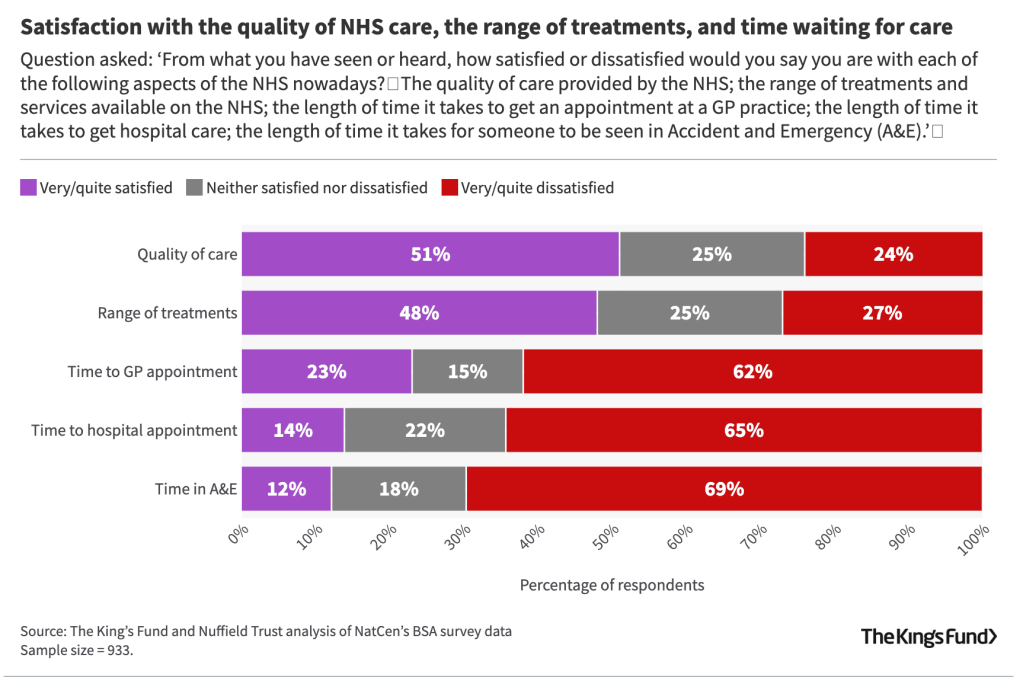
Dissatisfaction is rife across services – from dentistry, to GPs, to A&E, to hospital care, to social services. But it is the time spent waiting – in A&E or for GP or hospital appointments – that rankles most. Only 25 per cent are unhappy with the quality of care or the range of treatments available; around 50 per cent are satisfied.

The problem with NHS care is the quantity provided not the quality – as is also reflected in 75 per cent saying the NHS is understaffed. Produtivity and enhanced outcomes are important, but unless these lead to more responsive services, they may do little to shift public perceptions.

2. No tax, only spend

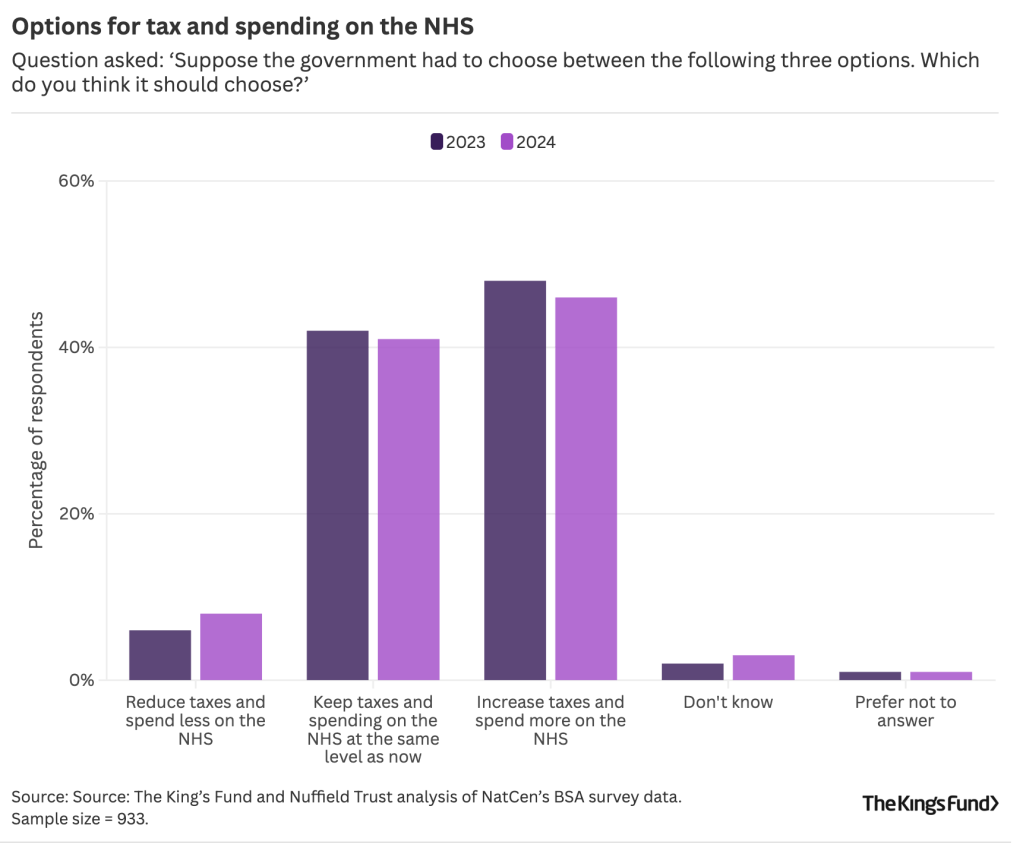
Nearly 70 per cent of people think that the government should spend more on the NHS, but only 46 per cent think taxes should go up to do this, a very slight fall from 2023. These views are not necessarily inconsistent with each other, or with the government’s policy, which has been to spend more on the NHS without raising personal taxes.

But I wish that British Social Attitudes would ask a follow up question, both on this specific issue and on their more general finding that the public wants to pay more tax for better public services, and has done for almost a decade. ‘Which taxes do people wish to see rise?’, they should ask or even ‘Do you think you should pay more tax?’ I suspect that there is far more enthusiasm for tax rises in the abstract than there is for the specific, let alone the personal. I may be wrong, but it would be useful to know.

3. Shaky foundations?

British Social Attitudes also asks about whether people sign up to three ‘founding principles’ of the NHS – universality, freedom at point of use, and funding through taxes. Bea Taylor from Nuffield Trust is quoted as saying, “support for the core principles of the NHS – free at the point of use, available to all and funded by taxation – endures despite the collapse in satisfaction.”

Well, up to a point. Support for the NHS being free of charge at the point of use has been sustained. But there are signs of change elsewhere. The proportion of people saying the NHS should be definitely available to everyone has fallen from 67 to 56 per cent since 2021, and the saying taxpayer funding definitely applies has fallen from 55 to 42 per cent. These are pretty substantial shifts.

The biggest gains have been both those opposing the propositions, and those feeling that the propositions ‘probably’ apply. It seems support for these core propositions, while still broadly intact, is less fervent than it once was – a change that could be attributed to anti-immigrant feeling (for the ‘universal’ principle), to a rise in Reform-driven debate about ‘insurance-based models’ (which the party is rather coy about), or simply to people thinking that something has to give.

As the Government prepares to launch its Ten Year Plan for the NHS, it will be interesting to see what that might be.

Makes no sense at all

In a small Midlands town at the weekend recently, I saw a stall for NONPOL, the ‘New Open Non-Political Organised Leadership’. This non-party party, whose leader Neil O’Neil won 166 votes in the 2024 General Election, presents party politics as a blight that distracts our leaders from common-sense solutions.

Disregarding the fact that many of these ‘common-sense’ solutions appeared on the flakier fringes of the paranoid right, it reminded me of how I used to rail against the idea of political parties. They made no sense, I thought, they were an impediment to true democracy and freedom of thought (too much classical education, you might say).

I didn’t like first-past-the-post voting either, whereby a party could – as Labour just have – win a huge majority of seats with only a plurality of votes. Monarchies and unelected second chambers I saw as ridiculous throwbacks. The idea of owning land seemed absurd, as did private property more generally. How could individuals lay claim to these things that pre-existed them and would live on for many years after?

All these opinions (and many more) were pretty average for a young person, and all were founded on reasoning from (not unreasonable) first principles. At one level, our system of government is deeply undemocratic, inherited political power is an absurdity, and the foundations of capitalist economics are hard to justify.

But these are no longer the principles that animate me. It’s not so much that I no longer believe what I once did; it’s more that other considerations – of what seems to work practically in creating a viable state – have gained more prominence. I’m sure others have had a similar experience. Some people call it ‘growing up’; teenage me would call it ‘selling out’; I prefer to think about it as adapting your perspectives as you see how things work.

Thinking about this made me think about the much-reported failure of younger generations to shift rightwards as they get older. This is often attributed to their inability to buy houses in early middle-age, and therefore to adopt the more conservative views that naturally accompany property ownership. That’s part of it, for sure, but there’s a bit more to it. All the things that seemed to work OK in the 1990s and 2000s, when I was in my twenties and thirties – capitalism, economic growth, government – have been rocked since 2008. The ensuing chaos has not given people a few years younger than me any reason to think that the system does actually work.

And I can’t help thinking, they may be right. But I hope the new government can prove them wrong.

Density – free riders and secret sauce

Russell Curtis, architect, On London contributor and one-man spatial think tank, published a new paper, Towards a Suburban Renaissance, on his blog last week. Reflecting on their generally low and static densities, Curtis argues that London’s suburbs could accommodate many more homes near stations, by gentle densification of existing residential streets – an upwards extension here, a replacement of a house with a low-rise block of flats there, a new build in a back garden there.

Without even encroaching on protected industrial land or open spaces, Curtis calculates that London could accommodate around 900,000 more homes in this way. Current completions are much lower than the current London Plan target of 52,000 homes a year, and both government ministers and London think tanks say that target should be set higher still. Realising even a small part of the potential that Curtis identifies would be a big boon.

You might think that in a city with a rampant housing crisis and record levels of homelessness, such a modest proposal would be enthusiastically debated by mayoral candidates in an election year. Or…you might not actually, because if you are the sort of person who reads On London, you are probably aware just how politically tricky suburban densification is in a contest where every Outer London vote counts.

Politics confounds any attempt to boost housing supply in the capital through suburban densification. The result is that any vacant site is developed to the max and everything else remains untouched, leading to a lumpy cityscape and eerie juxtapositions such as the transition from towers around East Croydon Station to the two-storey terraces of surrounding streets. Everybody can see the dysfunctional results of this approach, but the politics of changing tack are too tough: as Curtis has written for On London before, both the Mayor of London and Croydon Council have backed down from suburban density-friendly policies.

There are ways to open up the conversation, at least. The “Street Votes” proposal, developed by Policy Exchange and championed by the Nicholas Boys Smith, chair of government’s Office for Place, proposes empowering local communities to redevelop their own neighbourhoods, sharing in economic benefits and ensuring that redevelopment is seen locally as an enhancement rather than a blow to quality of place. A government consultation on making this idea a reality has recently closed, and Street Votes could make a difference where communities can see the potential benefits.

But I think there’s a bigger strategic issue too, about how we talk about density and amenity. I was thinking about this recently over lunch in a small village on the edge of London. Our hosts, heavily involved in the parish council, were discussing how they hoped to use tree preservation orders to scotch any danger of new homes being built on adjacent land.

Their other big campaign was to find a way of re-opening the local pub, which was shutting down owing to dwindling trade. They were prospective clients of my partner so I bit my lip, but in my mind’s eye I was shaking them by the lapels and shouting, “Don’t you see the connection? No more people means no more pub!” To which you might add, no more primary school, no more bus service, no more local shop…

When I look on borough planning consultation portals, I can always find an option to comment on loss of amenity from a development. It’s much harder to comment on loss of amenity from not developing. Across London’s and other cities’ suburban high streets, shops, restaurants and bars are struggling to survive in the face of changing consumer habits and constrained spending.

One answer to this is to shrug, feel a twinge of sadness and let the market find more economically viable uses for the space. Another is to try to make sure these services have enough customers to keep going. You don’t have to go to the pub every evening or ride the bus every day yourself, but you shouldn’t prevent the people who might do so from moving into the area and then complain when the landlord shuts up shop or Transport for London cuts service frequencies.

In urban areas we are all free riders, locked into relationships of mutual reliance on other citizens, and their use of public and private services. If we seal off our neighbourhoods from newcomers, we don’t preserve their character so much as undermine it. We need more homes in London to address the housing crisis for sure, but also to sustain the urban services, quality and vitality that bring people here in the first place. Density is the secret sauce of our cities. We need to sing its praises.

First published by OnLondon.

Missions Aspirational

You have to feel for Michael Gove. Rarely has a document been freighted with as much expectation as the levelling up white paper, which has been promised in one form or another since 2019. But even as the Department for Levelling Up, Housing and Communities was being given its new remit the spending shutters came down, ruling out new money – at least on the scale needed to radically alter hundreds of years of economic development.

Without new money the white paper sets direction rather than powering engines, though it does offer a few enticing hints of change. It promises, for example, to push devolution further and to bring some clarity and consistency to England’s idiosyncratic patchwork quilt of local government, and it celebrates the role of local policy-making. It even suggests that mayoral combined authorities and the Greater London Authority might bid for “sweeping further powers”, though it stops short of any significant transfer of fiscal powers.

And it does at least tell us what the government thinks “levelling up” is. At the core of the paper are 12 targets for 2030, heroically rebranded as “missions”. Advocates of mission-thinking as a way of galvanising action often point to John F Kennedy’s commitment to put a man on the moon by the end of the 1960s. Note that JFK didn’t make 11 other commitments at the same time. But most of these targets are laudable, even if the lack of detail on delivery makes them feel rather “aspirational”.

It is notable that most of them focus broadly on national improvements in social and economic conditions – job numbers, productivity and pay, violent crime, wellbeing, pride in place, school standards, adult training and home ownership – rather than explicitly on closing the gap between “LondonAndTheSouthEast” and other regions, which can of course be achieved by levelling up or by levelling down. Essentially the missions argue that all should rise together, though several qualify this by specifying that the worst-performing places should see the sharpest improvements.

Some targets are more explicit in their focus on narrowing gaps. Public transport across the country is to be “significantly closer to the standards of London” by 2030, which is a slightly ambivalent pledge given the cutbacks being considered by Transport for London in the absence of a long-term funding deal. It also does prompt a raised eyebrow – can other cities, let alone less densely populated towns, really support services like London’s?

The focus on narrowing the gap in healthy life expectancies also stands out, though the detail remains to be filled out in a separate white paper on health disparities later this year. In the meantime, the question of what geographies you use to judge success will be vital. As previously remarked here, the difference between places within the same borough can be every bit as stark as those between different regions.

There is a little more meat in the two economic missions. One pledges to improve pay, employment and productivity in every area of the UK – which should be good news for London, where productivity growth has stalled in recent years. The other proposes rebalancing public expenditure on research and development (R&D) outside the Greater South East. This could be one of the strongest measures in the white paper. Public spending on R&D is heavily focused on the “golden triangle” of London, Oxford and Cambridge, and there is a good argument that this concentration is failing on the grounds of economic efficiency as well as fairness.

Rebalancing investment to where it can make a real difference both directly and through attracting private investment rather than insisting it is spread evenly throughout the country, could make a real difference. The promise of £100 million for three new “innovation accelerators” in Greater Manchester, the West Midlands and Glasgow suggests that the need for focus is understood. Any switch of resources from London to other parts of the UK is likely to feel harsh, but a rebalancing of R&D spending is worth contemplating as a way of building up the knowledge economy in other cities.

Much less helpful is the white paper’s restatement of the government’s plan to divert funding for housing away from the areas of lowest housing affordability – that is, London and the South East. Doing so seems to fly in the face of its protestations that “levelling up is not about making every part of the UK the same, or pitting one part of the country against another. Nor does it mean dampening down the success of more prosperous areas”.

Less money for affordable housing in London is not likely to be good for London or the UK. London’s housing crisis is likely to worsen, with one of two results or a mix of them. Either the capital’s economy will suffer, with consequences for the rest of the country, or living in London will become more exclusive, further detaching the capital from the rest of the country. Investing to lever growth into other cities is a worthwhile endeavour. Removing support for infrastructure in places that most need it seems short-sighted and even spiteful.

Originally published by OnLondon.