It’s educational

London’s universities are deeply embedded in the city’s streets and its global city status. But it wasn’t always like this. Two hundred years ago, its lack of a university was keenly debated in London’s taverns and coffee houses, decried as an impairment of the capital’s global status and an impoverishment of its citizens.

University College London (UCL), initially established as a private venture, led the way in addressing this deficit from 1826 – it is now marking its bicentenary. King’s College London followed in 1831, and by 1836 the University of London was constituted as an examining and degree-awarding body.

The mere existence of these start-ups was a signal of changing times. While Scotland and Wales had their own universities, Oxford and Cambridge had stymied the establishment of new universities in England, threatening to prosecute any graduates who participated in them.

As Degrees of Innovation, a new report written by me and published by University of London, explores, these new universities were radical in their approach. At a time when Anglicanism and Englishness were seen as two faces of the same coin, neither UCL or King’s set religious tests for admission (though King’s was more closely allied with the Church of England).

The creation of a separate examining body enabled rapid and unintended expansion. By the 1850s more than 100 institutions across Britain and Ireland were affiliated to the University of London, and from 1858 its degrees were opened up to anyone who met entrance requirements.

University of London exams were taken and degrees awarded in centres across Britain and its empire. London’s universities were also relatively quick to open up to women: the first women’s colleges were established in 1850 and University of London awarded degrees to women from 1878 – 50 years before Oxbridge.

These new universities were lampooned in conservative publications such as John Bull magazine, which derided UCL as a “cockney college” that would teach dustmen to speak Latin and Greek. But a 1859 magazine article, possibly written by Charles Dickens, pushed back:

“The Oxford don may smile over his old port at an university that will extend her hand and offer a firm grip even to the young shoemaker who studies in his garret. He may feel a little scornful of a university that gives, to the poor as well as to the rich, to the man of few opportunities as to the man of many, at the cost of hard toil and years of self-denial, the name and rank of a scholar.”

Alongside London’s new universities, the 19th Century saw explosive growth in polytechnics and working men’s institutes. These sought to extend the benefits of adult education to all neighbourhoods and classes, and to bridge the widening skills gap between Britain and other industrialising economies.

By 1900, the new London County Council (LCC) had established a Technical Education Board, led by Quintin Hogg, founder of Regent Street Polytechnic (now the University of Westminster) and Sidney Webb, founder of the London School of Economics. The LCC took on responsibility for funding further and higher education, alongside City of London charities and guilds, while University of London awarded degrees across London.

By the 1930s, polytechnics could be found in every part of the capital, while two central clusters of universities had been established in South Kensington and Bloomsbury. In the latter, Senate House stood out – for many years the tallest secular building in London, its height only justified by the fact that its higher floors were not inhabited but occupied solely by books (and presumably librarians).

In moving into these areas, universities had been pioneers and catalysts for what we would now call “regeneration”, a tradition that continues today with UCL’s new campus in Stratford (pictured), Imperial’s in White City and King’s College’s in Canada Water.

Two centuries on from its first university establishment, London is seen as one of the best student cities in the world and has two of the top ten universities. Half a million people study in London every year and a further 100,000 study for London degrees from overseas. Young people from all social backgrounds have much higher rates of participation in higher education than in other parts of the UK, and London’s universities have an impressive record of enabling people from disadvantaged backgrounds to get good degrees and good jobs.

But universities and students in London face the same stresses as those across the country – fees that have been squeezed over the past decade, immigration policy changes meaning fewer foreign students and therefore less cross-subsidy, new technology threatening traditional models of teaching and learning, and questions being raised about the cost and value of degrees.

As the essays that accompany Degrees of Innovation suggest, London’s higher education history may offer inspiration for the future – offering more flexible courses, mixing in-person and online learning and allowing learning to become a lifelong process rather than a one-hit investment. London’s further and higher education institutions are a success story. With government help they can continue to support and showcase the capital and the nation as a whole.
Published by OnLondon on 16 March 2026

Glad it’s all over

A recent piece by the FT’s Gideon Rachman, on the re-awakening of the nuclear ams race, sent me back to the early 1980s, when the threat of nuclear war stalked the pop charts, even as unseen crises such as Able Archer 83 secretly brought the world to the brink.

Because I am a cheery soul, I already have a playlist on Spotify called ‘Nuclear‘, which draws together some of the irradiated pop dystopias that sold in such numbers 40 years ago. There are some absences (such as Sting’s ‘Russians’) largely on the grounds of my tastes, but the list does give a sense of how pervasive the nuclear threat was in popular culture – at a time when the charts were much more of a communal experience than they are today. I don’t detect the same looming anxiety about, say, climate change in today’s pop music. But I don’t listen to much modern pop music so what do I know?

And it wasn’t just music. In the UK alone, TV dramas such as Edge of Darkness (1985), A Very British Coup (1988) and, unforgettably, Threads (1984) all touched or centred on the politics and potential consequences of nuclear defence, nuclear diplomacy and nuclear war. There are, of course, US films such as War Games (1983) too, but there’s a blend of ghoulishness, glee, melancholy and cynical fatalism that seems peculiar to the UK dramas and pop songs.

I was a teenager in the early 1980s, so was perhaps particularly sensitive to this sense of dread that seemed draped over the world, just as I started taking an interest in it. Looking back, I suspect that spending long afternoons in darkened rooms listening to how different mixes of ‘Two Tribes’ by Frankie Goes to Hollywood incorporated civil defence warnings was not the most psychologically healthy of hobbies. (And I wonder whether the political apathy often attributed to ‘Generation X’ relates to us not confidently expecting to reach voting age, let alone maturity.)

But it wasn’t just morbid protogoths. The likelihood of nuclear war, “within the next year or two”, was a commonplace of discussion between my parents and their friends, sometimes overheard from upstairs as the dinner party drinking continued.

All that seems curiously distant now, only half-glimpsed through pop culture reflections, crowded out by more tangible 1980s markers such as Concorde and Sony walkmen. In his history of the Peloponnesian War, Thucydides commented that distant observers would judge Athens to have been far more powerful than it was owing to its wealth of monunmental buildings, but would not understand the power of Sparta, a great power that had a minimal (and mainly wooden) physical footprint.

In a similar way, the physical traces of this part of the Cold War are hard to find: missile and civil defence sites were buried or locked away, and most still are. You saw the women camped out at Greenham Common, but you never saw what they were protesting against. For most of us, the standoff was a strangely immaterial event, even a psychological one. But the songs and dramas of the 1980s can still give a sense of its power and how it was imprinted on our consciousness, like the ghostly shadows left by the nuclear blast at Hiroshima.

The Lady Kennaway’s last voyage

This is a family story, an unexceptional but striking vignette of the British Empire.

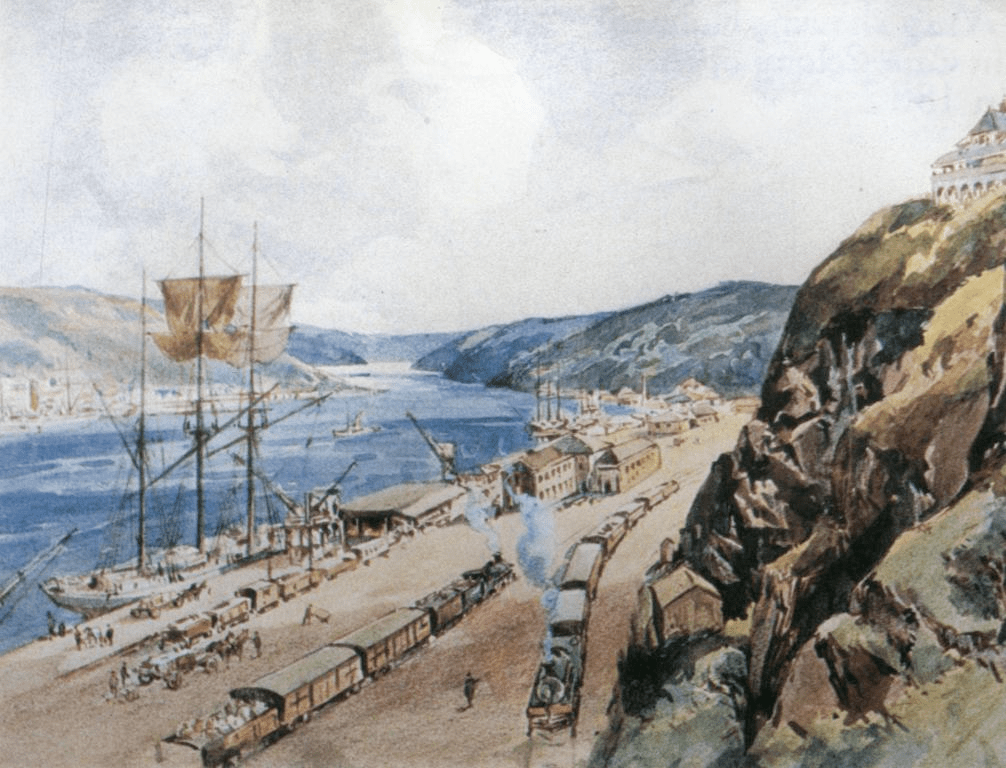
On 20 November 1857, The Lady Kennaway made anchor at East London, South Africa, having sailed from Plymouth, England, two months earlier. The ship was a rough passenger ship (in poor shape by then, judging by the fact that it had been refused insurance that year), about 121 ft long. Following its launch in Calcutta in 1817, it had been chartered by the East India Company, and subsequently transported convicts and settlers to Australia.

East London River Port, 1870s

The Lady Kennaway was wrecked a few days after landing, but not before its passengers had been disembarked. They included 153 women and girls, collected from orphanages and workhouses across Ireland (filled to bursting point by the Great Irish Famine of 1845-49), and taken to South Africa to marry demobilised soldiers.

These soldiers were not British, but mainly German mercenaries, recruited to fight for Britain in Crimea, and relocated to South Africa after the war (which they had barely fought in) had concluded. The British governor’s idea was that they could form the basis of a colonial settlement (and be rescued from the twin perils of intermarriage and homosexuality) by bringing out marriageable women. One of those women was my great-great-grandmother, Margaret Gallagher.

What must it have been like for her, plucked from the trauma of Ireland aged 20, where she had probably seen friends and family die from hunger, transported across the ocean in an ageing hulk and dropped into the heat of East London, the bright sunshine of a Cape spring, with the uncertain prospect of being married off to a soldier she had never met?

Margaret seems to have been lucky. She took up with Patrick Lowry, one of soldiers escorting them to King William’s Town, the provincial capital (now called Qonce). They married and had numerous children (family sources seem unsure of precise numbers), the second-youngest of whom, Annie, was born in Gibraltar, presumably a new posting for Patrick. Annie subsequently married and settled in Essex, where our lives overlapped for a year in the early 1970s.

As I said above, the story is far from exceptional – there must be 152 others like it from that one journey – but it is one little instance of how the great machine of the British Empire scooped people up and moved them halfway across the world, like so many pieces on a chess board.

It recruited foreign mercenaries for a Black Sea war, found it couldn’t use them, and shipped them to settle the lands from which the British had displaced Dutch settlers (who had in turn displaced the indigenous Khoikhoi through warfare and disease). It created orphans through negligent famine in one place, and sent them halfway across the world as soldiers’ concubines. It could be a surprisingly mobile and inter-connected world, but a cruel one too.