Blowing hot and cold on climate

As international delegates and world leaders gathered in Sharm el Sheikh for the opening of the 2022 United Nations Climate Change Conference (COP27), UN Secretary General António Guterres told them, “We are on the highway to climate hell with our foot on the accelerator.”

This dramatic language, and the last-minute decision of UK Prime Minister Rishi Sunak to attend despite domestic turbulence, reflects a growing sense of urgency. Extreme weather has dominated headlines in recent months. In Pakistan, hugely destructive floods followed a summer of temperatures that reached as high as 50C. In Europe, heatwaves dried up rivers, and triggered drought warnings and wildfires.

Heightened public concern can be seen in the long-term findings of the National Centre for Social Research’s (NatCen) British Social Attitudes survey. Our most recent survey, undertaken in late 2021, found a sharp increase in concern about environmental issues. Forty per cent of participants said they were personally very concerned about the environment, and 21 per cent said the environment was one of the top two issues for the country as a whole. The comparable figures for 2010 were 22 per cent and eight per cent.

Over the same period, climate change has also risen in importance relative to other environmental issues. Forty five per cent of British people now see climate as the most important environmental issue, compared to 19 per cent in 2010. Nearly two thirds of people think that climate change is extremely or very damaging to the environment (compared to 43 per cent in 2010), and three quarters think it will, to some degree, be bad for Britain.

People also make the connection between human behaviour and environmental damage: 60 per cent now see climate change as mainly the result of human activity. While there are still some who debate its causes, the number of people who say the climate is not changing at all is now vanishingly small – only one per cent held this view in 2021.

But while there is growing consensus that climate change is real, damaging, and results largely from human activity, the figures are not wholly re-assuring for governments and activists trying to spur faster action, as we engage in what Guterres calls “the fight of our lives”.

Firstly, public concern has increased, but is not as heightened as the urgent tone of debates and deliberations in Sharm el Sheikh might demand. The environment may be a top priority for one in five people, but it ranks lower for everybody else: healthcare, the economy and education remain the top three issues overall.

Secondly, public support for possibly painful mitigation measures is limited. NatCen found around half the population was willing to accept much higher prices to protect the environment, but only 36 per cent were happy to see much higher taxes or their standard of living being cut.

That said, willingness to pay was much higher in 2021 than it was in 2010, when only one in four supported much higher prices. This may not be surprising when we recall the circumstances of 2010, when the world was still reeling from the financial crisis. In the UK, the coalition government had recently come to power with promises of a spending squeeze to come, a return to recession loomed and unemployment had shot up.

And that is the third challenge facing policymakers: the salience of environmental issues seems to be significantly affected by what else is happening. NatCen’s data shows concern about environmental issues and willingness to make sacrifices to address them rose from 1993 to 2000, fell back dramatically by 2010, before recovering lost ground by 2021.

A similar trend is visible in more frequently compiled datasets such as Ipsos Mori’s issues index, which tracks opinion monthly. The September 2022 Issues Index shows concern about environmental issues (“pollution/environment/climate change”) peaking in 2007, in early 2020, then again in late 2021 – just before Cop26 – when they were briefly topped the list of issues of concern.

But a year later, these issues had already fallen back to fourth place – behind inflation, the economy and the health service. Environmental issues are matters of growing public concern, but they are quickly displaced when economic or health crises begin to dominate – and they take time to climb back as those crises recede.

While there is almost universal acceptance of the reality of climate change, there is much less consensus about just how important it is, particularly when the long-term nature of its impacts and mitigations are weighed against the imminent threats of acute financial and public health crises. Like our politicians, the public’s inclination may be to sort out the short term first. There is also less agreement about how climate change should be tackled. Pricing mechanisms gain some support, but taxation and behaviour change are a lot less popular.

All of this suggests that politicians and campaigners still have work to do in hammering home the importance of climate change, not least at events such as Cop27, in embedding it as a priority in turbulent times, and in making the case for mitigating measures that may be painful, as well as those that offer opportunities for green growth, energy security and a better quality of life for all.

Written for NatCen and originally published by the i newspaper

Yeah yeah industrial estate

“A good city has industry,” Mark Brearley writes in Made in London – From workshops to Factories, a handsome book co-authored with photographer Carmel King and journalist and curator Clare Dowdy.

It is a treasure trove, a glimpse into a London that is sometimes as much sensed as seen. King’s photographs show the almost luminous beauty and strangeness of the industrial processes taking place in the city’s backstreets and industrial estates, the rich variety of their products and the faces of the people whose lives are wrapped up in these enterprises.

Through these photographs and Dowdy’s interviews and company profiles you can learn about London’s silversmiths and stone-carvers, its brewers, bookbinders and ceremonial tailors, its makers of everything from umbrellas to chocolate truffles to glass eyes.

But Made in London is polemic as well as celebration. Brearley’s extended introduction argues that London needs to nurture not neglect its “city serving economy” of factories and workshops supplying everything from sandwiches and ready-meals to theatrical sets and ceremonial uniforms. These industries, “humdrum and hidden, but essential”, underpin London’s material economy – a counterpoint to the weightlessness of intangibles and traded services.

Brearley is a friend who I met when working for Richard (Lord) Rogers in Mayor Ken Livingstone’s Architecture and Urbanism Unit. He is an angular, usually charming, sometimes abrasive architect, whose interests in industrial estates, urban margins and slack spaces seemed, when I first met him, a world away from Rogers’s urban renaissance visions, though their perspectives actually proved great complements to each other.

Twenty years ago his campaigning could seem eccentric, even quixotic. Manufacturing in London was declining fast as production was dispersed across the UK or even worldwide. Industrial estates were brownfield sites in the making, their “legacy uses” awaiting enlightened developers. Manufacturing employment in London fell from 1.5 million in 1961 to just over 200,000 in 2001, and had halved again by 2017. Earlier this year Centre for London’s Industrial Land Commission found that 25% of the city’s industrial floorspace has been lost in the last two decades alone.

But Brearley persisted, both within the Greater London Authority and after its architecture team was disbanded by Boris Johnson as a freelance campaigner, an urbanism professor at London Metropolitan University and as part-owner of Kaymet – manufacturer of elegant (and pricey) aluminium trays. He has painstakingly assembled an inventory of manufacturing industry in London – numbering almost 4,000 businesses so far – walking the city’s messier streets and meeting the people who still earn their living through making things.

His campaign seems less eccentric now. Manufacturing employment has been growing by 2-3% a year since 2017, and the boom in online shopping has reignited demand for warehouse space in London – so much so that industrial land is becoming as valuable as residential land in some parts of the city. At the same time, while established large-scale industries have continued to leave, a revived interest in the culture of making – from wooden spoon-carving to craft ale-brewing – has inspired a generation of hipster-industrialists, while environmental and geopolitical factors place a premium on local production.

So London manufacturing is on the up. But Made in London also tells a tale of continued conflict and displacement, of “robust businesses, the workers of many minor miracles, confronted by developer and local government hostility, and forced to divert their energies into fighting expulsion from the city”. The book’s introduction points the finger at the city’s planners for trying to consolidate manufacturing into large, protected estates (“strategic industrial land”), and ignoring the potential for everyday industry – workshops, depots and yards – on each of London’s 600 high streets.

Brearley’s tone is characteristically emotive, even spikey, and he is sometimes too ready to assume bad faith motives on the part of local authorities (such as Southwark, which “lords it over” Old Kent Road, where his factory is located), rather than reflecting on the tricky and intrinsically conflicted process of managing land use and urban change. Faced with planning requirements for thousands of new homes and a net increase in industrial floorspace, some London boroughs face a genuine dilemma (even if clever design and management can help).

That said, it’s Brearley’s factory on the frontline, not mine, so he should be allowed his anger. And the passion he has brought to this subject for two decades, reflected in this lovely book, has served London well by shining a light on our city’s hidden workings and on their persistent vulnerability.

Originally published by OnLondon

Housing risks are multiplying

Fiscal, political and financial events are coming at us pretty fast right now, so it is easy to feel disorientated. But as the screech of U-turns fades and the smoke of burning policies clears, we already seem to be in a world that has fundamentally shifted from the stability of more than a decade of low interest rates.

Bank of England base rates, which have been below 1% for nearly 15 years, are already above 2% and some forecast they will rise as high as 6% next year (though expectations may be starting to fall, following the Chancellor’s latest statement). Mortgage rates have shot up too, with fixed-rate offers already jumping from 2% to more than 6%.

It is true that interest rate rises were already expected, but the chaos following the previous Chancellor’s “fiscal event” in late September means rises have been faster and sharper than most anticipated. What does this mean for the capital?

There’s not much good news, I’m afraid. Firstly, according to the Resolution Foundation, costs will rise sharply for those households whose fixed rate deals come to an end soon. A total of 5.1 million households nationwide – around 60% of all households with mortgages – have deals that run out before the end of 2024.

Londoners in this group will face the steepest rises, with average annual costs rising by £8,000. The capital has the lowest proportion of households with mortgages in England, but even so, there were around 1,000,000 mortgaged households in London in 2020, so around 600,000 of those could be facing a huge hike in the costs of their mortgages, assuming exit from fixed rate deals mirrors the national pattern. The impact will be selective but brutal.

At the same time, house prices are widely expected to fall – and to fall faster in London than elsewhere – as rising mortgage costs delay purchases or even force some sales. The top of the market is still booming, but there are dark clouds on the horizon. Some analysts have predicted London prices falling by as much as 12% by the end of 2024.

At first sight, this looks like it could be good news – at least for first-time-buyers, who paid an average of £440,000 for London properties last year. If those predictions of a 12% price drop were borne out across the market, this figure would fall to £387,000 by the end of 2024 and imply a (10%) deposit of £39,000 rather than £44,000. Together with the impact of Stamp Duty reductions announced in the ill-fated “mini-budget” – still standing at the time of writing, but anything could happen – this would reduce cash move-in costs by around £10,000.

But the impact of this possible saving would be rapidly wiped out by higher mortgage costs. The monthly cost of a 90% mortgage on a £440,000 property is around £1,777 on the basis of a 2.5% interest rate. If and when rates rise to 5%, even a £387,000 property would cost £2,036 per month – £250 more than now, and around two thirds of take-home pay for someone earning £50,000 a year.

For those buyers lacking the family wealth or savings to afford a deposit, falling prices and stamp duty cuts may help a first tentative foot onto the ladder. But the burden of those higher mortgage costs will soon wipe out those savings. Behind every silver lining, another cloud.

With a sharp fall in property values comes the threat of “negative equity”, a thoroughly unwelcome revival from the tail end of the last century. Negative equity – a term to describe when the value of a home is lower than the mortgage secured against it – was estimated to have hit around 40% of properties in London in the early 1990s.

A recent report by property analyst Neal Hudson suggests that a 20% fall in property prices would put 10% of London mortgages in the red. Again, the figure is higher than for other regions because prices in the capital have grown relatively slowly over the past five years, meaning recent buyers have had less chance to build up a buffer of equity.

Although negative equity is unpleasant and unsettling, it only becomes an acute issue if you are seeking to sell or remortgage a property. However, rising mortgage costs could force some sellers’ hands, particularly London’s newest buyers, who are those most stretched in terms of affordability and least cushioned by historically rising prices.

Private sector renters have it tough as well: rents are surging as landlords seek to pass on rising borrowing costs and as competition for properties intensifies, partly driven by a post-pandemic bounce. Some central London letting agencies already report more than 80 enquiries for each rental property, up from 16 in September 2019. As people delay purchases or – in a worst case scenario – see mortgaged properties repossessed, demand for rentals is likely to increase.

Something, you feel, will have to give. There will come a point when landlords will be unable to pass rising costs on to tenants or tenants will simply be unable to pay. Landlords may be forced to sell, as will some first-time buyers, which could feed a spiral of declining property values. Again, this has its attractions but raises the question of who will be able to buy when interest rates remain high?

London property prices may be overdue a correction (that is, a fall), but while interest rates continue to rise, it will be London’s private renters and first time buyers who will be most at risk of losing their home. Sadiq Khan has already renewed calls for rent controls and more funding for affordable housing as market supply stalls.

After the 2008/09 financial crisis a “mortgage rescue scheme”, administered in London by the previous Mayor, allowed housing associations to take a stake in properties to avoid repossessions. It had limited take-up in London and was closed early. But in a city that already has four times the national rate of homelessness, government action may again be needed to soften the blow.

Originally published by OnLondon.

There may be trouble ahead…

One of the grimmer expectations as sizzling summer gives way to apprehensive autumn is that we seem to be heading into a recession. But what sort of recession will it be? To paraphrase Tolstoy, even if all economic booms are alike, every recession is unhappy in its own way. How did London fare in recent recessions, and what could that tell us about the city’s prospects over the next couple of years?

1990-92 – from negative equity to currency speculation

The early 1990s recession technically ran from autumn 1990 to autumn 1991, though it cast a long shadow. It was triggered by rising inflation in the late 1980s, leading the government to put the Bank of England base rate up from around 8% in summer 1988 to nearly 15% in summer 1989 – nearly ten times its level today. Though the base rate came down steeply in the following years, it was still 10% in late 1991.

By this stage, the UK housing market was in freefall. Prices dropped by about 20% nationwide, and the fall was particularly sharp in London and the wider south east – around 30% between late 1988 and early 1993. A similarly sharp crash hit commercial real estate. The 1992 bankruptcy of Olympia & York, developers of Canary Wharf, was one of the most prominent collapses, throwing the planned Jubilee Line extension into doubt in the process.

The late eighties had seen a residential property boom, fuelled by right-to-buy, tax relief on mortgages and pretty lax lending criteria from banks. As prices plunged and mortgage costs rose, many new homeowners ended up with “negative equity” – property worth less than the debt secured on it. A study by economic geographer Danny Dorling estimated that around 40% of Londoners who bought homes in the late 1980s found themselves in this position – the highest rate in the UK. In some parts of east London, the proportion was more than 60%.

London’s workforce also suffered badly. In 1990 the unemployment rate in London was around 6.5%, the same as in Britain as a whole, but by 1994 it had doubled to 13% compared to 10% nationwide. Rates converged slightly in the following years, but London’s unemployment rate has stayed above the national level ever since. One analysis has suggested that factors driving higher unemployment in the capital included employers moving out of the city, high rates of closure in the manufacturing sector, and an increasing tendency for specialised sectors to recruit workers from outside the M25.

Screenshot 2022 08 23 at 17.23.45

A curious turning point in London’s economic fortunes was reached in September 1992, when the UK was forced to leave the exchange rate mechanism (ERM), a precursor to the European single currency, which had required the government to use interest rates to maintain sterling’s value against other European currencies.

As speculation against the pound intensified, the government tried to compete with the speculators by buying sterling and by temporarily putting interest rates back up to 15%, before throwing up their collective hands and leaving the ERM. The value of sterling and interest rates then fell quickly, with the latter reaching 6% by the end of the year, and staying between 3% and 8% until 2008. With relatively low interest and exchange rates, the UK in general and London in particular suddenly looked like a great destination for overseas investment. The stage was set for the 15-year boom that followed.

2008-09 – from credit crunch to quantitative easing

The 2008-09 recession was very different in character and impact. The main trigger for the recession was the “credit crunch” – a sharp reduction in banks’ willingness to lend as they realised that many of them had bought high-risk subprime mortgages, which were starting to default. Because of the way these mortgages had been bundled up the banks didn’t even know how exposed they were. This screeching halt to a lending boom hit the housing market, with knock-on effects on consumer spending and confidence.

As concerns about unidentified “nasties” sent bank shares plunging (dragging the rest of the stock market with them), the government stepped in with a £500 billion programme of loans and guarantees to keep the money moving in the UK banking system. Interest rates – by this time set by the Bank of England – were also reduced sharply to try to return liquidity to lending, falling from 5% in April 2008 to 0.5% a year later. And, like other central banks around the world, the Bank of England also began to buy up government bonds, thereby injecting more cash into the economy for lending and investment (“quantitative easing”).

The immediate impact of the financial crisis was highly visible in London, and commentators expected this “white collar recession”, which had its roots in irresponsible lending by the financial sector, to hit London hardest. In September 2008, the collapse of US bank Lehman Brothers provided schadenfreude-fodder TV footage of stunned-looking bankers leaving their Canary Wharf offices with cardboard boxes of belongings. Immediate job losses in banking were substantial: GLA analysis identifies a net reduction of 30,000 in financial services in 2008-09.

But London proved resilient: overall job numbers in the capital fell faster than in the rest of the country, but also recovered more quickly. Unemployment peaked at 10%, but that was much lower than in 1993. House prices also dipped sharply, falling 15 per cent in London in the year to May 2009, but had recovered to their 2007 level by 2011, three years sooner than that happened in the UK as a whole. Asking “How did London get away with it?”, Professor Ian Gordon of the London School of Economics has observed that the recession affected different classes in different ways: lower-paid administrative and manufacturing workers took a heavy hit, while professionals and people working in service sector jobs supporting them saw much lower job losses over time.

One reason for this, Gordon suggests, is that the package of support provided by the government helped to revive professional services, particularly through diverting investment from bonds into property and shares. In addition, while London’s construction sector took a hit, both the London 2012 Olympic and Paralympic Games and Crossrail were major programmes of public works that sustained demand. It is, of course, arguable whether London’s rapid recovery from 2010, closely tied as it was to soaring property costs, was good for the city as a whole or has acted as a brake on productivity and equity – but that is probably for another day.

2022-?? – prospects for the capital

So, does the coming recession look more like 1991-92 or 2008-09? Worryingly for London, it may resemble the former more that the latter: interest rates and inflation are rising rather than falling (and GLA research suggests that Londoners face particularly high inflation). Private renters are already facing steep rises according to some reports, and London’s owner-occupiers may struggle when fixed-rate deals come to an end: average mortgage debt in London was about 60% higher than across the UK according to a 2017 survey, and the capital has many more borrowers with high loan-to-income ratios. Meanwhile, after a boom in demand for higher quality office space, rising interest rates and energy costs, alongside persistently high levels of home-working, are chilling the commercial real estate sector.

Furthermore, it is hard to see where new money will come from to reignite London’s economy. Quantitative easing has ended (indeed, the Bank of England is contemplating reversing the process), new transparency rules may make London a less favourable destination for (shady) foreign investors, and Transport for London is haggling with government to sustain services rather than gearing up to deliver new infrastructure.

However, for the moment, the economy still seems relatively buoyant. The number of jobs in the capital grew by around 100,000 between March and June this year, and unemployment is falling (even if, intriguingly, more people are dropping out the labour market than entering work). And London continues to top league tables of popular cities for business, from finance to tech (ironically, the sector that powered remote work seems particularly focused on office location).

London’s resilience can emerge from surprising places, as it did in the 1990s when recovery took root in places such as Hoxton and Shoreditch that had been been laid low by recession. There may even be shafts of sunlight behind the clouds. Nobody wants to see a return to negative equity, but a medium-term correction to commercial and residential property values might actually make London more accessible as a place to live and work.

There may be trouble ahead, but London still has the diversity of people and place, the heritage and culture, the transport connections and restaurants, that make it one of the world’s greatest cities. It may be politically and economically difficult to commit major investment in the capital, but the government should at least avoid damaging the social, housing and transport infrastructure that will enable London to lead national recovery after the recession.

First published by OnLondon.

Baby bust and boomer boom – first thoughts on the 2021 census

The 2021 census, conducted in March last year, will forever be a strange record of a strange time – hard to interpret but fascinating for what it doesn’t tell us as much as for what it does. The first results, covering broad population figures, came out in June, and further detail will emerge in the coming months and years, with more expected in the autumn.

The census was already the subject of intense political debate because, as On London has reported, census figures underpin funding formulas for everything from schools to fire services. Undercounting London’s population may rob our public services of resources even as the cost of living crisis deepens.

Past censuses have been criticised for missing many Londoners, for example undocumented migrants who may be unwilling or unable to complete official forms. In 2021 there was the added impact of the pandemic: city-flighters, students stuck at home, hopeful immigrants and emigrants stymied by travel restrictions.

So we should be cautious when looking at London’s census results. But what do they tell us about how London is changing – from cradle to care home – compared to the rest of the country and compared to previous decades?

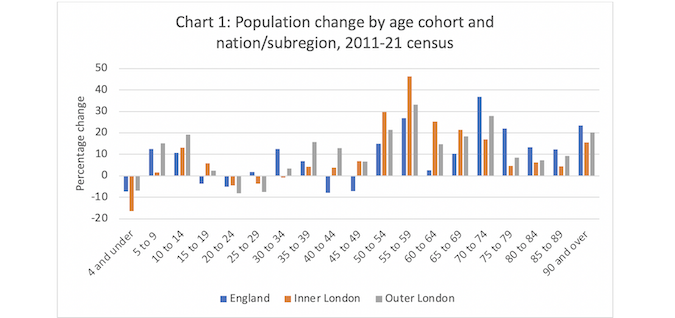
The two charts below summarise the numbers. The first compares the 2011-21 population changes for inner London, outer London and for England as a whole.

Screenshot 2022 08 16 at 19.03.09

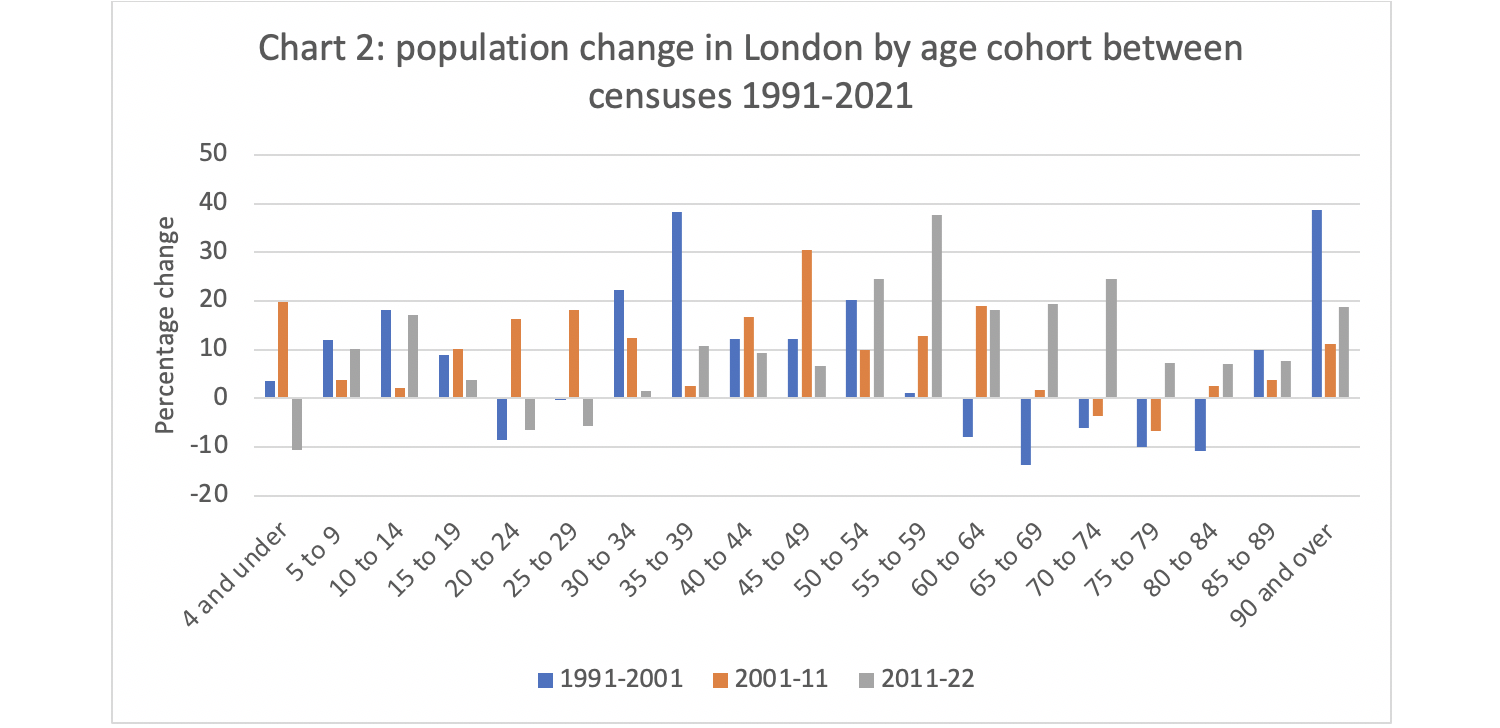
The second puts these changes in context by comparing the last decade in London with the findings for the capital of the previous two censuses.

Screenshot 2022 08 16 at 19.05.34

Here are five conclusions that can be drawn.

One: Baby boom and bust spells turbulence for education authorities

London had a baby boom between 2001 and 2011, adding more than 100,000 under-fives (a 24% rise in the age cohort). This was reversed in 2011-21, with the numbers of under-fives dropping particularly fast – by 16% in inner London.

Some of this change may be the result of young families moving out temporarily during the pandemic but, as  Greater London Authority demographers have explored, the birth rate more or less peaked around the time Boris Johnson started boasting of a London 2012 conception bonanza and has fallen back since then.

This makes planning school places fiendishly complicated: while demand for primary places fell in most of inner London, the outer H-boroughs (Harrow, Hillingdon and Hounslow) saw some of England’s highest growth rates for primary age children. And as the 2000s baby boom fed through, the secondary school cohort has grown much faster: Barking & Dagenham’s 10-to-14-year-old numbers grew by 43%, the fastest in England, with Hounslow, Richmond and Tower Hamlets close behind.

Two: London’s loss of young people was rural counties’ gain – at least temporarily

Between 2001 and 2011, 15 to 30-year-olds accounted for a net growth of around 300,000 people (around a third of London’s total net growth), reflecting the city’s magnetic pull for young people seeking to study, work or simply enjoy their lives. This contrasts with the overall stagnation in that population group in the previous census period spanning 1991 and 2001 and what looks like an almost comical reversal of the early century trend between 2011 and 2021. Rather than flocking to London, twenty-somethings seem to have headed down some deep country roads. For example, Test Valley, East Devon, Maldon and Harborough have seen the biggest rises in their numbers of 25 to 29-year-olds.

Some of this probably does reflect long-term relocation to new hipster heartlands of the West Country and the Kent and Sussex coasts, driven by soaring London rents and the ever-wider availability of flat whites. But I suspect that much more of this apparent exodus has already reversed, as young people who moved back to parental homes during the pandemic or began their university studies online have returned to larger towns and cities. The GLA’s helpful guide to the census uses payroll data to show just how many early-twenties workers left the capital during the pandemic and came back in autumn 2021.

Three: London’s boomers are booming

London’s middle-aged population (yes, including “Gen X”-types as well as “Boomers”) has soared, seeing some of the highest growth rates in England. The number of 55 to 59-year-olds in inner London grew by more than 45%, including by around 60% in Southwark, Lewisham and Lambeth. This contrasts sharply with England as a whole, where this age group grew by a more modest 27%. The London growth is also much faster than in previous decades: the 55 to 59-year-old population increased by 13% between 2001 and 2011, and by a negligible 1% the previous decade.

Some of this probably has its roots in London’s rapid growth of 35 to 39-year-olds in the 1990s, though of course there will have been plenty of churn between the census years. But it is interesting to consider why this generation may have chosen to stay in the city – and in inner London in particular – a rather than moving to the suburbs or a Home Counties village.

This was a generation that was able to benefit from relatively low house prices in the early 1990s following the property crash at the start of the decade. As mortgages are paid off, properties that were bought for tens of thousands of pounds are now valued at ten times as much. At the same time, since the pandemic, there has been a nationwide fall in the number of over 50s in the labour market.

It’s too early to join the dots convincingly between these trends – to say confidently why the numbers of middle-aged people have risen so fast in inner London boroughs. But we can speculate. Is this a “boomer belt” of reasonably well-off homeowners? People who may have stopped working and don’t feel the same financial pressures as younger Londoners in precarious housing, some of whom don’t see any great urgency in building more houses in established neighbourhoods? Interestingly, Brighton and Hove, which has similarly high housing demand and constrained supply, has seen a very similar demographic shift over the past decade.

Such stability makes for liveable neighbourhoods and lively local shops, cafes and restaurants. But at what price? If high prices and low supply squeeze younger and poorer people out of the inner city neighbourhoods, or even block them from moving there in the first place, stability may be at the cost of vitality and – in the longer term – economic productivity.

Four: London is ageing, even though not as fast as we thought

If London’s boomers stay in the city we will also see a big bulge in the older population when we come to review the 2031 census. Over the past ten years, London’s sixtysomething population has grown a lot faster than the English average. Among the over 70s, growth has been slower, though boroughs such as Waltham Forest and Redbridge have been closer to the national average.

As the GLA predicted, the census figures showed that previous estimates had over-done the size of London’s elderly population. However, growth is coming, and as today’s 60-year olds enter their seventies around the time of the next census, there will be a corresponding growth in demand for health and care services, making their currently dysfunctional funding and management an ever more urgent issue for London. It will also bring into sharp focus the issues of specialist housing for older people that were explored by my former Centre for London colleagues last year.

Five: Something was happening in 2021, but we don’t yet know what it is

The pandemic was probably more disruptive for London than any event since the Second World War (when no census took place). While its impacts were not as cataclysmic for city living as some predicted, we still don’t know what the long-term effects will be on working patterns or on how and where people choose to live. Nor do we know how new immigration arrangements, political change and the looming recession will affect the capital.

There may be a case for a mid-term census in 2026, as suggested by economic geographer Danny Dorling. But London will undoubtedly need to draw on data from the latest census and beyond to understand the city, who it is working for, and how it is changing.

First published by OnLondon.

Into the red

Levelling up has stalled, according to IPPR North’s latest analysis of public expenditure figures. The think tank’s press release highlights a 25 per cent real terms rise in spending per person in London between 2018/19 and 2020/21, compared to 20 per cent across England and 18 per cent in northern regions. IPPR North Research Fellow Ryan Swift said, “Our analysis suggests that levelling up was, in many ways, business as usual.”

These expenditure comparisons are a regular feature of regional inequality discussions, and are a pretty poor measure at the best of times. In every region, they aggregate places of great wealth and poverty. They also mix expenditure that represents investment in public services and infrastructure, with expenditure on welfare payments and support where local communities and economies are struggling. Everybody would want more of the first, but to need less of the second.

Transport spending figures are particularly contentious. While IPPR North research has repeatedly pointed to higher transport spending in London when arguing for more funding, Greater London Authority analysis from 2017 argued that, while London’s public expenditure on rail is high if compared to its resident population, it is much lower than the Midlands and North if compared to the number of journeys taken on it (with similar comparisons for expenditure on roads).

The pandemic has made such comparisons even more problematic. As both IPPR North and the Office for National Statistics (ONS) note, 2020/21 expenditure figures include huge sums spent on coronavirus support schemes such as furlough, self-employment support and business loans, all of which saw very high take-up in London, which has a bigger economy and many more jobs than any other region. But even when you take these costs and health spending out of the equation, IPPR’s analysis still shows London with eight per cent growth over three years, compared to three per cent across England and two per cent in the North.

What accounts for the rest of the increase? Welfare and transport primarily, according to the ONS analysis. Unemployment-related benefit claims shot up much faster in London than in the rest of England as the economy went into hibernation in 2020, as reported by Centre for London. And the capital city’s public transport system saw a devastating loss of fares revenue, relying on short-term government handouts to remain solvent. Far from being a sign of favouritism, this boost to spending in London is a symptom of a capital city on life support as the pandemic laid waste to its economy.

Extraordinary responses to extraordinary circumstances should be temporary, so the expenditure gap between London and other UK regions should narrow in coming years. But it is the other side of the fiscal balance sheet that should worry us all in the longer-term. Alongside increases in expenditure, taxes raised in London fell by £6.7 billion in 2020/21, with business rates accounting for nearly half that reduction, followed by VAT, stamp duty and air passenger duty. In 2019/20, London made a net contribution (total revenues minus total expenditure) of £40 billion to the UK; in 2020/21 London had a net deficit of £7 billion – the lowest deficit in the UK, but still a dramatic change in fortunes.

From this perspective, the pandemic has in fact closed the gap between the UK regions, but only by levelling London (and the South East) down. So we should be careful what we wish for as we emerge from the coronavirus crisis into a new age of economic instability. Yes, London should be arguing for the government investment in green jobs and neglected infrastructure that will help northern regions realise their potential. But all of us should also be making the case for supporting London’s economy, so that the UK’s premier global city can once again generate the revenues that will help turn these aspirations into reality.

First published by OnLondon.

9 to 5?

With Cristian Escudero

How many people are working from home, and how many have returned to the office? The answer to this – apparently simple – question is surprisingly complicated.

Estimates have varied – as the pandemic has waxed and waned, as government guidance and regulation has changed, and as different surveys have asked subtly different questions. As part of a new project at King’s College London, Work/Place: London Returning, we have been comparingthe different surveys and what their results tell us, alongside our own Wave 1 Work/Place survey of London’s workers. 

Although the headline figures emerging from the various surveys have varied, one feature has remained consistent throughout: London’s experience has been different to the rest of the UK’s. The capital saw more people furloughed at the beginning of the pandemic, and has persistently had more people working from home. For example, in its 2020 round of interviews, the Office for National Statistics (ONS) Annual Population Survey (APS) found that 37 per cent of London’s workers had worked at home the previous week, compared to 26 per cent across the UK. In January to March 2021, the ONS Opinion and Lifestyle Survey found that up to 65 per cent of Londoners and 46 per cent of people across England had worked from home as a result of Covid the previous week. In late March 2022, the same survey showed that around 26 per cent of the UK population worked from home, while 37 per cent of Londoners did. Most recently, in July 2022, ONS analysis showed London had seen sharper rises in homeworking, and bigger drops in commuting from out of region, than any other English regions between late 2019 and early 2022.

Remote working has always been more prevalent in London: APS data shows that 18 per cent of London’s workers had worked from home in the week prior to interview in 2019, compared to a UK average of 12 per cent. But why are people who live and/or work in London (the groups are similar but not the same) so much more likely to work from home, and are they likely to return to the office over time?

There are some factors that enable London’s workers to work remotely and there are others that encourage them to do so. More London workers can work remotely because of the industries they work in. As our paper sets out, many more Londoners work in professional services, and information and communications roles – for example, as lawyers, accountants, consultants, TV producers, IT consultants, architects. These jobs accounted for 22 per cent of London employment, but only 14 per cent across England. These were also the jobs that switched online most easily: in January 2021, employers in England estimated that 44 per cent of professional services workers and 59 per cent of information and communications workers had been working from home in the previous two weeks.

By contrast, in sectors such as hospitality – which rely heavily on face-to-face contact and account for a similar proportion of jobs in London and across England – nearly 75 per cent of staff were on furlough at that time. London’s workforce split between the workers who took their work home, and the workers whose work vanished as commuters and tourists stayed away, which also explains why the capital had both the most resilient productivity, and the highest rises in unemployment during the pandemic compared to other English regions.

Industrial structure accounts for some but not all of the difference. The effect is compounded by occupational structure: 62 per cent of Londoners worked management, professional or associate professional jobs in 2021, compared to 50 per cent across England. Around 40 per cent of people doing these jobs worked from home for at least one day the week before they were interviewed in 2020, compared to caring, skilled trade and customer service jobs, where 10 per cent or fewer reported doing so.

These features of London’s workforce help to explain why Londoners and London’s workers (overlapping but distinct groups) can work from home; the Work/Place survey also sheds light on why they are choosing to do so – at least some of the time. The survey found that the costs of commuting, and the time it takes, were the leading factors behind home-working. While respondents valued the flexibility of working from home, they did not dislike their office environment – on the contrary, many valued the sociability and buzz of their London workplace – but disliked the time and expense of daily commuting.

Commuting is a big cost – in terms of time and money – for people living and working in London. Labour Force Survey data for London boroughs showed their residents commuted an average of 39 minutes each way in 2016, compared to 28 minutes for other English local authorities, and showed similarly lengthy commutes for people living in commuter districts such as Chiltern, Dartford and Elmbridge. One London PR agency has estimated that commuting can cost £8,000 or more every year, when additional childcare costs are added to season ticket costs – equivalent to 22 per cent of the average PR salary after tax.

London workers have both the capacity and incentives to work from home, at least some of the time, and the fact that leisure visits have been recovering faster than workplace visits suggests that it is long-term changes in habits rather than short-term fear of infection that is influencing behaviour. Against this backdrop, it is unsurprising that our Work/Place survey found that only a minority think that the five-day commute will return. For the moment, the preference seems to be for hybrid working, with around 45 per cent of London workers viewing two to three days working from home as optimal. Culture and practice will shift the dial one way or another in specific organisations and industries, as would government action on the costs of commuting and childcare, but our research suggests that the impact of the pandemic on London’s work patterns has been significant and will be long-lasting.

First published by Kings College London.

Inverted pyramid of Pfeffel – Boris Johnson’s legacy

July 2012 was an odd time for me. I was working at London Legacy Development Corporation (LLDC) in offices minutes away from the Olympic Park, but as the London 2012 Games drew closer, it was clear there was nothing much for me to do. Not being a big sports fan I hadn’t bought any tickets, so a couple of days after the opening ceremony I flew to a small Greek island, where cheers from the local bar were the only indicator of London’s growing medal tally.

The LLDC itself had only been established a few months earlier. After years of wrangling between the Mayor of London and government, planning and delivering London’s Olympic legacy would be wholly in Boris Johnson’s hands.

You can probably guess what happens next. You expect chaotic bumbling, classical allusions, questionable personal morals, sound and fury signifying nothing. Boris Johnson’s behaviour has so tarnished his reputation in recent weeks and months that it is hard to even entertain the thought that good things came out of his mayoralty. But some did – and most of them are in the Queen Elizabeth Olympic Park.

Early signs were not auspicious. Following his election in 2008, one of Johnson’s first moves was characteristically whimsical. After a chance meeting with steel tycoon Lakshmi Mittal, he launched a competition for an “Olympic tower” as a landmark within the Olympic Park, which resulted in the tortuous steel folly that is the ArcelorMittal Orbit. 

Apart from this, the Mayor more or left the construction programme for the Games – well advanced by 2008 – to run its course. Instead he looked to legacy, re-opening the issue of getting a football club into the stadium (a saga in itself, and one extensively covered in Dave Hill’s excellent Olympic Park book), backing the establishment in 2009 of the Olympic Park Legacy Company (an uneasy joint venture between the government and the Mayor), and working with David Cameron’s government to convert this into what became the LLDC – a mayoral development corporation with more powers over planning and singular accountability to the Mayor’s office.

He also cast a wary eye over the plans for the legacy development that would follow the Games. A new masterplanning team, comprising Allies and Morrison and EDAW, who had worked on the Olympics masterplan alongside the Dutch firm KCAP, had been appointed just before Johnson was elected. Their plans for the Park included large scale urban blocks – like those eventually built in the athletes village – filling in the space between the retained venues and parkland. 

These would have made a striking contrast with surrounding neighbourhoods of terraced housing – not necessarily a bad thing, but not to the incoming Mayor’s taste. I want Georgian terraces, he told the design team at one meeting. Yes, they replied, we need to reinvent the terraced townhouse as a 21st Century typology. No, he insisted, I want Georgian terraces...

Beneath squabbles over architectural and urban form were deeper issues of money. The government had pushed for a design and delivery schedule that could generate enough capital receipts to repay debt that had been incurred in buying up land and borrowings from the National Lottery to pay for the Games. Denser development would yield higher returns, and house prices growing at 10 per cent a year would make later phases of development particularly valuable – at least on spreadsheets. 

As the Mayor and his advisors began to engage with the plans in the expectation of control shifting from Whitehall to City Hall, the Legacy Masterplan Framework was reinvented as the Legacy Communities Scheme, launched in 2010. Gone were most of the giant “European” perimeter blocks, as forms shifted to something reflecting what design advisor Ricky Burdett talked of as “London’s DNA”– terraces, townhouses and dense streets (with a few neo-Georgian flourishes to please the Mayor in the computer-generated images). We reworked the spreadsheets to show that debt could still be repaid, but this began to feel like an incidental, rather than central, objective for the legacy plan.

More change came in 2012, when Margaret Ford was replaced as LLDC chair first by Johnson’s idiosyncratic deputy Daniel Moylan, and then – after only a few months – by the Mayor himself, supported by Neale Coleman as deputy chair. Dennis Hone moved over from the Olympic Delivery Authority to replace Andrew Altman as chief executive and was asked to accelerate construction: the development corporation should act as a public body, not as a commercial developer; it should build housing, not bank its land while house price inflation stored up treasure in the future. 

A further dent in the spreadsheets came when Boris Johnson decided that Queen Elizabeth Olympic Park needed more than sports venues, mid-scale housing and a beautiful park. The success of the 2012 Games had piqued the interest of museums and universities, who had previously regarded the Park as a potential location for student housing but not much else. Boris Johnson became a cheerleader for a new cultural and educational district, dubbed Olympicopolis – a nod to the “Albertopolis” legacy from the 1851 Great Exhibition in South Kensington (and now renamed by his successor as East Bank, itself a reference to the 1951 Festival of Britain’s legacy).

The only problem with the plan – enthusiastically promoted by the Mayor as transformational to the global image of east London – was that it involved filling Stratford Waterfront, the most valuable site in the Park, with development that would require investment rather than generating receipts. Nevertheless, the Mayor pushed the plans forward, shepherding the Victoria and Albert Museum, University College London, Sadler’s Wells dance theatre and the London College of Fashion to agreement, securing capital investment from George Osborne’s increasingly-austere Treasury, and – less successfully – establishing a charity to fill the funding gap.

It is, of course, quite possible that another Mayor of London would have pushed back on spreadsheet architecture, and reshaped the Olympic Park plans to look “more like London”as Johnson did. It is possible too that another would have captured the imagination and commitment of Olympicopolis partners. But these changes in emphasis were distinctly Johnsonian in their chutzpah, their ambition and their grandiose historicism – even if accompanied by an equally characteristic blitheness about affordable housing and capital receipts. Ten years on, if the planning of the Games was Ken Livingstone’s, the shape of legacy is Johnson’s. 

First published by OnLondon

When tube lines go to war, one is all that you can score

The role of Parliamentary Assistant for the London Underground (Green Park) Bill sounded pretty exciting when the temping agency suggested it to me. Newly arrived in London at the height of the 1990s recession, I needed work and entertained daydreams of passing notes to MPs, briefing journalists and crafting ingenious arguments about, er, something to do with extending the Jubilee Line?

The Sisyphean reality – photocopying and bundling documents, then unbundling and shredding them a few days later – was a bit less glamorous. It was autumn 1993 and the Bill – the last piece of enabling legislation for the Jubilee Line extension (JLE) – was already in its last stages. Construction contracts had been let, and the parliamentary team started to disperse. 

Many of them moved round the corner to Dacre Street to work on Crossrail, which was the next big transport project. Or at least it was until May the following year, when a House of Commons committee stopped the bill process dead in its tracks. What I didn’t realise at the time was how intense competition had been between the JLE and Crossrail, and how significant this competition and its outcome would be for London’s evolution in the decades that followed. 

Both Crossrail and the JLE can trace their lineage back to the 1970s or beyond, but gathered momentum in the late 1980s, those strange years when London lost its metropolitan government yet saw resurgent economic growth and the first signs of population recovery after 50 years of decline. Secretary of State Paul Channon’s foreword to the Central London Rail Study, published in January 1989, referred to the capital’s economic growth “putting severe strains on London’s transport system”. The study proposed an east-west ‘Crossrail’ (as well as alternative Chelsea-Hackney and Victoria-Euston-Kings Cross options), and detailed project planning was given the go-ahead the following year. 

But something was stirring in the east. In 1981 Michael Heseltine, Secretary of State for the Environment (which then included local government and urban policy), had established the London Docklands Development Corporation to find new uses for the swathes of land left derelict by the closure of east London’s docks. Rail and road infrastructure – including the Docklands Light Railway (DLR) – had been an early priority, based on the loose expectation that the docks would be redeveloped for a mixture of housing and light industry.

All that changed in 1984 when American banker Michael von Clemm visited Canary Wharf. Von Clemm was looking for food preparation units for Roux Brothers Restaurants, in which he was an investor, but returned to his offices at Credit Suisse First Boston to propose that the bank could build offices there rather than continuing to haggle over floor space with the deeply conservative City of London Corporation. Michael Cassidy, the City’s then chair of policy and resources, recalls von Clemm taking him to the site and saying, “I’m going to build my office here, and I’m going to blame you – the City – for making me do it.”

A succession of plans, changes of ownership and bankruptcies followed, but in 1987 Olympia and York (O&Y), the Canadian developers of Battery Park City in New York, signed a development deal to build 12 million square feet of offices at Canary Wharf. This would mean 50,000 daily commuters, way beyond the DLR’s capacity, so O&Y promised to build a new railway line – unofficially and unfortunately known as the Canaryloo Line – to run from Waterloo through Canary Wharf to Greenwich. 

Margaret Thatcher’s government liked the entrepreneurial spirit of the proposal, but Department for Transport officials were nervous of freelancing rail schemes, so a separate East London Rail Study was commissioned to review options for improving access to Canary Wharf. It reported in July 1989 and recommended that the Jubilee Line be extended via Canary Wharf and North Greenwich to Stratford. The total cost would be around £1 billion, of which O&Y would pay the £400 million they had earmarked for their own project.

By summer 1989, therefore, two rail mega-projects were eyeing each other uneasily on the starting blocks. The government was committed to maximising private sector contributions to both, which gave the JLE an advantage, as private finance was already committed to it. So the JLE overtook its venerable competitor in securing parliamentary approval: the main bill was introduced into Parliament in late 1989 and received royal assent in March 1992, while the Crossrail Bill did not have its first reading until November 1991.

Just as many in the City saw Canary Wharf as a threat to their pre-eminence as a financial centre, the JLE’s rapid parliamentary process alarmed many of Crossrail’s supporters – particularly central London property companies such as Hammerson, Land Securities and Grosvenor – which feared that the usurper railway would boost Canary Wharf at the expense of the City. As the 1992 general election approached and the UK slipped into recession, a new coalition began to assemble, galvanised by the need to prevent Crossrail being sidelined.

This coalition, led by Sir Allen Sheppard of leisure conglomerate Grand Metropolitan, was formally launched after the election as London First. Robert Gordon Clark, who became London First’s head of communications the following year, says their primary focus on lobbying for Crossrail to be built either ahead of or alongside the JLE led one property journalist to rename them “London First, Docklands Second”. 

But by then, the JLE had problems of its own. The global recession had hit O&Y’s north American holdings hard, and in May 1992 its creditor banks pushed the company into administration. The JLE  had received royal assent but its funding package had collapsed. “I had to work very, very hard to get the Jubilee Line extension underway, because at the time the Treasury just didn’t want it. We were in recession and they were fighting very hard to avoid any capital expenditure,” recalls Steve Norris, who, after the election, was appointed minister for transport in London. 

The Treasury insisted that the banks who now owned Canary Wharf maintained O&Y’s £400 million commitment, perhaps hoping this would kill the scheme off but, as Norris observes, funding the JLE was the only way for the banks to recover their losses: “Their property in Canary Wharf had virtually negative value at that time. With the kind of rents you could get without decent connectivity, the whole thing was a liability not an asset. So all the banks signed up, which made it very difficult for [the Treasury] to refuse. But they were dragged kicking and screaming.”

Lagging two years behind the JLE in Parliament and lacking committed private sector finance in the wake of a recession, Crossrail was more vulnerable. In May 1994, the four-person committee reviewing the Crossrail Bill threw it out. The committee’s issues with the scheme included its lack of connectivity to the Channel Tunnel Rail Link, falling Tube usage (which was 20 per cent down on its 1980s peak by 1994), and above all the lack of committed funding from either the Treasury or private finance. 

Transport schemes never quite die, of course, so Crossrail was sent into a limbo of new designs, parliamentary procedures, cost-benefit analyses, studies, spending reviews, business cases and consultations. London First kept the flame alive, particularly when Labour came to national power in 1997 followed by London’s newly-elected Mayor Ken Livingstone worked closely with both the City and Canary Wharf to make the case for the scheme, which broke ground in May 2009.

As the Elizabeth Line finally opens, it feels like closure for this chapter of London’s history, even if Crossrail 2 (the old Chelsea-Hackney line) is receding into the future. The JLE stole a march on Crossrail by having a single private sector stakeholder with deep pockets, and by being first out of the parliamentary stocks (though the delivery of the scheme was beset by overruns and delays). It shouldn’t be this way, but sometimes being first is as important as being best. 

But it is hard to argue that the Jubilee Line extension should have been ditched. Without it, Canary Wharf’s development would have been blighted and London’s development would have been dramatically altered: no second financial centre, no Millennium Dome on the heavily polluted Greenwich Peninsula and maybe no Queen Elizabeth Olympic Park in Stratford. By accident and design, the JLE was transformational. Perhaps Crossrail would have gone ahead more quickly without it, and perhaps it would have been completed in time for the 2012 Olympic and Paralympic Games. But, given the constraints on public spending in the 1990s, perhaps not.

The most enduring legacy of the rivalry between these rail schemes was the galvanising effect they had on London’s businesses and local authorities, impressing on them the urgency of coming together to lobby for the capital’s needs – including for the introduction of a directly elected Mayor, later championed by London First. It is a coalition that still needs to speak for London today.

First published by OnLondon.