More house, in the middle of our street

Michael Gove was on fizzy form yesterday morning as he sought to sell his package of housing and planning reforms over the airwaves. “Beauty! Infrastructure! Democracy! Environment! Neighbourhoods!” he proclaimed, arguing that local empowerment would lead to better homes being built and fewer new developments being opposed. Coming from a minister once described by David Cameron as “Maoist” this sounded positively Leninist – All Power To The Neighbourhoods!

“Street votes” are at the heart of Gove’s announcements, though there is almost no detail about them in the draft Levelling Up and Regeneration Bill. They respond to a question often aimed at those arguing for the regeneration of social housing estates – why are you picking on social tenants? Why don’t people living in privately-owned neighbourhoods have to densify? To which the obvious retort is, why would they when they would see the pain of new development, but none of the gain?

The idea of street votes, developed by Samuel Hughes and Ben Southwood at Policy Exchange but with broad-based political support, is to put in place a framework that will encourage such densification. Local residents would be able to prepare plans and design codes for making their streets more dense – through infill, through upwards extension, through demolition and rebuilding – resulting in more homes to meet need, profits for local property owners, and tax revenues for local authorities. Even if you excluded older and listed buildings, the Policy Exchange report estimated 800,000 homes in London would be eligible.

The proposal is not a cure-all for the housing crisis in the capital or anywhere else, but it could be a part of the solution (I was one of the many endorsers of the original report). Street votes align incentives locally and could stop London’s new development being so “lumpy” – miles of untouched terraced housing interrupted by occasional eruptions of towers.

Ominously, some media reported (or were spun?) the policy as an opportunity to veto new development, and the biggest risk is that neighbours are unable to agree how or even if they want their street to change. In that case, resident and council time has been wasted, but people would still have the option to seek to extend or subdivide their own homes. Street votes won’t work everywhere, but that’s no reason to reject an idea that could work somewhere.

The other major measure that has been reported is a standardised infrastructure levy to fund affordable housing, and the roads, schools and surgeries which new homes need but are often a bone of contention for their opponents. A clear tariff for new development would create more transparency for developers, councils and communities.

Background papers to the Queen’s Speech indicate that this will be set locally, responding to concern that a national tariff would stifle development in some places while not meeting the costs of new infrastructure in others. Nonetheless, in the age of “levelling up”, there is an understandable worry that a levy would be used to siphon money away from London, hobbling its ability to build the 100,000 homes a year that government still insists are needed, even though the draft Bill underlines that the levy is designed to meet local costs.

But the bigger problem with the new draft Bill is what it doesn’t do. Stripped out since the Planning White Paper is any idea of a national system of zoning, by which councils and communities would identify the sites for new development and agree the design codes that would manage this. Like standardised tariffs, these were intended put in place up-front public consultation rather than scheme-by-scheme negotiation, which favours larger housebuilders with deep pockets and serried ranks of consultants to support them.

Gone too (or maybe not) are the targets that would hold government’s and councils’ feet to the fire. “I don’t want us to be tied to a Procrustean bed,” Gove mused cryptically on Radio 4, referring to the Greek myth about an innkeeper who would stretch his guests to fit his bed, or lop bits off until they did, although a government spokesman later confirmed that the national target of 300,000 homes in England per year still stood.

Enabling local residents to shape new developments, pushing for better design and ensuring that new building can be backed by the infrastructure that makes places work, should help reduce opposition to new development, particularly in gently pushing up densities in cities such London. But it cannot be the entire response to an ever-worsening housing crisis. Even if Londoners become uncharacteristically excited about new development, gentle densification of 800,000 homes in London would not easily deliver 100,000 homes a year. Cities need big plans, as well as thousands of small ones.

First published by OnLondon.

Bringing it all back home

London has had a rough two years since the pandemic started. The capital has been at the forefront of successive waves of Covid, commuters and tourists have stayed away, and Transport for London seems to be being kept alive by government in much the same way that a mouse is kept alive by a bored but malevolent cat.

In some of the city’s bleaker moments commentators have wondered whether it will ever recover – some doing little to disguise their glee. At the beginning of last year, decline enthusiasts seized on an analysis of Labour Force Survey stats, which estimated that London’s population might have declined by 700,000 – nearly eight per cent – since the beginning of the pandemic, mainly as a result of foreign workers leaving the capital. Would these workers ever come back? Would the city ever recover?

New statistics out this week from the Office for National Statistics suggest that, while employment of foreign workers in London has fallen, any exodus has been a trickle rather than a flood. Between June 2019 and June 2021, payroll employment fell by around 110,000 in London. Broken down by nationality, employment fell by 40,000 for UK nationals and by 85,000 for European Union nationals, but rose by 15,000 for other foreign nationals.

The chart below tracks employment numbers compared to June 2019. Across the country, UK and EU employment has fallen while employment of people from the rest of the world has risen. The switch from EU to broader international immigration reflects the UK’s new immigration regime, introduced at the beginning of 2020, which gives EU citizens the same status as people from other countries.

Screenshot 2022 03 03 at 16.29.29

The trends are similar in London to the rest of England, but the falls were deeper and steeper in the capital and recovery has been slower, as industries such as hospitality have struggled to emerge from the pandemic. But the changes are much less dramatic than previous estimates suggested. Even in the first year of the pandemic only 100,000 European workers left employment, and by spring 2021 the trends were being reversed for all groups. EU worker employment increased by 20,000 between January and June 2021.

There are some striking differences between sectors too, some more surprising than others. The sector with the steepest job losses, hospitality, saw a reduction of 30 per cent in employment of EU workers. It remains to be seen how far these numbers will rise again as London’s commuters and tourists return, and whether new jobs will be taken by UK, European or other overseas workers. Towards the end of last year a staffing crisis hit hospitality, but the government has ignored calls to make work permits available for more roles in the sector.

Other areas with sharp EU job losses included administration and arts, entertainment and recreation. In construction, on the other hand, the EU workforce grew by 12 per cent between 2019 and 2021, and the number of other international workers by 15 per cent, while the UK national workforce remained unchanged.

We should not place too much store by these figures. They estimate the number of people employed using HMRC payroll data, so they are not precisely equivalent to job numbers, still less to population numbers. But they do give an indication of the direction and scale of change.

Can we conclude anything about population numbers? At a push. If we take UK nationals out of the picture and make the (fairly bold) assumption that the ratio of population to payroll employment for the EU and international workers was roughly the same in 2021 as it was in 2019, it looks like London’s foreign national population might have dropped by around 100,000 in the two years to June 2021. That is a big drop in a city used to net international immigration of 80-100,000 people every year, but it is a lot a lot less than some estimates and it looks as if London is already well on the way to making up lost ground.

Two years ago, I suggested that the shift to non-EU immigration would favour London, all other things being equal. All other things have certainly not been equal, but London’s loss of overseas workers to date has been in line with the colossal international disruption we have seen over the past two years. As we recover and our global connections re-open, London’s growth may once again be turbo-charged by international migration.

Missions Aspirational

You have to feel for Michael Gove. Rarely has a document been freighted with as much expectation as the levelling up white paper, which has been promised in one form or another since 2019. But even as the Department for Levelling Up, Housing and Communities was being given its new remit the spending shutters came down, ruling out new money – at least on the scale needed to radically alter hundreds of years of economic development.

Without new money the white paper sets direction rather than powering engines, though it does offer a few enticing hints of change. It promises, for example, to push devolution further and to bring some clarity and consistency to England’s idiosyncratic patchwork quilt of local government, and it celebrates the role of local policy-making. It even suggests that mayoral combined authorities and the Greater London Authority might bid for “sweeping further powers”, though it stops short of any significant transfer of fiscal powers.

And it does at least tell us what the government thinks “levelling up” is. At the core of the paper are 12 targets for 2030, heroically rebranded as “missions”. Advocates of mission-thinking as a way of galvanising action often point to John F Kennedy’s commitment to put a man on the moon by the end of the 1960s. Note that JFK didn’t make 11 other commitments at the same time. But most of these targets are laudable, even if the lack of detail on delivery makes them feel rather “aspirational”.

It is notable that most of them focus broadly on national improvements in social and economic conditions – job numbers, productivity and pay, violent crime, wellbeing, pride in place, school standards, adult training and home ownership – rather than explicitly on closing the gap between “LondonAndTheSouthEast” and other regions, which can of course be achieved by levelling up or by levelling down. Essentially the missions argue that all should rise together, though several qualify this by specifying that the worst-performing places should see the sharpest improvements.

Some targets are more explicit in their focus on narrowing gaps. Public transport across the country is to be “significantly closer to the standards of London” by 2030, which is a slightly ambivalent pledge given the cutbacks being considered by Transport for London in the absence of a long-term funding deal. It also does prompt a raised eyebrow – can other cities, let alone less densely populated towns, really support services like London’s?

The focus on narrowing the gap in healthy life expectancies also stands out, though the detail remains to be filled out in a separate white paper on health disparities later this year. In the meantime, the question of what geographies you use to judge success will be vital. As previously remarked here, the difference between places within the same borough can be every bit as stark as those between different regions.

There is a little more meat in the two economic missions. One pledges to improve pay, employment and productivity in every area of the UK – which should be good news for London, where productivity growth has stalled in recent years. The other proposes rebalancing public expenditure on research and development (R&D) outside the Greater South East. This could be one of the strongest measures in the white paper. Public spending on R&D is heavily focused on the “golden triangle” of London, Oxford and Cambridge, and there is a good argument that this concentration is failing on the grounds of economic efficiency as well as fairness.

Rebalancing investment to where it can make a real difference both directly and through attracting private investment rather than insisting it is spread evenly throughout the country, could make a real difference. The promise of £100 million for three new “innovation accelerators” in Greater Manchester, the West Midlands and Glasgow suggests that the need for focus is understood. Any switch of resources from London to other parts of the UK is likely to feel harsh, but a rebalancing of R&D spending is worth contemplating as a way of building up the knowledge economy in other cities.

Much less helpful is the white paper’s restatement of the government’s plan to divert funding for housing away from the areas of lowest housing affordability – that is, London and the South East. Doing so seems to fly in the face of its protestations that “levelling up is not about making every part of the UK the same, or pitting one part of the country against another. Nor does it mean dampening down the success of more prosperous areas”.

Less money for affordable housing in London is not likely to be good for London or the UK. London’s housing crisis is likely to worsen, with one of two results or a mix of them. Either the capital’s economy will suffer, with consequences for the rest of the country, or living in London will become more exclusive, further detaching the capital from the rest of the country. Investing to lever growth into other cities is a worthwhile endeavour. Removing support for infrastructure in places that most need it seems short-sighted and even spiteful.

Originally published by OnLondon.

Living in The City

It is an unlikely proposition on the face of it – a new block to house 644 students nestled among the polished steel and plate glass of corporate lawyers’ and consultants’ offices on High Holborn, just opposite City Thameslink Station. But this is the planning application the City of London Corporation’s Planning Committee will consider on Tuesday, with officers recommending approval.

Student housing in the heart of the City? Is this a harbinger of changing times – even of decline – as London comes to terms with “life after Covid”?

City of London planning policies, backed by the London Plan, have always been stalwart in defending the Square Mile’s unique mix of “world city” commercial functions. Loss of office floor space, the corporation’s policy says, should be considered only in exceptional circumstances. And the recent boom in privately-developed student housing has been controversial. As this project indicates, it has generated good returns for investors but is often seen as disruptive to neighbourhood life and implicated in gentrification – but, then again, what isn’t? – and has spawned some of London’s ugliest new buildings.

The High Holborn block, designed by Stiff + Trevillion on a site previously occupied by solicitors Hogan Lovells, looks far from ugly in the artist’s impressions (see image). Developers Dominvs Group originally proposed a hotel on the site, but switched to student accommodation as the pandemic laid waste to international tourism. Dominvs are negotiating a deal with the London School of Economics to house their students, and their proposal includes community and cultural spaces on the ground floor and a public roof terrace alongside the student rooms (35 per cent of which will be “affordable”).

Still, the idea of student living in London’s financial district is a far cry from how the Square Mile felt when I first came to the capital almost 30 years ago. Back then the City was a closed-off place – literally so, as the police erected roadblocks (“the ring of steel”) as totemic protection against IRA bombers – showing a rather sombre face to the outside world, however dramatic and lucrative the global trading carried out behind closed doors. By 8.00 pm the pubs had closed and at weekends the narrow empty streets felt post-apocalyptic: beautiful, calm, but also rather eerie.

But the City has been changing. Their Covid recovery plan, which triggered quickly-quashed rumours of widespread conversions of offices to homes, talked of boosting the Square Mile’s visitor economy, of opening up more on evenings and weekends, of being a “City of culture and commerce”.

But this diversification predates the pandemic. Its roots go all the way back to the 1990s, when the construction of Canary Wharf offered an alternative business district (“Manhattan on Thames”) and gave financial institutions a choice. Having survived for more than a millennium the City can tend towards the conservative, but this new challenge forced the ancient institution’s aldermen and common councillors to think again about allowing the skyscrapers that global businesses wanted, but also about what goes on at ground level – what the area offers outside office hours.

The transformation has been gradual but profound, even if it has been accelerated by Covid and the changing dynamics of London’s property markets. You can see it in the expansion of restaurants and bars – hospitality jobs have almost doubled in the past 20 years – in the new shopping centre at One New Change, in plans for the Culture Mile that will stretch from the new Museum of London at Smithfield to the Barbican and in the rapid growth of new sectors such as fintech.

Seen from this perspective, building student housing on High Holborn is a logical progression not a departure. It is the next chapter in a story of reinvention as the City seeks to bring in different types of people, who will bring life to its streets and use its amenities when they might otherwise be quiet.

The planning officers’ report points to the benefits of an “influx of a new demographic of young people” and the proximity to Smithfield, where they will find clubs and bars as well as the new Museum of London. Officers also argue that the loss of office space is marginal (around 8,000 square metres, while 800,000 square metres is in the pipeline) and observes that the engineering complexity of working above and around Thameslink tunnels makes building and pre-letting high quality offices on the site difficult.

London’s Central Activities Zone (CAZ), its retail and hospitality sectors in particular, has had a tough couple of years, as commuters and international tourists stayed away. Cities with more people living in or around the centre have fared better, and GLA-commissioned reports have suggested that a bigger residential population could be part of central London’s future too.

My former colleagues at Centre for London are working on a project to explore where and how this might be realised. This will be a complex process, which will play out differently in different parts of the CAZ. But bringing a few hundred students in to add life, and maybe a bit of mess, to the capital’s ancient heart seems like a good place to start.

First published by OnLondon.

Level 22

While we wait for the forever-delayed Levelling Up White Paper, a “levelling up mindset” is starting to take hold across Whitehall. Just before Christmas newspaper reports suggested that the latest Department for Work and Pensions review would explore whether pensions could be paid earlier in areas with lower life expectancy.

It is an intriguing idea. There are big differences in life expectancy across England. Between 2017 and 2019, a man born in Richmond-upon-Thames could expect to live in good health for nearly 72 years – almost 20 years longer than a man born in Blackburn. A woman born in Wokingham would have a similar advantage over one born in Nottingham.

But it’s a bit odd too. Faced with these yawning inequalities and the worrying fall in healthy life expectancy since 2014-16, you might think that addressing the causes of ill health and early mortality would be the focus of policy, not making sure everyone gets a comparable return on their national insurance contributions.

Allowing people to take their pension earlier in some parts of the country could also have strange consequences. Is a workforce that has been shrunk through early retirement really what economically disadvantaged places need? Would a wave of pension-seekers moving to northern seaside towns really act as a catalyst for revival?

But there is a bigger problem too. Health inequalities can be just as sharp within as between regions or even local authorities: data at “middle super output area” (MSOA) level show that in Kensington & Chelsea there is a 25-year gap in healthy male life expectancy between North Kensington and the area around Sloane Square. If we really want to target earlier retirement dates at those areas where people are likely to have least time to enjoy their pensions, should we not be looking at individual wards and MSOAs rather than large geographical areas?

Of course we won’t be doing that: such a system would be fiendishly complicated and deeply unfair to poorer people living in wealthier neighbourhoods. But it does highlight one problem with the levelling up debate. Health and other aspects of inequality are often presented in terms of geographies because we have good data collected on a geographic basis. But geography is not necessarily the primary issue, as anyone who has seen the wealth of the Vale of York or the poverty in north Westminster will attest.

This is not to say geography is irrelevant: the 2020 Marmot Review of health equity argued that, while life expectancy in richer places was pretty similar across the country, poorer places in London had better life expectancy than poorer places in the north. The review suggested that a mixture of economic and policy factors (particularly the impact of austerity) had hit northern areas particularly hard and had therefore widened the gap since 2010.

But the Marmot analysis is still comparing places – which in London contain a diverse mix of people, and may have become more mixed in recent years – rather than classes of people. Londoners on the poverty line may be only a block away from an artisanal coffee shop, but that may not help their health or other life chances.

There is research indicating links between income and health (for example, people in the poorest 10 per cent of households are ten times more likely to report poor health than people in the richest households), but it is more scanty. Most research on health inequality (and other forms) continues to use place as a proxy for a whole suite of characteristics that may offer or deprive particular people of opportunity.

My hope for 2022 is that we develop a more nuanced discussion of “levelling up”. I think this means southerners acknowledging that there are regional imbalances that do need addressing. I’d suggest that two of these are the need for investment in strategic transport schemes (rather than the apologetic bodge-job of the Integrated Rail Plan) and in research and development. But it also means that we shouldn’t make the mistake of assuming that every inequality is primarily regional in character when that may simply be a result of the basis on which we collect and publish statistics.

Originally published by OnLondon.

Noel!

I’ve been enjoying Kaptin Barrett’s playlist, Now That’s What I Call A Renaissance Christmas, filled with old and new interpretations of Christmas carols from 1400-1600.

There is something quite otherwordly about the older carols. It is partly the Latin and the polyphonic structure, but also the exuberance and sense of mystery that is tonally very far away from the standards (‘Once In Royal David’s City’, ‘Hark the Herald’, ‘Away in a Manger’, ‘While Shepherds Watched’).

The older carols (of which ‘God Rest Ye Merry, Gentlemen’ is probably the most commonly sung example nowadays) seem to celebrate the sheer miraculousness of God made flesh and the virgin birth, and rejoice in the promise of redemption – in the depth of winters that would have been full of fear, hunger and death for many. There’s a lot of allegorical greenery reflecting the promise of spring’s eventual return, and a carnivalesque element of “It’s midwinter, we’re alive, Jesus is born, so let’s have a party!” (see, for example, the Boar’s Head Carol or Sir Christemas).

The Victorian crop, by contrast, seem much more formal, even staid. They focus on the details of the nativity, on the holy family as some sort of sentimental exemplar (my parents always used to stare at us pointedly while singing, “Christian children all must be, mild, obedient, good as he”). The ‘humility’ of God’s incarnation and the attendance of the shepherds is underlined. The carols are more interested in the humanity of Jesus – in his ‘relate-ability’ – than his divinity.

One reason for the difference may be the hiatus in carolling that took place after the Cromwellian suppression of Christmas celebration. From this brief history, it seems that carols were only really revived in the 19th Century. That’s quite a jump intellectually from the time of the Protectorate. To remain respectable, ‘true religion’ had to be filtered through enlightenment values, and to eschew mystery and saturnalia. The Victorian Christmas carol celebrates a properly ordered society, where dignity could be found in the lowliest conditions, where trumpets acclaim the majesty of God, and where the family is held sacred as the foundational unit of social structure.

But the long list of things I am inexpert in includes carols, enlightenment religion and medieval theology, so please take these musings as no more than that.

And, Merry Christmas.

Richard Rogers

“Did you really just tell Richard Rogers to buy you a pint of Guinness? Do you even know who you’re talking to?” my partner Alex said down the phone.

It was 2001, and I was following Richard into the Marquess of Granby, round the corner from the Mayor of London’s temporary offices in Marsham Street. I had just started working with Richard and knew he was an eminent architect, but don’t think I got quite how important he was to a whole generation of architects and designers (of whom Alex is one).

That’s probably a good indication of why I’m not the right person to write an appreciation of his buildings, even though I had rushed to see Centre Pompidou in Paris on a teen holiday with two schoolfriends, a sole moment of cultural enrichment in a week that passed in a haze of gauloises and gut-rot red.  His best buildings are effervescent with ideas, imagination and delight, engaged in playful if sometimes spikey dialogue with their surroundings, and opening their arms wide to users and passers-by. I find them entrancing to this day.

But I’m not going to write about them here. I want to write instead about working with and becoming friends with a truly incredible man.

Nicky Gavron, London Assembly member and tireless advocate for better urban planning, had brought Richard into see the newly-elected Ken Livingstone. Ken waved a copy of Richard’s Urban Task Force report, which had been published the previous year, saying “I want you to do this in London.” I had been working in the Mayor’s Office, and Ken asked me to work with his new Chief Advisor on Architecture and Urbanism (“Big Richard and Little Richard!” he grinned) to make that happen.

Together with Ricky Burdett, Director of LSE Cities, and Gale Valentine, we set up shop as the Architecture + Urbanism Unit (A+UU), recruiting Mark Brearley, John Fannon, Emily Greeves, Jamie Dean, Tobi Goevert and Eleanor Fawcett.  Richard had been an advisor to the Mayor of Barcelona, whose City Architect was a powerful figure overseeing large departments, and saw this as his model. We didn’t have the battalions for that, so had to persuade him to adopt a more subtle approach. We tried to intervene selectively in projects being promoted by the boroughs, Transport for London and the London Development Agency to push them to a better place, “catch and steer” in Mark’s phrase.

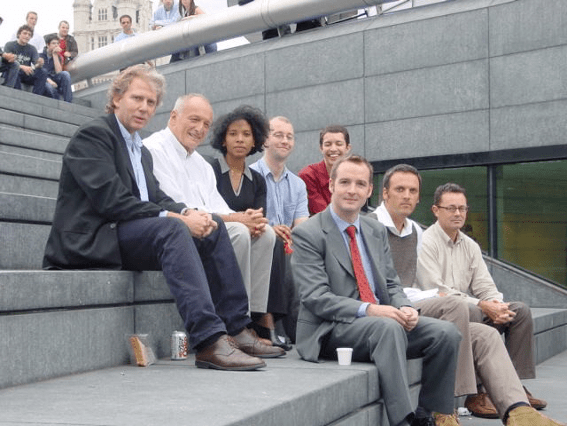
Architecture + Urbanism Unit at City Hall in 2002 or 2003. 
Top: Ricky Burdett, Richard Rogers, Gale Valentine, Jamie Dean, Eleanor Fawcett. 
Bottom: me, Mark Brearley, John Fannon.
Architecture + Urbanism Unit at City Hall in 2002 or 2003.
Top: Ricky Burdett, Richard Rogers, Gale Valentine, Jamie Dean, Eleanor Fawcett.
Bottom: me, Mark Brearley, John Fannon.
Photo: Tobias Goevert

Faced with the trundling beasts of public sector procurement, Richard often became frustrated (“Where are my million trees? Where are our 100 Public Spaces?”), exploding that he was wasting his time, or more amiably deciding he had had enough, and we all needed to go out for lunch or to the pub. He took no salary, but came in two days a week, chasing progress but also deploying all his skill and persistence at meetings with the Mayor and other bigwigs – to do deals on how architects would be selected and briefed, on what role design would play in the planning process, on how east London could fulfil its promise.

He stuck with it too, continuing to harry projects long after the rest of us had sounded the retreat, and showing patience and persistence with a bureaucracy that could be unfathomable even to insiders, where other architects would have packed up and retreated to the studio. Quite often, he would ask me to draft him a ‘tough’ (favourite term) note to the Mayor, demanding a project be stopped or an official sacked. As is the way of bureaucracies, these notes would then find their way back down to me from the Mayor’s Office, with a request for me to draft a response for the Mayor to sign off. I could keep these correspondence volleys going for weeks.

From 2004, I became increasingly involved in the London 2012 project, so saw less of Richard for a few years. A characteristic encounter was at the Venice Architecture Biennale, where he was awarded a Golden Lion in 2006. We greeted him in the street, and were scooped up and led to a lunch in a wood-panelled restaurant, down a side street I have never found since.

Flying back that evening, we were on the same plane as Richard and Ruthie, though they were in Business Class. I said hello as we got on, and expected they’d be long gone by the time we got out – that’s why you pay for Business Class after all. Instead, I found them waiting as we came through baggage reclaim, to see if we needed a lift anywhere. When we got into the Addison Lee, Richard told the driver “Chelsea, via Brixton.”  The driver muttered that Brixton wasn’t really on the way to Chelsea. “It is now,” replied Richard with a familiar mix of charm and steel which precluded much argument.

Richard continued to advise Ken, and then Boris Johnson for a couple of years, though took less of an active role as the A+UU morphed into the larger Design for London, headed by Peter Bishop. I think Richard saw his time at the GLA as something of a missed opportunity. We did not build his 100 public spaces or plant his million trees, and City East did not transform Docklands.

This is all true. But, as I said to him, those concepts had a long afterlife, and the cultural changes in how design and planning are done in London government were subtle but profound. The legacy of A+UU is still there in the current Mayor’s Good Growth by Design programme, in his panel of ‘Design Advocates’, in boroughs’ design review panels, in the Public Practice scheme that places newly qualified architects in public sector jobs, and in the inspiration he gave to a generation of planners.

After Richard left the GLA, I started working with him again, intermittently helping him to write articles or letters to the papers protesting against suburban sprawl, against toy town designs, and against the impact of austerity on the public realm – the ‘Continuity Urban Task Force’ as I used to call it. And it was very hard to pay for a meal at the River Café if he spotted us eating there. Richard enjoyed the good life – the River Café, the holidays in Mexico and Italy, opera and art – but he sought to share it as widely as possible, and was genuinely upset and angry when people were denied access to decent housing, food and healthcare.

In 2013, the Royal Academy hosted Richard Rogers: Inside Out, an exhibition that was as much about Richard’s political and civic beliefs as it was about his buildings. This caught the interest of Katy Follain, an editor at Canongate, and she asked Richard to write a book with the same blend of the personal, professional and political. I was trying to find something new to do after ten years on the Olympic treadmill, so was flattered when Richard and Ruthie asked me to help (especially given Canongate’s offer of some real writers).

The experience was hard going to begin with, when some early draft chapters came back covered in red scrawl. Richard’s dyslexia may have meant that he struggled to write long-form prose, but he knew what he wanted and knew what was good. We played around with structure, between timelines and topics, and ended up with a book that started narrow – focusing on a boy’s birth in Florence and his arrival in cold grey England in the 1930s – then widened its scope, using projects as jumping off points for discussions of urban development, public space, politics, inequality.

At first, Richard was reticent about the autobiographical elements; he wanted to look forward not back. But over time, he relaxed into the process, with long interviews where he reflected on his life, influences and ideas, recorded in his house in Chelsea, in his Hammersmith offices, on the terrace of the Tuscan farmhouse he and Ruthie rented every summer. The conversations were inspiring, a comfort to me as my own parents slid into ill-health, and often great fun. One taped interview, on the train back from Manchester after a party conference, starts structured and gradually dissolves into giggles as the free Virgin Rail Rosé takes effect.

As the chapters of A Place for All People were edited and finalised, Richard turned his attention to the design. I think Canongate were used to authors who would turn over a manuscript, fret a bit about the cover photo, then shut up until the proofs arrived. Richard had other ideas. He called up Andy Stevens, the graphic designer who had worked with him and his son Ab on the Inside Out exhibition design, and negotiations with Canongate began (Tracing paper? No. Different coloured papers for different sections? No. Spiral binding? No.) Once a format was agreed, pages would be laid out and reviewed again and again, by Richard, Ruthie and Ab, until Richard was happy with the flow and interplay of the textual and photographic narratives.

And this, I think, was at the heart of Richard’s genius. He was notoriously bad at drawing and struggled with writing, but he had brilliant ideas, acute judgement, and – an overused word but right in his case – a vision for what places and societies could be. He searched out the right partners and collaborators, and used all his powers of charm, persuasion, encouragement and menace to bring out the best in them and make the results of their work together as good as it could be.

Richard was so full of life, so endlessly curious, so excited about the possibility of a better world, and so tireless in trying to bring it about, that the world seems to have lost a little of its colour with his death. I’ll miss him enormously.

Retro first, last and always?

For a decade or more the redevelopment of London’s social housing estates has been a flashpoint. Councillors have lost their seats and council leaders have been deposed. Plans have been challenged in court, in council chambers and on the streets.

Boroughs have pushed forward redevelopment schemes, often in partnership with private developers, as a way of meeting housing targets and avoiding the huge repair bills that have accrued for older post-war estates. Campaigners have countered that demolition and rebuilding disrupts communities, can displace residents and replaces social rented homes with unaffordable intermediate and market housing.

Underpinning these debates are deep-seated issues about community and mobility, trust in public authorities, the roles of public and private capital, and what sort of housing London needs to offer its growing population.

Now, another ingredient can be added to this volatile mix: an increasing focus on embodied carbon generated by the energy-intensive production of materials such as steel and concrete suggests that retaining older buildings may be more environmentally as well as socially sustainable.

The issue is not binary. In some cases, particularly over the longer term, demolition and replacement with a building that uses less energy may make more sense than spending substantial sums on retrofit , even when embodied carbon is taken into account.

But thinking about embodied carbon tends to tilt the balance towards retrofit. At COP26 in November architects, property and construction firms signed a pledge to reduce embodied as well as operational emissions. A campaign led by the Architects’ Journal is championing retrofit and reuse.

So, if retrofit makes sense for people and planet, why are demolitions still taking place? Discounting the possibility that London boroughs actively want to inconvenience and displace their citizens (an accusation that has been levelled at some in the past), I believe that housing targets, financial incentives and complexity work together to push councils towards demolition and redevelopment.

Firstly, demolition makes it more straightforward to increase housing numbers in response to London’s persistent housing crisis and tough housing targets: even if Covid slows or reverses population growth, the capital has a backlog of need and a yawning affordability gap. As big “brownfield” sites become scarcer, boroughs and housebuilders are searching for ways to build more within the capital’s already built-up areas – hence sporadic eruptions of tower blocks across the city. Building denser in privately owned streets is part of the answer, but large post-war housing estates offer the advantage of single ownership, even when this has been eroded by right-to-buy.

Many post-war estates currently under threat are also relatively low rise (though not that low density) by today’s standards. Last week, the redevelopment of Central Hill, a widely-celebrated low-rise 1960s estate designed by Lambeth borough architects Rosemary Stjernstedt and Ted Hollamby, took a step forward when Homes for Lambeth (a council-owned development company) announced a shortlist of firms to prepare a masterplan.

Assessing options for Central Hill in 2017, Lambeth estimated that redevelopment could add more than 500 homes to the 456 already on site. Alternative plans prepared by Architects for Social Housing (ASH), who campaign for alternatives to demolition, proposed refurbishing the existing stock and adding 242 new homes through infill and roof extensions – half the number proposed by the borough.

Refurbishing council housing can also be an expensive process, with limited scope for recovering costs. Refurbishment is funded through the ring-fenced Housing Revenue Account, which relies on rents for income. In 2017, Lambeth estimated that refurbishment costs at Central Hill would be £44,000 per socially rented home, compared to a benchmark of £18,000.

Redevelopment has a different business model. It can be undertaken in partnership with a private developer or through an arms-length housing company with more freedom to borrow and the potential to cross-subsidise, enabling social housing to be replaced by building more for market sale or rent. Lambeth aims for its redevelopment of Central Hill to be cost neutral overall, while its assessment of the ASH plan found no potential for cross-subsidy of refurbishment works. The imbalance is worsened by unequal tax treatment: new builds are VAT free while refurbishment is usually charged at the full rate.

And long-term carbon implications of new build compared to refurbishment are rarely quantified or considered. Even where “carbon costs” can be calculated, local authorities do not benefit from any carbon savings achieved. The government’s Social Housing Decarbonisation Fund has been designed to help improve the energy performance of socially rented homes, but even its maximum grant of £16,000 would not close the funding gap that Lambeth estimated for Central Hill.

Lastly, I think there is a complexity challenge. There is a mature market of developers who can enter into joint ventures with local authorities and deliver a programme of “regeneration” (demolition and redevelopment). By taking control of the site, they can manage risks and adjust the pipeline of development to respond to changing market circumstances and viability reviews. A local authority-owned housing company is in broadly the same position.

But a programme of refurbishment and infill is trickier, particularly where substantial structural work is required. As anyone who has had builders at home knows, refurbishment is disruptive, and budgets need flexibility to cope with unexpected costs, which can rise sharply. Managing disruption to tenants, different teams of contractors and the risks of spiralling costs will sit squarely with local authorities, which have seen their planning and development budgets slashed over the past decade.

Decisions on refurbishment and redevelopment are genuinely complex, balancing the needs of existing and possible future residents, and juggling financial priorities and environmental imperatives. However, despite their declarations of “climate emergency” boroughs lack the incentives and many have been stripped of the skills to invest in and add to their existing housing stock, rather than bringing in the bulldozers again and again.

Originally published by OnLondon.

It started with a Zang

‘Video Killed the Radio Star’ by The Buggles was released in September 1979, a couple of months before The Clash asserted that “phoney Beatlemania has bitten the dust”. Both songs mark a watershed, but their tone couldn’t be more different. The Buggles song, fronted by producer Trevor Horn, is more playful and ambiguous than The Clash’s tub-thumping anthem – wistful about the past, but also avid for a future “rewritten by machine and new technology”.

The song could be a statement of intent. It sets the scene for a decade in which Trevor Horn’s ZTT Records was a persistent if mercurial innovator, blazing trails that sputtered out or reignited years later.

From the outset, the label (co-founded by Horn, Jill Sinclair and self-described ‘semiotician’ Paul Morley) was deeply “serious about the frivolous and frivolous about the serious” (to borrow one of Susan Sontag’s aphorisms from Notes on Camp). It was a pop label named after the sound of machine gun fire (‘Zang Tumb Tumb’), as transcribed by Italian Futurist (and Fascist) Filippo Marinetti. And one of its first big hits celebrated nuclear annihilation with a catchy but dumb-as-you-like chorus of “when two tribes go to war, one is all that you can score” over a Hi-NRG beat, with remixes sampling civil defence instructions for the disposal of corpses.

It’s astonishing to recall now how Frankie Goes to Hollywood, ZTT’s first big success, dominated the charts in 1984. They seemed to come out of nowhere, but their first three singles – tackling sex, war and love – soared to number one, aided by Paul Morley’s marketing talents and Radio 1 DJ Mike Read’s refusal to play ‘Relax’, and selling in numbers unknown to modern popcharts.

Frankie’s success can slightly overshadow other ZTT acts of the mid-80s. The Art of Noise (another futurist reference) and Propaganda, produced machine-music too poised and chilly to fit easily into 1980s compilation albums, but rediscovered and revered since. And Horn collaborated with fellow-Buggle Bruce Woolley on Grace Jones’ magisterial ‘Slave to the Rhythm’.

By the end of the decade, as Stock Aitken and Waterman’s version of electro-pop crowded the charts, ZTT were finding a new musical inflection point, trying to assemble a techno supergroup with Derrick May, and releasing records by Adamski, Seal and 808 State (it was the death of 808 State’s Andy Barker that got me thinking about ZTT). These were pioneering cross-over tracks but not populist novelties, as comfortable mimed on Top of the Pops as they were mixed with obscure Dutch white labels in a warehouse or disused airfield. The grandiloquent Morley/Horn touch can be detected in the spoken word into to ‘In Yer Face’, 808 State’s jackhammer second single, harking back to the Frankie’s riffing on Hitler and Castro speeches in ‘Two Tribes’ (amazing how much more accepted playing with Fascist and Nazi references was in the 1980s).

ZTT’s records pepper the critical touchpoints of 1980s and 1990s cultural history, as does their iconography of logos, Katherine Hammett t-shirts and album cover design, but the label’s legacy seems curiously weightless – compared to Manchester’s Factory Records, for example. Nobody could call Frankie Goes to Hollywood a one-hit wonder, but like many ZTT acts they burned brief and bright, then sputtered or stormed out in personal and legal disputes (808 State are a rare exception to this rule). Paul Morley describes this ephemerality as intentional. Interviewed by Barney Hoskins in 2013, he said:

“I’ve always been a bit pissed off with people like Weller and the Clash and Killing Joke, these people who say there can be some kind of polemic within pop. Well, Two Tribes was trying to prove to people that it’s impossible. I mean, we get to No 1 for nine weeks with an explicit, extravagant anti-war thing with the real government warning on there, and the next week it’s George Michael taking over at No 1, and that’s the end. Nine weeks, and nothing’s happened. I like that in a way.”

Does London really have the lowest cases and lowest vaccination rates?

As autumn sets in and Covid case numbers drift upwards, there is some good news for Londoners. Having been hit hardest by the first wave of infections, the capital now has some of the lowest case numbers. On 18 October, out of 315 English lower tier (unitary and district) councils, the ten with the lowest case rates were all London boroughs (except where indicated, all data in this article have been downloaded from the excellent Government dashboard).

This isn’t to downplay the terrible effect Covid has had on London. The disease has already killed more than 20,000 people in the capital, and has had a particularly brutal impact on poorer and disadvantaged communities. However, unlike March 2020, when cases shot up in the city and widespread urban flight was predicted, today you are safer from Covid living in Inner London than almost anywhere else in the UK.

This is good news, but it’s not immediately clear why London cases are so low. While the capital has the highest levels of antibodies according to the latest Office for National Statistics (ONS) survey, it also appears to have the lowest vaccination rates. The ten English lower tier authorities with the lowest vaccination rates by 14 October were all in London, and are many of the same boroughs that also have low infection rates. I’ve been wondering how we can account for this, without making spurious assertions about vaccine effectiveness.

Vaccination is not the only way to acquire immunity, so Londoners’ early exposure to the virus will have made a difference. London’s cumulative case numbers are equivalent to around 12.5 per cent of the population, which is higher than the other southern English regions, but lower than the Midlands and North. But in the early days of the pandemic, most cases were untested and unreported unless people became seriously ill, so London’s total cases have almost certainly been underestimated. By July 2020, 13 per cent of working age Londoners were already estimated to have been exposed to the virus, twice the national average.

However, there are also issues about how vaccination rates are calculated. Most Covid statistics use the 2020 mid-year population estimates as their denominator, but vaccination rates use the National Immunisation Management Service (NIMS) database. Reputable commentators have suggested that this database, which has been credited for supporting the rapid roll-out of vaccines, tends to overestimate populations of working age adults – particularly young adults and students, who are most mobile. Using ONS mid-year estimates for 2020 rather than NIMS figures makes a big difference to vaccination rates in London, as shown in the chart below, which shows the position as of 12 October.

Richard 2

(A side note: might the ONS mid-year estimates from 2020 also be wrong? They probably are. Most commentators believe London has lost population over the last year, though estimates vary wildly, from Professor Jonathan Portes’ estimate that around 700,000 people may have left the capital, to the GLA’s more cautious projection that around 100,000 people have done so. If we reduced London’s population by a pretty extreme ten per cent, or around 900,000 people, both vaccination and case rates would be higher, but not dramatically so – though the effect would be greater if population loss was concentrated in the Inner London boroughs.)

What does this all tell us? The first thing, which many of us have learnt over the past 18 months, is to be careful to interrogate statistics, asking what story they are being made to tell and whether there are other stories that might also fit, particularly where there seem to be dramatic differences between places. 

The second is to ask why local vaccination rates are being published in ways that seem to make take-up look artificially low in places with younger populations. This might seem trivial, or even a useful nudge for the young and for people in vaccine-hesitant communities to get their jabs, but using questionable data for righteous ends can be toxic. There are enough scurrilous rumours about vaccination effectiveness circulating without allowing people to draw hasty conclusions from the fact that the places with the lowest case rates are also those that appear to have the largest proportions of unvaccinated people.

The figures for deaths in council areas are seven day case rates by date reported, and the deaths attributed to Covid in the capital are defined as those where Covid has been mentioned on the death certificate, as of 14 October. 

Originally published by OnLondon.