When every day was like Sunday

A fragment, of what I’m not quite sure.

Sunday is the pivot of the week, its end and its beginning. These are family memories of some of the 2,500 or so I have lived so far.

In my 1970s childhood, Sundays were quiet and formulaic. At morning mass with my Mum and sister, I would already by thinking profanely about lunch – the roast meats, the heavy puddings (steamed syrup sponge or lemon meringue pie). We would have a drink before lunch (gin or Campari for the parents, Sodastream for the children), and Dad would often decide to hold a quiz during the meal, to occasional visitors’ horror. Afterwards he would take us children for a walk in the beech-clothed Chilterns, while my mother had an unusually self-indulgent snooze.

For much of the 1980s, I was at boarding school. Sundays there also revolved around church and lunch (and cycling off to neighbouring villages to find pubs that served teenagers). But I also remember the periodic visits to midlands hotels with my parents. Big lunch, a bit of booze, then a walk and slightly tearful return to school. I wasn’t that miserable to be honest, so I suspect the tears were part performance and part response to the melancholic timbre of those days – always bleak autumn in my memory.

Lunches together were less frequent in the 1990s and 2000s. I was at university then living in London, so trips to my parents’ house were celebratory occasions, allowing Mum to showcase new dishes and giving Dad the excuse to ‘kill the fatted bottle’ (his phrase), before driving me erratically back to the station.

Then in the 2010s, as my parents weakened, we would be there to drive Mum to mass, to bring and cook a meal, reproducing and revising her repertoire, cutting up her food and wheeling my father through for his still enthusiastic assault on food and wine.

Now Mum is on her own; we bring our own food, as the carer spoons puree into her mouth.

It’s all so fucking swift, so remorseless.

Inner city life, inner city pressure

As the weather improves and lockdown restrictions are relaxed, life is ebbing back onto the streets of central London. People who were commuting in daily just over a year ago are beginning to revisit a city centre that is both familiar and utterly transformed. And to think about its future.

There are still more questions than answers about that future. How much remote working will persist, and how will much-discussed models of ‘hybrid working’ play out? Will employers reduce their demands for workspace, and will any surplus space be picked up by new arrivals attracted by lower rents? How quickly can tourist and international student numbers recover, and how will shops, pubs and restaurants cope if both commuting and tourism remain suppressed?

These uncertainties are likely to persist for some months, but some slackening in demand for office and retail space is widely expected, as working and consumption patterns change, and employers rethink their needs. Some premises might be adapted by cultural and community organisations, for experimental pop-ups and meanwhile uses, but it is likely that new residential development will play a part too.

This could actually help build the city’s resilience. As Centre for London set out just before the pandemic bit, central London’s population has been growing fast over the past decade, but the city centre is still less densely populated than Paris or New York. So when coronavirus brought commuting and tourism to a standstill, central London and its businesses were particularly hard hit by the loss of trade, and have continued to struggle as restrictions have been successively relaxed, re-imposed and relaxed again.

So more people living in the city centre is not only likely but desirable, as was underlined in Arup’s recent report for the Greater London Authority on the future of the Central Activities Zone (CAZ):

“A higher CAZ residential population, to offer more sustainable lifestyles, resilience, increased vibrancy and ‘stewardship’ of the CAZ’s resources for others, and bringing London more into line with its global rivals.”

But allowing more residential development or conversion in central London is not straightforward. The current London Plan and borough planning documents give the CAZ and Canary Wharf special status, to protect the clustering and density of ‘strategic functions’ (for example global commerce, education, culture, government and tourism) and give these uses priority over housing. This protection, the argument goes, preserves the essential character of central London as a truly global city centre and the economic powerhouse of the UK.

How could more housing be brought into the mix without diluting these qualities and this global draw? Should new build and conversions be pepper-potted through the CAZ, or focused in a few neighbourhoods? And can office and retail conversions retain flexibility, or is any switch to housing a permanent change?

Some parts of central London and some building types look a lot more inhabitable than others. Big open-plan offices, as found in the heart of the City and Canary Wharf, are unlikely to be adapted as easily as older buildings in the West End, Clerkenwell, Bloomsbury and the South Bank, which have switched from houses to flats to offices and now perhaps back to housing over the years.

There are also issues of management and services. How would potential disputes between residents and businesses be resolved over night-time deliveries, late-night crowds leaving bars and nightclubs, parking and vehicle access? And where will health services and schools be located, as well as everyday shops?

All of these factors suggest that a remixing of London’s city centre will need to be carefully managed, not left to the free-for-all of ‘permitted development’ from office to residential uses that government is proposing – and which has led to some truly atrocious conversions of commercial buildings. Central London currently has exemptions from permitted development, but these expire in summer 2022, and London’s boroughs will soon need to start making the case for renewing them.

Central London is a dynamic and creative place. As we emerge from the pandemic into a world that is still being reshaped, Centre for London hopes to explore how we can apply that dynamism and creativity to refresh its mix of uses, as well as to support the national recovery.

[Published by Centre for London, 26 May 2021]

Now is time for a TfL deal

Transport for London (TfL) is the seat of the Mayor of London’s most significant power and responsibility. Welded together in 2000 from an assortment of public corporations, government agencies and joint committees, TfL spends more than £10 billion every year and employs more than 25,000 people. While London’s Mayor is underpowered in many respects, their control of this integrated transport authority is envied by many other cities in the UK and beyond.

Right now, transport is also Sadiq Khan’s biggest headache and biggest priority. TfL’s revenues collapsed during the pandemic, as passengers stayed home, and the network has only been saved from bankruptcy by government support packages, repeatedly agreed at the last minute and accompanied by terms and conditions that have nibbled away at the Mayor’s authority.

The latest support package is due to expire on 18 May, so the next cliff-edge is approaching fast. TfL have been arguing for a longer-term settlement, and their scenario planning predicts suppressed income till 2024/25 in almost any conceivable future. With neither mayoral or general elections scheduled till 2024, and the pandemic in what we all hope is irreversible retreat, obstacles towards striking a longer-term deal should now be surmountable.

Doing the right deal will require radical thinking from the mayor and government alike. Pushed to find new sources of funding for infrastructure investment as well as operations, Sadiq Khan has argued that TfL should receive the £500 million that Londoners pay in vehicle excise duty (VED), which is currently ring-fenced to pay for road repairs outside the capital. Alternatively, there have been discussions of a charge for people driving into London from outside.

Neither proposal bears much scrutiny: the VED settlement is indeed unfair to London, but is a declining revenue source, and allocating more to London would mean allocating less outside the capital (or government making up the balance). A boundary charge would be another way of making those who live outside the capital pay towards the services that they use, but would likely have a negative effect on people living and working around the edge of London, and could generate more hostility to the capital at a time when it needs support and visitors.

A more equitable approach would be London-wide road user charging, to replace the increasingly complex hierarchy of charging zones and fees, as recommended in Centre for London’s 2019 report, Green Light. A pay-by-the-mile scheme, which reflected congestion, pollution and the availability of public transport alternatives, could raise substantial sums. For example, an average charge of 5p/mile for cars and light goods vehicles, and 50p/mile for HGVs, could raise as much as £1.5 billion every year – twice as much as is currently raised by the congestion charge.

Such a scheme would also make policy sense. It creates incentives for lower carbon transport options, rather than using public transport revenues to cross-subsidise highways maintenance, as is currently the case. The Green and Lib Dem candidates both argued the case for road user charging during the mayoral election campaign, but Sadiq Khan was more cautious, committing only to “ask TfL to consider other ways of raising income to make up for the loss of VED” if the Government refuses to pay up. And you can see why – the politics of restrictions on car use have become a hot button issue in this election. But now, at the beginning of a three-year term, is the time to make the case for bolder action.

But if transport funding is the elephant sat solidly in Sadiq Khan’s in-tray, it should have at least one foot planted in Government’s. Under a deal negotiated with Boris Johnson, when he was Mayor, central government grant support for TfL was phased out, with business rates and fares plugging the gap. All very well when London’s economy was booming, but even the most optimistic scenarios see business rate revenues and fares alike suppressed in the short- to medium-term.

London’s transport system could be allowed to decline, and this is one the scenarios explored by TfL, but this would be a hugely retrograde step, which would deal a substantial blow to the capital’s chances of recovery and of achieving zero carbon targets, and to tax revenues from London supporting public services across the country.

Government knows this, so they know how costly it could be to starve London’s transport system of resources. If the Mayor can show he has the vision to transform London’s public transport funding model, the Government should make available the funding to support him during an economic crisis that has hit London particularly hard.

[First published by Centre for London, 10 May 2021]

Fork out to eat out to help out

As London’s pubs and restaurants make the first tentative steps towards re-opening after a disastrous year, with excited punters booking weeks in advance for chilly pavement tables, reports suggest they are struggling to find staff.

Restaurants, bars and hotels were having difficulty recruiting and retaining even before Covid, as Centre for London revealed in its 2019 report into kitchen jobs. Since then, the implementation of tougher immigration rules has combined with an exodus of overseas workers (estimated at anywhere between 35,000 and 700,000) from the capital during the pandemic to turn the crisis acute.

As the UK’s borders open up, some foreign workers will return, though the exclusion of many hospitality jobs from the “shortage occupation lists” that allow mid-skilled workers to obtain work visas will make replacing those who choose not to come back more difficult.

Home Secretary Priti Patel said last summer that “the new points-based system will encourage employers to invest in the domestic UK workforce, rather than simply relying on labour from abroad.” Given that more than 50 per cent of hospitality and food workers are foreign nationals, this approach may be tested sooner than she had planned.

Can the domestic workforce plug the gap for London’s hotels, restaurants and bars? With unemployment in the capital higher than in any other region (nearly 10 per cent of the workforce were claiming unemployment benefits in February), there’s a deceptively neat answer to the recruitment challenge.

But jobs in hospitality can be a tough sell. Despite the camaraderie and fun many experience, the work can be tough, with antisocial hours and limited opportunities for advancement. Right now, unemployed Londoners may be worried about exposure to the virus as customers return. They could also hesitate before seeking employment in a sector that will be first in line for closure if the government’s “irreversible” lifting of Covid restrictions results in the brakes being slammed on again.

And there are deeper issues of pay and conditions. In 2020, around one million people worked in hospitality (“accommodation and food services”) in London, according to government surveys. Almost 25 per cent of those workers were paid less than the National Living Wage of £8.20 per hour (for 21-24 year olds), and 75 per cent were paid less than the London Living Wage (designed to reflect the actual cost of living in the capital) of £10.75 per hour.

Can employers afford to pay more? Ingredient costs have been rising as a result of Brexit, and business rates in London penalise enterprises that take up space, such as the places people meet to eat, drink, dance and sleep. Business rates payable by restaurants in London increased by a third in the 2016 revaluation. On top of this, many hospitality businesses that have struggled to survive lockdown now face a precarious future, as social distancing persists even as tourists and commuters start to trickle back. It is a lot to ask the sector to shoulder the burden of raising wages on its own.

The government could do more, by extending business rate holidays in the short term and reforming business rates in the longer term. Landlords should show restraint when negotiating rents. But we also need to ask whether we are paying enough when we go out to eat and drink. Londoners eat out more frequently than people in other parts of the country, and the capital has restaurants that offer great value alongside the glittering palaces of oligarch-baiting excess.

Many Londoners celebrating the emergence of hospitality from its enforced hibernation and reflecting on how much they value eating out will have built up a stockpile of cash during the lockdown periods. Perhaps this is the moment to re-appraise the prices we pay, so that essential and skilled tasks such as taking orders, cooking food and washing plates are well enough rewarded to attract people with the skills the sector needs, both from the rest of the world and London itself.

[First published by OnLondon, 7 May 2021]

Fund for all the family?

Five days after the 2021 Budget, are we any clearer what “levelling up” means?

One thing is clear. It doesn’t mean investing to tackle London’s problems, even after the damage done to the capital by the pandemic. Only two of London’s boroughs (Newham and Barking & Dagenham) are included in the priority tier of local authorities eligible for the new £4.8 billion Levelling Up Fund. The three prioritising ‘place characteristics’ set out in the Fund’s Prospectus could have been designed to exclude the capital:

  • Need for economic recovery and growth;
  • Need for improved transport connectivity; and
  • Need for regeneration.

It’s not yet clear how these are quantified and compared (or precisely what “regeneration” means), but the first two work well enough to rule out London, which is distinguished by a persistent mixture of dynamism and deprivation alongside an enviable transport network. Boroughs like Westminster and Tower Hamlets have intense poverty among their residents, but also have three times the economic output per head of the UK as a whole, and twice that of other big cities like Manchester, Belfast and Edinburgh.

So this is not a fund for London, or for investing in the needs of people rather than place. And there is a case to be made for that: even London’s most fervent advocates would recognise that there are places in the UK that urgently need investment in connectivity and economic activity. You could even see a precursor in Michael Heseltine’s City Challenge programme of the early 1990s: selecting and investing heavily in a few urban centres, following a bidding process, which would in turn power up new enterprise and opportunity around them.

But that doesn’t seem to be how this Fund will be applied. The prospectus invites local authorities to submit one bid each for up to £20 million (£50 million in exceptional cases for big transport projects). Twenty million is a substantial sum, but hardly transformative – and significantly less than was allocated to City Challenge bidders 30 years ago, when 20 cities received £37.5 million each (around £72 million in today’s money). Assuming £2 billion is handed out in the first round, this would enable 100 bids to be funded. It looks as if spreading the jam wide and thin is the priority.

This may also explain the variety of places in the priority tier. It includes most major city centres (apart from London and also struggling smaller cities like Sheffield, Plymouth and Portsmouth). But it also comprises “Red Wall” marginals and prosperous suburbs and rural areas such as Richmondshire (I suspect to the Chancellor’s embarrassment), Lewes and Trafford.

Poverty is not confined to the inner cities, but not every smaller town and rural area is struggling either. Some lack economic powerhouses and transport hubs, but nevertheless have prosperous populations of commuters and retired people. You can see the government’s problem here: it is hard to distinguish struggling from successful smaller towns without giving a higher weighting to deprivation measures, and  doing that would have pushed the focus back towards London and the other big cities.

The language of the prospectus seems to fudge things further. It makes a very tentative and non-economic case for infrastructure investment:

“Investing in infrastructure has the potential to improve lives by giving people pride in their local communities; bringing more places across the UK closer to opportunity; and demonstrating that government can visibly deliver against the diverse needs of all places and all geographies.”

Elsewhere, the prospectus talks about funding projects that “bring pride to a local area”, about “infrastructure that has a visible impact on people and their communities”. It starts to sound as if the purpose of the fund is performative. It aims to give the appearance of activity and impact in the next three years, redeeming the electoral promise made to “Red Wall’ constituencies, rather than seeking any lasting change, let alone the type of economic rebalancing that has evaded ministers for decades.

Either I’m being deeply cynical or the Levelling Up Fund is. There’s no sense of strategy, of how “levelling up” might be achieved, or even of what it is. A bold government could focus a critical mass of investment on the places and projects that could maximise prosperity and opportunity, or it could hand funding over to local politicians to allocate in line with local priorities. Instead, we have the continuation of centralised munificence, infrastructure investment by supplication.

The Mayor of London and borough leaders have expressed anger at how the Levelling Up Fund has ignored London’s needs. If I was leader of a northern city, I might be angrier still.

[First published in OnLondon, 7 March 2021]

Property taxes need reform, but changes must be fair to Londoners

Britain’s domestic property taxes are in a terrible state. Council Tax bands are still based on house valuations made in 1991, and the 30 years since then have seen huge variations in house price growth between different places and properties. Stamp Duty is a tax raised on people when they move house, which has the effect of gluing up the property market and of encouraging people to stay for longer in homes that are too big or too small for them. What can be done to change this unsatisfactory situation? And what might the implications be for London of any major reforms that might be tried?

One idea that has been gaining currency in the run-up to the budget is flat rate property taxes, with home-owners paying a set proportion of their property’s value each year. Research by WPI Economics suggests that a tax of 0.48% of values could generate enough revenue to replace both Stamp Duty and Council Tax. And the Fairer Share campaign suggests that such a tax would leave 76% of UK households better off.

Property value taxes have a lot to recommend them (as do more ambitious proposals, such as land value taxes, and more modest reforms, such as new Council Tax bands). They are a lot more progressive than other taxes: Council Tax for the most expensive properties is only three times the rate it is for the cheapest properties, whereas property prices can vary by a factor of more than 100.

There would be issues with implementation: for example, transitional measures would be needed to avoid “cash-poor” owners of larger houses being hit by such a dramatic hike in taxes that they might be forced to sell in a hurry. But there’s a bigger problem for London. Levying property value taxes nationally at a flat rate would represent a massive shift of the tax burden onto London from the rest of the UK. The Fairer Share website suggests that communities outside London would pay £6.5 billion less in property taxes. As their proposal is intended to be fiscally neutral overall, that means London would pay £6.5 billion more.

Such a shift may have populist appeal at a time of “levelling up” (though maybe not for the many Conservative MPs in London and the south east whose constituents would suffer), but it ignores the fact that Londoners are as much victims as beneficiaries of high house prices. Incomes in London are higher than in the rest of the country, but they are much closer to the average once housing costs are taken into account. And low-paid Londoners, who earn little more than counterparts elsewhere, are already particularly squeezed: London has the highest rates of child poverty in England.

Adding £100 a month to Londoners’ tax bills (in line with the “capped” Fairer Share proposals) would drag incomes in the capital below the national average, even before other costs of living were taken into account. On top of that, Londoners will be struggling in the wake of a pandemic that has hit the capital hardest: in December 2020 London had seen the steepest rise in benefit claims of all the UK’s nations and regions, and had the second highest rate of claimants (after the West Midlands).

There is still a case for tax reform, and the budget would be a good opportunity to announce a careful review. But, as the London Finance Commission (set up by Boris Johnson and reconvened by Sadiq Khan) argued, this should take place on a regional basis, not through nationalising local taxes. The overall fiscal flows between different parts of the country could be preserved (perhaps with a review every few years to take account of how different regions have prospered), while different regions could set property taxes that reflected the specifics of their housing market – with different Council Tax tiers, flat rate taxes, or exemptions and discounts applied to reflect local economic circumstances.

And this is not to argue against London paying a fair share to the rest of the UK. London’s taxpayers made a net contribution (taxes minus public spending) of nearly £40 billion in 2019. And that’s fair: London has more productive businesses, high-spending tourists and rich residents – or at least it did in pre-pandemic times. But squeezing the capital further, as the UK struggles to recover, would look extractive, blinkered and self-defeating rather than fair. 

[First published in OnLondon, 28 February 2021]

Will sex save the city?

Ah, the romance of urban economics and human geography!

In a thread of tweets last month, global cities guru Richard Florida reflected on the future of clustering, the force of agglomeration that brings industries and people together in cities. Looking at advances in remote working during the pandemic, he suggested that location may become less important in future for industry clustering than for talent clustering. HQs may locate where CEOs want to live, even if that is not an urban centre, but talent will continue to cluster in selected locations. In his words, “young folks will continue to be drawn to cities for a combination of thick labor and more so mating markets.” 

Bloomberg columnist Noah Smith reached a similar conclusion pondering whether the changes triggered by the pandemic will enable workers to escape the overpriced grasp of ‘superstar cities’. He sees access to labour markets and office productivity as easier to replicate in a world of remote work, but is less sure about the informal knowledge spillovers that form the dark matter of agglomeration. And he thinks the social value of cities would be even harder to replace, particularly for young people seeking “bars, music venues, fun social events, lots of potential friends in their age group, and — probably the most important piece — opportunities to meet romantic partners.”

So will sex save the city? Cities have always cast their net wide, gathering young people (or at least those with the means) to meet and match up – from the aristocratic dances of “the season” in the eighteenth and nineteenth centuries, to the graduate convergence that sees a net flow into London of 25,000 people aged 20-24 in a normal year.

For all the features about the frustrations of dating in big cities, and despite the rising role of dating apps, restaurants, bars and workplaces still play a pivotal role in bringing many couples together. For all of those, cities offer a ‘thicker market’ – more opportunities and more choice, particularly for gay people or people from other minority groups who are more likely to be gathered in the big urban areas. And meeting up with your perfect online match is easier if they are a tube ride, rather than a flight, away.

London’s employment, entertainment and dating offer has drawn young people from across the world for years, but its short-term outlook looks pretty challenging right now. The restaurants and bars are closed, the theatres and nightclubs are silent, and the flows of people that animate the city are stilled. As reflected in Arup’s recent report for the Greater London Authority (and in Centre for London’s reports), London’s core has seen some of the sharpest slowdowns in activity of any city in the UK or comparator cities abroad, and London as a whole has seen the UK’s sharpest spike in unemployment and highest levels of furlough.

GLA research published in October estimated that lost tourist and commuter expenditure in the Central Activities Zone would be £13 billion in 2020. This loss of custom has hit London’s hospitality and cultural sectors particularly hard. Arup estimate that the West End arts and culture economy shrunk by 97% in 2020.

Moreover, while the UK’s vaccinations are a huge success story, the appearance of new strains of coronavirus means that an imminent big bang re-opening of London to international tourists, students and business visitors seems unlikely. But that will change over time; global travel will rebound, even if not this year. As I write, snow is turning to sleet outside, gusting around in a bitter easterly wind. As ever in the depths of winter, summer seems almost inconceivable, but we all know it will come.

The challenge is not to give up on London’s hospitality and cultural industries, magnets for the people who come to London to work, to study, to innovate, to make friends and more, as well as for those who visit for conferences or holidays. Confusing short-term sickness with long-term viability risks becoming a self-fulfilling prophecy, if we let the infrastructure of the city’s sociability decay. 

This means that more support is likely to be needed this year – to sustain what is hard to replace, to allow space for new growth, and to address long-term problems such as housing quality and affordability – so that London can continue to play its role as the UK’s gateway to the world. When we emerge from the other side of this crisis, young people will once again be drawn to the possibilities and freedoms that cities can offer. London needs to be ready to welcome them back.

[Published in OnLondon, 14 February 2021]

Book Review: Red Metropolis by Owen Hatherley

Owen Hatherley’s book springs from an honourable impulse – to rescue London from lazy stereotyping as an elitist hothouse of privilege, distant from the more authentic social and economic struggles of the northern cities. He aims to rekindle pride in London’s rich heritage as a radical trailblazer of social progress, and for the most part he succeeds.

Hatherley’s previous books have covered everything from the ersatz urbanism of Blair-era ‘regeneration’ projects, to the communist architecture of eastern Europe, to the commodified nostalgia of Cameron’s austerity years. Most recently he has focused his gaze on London (he is also editor of the fascinating Alternative Guide to the London Boroughs, published by Open House last year). A self-described communist, Hatherley began writing Red Metropolis in December 2019, and describes the book as an “attempt to write myself out of the feeling of numb horror” caused by Labour’s defeat in that month’s general election.

Red Metropolis is a work in three acts, focusing in particular on London’s perennial housing crisis and on public housing, one area of social welfare that has consistently had a local dimension. The first part traces the history of London County Council (LCC) from the messy politics and patchy administration of the late 19th Century to 1965, the second records the ascendancy of the New Left in the Greater London Council of the 1980s, the third looks (sorrowfully) at the record of the three mayors of London since 2000. 

The LCC took over from the unelected Metropolitan Board of Works in 1889, and for nearly twenty years, under a shifting “progressive” leadership comprising liberals and various left groups that would later merge into the Labour Party, was a pioneer of municipal socialism. Directly employed labourers built council housing in the Boundary and Millbank estates, which Hatherley praises for their “high-quality materials, urbanity and spaciousness”, and the LCC’s borough allies (including Battersea, where John Archer, the first Black mayor of a borough, was elected in 1913) built smaller-scale schemes such as the Latchmere Estate. 

The Progressive alliance faltered and the Conservatives dominated the LCC for the next 25 years, but by the 1920s, the Labour Party had begun to build a power base (particularly in the “Five Red Boroughs” – Battersea, Bermondsey, Deptford, Poplar and Woolwich). In 1922, Poplar councillors, led by George Lansbury withheld rates from the LCC in order to fund social programmes, arguing that it was “Better to Break the Law than to Break the Poor”. Thirty were briefly jailed in an episode which is a precursor to the 1980s rate-setting protests and the legal challenges to the GLC’s “Fares Fair” policy.

Poplarism stirred up persistent debates within the Labour Party between advocates of constitutional change and those seeking more direct action. Herbert Morrison, who dominated the London Labour Party from the 1920s, and led the LCC from 1934 to 1940, was a vociferous opponent of the latter approach. Morrison has been a controversial figure in left politics, at times criticised (like his grandson Peter Mandelson) for his focus on “electability”, but also for his model of ‘bureaucratic nationalisation’, with professional managers in control rather than workers themselves. 

Hatherley is more generous in his assessment. Even though 1950s schemes such as the Alton Estate are more to his taste architecturally than the “staid and stiff brick tenements” of the 1930s, he argues that Morrison prefigured the post-war settlement by offering free healthcare, building housing, schools and parks, and by establishing London’s own nationalised transport board, and also praises the sometimes-maligned Abercrombie plans that were developed in the heat of the War. Like Robert Moses in New York, Morrison remade his city, and made plenty of enemies along the way.

LCC puritanism – they built estates without pubs and Morrison wanted lidos closed at night to stop “people fucking in them” –was roundly rejected by the “New Left” leadership of the Greater London Council in the 1980s. Hatherley brings to life the carnivalesque egalitarianism of County Hall under Ken Livingstone, its corporate wood-panelled corridors thronging with punks, Rastafarians, gay rights activists, artists, radical feminists and communards. One of the ironies of the past 30 years is how the anti-racist and gay rights campaigns led by the GLC, which led to vitriolic tabloid attacks at the time, have become entirely mainstream, while its economic programmes, such as the “People’s Plans” for reindustrialisation of London’s docks, look positively quaint.

The importance attached by the New Left to community-based politics and participation above all things led, Hatherley argues, to its rejection of Morrisonian housebuilding programmes. Partly as a result of this and partly because the city was still depopulating through the early to mid-1980s, the Livingstone-era GLC built little housing and what it did build was often “twee and flimsy” – pockets of suburban semis that can still be seen dotted around inner London. The antipathy towards grand schemes led to renowned architects such as Neave Brown in Camden and Ted Hollamby in Lambeth being pushed out of their local authority jobs. (In another nice irony, the communist Hollamby went on to work at London Docklands Development Corporation, the epitome of Thatcherite laissez-faire urban policy).

Despite this, Hatherley sees the GLC’s record as a “social democratic Paris Commune” as a guiding light for the Corbynista left in 2015-19: “so successful was it that London’s governing body had to be abolished out of existence.” But he identifies a wider legacy too: the GLC’s focus on cultural policy was foundational to London’s 21st Century character, and its abolition in 1986 alongside the ‘Big Bang’ of financial services deregulation, helped define the politics and economics of London today. 

Hatherley is less impressed with – and I think less fair to – the three Mayors in City Hall since 2000. He gives Ken Livingstone and Sadiq Khan some credit, for transport projects and policies in particular, but excoriates all three for their failure to tackle London’s housing crisis. In particular he sees them as in thrall to a faustian pact with private sector developers to build affordable housing through Section 106 agreements, designed to mitigate the impacts of new development and to reflect the value created by the grant of planning permission. This approach, he argues, has fanned London’s red-hot property market, encouraged speculation by landlords, and widened inequality in the capital.

The narrative is powerful, but some details are smudged. Hatherley writes that Livingstone failed to define what “affordable housing” meant; but the 2004 London Plan gives broad definitions, and supplementary guidance published in 2005 goes into some detail in defining “social”, “intermediate” and “low cost market” housing, and specifying in what proportions these should be built. He says that the 2012 Olympics resulted in more social housing being lost than was built; but even the social housing provision in the Olympic Village (around 700 homes), exceeds the number that were lost at Clays Lane, the housing co-op that was demolished on the north of the site. And he damns Sadiq Khan’s efforts with faint praise, saying there has been “some encouragement” of councils to build housing; but Mayors need to agree affordable housing funding with national government and Khan has allocated £1 billion of the capital grants he has secured to councils to build 11,000 social rented homes.

But these and a few others are errors of detail. The central accusation stands, against the local government leaders who did deals with private developers as well as against the three Mayors themselves. In recent years the “cross subsidy model” of affordable housing provision, which has also been adopted by councils themselves as well as housing associations, has come in for increasing criticism: it requires rising prices to work, so fuels the pressures that it seeks to address, and creates an industry of opaque and gameable viability assessments. 

What else could the Mayors have done? Housing was explicitly excluded from their functions until 2007 (the GLA was designed to have minimal overlap with borough powers), and control over capital grants for affordable housing was only handed over in 2011. Restrictions on councils’ ability to borrow against their rent rolls in order to build have also only been relaxed in recent years. Hatherley reports Alex Salmond suggesting that Ken Livingstone should have demanded the right to charge more Council Tax on the wealthy to build more social housing, but the right to reform Council Tax was in the Scottish Parliament’s gift from the outset. It was never on the table for London. Two reports from the London Finance Commission, under Boris Johnson and Sadiq Khan respectively, have sought more powers over property taxes for London but been studiously ignored.

The approach of the mayoral administrations could also do with some interregnal context. The abolition of the GLC (and other metropolitan counties) came near the high point of conflict between central and local government. As Thatcher was replaced by Major, more centrist borough leaders such as Haringey’s Toby Harris built consensus with businesses and across party lines – until 1995, there were separate membership organisations for Conservative and Labour boroughs. The 2000 version of Ken Livingstone was as much part of this détente as John Major and Tony Blair were. Even bust-ups such as the London Underground public private partnership were about the nature of private sector involvement in the running of the Tube, not the principle of it.

Red Metropolis is an informative, lively and punchy read, at once optimistic about London’s possibilities and angry at its realities. Hatherley brings to it his perceptive and humane architectural sense (equally damning of both the “chilly Piranesian grandeur” of County Hall and the “grub-like” City Hall), an ear for a quote, and an eye for the curiosities and ironies of London’s evolution. The captions under artless urban photographs (by the author and Daniel Trilling) provide a wry running commentary on the text, and on the persistent gaps between rhetoric and reality.

Hatherley closes by observing that, unlike the 1980s when the left captured Labour municipalities across the country but remained shut out from the commanding heights of the party, the Corbyn years saw the party’s leadership shift sharply to the left, without this being reflected in councils, which generally continued to be run by pragmatic/compromised (delete to taste) centrists. Even those, such as Haringey and Newham, that saw leadership changes during the “Momentum years” have failed to implement the Poplarist programmes that Hatherley would like to see. 

The final pages argue, uncontroversially, for more devolution, for decentralisation of government and for more openness to international examples, as well as for an end to growth and a more confrontational attitude towards central government. He believes that London government can acquire powers by staking claims – “Better Break the Law than Break the Poor” still. This is a high-risk strategy, though it did recently work when Mayor Boris Johnson decided to sack the Metropolitan Police Commissioner without the power to do so or reference to the Labour Home Secretary.

Red Metropolis is a salutary reminder of the sense of possibility that can and should infuse London politics, despite the conflicts and compromises that governing a city of nine million people involve. If London is in Henry James’ words “only magnificent”, this magnificence is partly the result of the striving and the strife so well described in this book.

[First published in OnLondon, 8 February 2021]
Losing my religion – or how I learned to start worrying and distrust the news…

 As the waves of Covid19 have ebbed and flowed over the past 10 months, I have become more and more fixated on the data that chart their course. Every afternoon, I check if the daily case, hospitalisation, death, and now vaccination numbers have been updated. I look at the curves, at regional patterns, at the maps that enable me to zoom in to my neighbourhood, and those where family and friends live. Every week I look out for the ONS infection survey, and for other surveys like the Imperial REACT study and the Kings College London’s ZOE symptom tracker.

Why am I doing this? I’m not sure it’s healthy behaviour. I am not an expert in interpreting epidemiological data; and much of the time I learn very little. The problem is that I find myself believing less and less what the government or most media outlets are telling me. I see a headline proclaiming that the lockdown is having no impact, even as cases are falling across the country, then another telling me the opposite 48 hours later. The next day a paper tells me that a new strain of coronavirus is more deadly (albeit with sly quote marks), while another news outlet tells me the question is still open.  The government cautiously suggests there is some evidence that lockdown is having an impact, when their own data show that case numbers have fallen by a third since the beginning of January.

At one level, this is not really surprising. The pandemic is a complex phenomenon, and its progress is the product of imperfectly understood pathology and the unpredictable behaviour of wearied humans, which is further complicated by delays of weeks between actions and effects. Different data may point in different directions, and reasonable people may disagree on interpretation.

But I worry that a lot of disagreement is not reasonable, but partisan. Online, the debate is polarised between presumed ‘covid deniers’ and alleged ‘lockdown lovers’. Passionate intensity reigns, and good faith arguments seem thin on the ground. When in early January I pointedto some limited evidence that case numbers seemed to be falling in the parts of the south east England that had been locked down since mid-December, I was corrected (rightly) for looking at case numbers rather than positivity rates (though the trend was sustained, so I was right even if accidentally), but I got the feeling that my real error was being on the wrong side of the argument, that I was suspected of trivialising the illness, or making a point for or against lockdowns.

So far, so Twitter. But the mass media are not much better. Rather than trying to offer level-headed analysis, some papers seem wilfully optimistic, others determined to find the clouds behind every silver lining. And Government, along with a BBC that has increasingly operated as state broadcaster during the crisis, seems to issue statements and information based primarily on their likely effect on behaviours, rather than on their accuracy.

I have mixed feelings about all this. I can actually understand and to some extent support the ‘behavioural’ approach taken by the government and the BBC. The last thing we need now is irrational optimism leading to reduced compliance with government restrictions. Even George Orwell saw the value of propaganda in war time; and if the enemy today is complacency and lockdown fatigue, then we cannot be surprised if the government uses every means to keep it at bay. 

But this approach has shaken or even corroded my faith in institutions (a faith that may have been too blindly given in the first place). I have always listened to politicians through a sceptical filter, but that filter is now applied to scientific advisors, academics and BBC journalists. Hearing them, I no longer simply expect to become better informed, but at some level suspect that I am being played, that the aim of the communication is behaviour modification (“a call to action” – or more likely inaction, these days) not enlightenment. 

Scepticism may be healthy, but when faith in institutions is eroded, all sorts of wild flights of fantasy can take its place. To paraphrase a quote attributed to GK Chesterton, when people stop believing in institutions, they don’t believe in nothing, but can believe in anything. Behaviour change communication may be entirely benign in intention, but it also risks fuelling conspiracy theories and sweeping distrust of experts. 

Meanwhile, I go back to the data, clicking on the charts every afternoon, trying to keep both optimism and pessimism in check as the pandemic rolls grimly on.


Against declinism

Jointly with Mark Kleinman

[First published on Kings College London blog (also at Centre for London blog and OnLondon, w/e 24 January 2021]

London enters 2021 in a very different mood, not just to last year, but to much of the zeitgeist of the last 30. There were fireworks on the Thames on new year’s eve, but no crowds were watching in the streets and parks. The mood of the impressive light and sound show was one of resilience and solidarity, rather than unbridled confidence. As with the opening ceremony for the 2012 London Olympic Games, praise for the National Health Service took a central role, but the tone was less celebratory than seriously grateful.

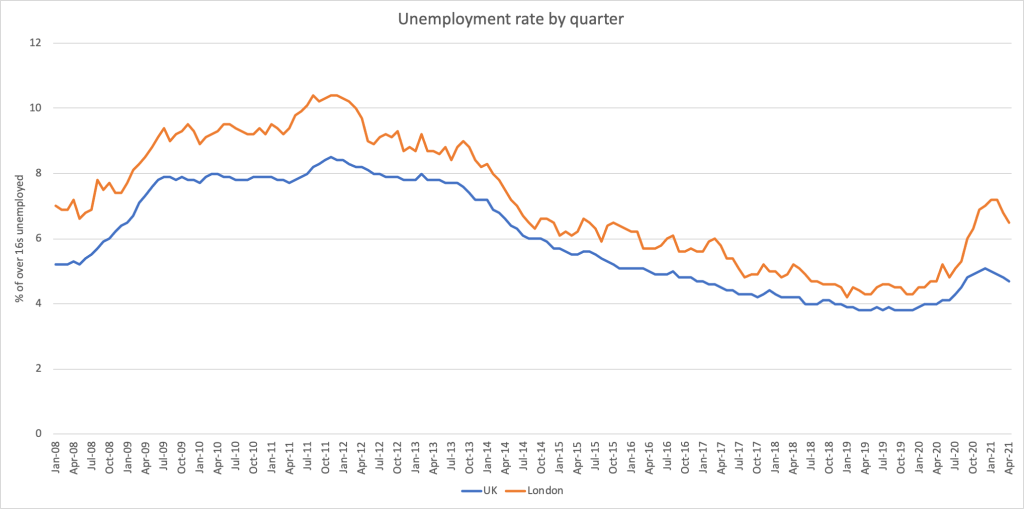
London has suffered badly, both from the health and the economic impacts of the pandemic, as can be seen in The London Intelligence Economic Tracker. As we write, the NHS in London and throughout the UK is again straining under pressure. The emerging labour market evidence shows a particularly severe downturn in London. The Greater London Authority (GLA) Economics team report that the number of workforce jobs fell 3.8% (229,000) in the capital between March and September – a far greater fall than for the UK as a whole, at 1.8%. They go on to say that while in the earlier stages of the pandemic, there were only modest changes in headline labour market statistics relative to the large falls in activity, this has changed more recently, with large movements in London’s unemployment rate. In the three months to October, the unemployment rate rose a record 1.2 percentage points to 6.3% in London – the largest quarterly rise since the series began in 1992. Only the North East region has a higher current unemployment rate than London, at 6.6%.

As we hobble through the next few months, bigger questions are being asked about the future of cities and of London in particular. Will the “urban age” of big cities leading global trade and growth return? Or does the future lie in more dispersed and fractured economic activity, as globalisation falters, global travel slows and/or the benefits of agglomeration are outweighed by the convenience and safety of working from home?

The debate has been growing in recent years about whether we have reached “peak London”, whether the city’s phoenix-like recovery from post-war deconcentration and urban flight has run out of steam. Like waves of pandemic infections, the turning point of cities’ fortunes are more easily visible after the event: nobody really expected London to start growing again in the mid-1980s.

Population growth has been slowing in London over the past three years. Moreover, recent analysis of Labour Force Survey data by Michael O’Connor and Jonathan Portes suggests that London’s population could have fallen during the pandemic by as much as 700,000 – a huge turnround. And consultants PwC recently forecast a 300,000 person decline by the end of 2021. These are only estimates and projections, and of course much of this change might be temporary. Will 2020 prove to be a blip, reflecting the extraordinary circumstances of the pandemic, or will it be another inflection point like 1987?

The latest demographic projections issued by the GLA in November 2020 forecast a return to growth – though at a slower rate than the past decade, when London’s population grew by almost 90,000 every year. Their “central projections” anticipate growth of around 50-70,000 people per year instead, with the next two years at the lower end of this scale. This would lead to a potential population of around 11 million by 2050 (compared to just under 9 million in 2019).

Population growth is driven by two factors: migration and natural increase. In the year to mid-2019, London’s population was estimated to have increased by 54,000. This consisted of net of 77,000 people to London from overseas, net movement of 94,000 people from London to the rest of the UK, and a net increase of 71,000 people from the balance of births and deaths.

The GLA’s central projection assumes that international migration will be suppressed for the period to 2022, but will then bounce back to average 95,000 (net) every year. The GLA’s expert panel felt that on balance, future reductions in migration are more likely than increases. However, they advised against discounting the possibility of higher levels of international migration, pointing to the resilience of international migration; the possibility that new immigration rules may result in foreign nationals settling in London for longer, and potential reductions in emigration rates of UK nationals in post-Brexit Europe.. The projections also suggest that net domestic migration to the rest of the UK will return to around 100,000 per year by 2030. So most of the projected growth will be fuelled by resurgent natural change (births minus deaths), which has fallen since 2010 but is forecast to stabilise at around 60,000 per year. London will continue to see a rapid churn in population, but its growth will be fuelled from within.

Similarly, the GLA project continued economic growth over the longer term. Their economic projections anticipate contraction and jobs losses in 2021, followed by recovery in 2022, with economic output (GVA) exceeding the 2019 peak by 2022, and the number of jobs in 2022 just reaching the peak of three years earlier. Beyond that, the implication of GLA and other forecasters’ cyclical and trend analyses is for the London economy to resume previous levels of growth, both in output, and perhaps to a slightly lesser extent, employment.

How credible is this? London’s position as a leading global city has taken a hit from Brexit and the UK’s management of coronavirus, but the city is still in a potentially strong position, with strengths in tech, green innovation, financial and business services, education, arts and culture. London needs to remain open and inviting, through immigration policy but also through nurturing and restoring its wounded cultural and hospitality sectors – the “soft power” foundations of its global appeal. The UK as a whole will continue to need London, as a driver of economic growth, for its fiscal contribution and as its gateway to the world. Brexit, and the UK’s potential isolation outside the major trading and economic blocs, makes London’s role more rather than less important.

How much does the government understand this, and will it commit to the infrastructure and other support needed for London to continue to grow? The signals are mixed: national planning policy is now focused on concentrating growth in cities, and the government’s latest algorithm envisages London building more than 90,000 homes every year – many more than the Mayor’s London Plan proposes, the GLA’s projections would imply, or that London is actually building at the moment.

Given this expectation, and the economic importance of London and South East, you would expect the government to want to invest in the capital’s infrastructure. But worryingly, in the National Infrastructure Review last November, the government suspended support for Crossrail 2, the next phase of major transport infrastructure investment in London, beyond safeguarding work. As Alex Jan has commented, Crossrail 2 is “pretty integral” to the London Plan, though all major infrastructure projects have their ups and downs – Crossrail 1 was first mooted in the 1970s, with roots in the Abercrombie Plan of 1944. Government commitment to “levelling up” regional imbalances in the UK is welcome, but this should not happen by starving the capital of much-needed public investment.

We will not know for some time whether short-term population and economic decline are temporary diversions or longer-term redirections of London’s future. We do not know whether 700,000 people really have left London over the last year, or whether and how quickly they may come back. And we do not known how far recovery from the crisis could see some rebalancing of activity within London and the wider South East. We know, in short, that there are still a lot of unknowns.

But public policy should shape the future rather than just responding to it (a core proposition of Centre for London’s London Futures programme), and governments should be wary of drawing conclusions about long-term trends from short-term disruptions. London’s potential for growth should be nurtured so that the city can work better for all its current citizens, as well as the two million more who could arrive in the next 30 years, and so that the capital can support recovery across the UK.