Come together

Interviewed on Radio 4 for the launch of his re-election campaign on Monday, Sadiq Khan said this year offered “a moment of maximum opportunity for Londoners, for there’s the prospect not just of a Labour Mayor, but of a Labour government working together [with a Labour Mayor].”

Even if the tone was more bullish than the Labour leadership might like, Mayor Khan has a point. Since he was first elected in 2016, he has lived with a chaotic kaleidoscope of Conservative governments. When these have shown any interest in the capital, it has generally been to frame it as an overheated reservoir of “wokery”, or to attack Khan’s record on policing and planning – most recently through directing a review of industrial land and opportunity area policy, announced the day before the pre-election period formally began.

Khan’s predecessors were luckier. Ken Livingstone’s first term started with him politically homeless, expelled from Labour for running as an Independent against their official candidate, Frank Dobson. The early days, when I was working in the Mayor’s office, were notably scratchy: Livingstone’s first meeting with Deputy Prime Minister John Prescott was cryogenically chilly, his battle against the London Underground public private partnership poisoned relations with HM Treasury, and I remember the air turning blue as he offered London minister Keith Hill his frank thoughts on provisional spending settlements.

But Livingstone benefitted from coming to power when the public spending taps were being turned on, and when the Labour government led by Tony Blair wanted to show that its new devolutionary settlement was a success. By 2004, following back-channel discussions with Number 10 and a more publicly visible collaboration with culture secretary Tessa Jowell over the London 2012 Olympics bid, he was back in the party.

Buoyed by London’s unexpected success in winning the Games, Livingstone’s second term saw substantial public spending in London, government and parliamentary approval for Crossrail – today’s Elizabeth line – and new legislation that extended the Mayor’s powers on housing, planning, culture and waste.

Boris Johnson benefitted from this legacy following his election in 2008. And from 2010 Livingstone’s Conservative successor had the following winds of a Conservative-led coalition in his sails.

He too secured more powers, through the Localism Act and and the Police Reform and Social Responsibility Act, both passed in 2011. And although London boroughs’ budgets were cut heavily – as were those of other urban councils – the government was surprisingly generous in investing in the Olympic Park legacy, including Johnson’s pet project, Olympicopolis (now East Bank), perhaps aware that just as a successful Olympics can show off a city, a tumbleweed-strewn legacy can show it up.

The only initiative that failed to make any headway was the London Finance Commission, a deliberately non-partisan campaign for fiscal devolution, which was beached on the sands of Treasury insouciance in 2013, and again in 2017 when Khan had a second go.

Khan came to power in spring 2016, as the five years of public spending cuts started to take their toll and the European Union referendum campaign slouched to its self-harming conclusion. The years since have been dominated by a grim procession of crises – Brexit contortions, the Covid pandemic and spiralling inflation – which have seen the Mayor and the government on the opposite sides of arguments, with spending decisions marked by public spats and denunciations rather than the private haggling and public consensus that operates between political allies.

While the “metropolitan elites” of London became useful villains, “levelling up”, the regional policy boondoggle Johnson wielded in the 2019 general election campaign, has little to show by way of results apart from cancelled and delayed projects, funding and tax decisions that do down the capital, and occasional outbreaks of opportunistic culture war posturing.

So Mayor Khan can be forgiven for believing, in words that still carry a faint resonance from the 1990s, that “things can only get better” if he wins a historic third term. Labour have said little about their plans for devolution beyond a promise of legislation and speeches focused on bringing some consistency to the patchwork quilt of devo deals spread across England. Furthermore, the UK’s dismal fiscal outlook suggests that “turning on the taps” of public spending is still a distant prospect. But Labour’s economic growth mission cannot pass over the opportunities London offers.

There could be a golden moment ahead. By the end of the year, a Labour Mayor and a Labour Prime Minister could be simultaneously in post, short of cash but rich in political capital. Starmer and Khan have their differences – on relations with the EU and Green Belt development, for example – but must be able to agree a shopping list of measures that are cheap and capable of having a real impact on growth and prosperity, even if some are controversial.

Such measures might include selected urban extensions in the Green Belt, more fluid European work permit arrangements for young people, performers and professionals, rail devolution in London, and maybe one more push for a system of fiscal devolution that enables London (and other English cities) to manage local taxes and local development.

Sadiq Khan has been quick – on occasion too quick – to point the finger at central government for everything wrong in London. A double win in the capital this year would give Labour a chance to show just how much better the relationship between City Hall and Whitehall could work.

Originally published by OnLondon.
Inverted pyramid of Pfeffel – Boris Johnson’s legacy

July 2012 was an odd time for me. I was working at London Legacy Development Corporation (LLDC) in offices minutes away from the Olympic Park, but as the London 2012 Games drew closer, it was clear there was nothing much for me to do. Not being a big sports fan I hadn’t bought any tickets, so a couple of days after the opening ceremony I flew to a small Greek island, where cheers from the local bar were the only indicator of London’s growing medal tally.

The LLDC itself had only been established a few months earlier. After years of wrangling between the Mayor of London and government, planning and delivering London’s Olympic legacy would be wholly in Boris Johnson’s hands.

You can probably guess what happens next. You expect chaotic bumbling, classical allusions, questionable personal morals, sound and fury signifying nothing. Boris Johnson’s behaviour has so tarnished his reputation in recent weeks and months that it is hard to even entertain the thought that good things came out of his mayoralty. But some did – and most of them are in the Queen Elizabeth Olympic Park.

Early signs were not auspicious. Following his election in 2008, one of Johnson’s first moves was characteristically whimsical. After a chance meeting with steel tycoon Lakshmi Mittal, he launched a competition for an “Olympic tower” as a landmark within the Olympic Park, which resulted in the tortuous steel folly that is the ArcelorMittal Orbit. 

Apart from this, the Mayor more or left the construction programme for the Games – well advanced by 2008 – to run its course. Instead he looked to legacy, re-opening the issue of getting a football club into the stadium (a saga in itself, and one extensively covered in Dave Hill’s excellent Olympic Park book), backing the establishment in 2009 of the Olympic Park Legacy Company (an uneasy joint venture between the government and the Mayor), and working with David Cameron’s government to convert this into what became the LLDC – a mayoral development corporation with more powers over planning and singular accountability to the Mayor’s office.

He also cast a wary eye over the plans for the legacy development that would follow the Games. A new masterplanning team, comprising Allies and Morrison and EDAW, who had worked on the Olympics masterplan alongside the Dutch firm KCAP, had been appointed just before Johnson was elected. Their plans for the Park included large scale urban blocks – like those eventually built in the athletes village – filling in the space between the retained venues and parkland. 

These would have made a striking contrast with surrounding neighbourhoods of terraced housing – not necessarily a bad thing, but not to the incoming Mayor’s taste. I want Georgian terraces, he told the design team at one meeting. Yes, they replied, we need to reinvent the terraced townhouse as a 21st Century typology. No, he insisted, I want Georgian terraces...

Beneath squabbles over architectural and urban form were deeper issues of money. The government had pushed for a design and delivery schedule that could generate enough capital receipts to repay debt that had been incurred in buying up land and borrowings from the National Lottery to pay for the Games. Denser development would yield higher returns, and house prices growing at 10 per cent a year would make later phases of development particularly valuable – at least on spreadsheets. 

As the Mayor and his advisors began to engage with the plans in the expectation of control shifting from Whitehall to City Hall, the Legacy Masterplan Framework was reinvented as the Legacy Communities Scheme, launched in 2010. Gone were most of the giant “European” perimeter blocks, as forms shifted to something reflecting what design advisor Ricky Burdett talked of as “London’s DNA”– terraces, townhouses and dense streets (with a few neo-Georgian flourishes to please the Mayor in the computer-generated images). We reworked the spreadsheets to show that debt could still be repaid, but this began to feel like an incidental, rather than central, objective for the legacy plan.

More change came in 2012, when Margaret Ford was replaced as LLDC chair first by Johnson’s idiosyncratic deputy Daniel Moylan, and then – after only a few months – by the Mayor himself, supported by Neale Coleman as deputy chair. Dennis Hone moved over from the Olympic Delivery Authority to replace Andrew Altman as chief executive and was asked to accelerate construction: the development corporation should act as a public body, not as a commercial developer; it should build housing, not bank its land while house price inflation stored up treasure in the future. 

A further dent in the spreadsheets came when Boris Johnson decided that Queen Elizabeth Olympic Park needed more than sports venues, mid-scale housing and a beautiful park. The success of the 2012 Games had piqued the interest of museums and universities, who had previously regarded the Park as a potential location for student housing but not much else. Boris Johnson became a cheerleader for a new cultural and educational district, dubbed Olympicopolis – a nod to the “Albertopolis” legacy from the 1851 Great Exhibition in South Kensington (and now renamed by his successor as East Bank, itself a reference to the 1951 Festival of Britain’s legacy).

The only problem with the plan – enthusiastically promoted by the Mayor as transformational to the global image of east London – was that it involved filling Stratford Waterfront, the most valuable site in the Park, with development that would require investment rather than generating receipts. Nevertheless, the Mayor pushed the plans forward, shepherding the Victoria and Albert Museum, University College London, Sadler’s Wells dance theatre and the London College of Fashion to agreement, securing capital investment from George Osborne’s increasingly-austere Treasury, and – less successfully – establishing a charity to fill the funding gap.

It is, of course, quite possible that another Mayor of London would have pushed back on spreadsheet architecture, and reshaped the Olympic Park plans to look “more like London”as Johnson did. It is possible too that another would have captured the imagination and commitment of Olympicopolis partners. But these changes in emphasis were distinctly Johnsonian in their chutzpah, their ambition and their grandiose historicism – even if accompanied by an equally characteristic blitheness about affordable housing and capital receipts. Ten years on, if the planning of the Games was Ken Livingstone’s, the shape of legacy is Johnson’s. 

First published by OnLondon

Missions Aspirational

You have to feel for Michael Gove. Rarely has a document been freighted with as much expectation as the levelling up white paper, which has been promised in one form or another since 2019. But even as the Department for Levelling Up, Housing and Communities was being given its new remit the spending shutters came down, ruling out new money – at least on the scale needed to radically alter hundreds of years of economic development.

Without new money the white paper sets direction rather than powering engines, though it does offer a few enticing hints of change. It promises, for example, to push devolution further and to bring some clarity and consistency to England’s idiosyncratic patchwork quilt of local government, and it celebrates the role of local policy-making. It even suggests that mayoral combined authorities and the Greater London Authority might bid for “sweeping further powers”, though it stops short of any significant transfer of fiscal powers.

And it does at least tell us what the government thinks “levelling up” is. At the core of the paper are 12 targets for 2030, heroically rebranded as “missions”. Advocates of mission-thinking as a way of galvanising action often point to John F Kennedy’s commitment to put a man on the moon by the end of the 1960s. Note that JFK didn’t make 11 other commitments at the same time. But most of these targets are laudable, even if the lack of detail on delivery makes them feel rather “aspirational”.

It is notable that most of them focus broadly on national improvements in social and economic conditions – job numbers, productivity and pay, violent crime, wellbeing, pride in place, school standards, adult training and home ownership – rather than explicitly on closing the gap between “LondonAndTheSouthEast” and other regions, which can of course be achieved by levelling up or by levelling down. Essentially the missions argue that all should rise together, though several qualify this by specifying that the worst-performing places should see the sharpest improvements.

Some targets are more explicit in their focus on narrowing gaps. Public transport across the country is to be “significantly closer to the standards of London” by 2030, which is a slightly ambivalent pledge given the cutbacks being considered by Transport for London in the absence of a long-term funding deal. It also does prompt a raised eyebrow – can other cities, let alone less densely populated towns, really support services like London’s?

The focus on narrowing the gap in healthy life expectancies also stands out, though the detail remains to be filled out in a separate white paper on health disparities later this year. In the meantime, the question of what geographies you use to judge success will be vital. As previously remarked here, the difference between places within the same borough can be every bit as stark as those between different regions.

There is a little more meat in the two economic missions. One pledges to improve pay, employment and productivity in every area of the UK – which should be good news for London, where productivity growth has stalled in recent years. The other proposes rebalancing public expenditure on research and development (R&D) outside the Greater South East. This could be one of the strongest measures in the white paper. Public spending on R&D is heavily focused on the “golden triangle” of London, Oxford and Cambridge, and there is a good argument that this concentration is failing on the grounds of economic efficiency as well as fairness.

Rebalancing investment to where it can make a real difference both directly and through attracting private investment rather than insisting it is spread evenly throughout the country, could make a real difference. The promise of £100 million for three new “innovation accelerators” in Greater Manchester, the West Midlands and Glasgow suggests that the need for focus is understood. Any switch of resources from London to other parts of the UK is likely to feel harsh, but a rebalancing of R&D spending is worth contemplating as a way of building up the knowledge economy in other cities.

Much less helpful is the white paper’s restatement of the government’s plan to divert funding for housing away from the areas of lowest housing affordability – that is, London and the South East. Doing so seems to fly in the face of its protestations that “levelling up is not about making every part of the UK the same, or pitting one part of the country against another. Nor does it mean dampening down the success of more prosperous areas”.

Less money for affordable housing in London is not likely to be good for London or the UK. London’s housing crisis is likely to worsen, with one of two results or a mix of them. Either the capital’s economy will suffer, with consequences for the rest of the country, or living in London will become more exclusive, further detaching the capital from the rest of the country. Investing to lever growth into other cities is a worthwhile endeavour. Removing support for infrastructure in places that most need it seems short-sighted and even spiteful.

Originally published by OnLondon.

Careless vistas

So many prime ministers have pledged action on social care before recoiling, that I really wanted to celebrate the PM grasping the late summer nettle of reform. But he seems to have  brushed casually past it while racing after shimmering mirage of making the NHS “the envy of the world”. Providing a ‘cap and floor’ for personal contributions to care is a good thing. It will reduce anxiety and help protect inheritances for many moderately well-off families, though using workers’ national insurance contributions to do so seems pretty well the least appropriate way of achieving that.

Or almost. State-provided adult social care (which London Councils estimate is 65 per cent of home care and 54 per cent of residential care) is currently funded by London’s boroughs, drawing on government grants, and the dysfunctional ugly twins of local government finance – council tax and national non-domestic rates.

Paying for social care accounted for more than 50 per cent of London borough service spending in 2018/19 according to Centre for London analysis (excluding public health, education and police services). London’s older population and younger population with care needs are both forecast to grow over the next decades, so the costs will rise. When he was chief executive of Barnet Council, Andrew Travers drew a ‘Graph of Doom’ showing social care (including children’s services) gobbling up the whole borough budget by 2030. The £3 billion or so (out of a total of £36 billion) left for reform of the system over the next three years would only just close the funding gap in London. It’s pretty thin gruel.

Even putting the matter of funding levels and taxes to one side for a moment, it makes no sense for the service to be delivered this way. People value social care, and see it as a critical service, but also look to councils for housing, planning, waste collection, street cleanings, park, libraries and schools.

The current model also creates an unhealthy tension between the NHS and social services, as older people are shunted gracelessly between home care, hospitals and residential care. I have heard anecdotes about councils employing full time lawyers to argue against hospital discharges into their care, and (full disclosure) I am personally in the middle of an unseemly haggle with the NHS and social services about who should be providing my mother’s care.

The row over the miserly allocation of funding to social care improvement, compared to the sums lavished on the NHS, illustrates the point. It is artificial to distinguish between the care provided to an old person at home and the care she receives on a hospital ward, not least because if you get the former right, you are less likely to have to pay for the latter.

I am generally all for devolution, but I think this may be the exception. The PM announced that the “NHS and social care systems need to be brought closer together” and talks of “integrated care systems”, but we have been hearing soft phrases like that for years. I think we need to be bolder, and nationalise funding for adult social care.

This does not necessarily mean nationalising care homes and care agencies, though in some cases that might be desirable or even necessary. It should mean tighter regulation to ensure decent pay and more consistently compassionate care.  In many cases, services would be provided pretty much as they are now (the NHS is far more used to operating through third-party providers than it was in the past), but decisions would be taken in a genuinely integrated way, where budgets allocations were not the issue.

This is not intended as a criticism of borough social services departments – London has some pioneering boroughs like Hammersmith and Fulham, who are I think the only local authority who levy no charges for home care, regardless of care recipients’ savings.

And the NHS is far from perfect; it has a lot to learn from social services about the management of long-term conditions, which often seems to take second place to the more life-affirming business of ‘curing’ people in hospitals. There would still be a role for local authorities, in managing interfaces with housing and other services, in promoting public health and preventative services, and in acting as champions and advocates for their residents – perhaps through continuing to play a part in assessments of need.

There are elements of today’s announcement that should be celebrated, but it is still tinkering with the system rather than seeking to transform and upgrade arrangements that date back 70 years. There has been a lot of talk about better joint working between the NHS and local government, but progress has been limited in London.  I’m afraid that the consequences of missing the opportunity for more fundamental structural change – or at least beginning a debate about it – will become increasingly apparent in the next few years.

Level 21

There is an argument to be made for regional levelling-up, even in the pages of On London. Poverty and ill-health may be spread throughout the country, but the productivity gap between London and other UK regions and cities is wide and has been growing. In 2018, London’s workers generated an average of £46 per hour worked compared to an average for £32 for England’s other city regions. And that gap is wider than in most other European countries.

This productivity gap results in significant fiscal transfers from London to the rest of the UK – nearly £4,000 per head each year. Building higher productivity in other UK regions should, in the long-term, help rebalance tax and spending across the country, as well as improving the lives of citizens. As the Prime Minister said in his levelling-up speech this morning, making every UK region as productive as London would make a huge difference.

And there are ways of stimulating productivity outside the capital. One is to invest more in research and development (R&D) in universities outside the golden triangle of London, Oxford and Cambridge, as was recently recommended in a report for NESTA. Another would be to accelerate development of Northern Powerhouse Rail, connecting the major cities of northern England and complementing the north-south connections of HS2.

But there are at least two problems with this approach. One is cost. However much the PM asserts that “this is not a zero-sum” game, commitments cost money. Northern Powerhouse Rail would cost around £40 billion and levelling-up R&D spending would require about £4 billion extra each year. Both projects could generate significant returns in terms of productivity and tax revenues, but over the less electorally-helpful longer term.

That connects to the second problem, which is that both of these projects would directly benefit larger cities, helping to create and connect hubs of economic activity and growth in places such as Manchester, Leeds, Newcastle and Birmingham, which already have strong research universities. But few of these places vote Conservative in large numbers (the West Midlands is an exception, which may explain the choice of Coventry as the PM’s speech venue), nor is building their HE-led knowledge economy guaranteed to secure more votes.

The “red wall” votes that the PM is keen to shore up are from smaller towns, outlying areas, places that feel more left behind. It is true that if investment in cities was successful indirect benefits would spread much wider. Just as towns like Brighton and Basingstoke benefit from their proximity to London, smaller towns and cities clustered around the norther cities would gain.

There would be jobs directly created to support new city enterprises, commuters and hybrid workers spending more money locally, and new opportunities opened up so that, as the PM said, people wouldn’t have to move away from where they grew up (though speaking as someone who grew up in villages and small towns, I can tell the PM that getting away was my priority, not a terrible burden).

But I’m not sure the government is ready to make the case that urban investment helps everyone. The urban-dominated ‘Northern Powerhouse’ didn’t get a mention, nor did investment in R&D, nor did major rail infrastructure. Instead we had a breathless litany of initiatives – Football pitches! New roads! Cycle Lanes! Hydrogen! Will Jennings and colleagues recently described this as “governing as political spectacle”, committing to projects that make a quick, visible and maybe superficial difference, rather than a longer-lasting and systemic one. We’re back to Tony Blair calling, in a leaked memo, for “eye-catching initiatives with which I can be personally associated.”

It was positive that the speech turned to devolution and local leadership towards the end, though galling to hear the PM complain about how centralised the UK is, given how Sadiq Khan has been treated in recent months. It sounds like the forever-delayed Devolution White Paper may yet inform the Levelling Up White Paper expected in the autumn – though talk was of county-level devolution deals where local leadership aligned with government objectives, rather than a new settlement between the centre and localities.

Levelling-up itself remains elusive. There were nods to closing the productivity gap in the PM’s speech, but too much was given over to a generic but worthy list of ways to make places and people’s lives better across the country. These are important, but while they may mitigate regional imbalances, they don’t really address them. We’ll have to wait for the White Paper to see how the PM’s levelling up plans balance the serious and strategic, with the superficial and electoral.

First published by OnLondon, 15 July 2021.

A pretty bleak hope

I have a terrible admission. I suspect the Government has more or less made the right decision in relaxing restrictions from 19 July.

It’s clearly a fraught subject, but I can only take on trust what chief medical officers Chris Whitty said at the press conference yesterday (around 20 minutes in): whereas there was a strong scientific consensus for delay from 21 June, there is no such consensus now, and that there is “extremely wide agreement” that an ‘exit wave’ is inevitable, whenever restrictions are lifted. Those statements make it very hard to argue for continued imposition of some of the toughest government restrictions – on freedom of movement and assembly – that we have seen since World War 2.

The next few months will be bumpy, even if people take it as slowly as the Government is urging. Infection rates are falling in some places: the surge we saw in Brighton last month has subsided, but I suspect that this is a false dawn as students have dispersed (there have been similar slowdowns in other university cities). There have also been sharp drops in places like Blackburn, where this wave started, and peaked around a month ago. But I’d be surprised if cases didn’t go up again in coming months as people start deploying their new freedoms (though I get the impression that restrictions are already being ignored by some of the age groups who have seen most infections).

But I don’t think we’ll be going back into another full lockdown. I can’t see the point. In March to June last year, we didn’t really know what we were dealing with, how to treat it, how to test for it, whether we could inocculate against it. The lockdown bought us time. In January to April this year, we knew we had a vaccine that worked, so it would have been absurd not to seek to suppress cases of a deadly virus while the vaccine was deployed through the population.

Now, apart from younger people and refuseniks, we are as vaccinated as we are going to get. There is nothing new coming to save us. We need to get through the exit wave, and accept that there will be losses and damage (though scientists suggest that the difference will be one of timing rather than scale in response to different re-opening dates). And we need to hope – it’s a pretty bleak hope – that the NHS can cope and that we will be safer the other side. Despite the rhetoric, there have only ever been two strategies for dealing with covid: aquiring population immunity through infection and inocculation, or suppressing the disease. Suppression went out the window early on (and can’t really work long-term on an individual country basis), so we are left with managing the timing and route to population immunity.

The Government’s approach can easily look callous, however. The latest guidance for clinically vulnerable people more or less amounts to ‘Don’t get covid’, and we still lack adequate pay and protection for people forced to isolate because of the illness – particularly those in more exposed professions. I can see the case for replacing precautionary quarantine with a regime based on testing and symptoms, but it can’t make sense for people who know they have covid to be forced to go to work. These blindspots make the Government look at the very least careless about those who are clinically or economically vulnerable. I can’t understand why they don’t see this.

So I’m looking forward to standing near a bar again, to saying goodbye to bossy signage, QR codes and performative perspex, to returning to packed gigs in due course. But I’ll be wearing my mask on the train, and approaching the next phase of the pandemic with trepidation not celebration.

Ten years after

Making the case for London has been complicated during the pandemic. It risks conflict with the ‘metropolitan elite’ myths so fondly fostered by government (and so ably skewered by my former colleague Jack Brown on Monday’s Start the Week). And, like many civic leaders, Sadiq Khan has been trying to tell a story of devastating impact to a seemingly indifferent government, but also to entice workers and tourists back into a renascent capital by reminding them of all London has to offer.

The pandemic has indeed had a particularly brutal impact on London’s citizens and economy, but recent figures suggest that the tide may be beginning to turn. Tube and bus ridership is higher than any time since March 2020, though still up to 50 per cent below pre-pandemic levels. Google mobility data also shows a slight return to central London, though more for retail and recreation than for work (which accords with higher public transport use at weekends).

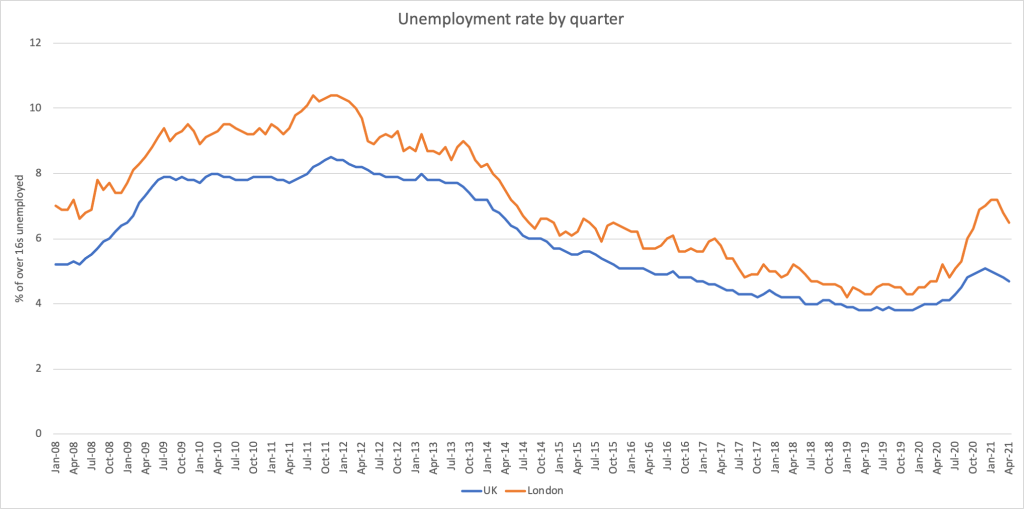
And, according to the latest ONS figures, London’s unemployment rate has also dropped, falling from 7.5 per cent in the three months to January, to 6.5 per cent in the three months to April. Unemployment is still higher than any other region’s, London boroughs still have some of the highest claimant counts and furlough rates in the country, and the economic impact of coronavirus has hit specific demographic groups hardest, but there are glimmers of hope.

So, it’s worth looking back to the last recession and recovery when London has hit hardest but recovered fastest. Could history repeat itself? As the chart below shows, London’s unemployment rate rose sharply ten years ago, and was more than two points higher than the UK’s in mid-2011, but then fell much more quickly, roughly tracking the national rate from 2014. A similar gap opened up last year, but has begun to narrow since January.

Unfortunately for London there were specific features of the 2011/12 recovery that favoured the capital. Quantitative easing, Government’s response to the financial crisis, diverted investment into booming equity and housing markets. And the London 2012 Olympic and Paralympic Games may have had a minimal direct impact on spending (most of the construction was complete by 2012, and Olympic Games years displace normal tourism expenditure), but were a powerful showcase for the UK internationally, and for London in particular.

Added to this, ten years ago, Boris Johnson (then Mayor of London) was keen to make the case for the capital, and able to persuade the Coalition Government that starving London of cash was no way to help the rest of the country, so projects such as Crossrail and the Olympic Park legacy development went ahead.

None of these factors are present today. Rather than being boosted by cheap money, financial services have been sidelined in Brexit negotiations in favour of more picturesque and politically salient (but far less productive) industries like fisheries. Big infrastructure projects, such as the redevelopment of Euston Station for HS2, are being squeezed, hopes of a swift return to international travel are receding, and the narrative of ‘levelling up’ looks pretty hostile to London and its nine million citizens.

At the G7 Summit last weekend, Boris Johnson warned against repeating the mistakes of the ten years ago, when (as he didn’t quite say) austerity extended and deepened the impact of the recession for many people and places. This is right, but the correct lesson is to extend support wherever it is needed to ‘level up’ the prosperity and life chances of citizens and communities, not to stall the UK’s economic engine in pursuit of headlines or electoral advantage.

Good advices?

 [First published in Local Government Chronicle, 24 November 2020]

Choosing the right advisors is one of the most important decisions that political leaders make, as recent Downing Street dramas have illustrated. This is perhaps particularly true for the mayor of London, who unlike the prime minister or a council leader does not have the support of a party group, but only the watchful eye of a scrutinising London Assembly.

So, alongside City Hall’s expert staff, mayors need mates; their own people who can advise and represent them in such a huge city. The mayor of London can bring in 12 appointees, and the ways in which the three mayors to date have appointed and worked with their teams have been indicative both of their strengths and their weaknesses – as detailed in London’s Mayor at 20, a collection of essays, analyses and interviews looking back over the past two decades of the capital’s mayoralty.

When Ken Livingstone was elected in 2000, he came with a gang of advisors who had worked with him for many years – from the Greater London Council, from activism since then, from his parliamentary office. Most had worked with him when he had decided to run as an independent following Labour’s bungled attempt to fix candidate selection. Within weeks of his election, Ken had advertised posts as ‘policy advisors’, and many of these were filled by familiar faces.

The team were all broadly from the political left, albeit from different denominations; Simon Fletcher, Ken’s chief of staff and former parliamentary researcher, brokered agreement on priorities and positioning. The mayor used to describe advisors such as Neale Coleman, John Ross, Jude Woodward and Lee Jasper as being like ministers – with full authority to represent his views. The team was consistent through Ken’s two terms, with the mayor showing loyalty (and damaging his 2008 re-election campaign) when advisors became embroiled in newspaper allegations of cronyism.

Unlike his predecessor, Boris Johnson had no deep roots in London politics, and had only been an MP since 2001. There was no gang waiting in the wings when the ebullient loner was elected in 2008. Nick Boles, then Conservative MP for Grantham and founder of the Policy Exchange thinktank, worked with the new mayor to appoint deputy mayors.

The initial tranche proved shaky: one was prosecuted for fiddling expenses, another was found to have fabricated his CV, and a third senior advisor made comments on race issues that led to swift resignation. Tim Parker – a corporate restructuring guru appointed as chief of staff and first deputy mayor – left when it became clear that there wasn’t the scope or appetite for the application of his specialised skill set, and that Boris wanted to take decisions as mayor rather than acting as a media-friendly figurehead.

Other appointments were more stable, some becoming long-term Johnson allies. Munira Mirza, deputy mayor for culture and education, followed Johnson to Downing Street, as did chief of staff Eddie Lister, who is now temporarily filling the same role at 10 Downing Street. Lister, and Simon Milton the former Westminster City Council leader who preceded him at City Hall, took a relatively light-touch approach to policy co-ordination, leaving other deputy mayors, such as Stephen Greenhalgh, Kit Malthouse and Isabel Dedring, with space to develop policy positions, but also giving a looser sense of direction than under Livingstone.

If Sadiq Khan drew one lesson from Boris’s wobbly transition, it was not to make appointments too quickly. His deputy mayors were appointed painstakingly over his first six months in office. Senior local government figures such as James Murray and Jules Pipe, former mayor of Hackney, were appointed alongside former GLA officials Justine Simons and Shirley Rodrigues, and external figures such as human rights barrister Matthew Ryder, shadow transport minister Heidi Alexander and former Home Office special advisor Sophie Linden.

These appointments have been carefully judged, but the deputies are not close to Sadiq and his decision-making in the way that Ken’s were, or eventually Boris’s became. Less prominent are the inner circle of advisors who agree policy positioning: chief of staff David Bellamy, director of policy Nick Bowes, and communications and external affairs directors Leah Kreitzman, Paddy Hennessy and Jack Stenner.

The London mayoralty is an unusual role: it can be a springboard or a dead-end; it suits loners and mavericks, but requires constant coalition-building; it gives extensive powers of patronage and appointment, alongside singular accountability. It is a job to which the incumbent is elected alone, but not one which any mayor could hope to carry out alone. Appointing advisors and deputies is an early but critical decision, requiring trust and judgement. For a political loner like Boris Johnson it is a fraught business, and one that has given him a rocky start both as mayor of London and as prime minister.

5 ways mayors have changed London (Nov 2018)

[Originally published on Centre for London blog, 7 November 2018]

This year, the London Mayoralty turns 18 years old and ‘comes of age’. During this time, London’s three Mayors – Ken, Boris, Sadiq – have used the limited levers that they had – sometimes to breaking point –  to improve the city.

But what impact have they actually had? Here’s five ways that the Mayors have transformed our city since the Mayoralty was established.

1. Leading London’s urban renaissance

The London Plan, as adapted and evolved by the three Mayors, set a world standard in promoting smart growth, sustainable development, urban renaissance.  The plans committed to accommodating growth within the city, focusing on public transport walking and cycling, developing ever more ambitious housing targets, renewing the public realm, and harnessing the dynamics of development to create a fairer and greener city.

2. Driving transport innovation

The Mayor’s ability to integrate transport and development – the envy of other cities like New York – has been central to the London Plan.  But Transport for London – chaired by all three Mayors in a signal of its significance – has also led policy innovation in transport – from the original congestion charging zone, to bike rentals, to the Oyster card and contactless payment, to the ultra-low emissions zone.

3. Providing civic leadership

The Mayors have also provided a focal point for civic leadership. This has not just been a matter of fronting bids for major events, and representing the city in trade fairs and Whitehall spending rounds. It has also sadly meant leading the city at times of tragedy – after the London bombings in 2005, and the terrorist attacks and Grenfell Tower fire that the city faced last summer. The Mayors have, with differing emphases and tone, presented London and the world with an image of capital that is inclusive, tolerant, diverse, open, united.  It’s an aspect of the Mayor’s role that is not mentioned in any statute, but eighteen years on you wonder how we lived without it.

4. Doing deals with central Government

Having a Mayor has enabled London to do deals with central Government on how to finance and deliver major infrastructure projects.  These deals – on the London 2012 Olympics and legacy, on Crossrail and on the Northern Line Extension – have helped London to accommodate its growth, to weather the storms of the financial crisis, and to transform areas benighted by decades of underinvestment – while also building world-leading capacity in major projects.

5. Making the case for more power

And the Mayors have secured new powers through statute.

  • In 2006, the Mayor was given powers to stage the London 2012 Olympics – which was fortunate given that he and the government had committed to do so the previous year.
  • In 2007, planning powers and housing powers were strengthened, as was the London Assembly’s role in approving mayoral appointments.
  • In 2011, policing oversight – always a bone of contention between the Mayor and Home Secretary was reformed, as the Metropolitan Police Authority was replaced by the Mayor’s Office for Policing and Crime
  • Also in 2011 the Localism Act empowered the London Assembly to reject mayoral strategies, and passed control of HCA and LDA land to the Mayor, delegated the affordable housing budget, enabled the Mayor to establish Mayor Development Corporations – shifting the focus of the GLA from strategy to delivery.But progress since 2011 has been faltering.  There have been devolution deals on the Adult Education Budget, agreements on health and social care, and discussions on justice devolution.  But despite two London finance commissions, and strong representations from the Mayor and London Councils, further devolution feels like unfinished business.

And at no time since the Mayoralty was set up 18 years ago have the challenges facing the capital looked more daunting. Local government services are under increasing pressure. A cooling housing market is leading to a slowdown in the construction and availability of affordable homes. Migration from the EU and across the country is falling. And all of this before Brexit.

Against that background, we need to rethink the way London operates for new times. We need to continue to make the case for new powers for the Mayor – across housing, taxes, and skills, to help London meet the challenges ahead.

From adhocracy to algorithm – notes on mayoral style (July 2018)

 [Originally published in OnLondon, 7 July 2018]

Halfway through his first term, there are some curious paradoxes about Sadiq Khan’s tenure as Mayor of London. He has a solid record of announcements under his belt, from a remixed London Plan to cash for affordable housing and eye-catching initiatives such as the borough of culture or ballots on estate regeneration.

While there’s a mounting funding crisis in Transport for London, initiatives such as the Hopper fare for buses have been successful, even if pedestrianising Oxford Street has fallen foul of Westminster Council politics. And Sadiq has campaigned for a capital-friendly Brexit, been vigorous in promoting London’s openness, and appointed well-respected and diverse deputy mayors and committees of advisors.

And yet. And yet. Despite assiduous media management, there are some voices – from Greater London Authority officers to housebuilders to senior borough executives – who talk of the Mayor as remote, inaccessible, disengaged. You can’t meet with him or speak with him, they say. You think you’ve agreed something with a deputy mayor, they complain, but then Sadiq does his own thing. It’s all smoke and mirrors, run by a tight gang around the Mayor who already have their eye on his next big job.

It’s worth pausing to ask whether these murmurs of discontent are simply the protests of the former in-crowd feeling the chill of a change in administration and a significant change in political direction. There’s certainly some of this, and you could argue that previous mayors were perhaps too eager to court housebuilders to little effect in terms of housing delivery.

But I think there’s something more – a change in style, or even mode of governance. Boris Johnson and Ken Livingstone both governed in a highly personal manner; they wielded their authority in a way that the sociologist Max Weber might have described as “charismatic”. For Ken, leadership was a matter of drawing together the factions and alliances that had enabled him to rise to the top of the Greater London Council, doing deals with developers even when he felt like bringing a long spoon, schmoozing the blazered sportsocrats of the International Olympic Committee, and alternately raging at government and wheedling powers and resources from it.

Boris’s regime was even more personalised. From successes such as the promotion of the “Olympicopolis” legacy plan for the Olympic Park – now renamed Eastbank – to more questionable follies such as the ArcelorMittal Orbit, the Garden Bridge and Emirates cable car, his most prominent initiatives were high risk, opportunistic deals, bearing only a glancing relationship to mayoral powers or remit, but using sheer force of personality to lever resources from high net worth individuals and corporations.

All of which seems very far away from Sadiq’s approach. He’s not interested in doing deals, you sense, but in tightening and adjusting the policy levers at his disposal to secure the results he wants. His governance rests on the “legal-rational” (Weber’s term again) basis of the mayoral powers and remit, with decisions taken calmly and rationally – albeit with a keen eye for politics – rather than on the basis of deals done personally or with subordinates.

It’s a fundamentally different model, and one that other people in City Hall (perhaps lower down the pecking order and therefore less likely to miss direct access to the Mayor) relish. One said to me, “With Boris, you got the feeling that he had a highly-tuned machine that he couldn’t be bothered to steer. With this lot, you get clear direction, and authority to go out and do things.” It is also probably more like the technocratic mayoralty that I and fellow members of the transition team expected before the first mayoral election in 2000, when we played “war games” about how the newly established Mayor and London Assembly would operate in practice.

Whether Sadiq’s approach will be more or less successful than his predecessors’ remains to be seen. A city cannot just be governed by deals with developers and ad hoc initiatives devised in Davos cloakrooms, but it probably can’t run like an algorithm either. The Mayor’s resources are limited, so he needs to work with investors and developers to build the city he wants. With a few exceptions, I applaud Sadiq’s policies. But I wonder how some of them will be implemented.