Past caring

Let’s start with the good news, such as it is. The immigration white paper published on Monday re-affirms the government’s commitment to a “fair pay agreement” to improve the terrible pay and conditions faced by care workers. This cannot come soon enough, but whether it will be sufficient, alongside withdrawal of the social care visa, to avoid a social care staffing crisis is another question.

London is at the sharp end, as the Skills for Care dashboard shows. The capital has the highest care worker vacancy rates in England: 11 per cent compared to an average of eight per cent across the country, with vacancies highest in the “independent” sector (that is, not directly employed by the NHS or local authorities), which accounts for four fifths of the city’s 250,000 adult social care workers.

These include workers in care homes, nursing homes and ‘domiciliary’ carers who visit mainly elderly clients (precise numbers are hard to come by, but around 60-70 per cent of adult social care clients are over 65) in their own homes to help them with food, getting dressed, washing and personal care.

London’s care workforce is older than elsewhere and includes more foreign nationals: 54 per cent are British, compared to 73 per cent across all England and 80 per cent-plus in the north. Workers directly employed by London local authorities are paid an average of £15.52 per hour, but these are only a small minority.

Those in the independent sector receive an average of £11.54 – little more than their counterparts outside London and substantially less than the London Living Wage of £13.85. Lastly, and these factors may all be connected, London’s care workers are far more likely to be employed through an agency and on zero hours contracts.

So, if a staffing crisis hits, London will be in the front line. A fair pay agreement may help over time, but if there are vacancies across the country during a transition period, London’s care workers may vote with their feet, seeking better pay and conditions beyond the M25.

But – and I don’t think this point is made enough – it’s not just about pay. The best care workers I have met are those who feel a genuine sense of vocation. As well as the patience, gentleness, and physical and emotional strength to deal with frail bodies and failing minds, these carers genuinely love the work they do, looking past the difficulties to take pride in looking after other humans. We shouldn’t exploit their calling with poor wages. But I’m not sure a pay boost, together with some general gesticulating towards economically inactive people, is enough either.

Setting that to one side, how would a 20 per cent pay rise (based on raising the average to London Living wage) for London’s care workers be funded? Though local authorities only employ a minority of care workers, they generally pay care costs for anyone with assets of less than £14,250 and a proportion of costs for those with up to £23,250. (Hammersmith & Fulham Council is one of the few local authorities not to apply a means test for domiciliary care and day care).

In London around 70 per cent of people in care homes and 85 per cent of those receiving care at home are local authority-funded – some of the highest proportions in the country, reflecting the relative poverty of London’s older people. Given growing demand from an aging population, national insurance rises and adult social care overspends mounting up every year, boroughs would struggle to pay an extra 20 per cent on care home and care agency fees. And it doesn’t look as if the government is inclined to pay them more.

For those paying fees themselves, an increase in costs might mean quicker draining of capital reserves (and recourse to local authority support), or attempts to cut back on spending. But cutting back on care provision could be a false economy. Battling on, as many older people are inclined to do, can raise the risk of accidents at home and send more older people into hospital. Finding enough carers to provide short-term “re-ablement” support for them when they leave hospital is already a challenge. Shortages of care staff will likely mean longer hospital stays for “medically fit” older people – adding to pressure on beds, and often resulting in worse health when they do leave.

Alternatively, family members could be asked to do more, as Conservative ministers have occasionally suggested. But is it right or economically sensible to ask people (generally women) to leave careers at a time of peak earnings to become full-time carers? Families need to be involved in care but abandoning other plans to become a live-in carer for elderly parents, as many women of my mother’s generation did, is not going to work for everyone.

The whole thing is a mess, and is going to become messier as the population ages. Yes, we need to improve pay, conditions and esteem. And yes, we probably should enable some continued immigration for the care sector. But the whole system needs a rethink. It’s not new to say this. There have been plenty of reviews (the Casey Review announced earlier this month is the latest in a long line), and more or less sensible ideas for caps on care costs, for compulsory insurance policies and for levies on estates. But all have been shot down or proved electorally toxic.

The problem is, as the Financial Times’s Stephen Bush observed this week, “at any given time, most people are not experiencing the care crisis”. And when we stop experiencing it, we don’t want to think about it any more. I don’t really want to think and write about it. My parents no longer receive care and I hope it’s a few years before I need to. But we need to find a better way. What we have now simply isn’t good enough, and I fear it’s about to get worse.
I can’t get no…

Record levels of dissatisfaction with the NHS‘ seems to have become an annual headline fixture, dusted off each year around this time, when the King’s Fund and Nuffield Trust publish the health findings from British Social Attitudes.

This year was no exception, with just 21 per cent of people expressing themselves ‘satisfied’. But what exactly are people dissatisfied about, and what do they want done about it? Given the importance of debates about the NHS, it is worth diving into the figures to understand a bit more.

1. Wait in vain

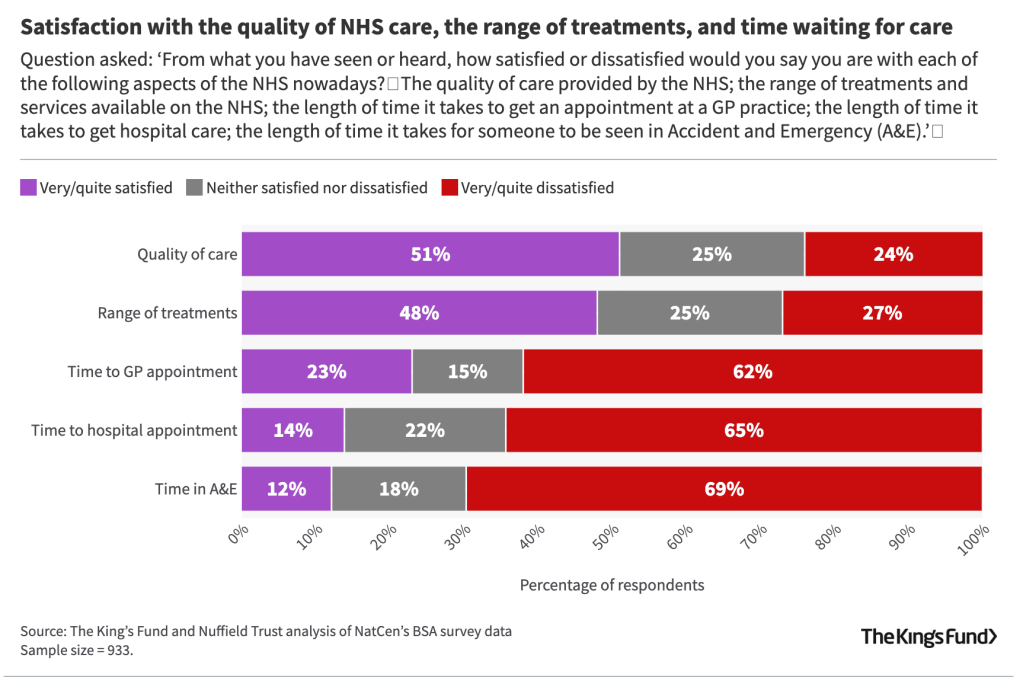
Dissatisfaction is rife across services – from dentistry, to GPs, to A&E, to hospital care, to social services. But it is the time spent waiting – in A&E or for GP or hospital appointments – that rankles most. Only 25 per cent are unhappy with the quality of care or the range of treatments available; around 50 per cent are satisfied.

The problem with NHS care is the quantity provided not the quality – as is also reflected in 75 per cent saying the NHS is understaffed. Produtivity and enhanced outcomes are important, but unless these lead to more responsive services, they may do little to shift public perceptions.

2. No tax, only spend

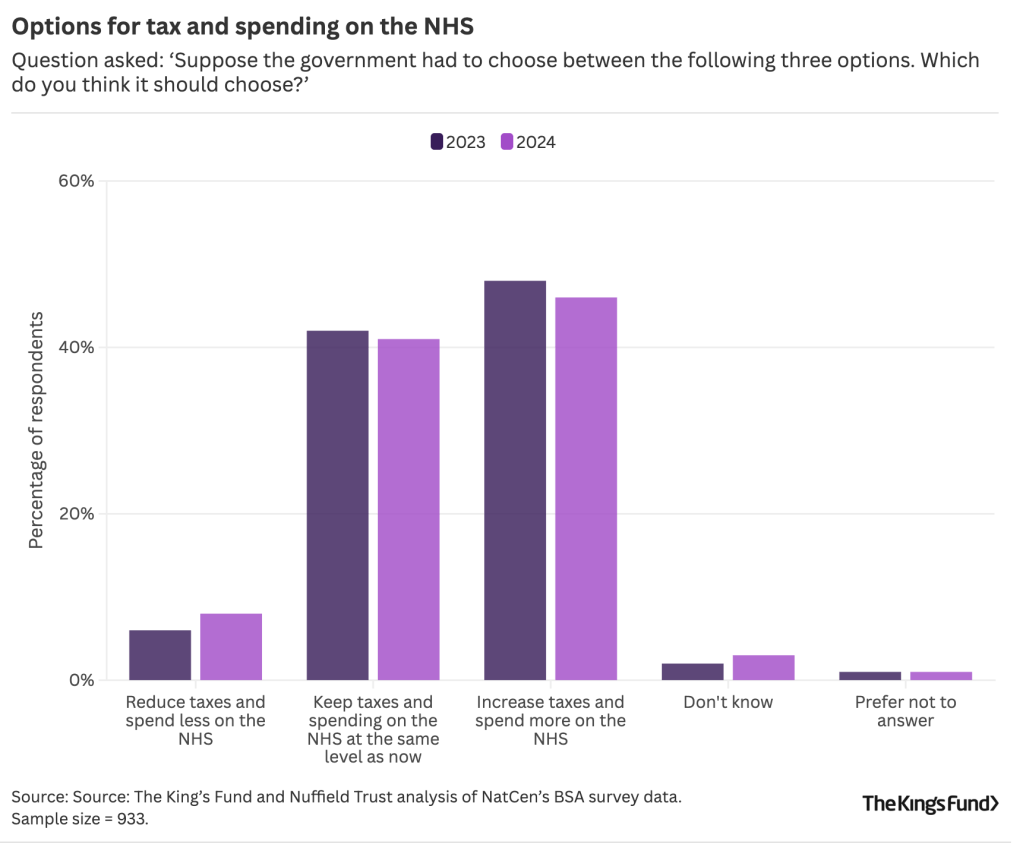
Nearly 70 per cent of people think that the government should spend more on the NHS, but only 46 per cent think taxes should go up to do this, a very slight fall from 2023. These views are not necessarily inconsistent with each other, or with the government’s policy, which has been to spend more on the NHS without raising personal taxes.

But I wish that British Social Attitudes would ask a follow up question, both on this specific issue and on their more general finding that the public wants to pay more tax for better public services, and has done for almost a decade. ‘Which taxes do people wish to see rise?’, they should ask or even ‘Do you think you should pay more tax?’ I suspect that there is far more enthusiasm for tax rises in the abstract than there is for the specific, let alone the personal. I may be wrong, but it would be useful to know.

3. Shaky foundations?

British Social Attitudes also asks about whether people sign up to three ‘founding principles’ of the NHS – universality, freedom at point of use, and funding through taxes. Bea Taylor from Nuffield Trust is quoted as saying, “support for the core principles of the NHS – free at the point of use, available to all and funded by taxation – endures despite the collapse in satisfaction.”

Well, up to a point. Support for the NHS being free of charge at the point of use has been sustained. But there are signs of change elsewhere. The proportion of people saying the NHS should be definitely available to everyone has fallen from 67 to 56 per cent since 2021, and the saying taxpayer funding definitely applies has fallen from 55 to 42 per cent. These are pretty substantial shifts.

The biggest gains have been both those opposing the propositions, and those feeling that the propositions ‘probably’ apply. It seems support for these core propositions, while still broadly intact, is less fervent than it once was – a change that could be attributed to anti-immigrant feeling (for the ‘universal’ principle), to a rise in Reform-driven debate about ‘insurance-based models’ (which the party is rather coy about), or simply to people thinking that something has to give.

As the Government prepares to launch its Ten Year Plan for the NHS, it will be interesting to see what that might be.

Level 22

While we wait for the forever-delayed Levelling Up White Paper, a “levelling up mindset” is starting to take hold across Whitehall. Just before Christmas newspaper reports suggested that the latest Department for Work and Pensions review would explore whether pensions could be paid earlier in areas with lower life expectancy.

It is an intriguing idea. There are big differences in life expectancy across England. Between 2017 and 2019, a man born in Richmond-upon-Thames could expect to live in good health for nearly 72 years – almost 20 years longer than a man born in Blackburn. A woman born in Wokingham would have a similar advantage over one born in Nottingham.

But it’s a bit odd too. Faced with these yawning inequalities and the worrying fall in healthy life expectancy since 2014-16, you might think that addressing the causes of ill health and early mortality would be the focus of policy, not making sure everyone gets a comparable return on their national insurance contributions.

Allowing people to take their pension earlier in some parts of the country could also have strange consequences. Is a workforce that has been shrunk through early retirement really what economically disadvantaged places need? Would a wave of pension-seekers moving to northern seaside towns really act as a catalyst for revival?

But there is a bigger problem too. Health inequalities can be just as sharp within as between regions or even local authorities: data at “middle super output area” (MSOA) level show that in Kensington & Chelsea there is a 25-year gap in healthy male life expectancy between North Kensington and the area around Sloane Square. If we really want to target earlier retirement dates at those areas where people are likely to have least time to enjoy their pensions, should we not be looking at individual wards and MSOAs rather than large geographical areas?

Of course we won’t be doing that: such a system would be fiendishly complicated and deeply unfair to poorer people living in wealthier neighbourhoods. But it does highlight one problem with the levelling up debate. Health and other aspects of inequality are often presented in terms of geographies because we have good data collected on a geographic basis. But geography is not necessarily the primary issue, as anyone who has seen the wealth of the Vale of York or the poverty in north Westminster will attest.

This is not to say geography is irrelevant: the 2020 Marmot Review of health equity argued that, while life expectancy in richer places was pretty similar across the country, poorer places in London had better life expectancy than poorer places in the north. The review suggested that a mixture of economic and policy factors (particularly the impact of austerity) had hit northern areas particularly hard and had therefore widened the gap since 2010.

But the Marmot analysis is still comparing places – which in London contain a diverse mix of people, and may have become more mixed in recent years – rather than classes of people. Londoners on the poverty line may be only a block away from an artisanal coffee shop, but that may not help their health or other life chances.

There is research indicating links between income and health (for example, people in the poorest 10 per cent of households are ten times more likely to report poor health than people in the richest households), but it is more scanty. Most research on health inequality (and other forms) continues to use place as a proxy for a whole suite of characteristics that may offer or deprive particular people of opportunity.

My hope for 2022 is that we develop a more nuanced discussion of “levelling up”. I think this means southerners acknowledging that there are regional imbalances that do need addressing. I’d suggest that two of these are the need for investment in strategic transport schemes (rather than the apologetic bodge-job of the Integrated Rail Plan) and in research and development. But it also means that we shouldn’t make the mistake of assuming that every inequality is primarily regional in character when that may simply be a result of the basis on which we collect and publish statistics.

Originally published by OnLondon.

Careless vistas

So many prime ministers have pledged action on social care before recoiling, that I really wanted to celebrate the PM grasping the late summer nettle of reform. But he seems to have  brushed casually past it while racing after shimmering mirage of making the NHS “the envy of the world”. Providing a ‘cap and floor’ for personal contributions to care is a good thing. It will reduce anxiety and help protect inheritances for many moderately well-off families, though using workers’ national insurance contributions to do so seems pretty well the least appropriate way of achieving that.

Or almost. State-provided adult social care (which London Councils estimate is 65 per cent of home care and 54 per cent of residential care) is currently funded by London’s boroughs, drawing on government grants, and the dysfunctional ugly twins of local government finance – council tax and national non-domestic rates.

Paying for social care accounted for more than 50 per cent of London borough service spending in 2018/19 according to Centre for London analysis (excluding public health, education and police services). London’s older population and younger population with care needs are both forecast to grow over the next decades, so the costs will rise. When he was chief executive of Barnet Council, Andrew Travers drew a ‘Graph of Doom’ showing social care (including children’s services) gobbling up the whole borough budget by 2030. The £3 billion or so (out of a total of £36 billion) left for reform of the system over the next three years would only just close the funding gap in London. It’s pretty thin gruel.

Even putting the matter of funding levels and taxes to one side for a moment, it makes no sense for the service to be delivered this way. People value social care, and see it as a critical service, but also look to councils for housing, planning, waste collection, street cleanings, park, libraries and schools.

The current model also creates an unhealthy tension between the NHS and social services, as older people are shunted gracelessly between home care, hospitals and residential care. I have heard anecdotes about councils employing full time lawyers to argue against hospital discharges into their care, and (full disclosure) I am personally in the middle of an unseemly haggle with the NHS and social services about who should be providing my mother’s care.

The row over the miserly allocation of funding to social care improvement, compared to the sums lavished on the NHS, illustrates the point. It is artificial to distinguish between the care provided to an old person at home and the care she receives on a hospital ward, not least because if you get the former right, you are less likely to have to pay for the latter.

I am generally all for devolution, but I think this may be the exception. The PM announced that the “NHS and social care systems need to be brought closer together” and talks of “integrated care systems”, but we have been hearing soft phrases like that for years. I think we need to be bolder, and nationalise funding for adult social care.

This does not necessarily mean nationalising care homes and care agencies, though in some cases that might be desirable or even necessary. It should mean tighter regulation to ensure decent pay and more consistently compassionate care.  In many cases, services would be provided pretty much as they are now (the NHS is far more used to operating through third-party providers than it was in the past), but decisions would be taken in a genuinely integrated way, where budgets allocations were not the issue.

This is not intended as a criticism of borough social services departments – London has some pioneering boroughs like Hammersmith and Fulham, who are I think the only local authority who levy no charges for home care, regardless of care recipients’ savings.

And the NHS is far from perfect; it has a lot to learn from social services about the management of long-term conditions, which often seems to take second place to the more life-affirming business of ‘curing’ people in hospitals. There would still be a role for local authorities, in managing interfaces with housing and other services, in promoting public health and preventative services, and in acting as champions and advocates for their residents – perhaps through continuing to play a part in assessments of need.

There are elements of today’s announcement that should be celebrated, but it is still tinkering with the system rather than seeking to transform and upgrade arrangements that date back 70 years. There has been a lot of talk about better joint working between the NHS and local government, but progress has been limited in London.  I’m afraid that the consequences of missing the opportunity for more fundamental structural change – or at least beginning a debate about it – will become increasingly apparent in the next few years.

Donning the Cap?

Social care for older people is one of those issues that every political party professes to care about, but none is willing to tackle. At election times, it is ritually acknowledged as important, then sidelined by voters and politicians alike.

The one exception to this was the 2017 election, when Theresa May\’s Conservative Party had a rare moment of political courage and came up with a proposal that was at least rational and and thought through. They were duly punished, for reasons which we\’ll come back to, and which probably explain the timidity across the spectrum.  This time round main parties\’ manifestos are artfully evasive – all but conspiring to avoid the subject – but point the way to a possible consensus in the next Parliament.

Before considering the parties\’ proposals, such as they are, it is worth looking at how social care operates at the moment. Unlike the NHS, the glamorous sibling that carries us through critical moments of our life and is never far from TV screens whether in dramas, documentaries or new bulletins, social care for the elderly lurks in the shadows. It\’s one of those things best not known about it, until you have to learn a lot in a hurry (I have, so this rant is all a bit parti pris).

Care today, gone tomorrow
If an older person needs help living in their own home, with everything from moving around, to washing and dressing, to using the loo, the local council\’s social services department will appoint carers to visit up to four times a day to help out with those tasks (\’domiciliary care\’). If needs are more severe, you may have to go into a care home, or a nursing home with more specialist medical staff.

Costs mount up quickly: four visits a day can cost £400-500 per week (£26,000 a year), while residential care can cost twice as much. And, if you have capital assets above £23,250, you will have to meet those costs (or make your own arrangements). If you have less than £14,250, the council will pay all your costs. If you are receiving care at home, and own that home, you won\’t have to include that in your assets; but if you are in a care home, it will be included, unless you have a partner or dependents living there.

There is one big exception to all this – \’continuing health care\’ (CHC). A 1999 court decision held that all the care needs of a particular severely disabled adult were in essence \’health care\’ needs, and should therefore be funded in full by the NHS, at home as much as they would be in hospital.  CHC is a big cost for the NHS, more than £3 billion per year, and getting it involves an undignified argument about precise levels of enfeeblement with clinical commissioning groups who will fight hard to avoid assessing patients as eligible.

The inequitable split between means-tested social care and universalised health care was one of the things that sunk Mrs May\’s modest proposal in 2017. She proposed that people would be required to pay for social care until their assets reached £100,000 – a much higher threshold than currently, but this time including the value of property (which would not have to be sold until after death). But why should someone with dementia have to impoverish themselves – or rather eat into their children\’s expected inheritance – while someone with cancer would receive their treatment free, the critics asked? Dementia Tax, they shouted! After that, the deluge, a hung Parliament, and all the fun that has ensued.

Caps and consensus
Which brings us to the parties\’ manifestos this time round. The Conservatives\’ is triumphantly vague, allocating around £1 billion a year extra to budgets for adult social care (currently just over £21 billion), and promising to build a consensus for reform.

Beyond that, there is a promise that \”nobody needing care should be forced to sell their home to pay for it\”. As discussed above, there are only a few circumstances today where people are forced to sell their homes, and giving the same exemption to a £50 million mansion as to a £50,000 flat seems a little arbitrary.

The Daily Mail, which has campaigned vigorously against people being forced to sell their homes, might be more enthusiastic about the Labour Party\’s plans for universally free personal care for over-65s (except, you know, socialism, Corbyn etc). But Labour\’s plans are themselves unclear: the  Manifesto promises a \’National Care Service\’ providing free personal care to the over-65s – but then talks, confusingly, about eligibility criteria and lifetime cap of £100,000 on individuals\’ payments towards their care.

The idea of a cap on costs goes back to the 2011 Dilnot Commission, which recommended a cap on lifetime costs of around £35,000. It certainly makes more financial sense than universal free provision, which has been priced at £6 billion a year. The fact that Labour\’s spending plans show the cost of social care reform as £2 billion suggests that capping costs, rather than free provision, is the real plan.

It is one idea that might even attract cross-party support. The coalition government\’s 2014 Care Act provided for a cap to be set, and a cap of £72,000 was proposed for 2020, but the idea has been quietly dropped, as the long-awaited Green Paper on Social Care continues to be, erm, awaited. The idea of a cap also appears in the Liberal Democrat manifesto, bashfully buried at the end of a waffly paragraph about \’sustainable\’ and \’joined-up\’ funding.

A cap is essentially a form of social insurance: we don\’t know whether we will need care when we get older, so the state insures us, but will levy an \’excess\’ of up to £100,000 from those who can afford it.  It is perhaps more surprising to find such a measure in a Labour manifesto. On its own a cap is deeply regressive, hitting the poorest hardest, while allowing the rich to retain the bulk of their wealth. Admittedly, the Dilnot Review recommended that the cap be combined with a means-tested threshold, so people would not have to pay anything if they had less than £100,000 in assets (as reflected in Mrs May\’s fateful 2017 proposal).

Such a cap and threshold approach would protect the poorest, but still privilege the rich over the moderately wealthy. While 30 per cent of people leave less than £100,000, so would be not have to pay anything towards care costs, 55 per cent of people leave between £100,000 and £500,000, so would take a significant hit. It might not be as much as they would pay without a cap, but voters may not see it like that: nobody plans to lose in the lottery of long-term care.

The parties\’ proposals leave a lot of issues unaddressed. The quality of care provided by carers rushing from appointment to appointment can be highly variable, and the working conditions and pay are so poor that the profession tends to attract the dedicated or the desperate. In much of the UK, care agencies are dependent on workers from overseas, so Brexit and a change in the immigration regime may be an additional threat. But half-hidden within the parties\’ manifestos is the germ of a consensus, a potential route through the treacherous terrain of funding services that few of us plan to use, but most of us will.

Eat yourself fitter?

The health stories came on like a rash last week. Kitchen sprays cause COPD, yoghurt stops heart attacks, processed food gives you cancer.
The outbreak was partly the result of the American Association for the Advancement of Science conference, always fertile hunting grounds for ‘things that will kill or cure you’ stories. But the fascination of these stories for the media never seems to fade, even though they miss two big issues.
The first is, without getting too Lenten about it, we are all going to die. Every person saved from a heart attack – where rates have dropped dramatically in recent years –  is one more waiting in line for cancer or Alzheimers.  While dying before your time is a tragedy, the slow drawn-out processes of decline that accompany diseases of ageing are miserable too.
But perhaps more seriously these stories peddle a myth of control, suggesting that we can cheat death through our behaviour.  We do, of course, know much more than we used to about the damage done to health by our own behaviour – smoking, drinking, poor diet and inactivity – as well as by environmental factors like air pollution.
But these behaviours only load the dice; they don’t determine the outcome.  Bad diet, for example, is associated with about 15 per cent of deaths from cardiovascular disease, smoking and inactivity with another 10 per cent. So three out of four deaths from heart attack and stroke have nothing to do with any of these. Of course, we shouldn’t neglect health, or downplay its impact on the quality of our lives as well as the manner of their ending, but most people dying from ‘diseases of lifestyle’ are just unlucky.
There seems to be a certain ironic obtuseness in the amount of effort we put into trying to influence the one thing that is beyond our control – our mortality and its means – while neglecting the huge threats posed by climate change, or any number of social evils, which are firmly within our grasp collectively if not individually.

Are we not Devo?

[Originally posted on Centre for London blog on 18 March 2015 – I realise I should have been cross-posting, not least to keep a record.]

A devolutionary ‘city deal’ was announced in the budget this morning for West Yorkshire, adding to those already in place for Glasgow, Sheffield and Greater Manchester. More are promised, for Cardiff, Aberdeen, Inverness and Cambridge. But like kids covetously eyeing each other’s toys, the other cities are asking, ‘How do we get what Manchester has?’

Manchester (or rather the Greater Manchester Combined Authority, which will comprise the leaders of the ten Greater Manchester councils, plus a directly-elected mayor) is setting the standard. It will have devolved powers over transport, housing, policing and crime, skills, international promotion and – following a surprise announcement last month – NHS spending. The Chancellor’s budget added full retention of growth in business rates (other cities get 50 per cent). Other cities deals announced so far have been far more modest in scope, covering skills, specified infrastructure schemes, business support and some international promotion coordination.

And London is lagging too. The Chancellor’s speech alluded to announcements about devolved funding for skills, more planning powers and a London Land Commission, all of which were made last month when the Mayor and Chancellor launched their Long Term Economic Plan for London. But neither the Greater London Authority nor the boroughs have any control over London’s health service.

To be fair, taking on the NHS in London (which employs 200,000 people, more than the construction industry) could be seen as a poisoned chalice (eve a hospital pass), as institutions (most recently Barts Health NHS Trust) teeter on the brink of failure. But the failure to join up health and social care has become one of the NHS’ big problems, with old people whose care has been neglected ending up in A&E, and hospital beds occupied by patients who are ready for discharge, but can’t access social care services to enable them to leave. The short-term incentives are to dump costs between local government and the NHS, but both parties have an interest in tackling a problem that is leading to unnecessary suffering and huge wastes of money. This may mean some tough choices, but the past few years have certainly given London local government the experience it will need in taking tough choices.

So why can’t London look after its own health services? Other cities have been told that they can’t go ‘The Full Manc’ unless they accept a directly-elected Mayor rather the relying on a congress of council leaders (thereby opening a new front in the war of attrition over elected mayors that has been running for the best part of 20 years). But London has plenty of mayors: Boris Johnson as Mayor of (Greater) London, as well as mayors Bullock, Pipe and Wales of Lewisham, Hackney and Newham respectively.

Perhaps the two-tier local government system makes London too complex? London certainly is complicated, sometimes Byzantine, though the Greater London Authority and London councils are working quietly behind the scenes, including on a shared bid for further devolution. And in any case, the governance arrangements proposed for Manchester, which include a Greater Manchester Strategic Health and Social Care Partnership Board, and a Greater Manchester Joint Commissioning Board comprising NHS England, clinical commissioning groups and boroughs, are hardly straightforward.

Perhaps the real problem is one of government, not governance. Perhaps, as they look over the River at St Thomas’s Hospital, MPs consider that handing over the NHS in the capital to London’s elected leaders is a step too far, as is the case with the Met Police. Perhaps, as in Washington DC, some capital city services are seen as too important for local accountability.

This fear of letting go should not be determining public policy in London. But if it is, Londoners may start to wonder whether the presence of Parliament and Government is a boon to the capital, or a millstone.

The chronic

There\’s a wonderful scene in Generation Kill, the HBO mini-series following a battalion of US Marines through the confusion of the 2003 invasion of Iraq, when the embedded journalist asks Lt Col Stephen \’Godfather\’ Ferrando why he speaks with such gravelly whisper.

\”Throat cancer,\” Godfather rasps laconically.

\”You a smoker?\” asks the journalist.

\”No,\” a long pause, \”just lucky, I guess.\”

I\’ve been thinking of this exchange as conversations with friends and acquaintances have touched on the various illnesses – heart disease, liver problems, cancers, degenerative conditions – that are beginning to intrude on forty-something lives. Almost invariably, the first reaction is, \”But s/he doesn\’t smoke/drink that much/eat turkey twizzlers/[insert bad habit of choice].\”

I wonder whether this surprise at people becoming ill despite their virtuous lifestyles is a peculiarly modern way of thinking. Medical science has made huge advances in digging beneath the symptoms to identify the underlying epidemiology, physiology and causes of diseases, and equally great strides in identifying the environmental or behavioural factors that can increase or decrease susceptibility to particular diseases.

But only very rarely has science identified a straightforward and un-varying causation: if you do x, you will contract y; if not, not. \’Luck\’ (which is actually how we describe causal factors that we don\’t understand) continues to play a part: only an idiot would deny the links between smoking and lung cancer, but 10 per cent of lung cancer cases still arise in non-smokers. We prefer certainty, and not to acknowledge that \”time and chance happeneth to all\” (hence, I suspect, the scrabble to blame non-smokers\’ cancers on \’passive smoking\’). And governments collude in the process, understanding that preventing the damage caused by unhealthy lifestyles works better, and probably costs less, than medical intervention to reverse or mitigate it in later life.

But is this assumption that our lifestyles can protect us from illness really a symptom of modernism, or does it represent the atavistic resurgence of something much older – a perception of disease as a punishment for moral iniquity? This view broke cover in the early days of HIV (memorably satirised in Brasseye\’s distinction between \’good AIDS\’ and \’bad AIDS\’), and persists in the absurd economic debates about whether smokers pay more in excise duty than they cost in medical care, and in the vilification of poor people for their diets. In understanding epidemiology, have we slipped back to attributing blame?