Gilded palaces

If there are two things I dislike with a moderate but consistent intensity, they are shopping malls and crowds.  So it was against all sorts of better judgement that I visited Westfield Stratford this evening.

As we walked through the thronged corridors of shops clad in gleaming marble, shiny glass and fashionably-distressed copper, my companion observed that the crowds really looked and sounded like East London – loud, ethnically mixed, not particularly well-heeled.

This reminded me of a middle-aged man I watched being interviewed when the Royal Festival Hall was refurbished in 2007.  When the building opened in the 1940s, the interviewee was growing up in South London, and vividly remembered his first visit to the venue: he could not believe that someone like him was not only allowed but encouraged to visit somewhere with this thickness of carpet, this richness of marble, this elegance of balustrade.

In many ways Westfield Stratford, the apotheosis of 21st century consumer capitalism, is the polar opposite of the Royal Festival Hall, with its high-minded aspirations towards \’culture for the masses\’.  But the buildings share something too: like the Festival Hall, Westfield Stratford isn\’t a dumbed-down version of something else.  It doesn\’t fob local people off with cheap finishes and \’value\’ retail outlets, but gives them as good a high-end shopping mall that it would build anywhere else.

There are plenty of criticisms to level at malls – their gaudy promotion of consumerist fantasy, their impact on neighbouring shops, their introverted street systems and privatised public space – and Westfield Stratford will probably be accused of many of these. But it doesn\’t patronise, or pander to presumed poverty of aspiration.  It deserves credit for that.

Step on

After the riots, the surge of opinion and analysis. As Aditya Chakrabortty observed in today\’s Guardian, this week\’s mayhem has acted like a tumultuous Rorschach Test in which everyone can see what they want to see. So, three quick thoughts on the week\’s events (please take \’nothing can justify\’, \’London is the poorer\’ and \’in a very real way, we are all guilty\’ as read):

As any halfway-decent engineer understands, suspension bridges wobble worst when crowds fall into step: the unified pace amplifies the sway, and bridges become perilous. This natural tendency to lock step scuppered the Millennium Bridge in 2000, and a sign on Albert Bridge still warns troops to break step. Social networking enabled the rioters to converge and focus their looting, but enabled the clean-up too. The cumulative impact was dramatic: just as rioters overwhelmed the police, volunteer street cleaners swamped Hackney and had to be redirected to Clapham Junction. The capacity of social networks to foment groupthink makes for a queasy feeling, like being on a ship that lurches, as its passengers rush first one way then another. This alleged anarchy was built upon systems and herd mentality.

The roll-call of closed roads on Tuesday\’s radio bulletins gave a trivial taste of what is must be like to live in a war zone, never sure from one morning to the next what districts remain intact. It showcased the precariousness of urban life: the actions of a few hundred teenagers can quickly disrupt the delicately-balanced metabolism of the ecosystem (as can a few days\’ fuel blockade, or a heavy snowfall). But Tuesday also showed the resilience of that ecosystem: people picked their way past burnt-out buildings to the tube, and shops continued to operate from behind smashed windows.

Finally, the riots may not have been explicitly political, but they were about power. Or at least about powerlessness. It may be as futile as it is presumptuous to speculate about individual rioters\’ motives, but it is not hard to read into the faces captured on CCTV the euphoric rush of suddenly and surprisingly being in control – of your life, of your neighbourhood, of your scared fellow citizens. The price to be paid for those moments will be harsh, but will the violent euphoria prove addictive?

My old haunts

More than any other part of London, Southwark remains medieval. Its narrow streets, hard against railway embankments, retain an eldritch flavour of their history, of their ghosts, that centuries of development cannot fully erase.

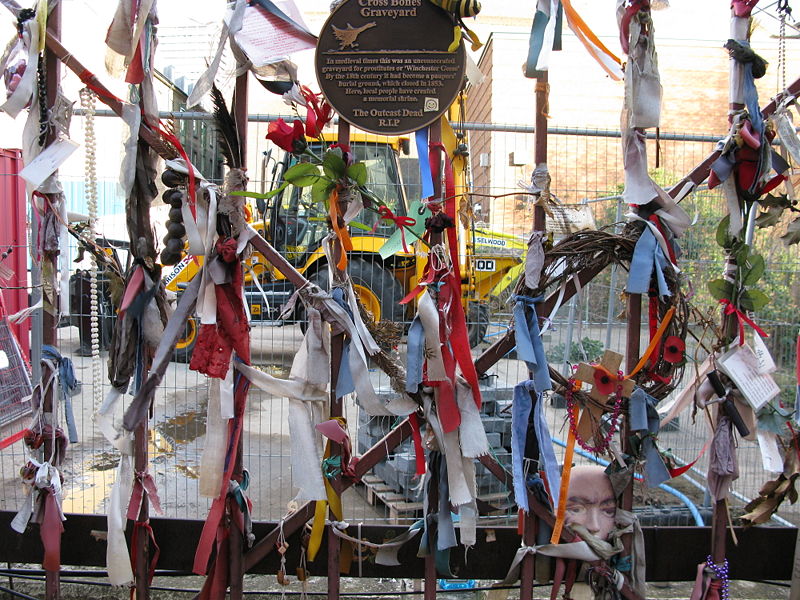
Turning down Redcross Way from Union Street a few days ago, I was immediately confronted by a faded Jubilee Line extension worksite hoarding, a ghost of my own past. Beyond this, a gate was strung with faded flowers and tributes, like the scene of a truly cataclysmic road traffic accident, or the streets of New York after 9/11.

The gate (photo, left, ProfDEH) leads into Cross Bones, an uncon- secrated burial ground first identified as a \’single women\’s church yard\’ in the 16th Century. That is to say, it was a burial site for prostitutes, known as \’Winchester Geese\’ after the Bishop of Winchester who licensed their trade, together with other unsavoury activities (bull and bear baiting, acting etc) that were only permitted south of the River.

Cross Bones subsequently became a general paupers\’ burial ground, and was closed owing to overcrowding in 1853. The Jubilee Line extension works required partial excavation of the site, though only 19th Century corpses (45 per cent of them less than a year old at time of death) were recovered.

Successive attempts by Transport for London and its predecessors to develop the site have faltered in the face of local opposition. Led by a playwright called John Constable, a local community group runs monthly remembrance rituals, and an annual event at Halloween. Despite the neo-pagan/psychogeographical hokum that these seem to involve, it is touching that some people still honour the memory of what they term \”the outcast dead\”, as the trains and lorries of the 21st Century rumble by oblivious.

Tales of antique power

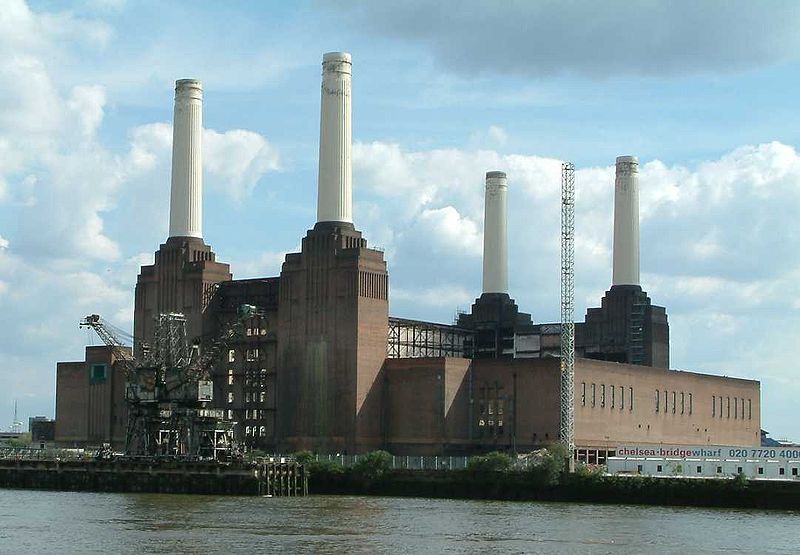
Another year, another scheme for redeveloping Battersea Power Station begins to wilt. The site is caught in a double bind. The listed power station (right, photo Tagishsimon) takes up so much space and requires so much investment to keep it safe, let alone equip it for re-occupation, that it is hard to make any scheme make commercial sense at the best of times.

Balancing the books requires a density of development on the rest of the site that cannot be reconciled with its poor public transport accessibility, and the costs of building new infrastructure (the most recent proposals include a spur from the Northern Line) just make marginally viable proposals more fragile still.

You could argue that the only way to bring the site into use would be to demolish the power station. That would be a shame. I have been lucky enough to visit the building, designed by Sir Giles Gilbert Scott and opened in 1933, and its interiors are as stunning as its looming form, if not more so. The turbine halls are elegantly tiled, and the control rooms truly magnificent. Crafted wooden fittings are surrounded by decorative wall and ceiling tiles, and bakelite switches are inscribed with the names of substations and districts. This, the interiors say, is a place where something important, and magical, takes place.

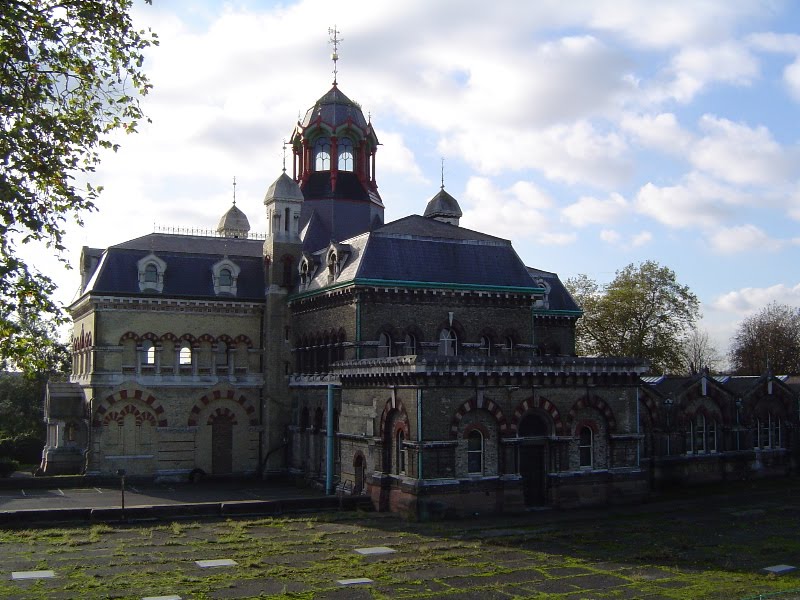
The overall impression is one of pride, pride in the modernism and progress that this temple of power once represented, a pride that can also be seen in elaborate Victorian shrines of sanitation, like Bazalgette\’s ornate pumping stations at Crossness and Abbey Mills (left, photo Gordon Joly).

This pride in utilities is something we have lost. As I walked through Redhill a couple of weeks ago, the contrast between the grandeur of the Royal Earlswood Hospital and the shabby incoherence of the East Surrey Hospital could not have been starker. While offices, libraries and civic centres can still win awards, it is almost as if the mundane necessities of power, health and sanitation have become embarassments, to be covered up and smothered, like a burp in polite company.

We are left with tacky trash, rendered all the more conspicuous by its artless attempts to blend in.

In praise of indifference

Last week, I visited a friend who now lives in a medium-sized Midlands town. He\’d been in London a few weeks earlier, he told me, at a party. Later in the evening, with a few other fairly intoxicated late-30s types, he\’d ended up in a drum-and-bass club in Islington.

He was amazed at how little attention this frazzled group attracted, despite being the oldest people there by about fifteen years. It would have been very different in his home town, and not in a particularly positive way.

I started to say something about London being \’inclusive\’ and then stopped myself. I\’ve been writing too many public sector policy documents. The people in that club weren\’t being inclusive; they had just erected screens of privacy around themselves and their friends. Unless and until the newcomers did something outrageous – stripping, starting fights, lighting cigarettes – they were invisible.

Tonight, in Brixton, in Brick Lane, in Soho, people from all ethnicities, nationalities, sexualities and classes will gather to enjoy a Saturday night out. They will be in the same places, but they won\’t be together in any real sense.

Big cities like London may have weak \’social capital\’, to borrow the concept popularised by Robert Putnam in \’Bowling Alone\’, but they are also places where an astonishing variety of people manage to live (for the most part peacefully) in close proximity to others with whom they have little in common. In the urban context, strong communities can be exclusive and antagonistic, as the murderous turf wars of London gangs illustrate.

Outside the world of well-meaning platitude, Londoners do not spend an enormous amount of time \”celebrating diversity\”. Rather, we are indifferent to difference, preserving privacy in the crowd.

To see ourselves as others see us…

Following a shaky and inauspicious start, the Olympic Torch is on its way round the world (or \’Journey of Harmony\’, to use official Olyspeak). On 6 April, the Torch will arrive in London. What sort of city will it find? According to the official torch relay website, quite an alarming one.

London, the website tells us, was founded by Roman Celts, but then burnt to the ground by Boudicca in the Seventh Century, the first of a veritable catalogue of calamities. The capital grew to become “an important commercial and social centre” in the Seventeenth Century, “however all was not well”. The Great Plague devastated the population and “London simmered under the smell of death” until cleansed by the Great Fire (which also destroyed four fifths of the city).

Pausing for breath, London had a chance to rebuild itself, but despite the best efforts of John Nash the city quickly became overcrowded by people and sewage. Jospeh Bazalgette’s sewage system rescued London from cholera, only for the city’s skyline to be “re-arranged” by the bombing raids of the Blitz. Post-war re-construction seemed for a moment to put the city back on an even keel, before the London Fog descended to kill thousands, “adequately being nicknamed the ‘Foggy City’.” Welcome to London.

There are a number of ways of reading this narrative, which seems to have been assembled from a combination of visits to the London Dungeon, the grimmer sections of 1066 and All That, and perhaps some briefing from the French tourist authorities. One can simply enjoy someone else’s perspective: the website also gives some culinary information – toad-in-the-hole is “not as strange as it seems”, and afternoon tea has declined “as life has taken on a faster pace”.

More seriously, one might see, within this tale of woe, sewage, pestilence and fog, a veiled rebuke from China: “Do not criticise our degraded environment, our polluted rivers, the smog that hangs heavy over Hong Kong. You too have been here, and not that long ago either.”

Another reading is perhaps more optimistic. The website doesn’t need to talk up London in the way that it does the beauty of Almaty. “Everybody knows” that London is a mess, with a legacy of poxy people, chaotic architecture and noxious air. But it is still London, a serious city. Who\’d visit for their health? In the guise of a warning, this gruesome pen portrait pays London a sly compliment.

Underneath the arches

[I wrote this article in spring and have fruitlessly pitched it at all sorts of publications since then. I think the story – one of modernist optimism and arrogance – is fascinating, but I guess that\’s the problem with writing things that you find interesting: will anyone else? Anyway, station architecture seems to be in vogue this week, so here\’s some ambivalent advocacy for one of London\’s least loved landmarks.]

Arriving at Euston Station during the rush hour is a curiously calming experience to anyone used to the chaos of British transport planning. As commuters stream across the concourse or gaze abjectly at the departure boards, the layout of the airy concourse is immediately comprehensible; you can see, in an instant, where everything is.

The triple-height space is bright and naturally lit, with a recessed concrete roof seeming to float above clerestory windows that let daylight flood in. The Station’s design, by British Railways architect RL Moorcroft, was deliberately minimal and monochrome: passengers and advertising hoardings would provide colour; seats were rejected as unnecessary distractions from the business of movement (and as magnets for “layabouts”). While retail kiosks now litter the concourse’s elegant green-grey marble floors, this clarity shines through the clutter.

But there is a strange absence too. The station seems almost embarrassed by grubby presence of trains themselves. Long ramps hurry you through ticket gates, to a low-ceilinged train-shed, whose industrial design and lighting, softened only by a few tentative pot plants, contrasts with the calmness of the concourse. This is not a place for the lingering goodbyes of departing lovers, or for the grimy romance of steam, but a machine for the efficient and hygienic processing of people and goods in an electric age.

This segregation of concourse from trains suggests that the model for Euston was the modernism of airport design, not anything as clunkily old-fashioned as a railway station. In the 1960s, of course, airports were still glamorous places, holding out promises of the exotic, rather than airless boxes stuffed with opportunities for queuing, and humiliation in the name of security. When the station was completed in 1968, Architects Journal made this comparison explicit, criticising the paucity of catering outlets at Euston compared to West London (now Heathrow) Airport, and – more outlandishly – asking why the station still relied on porters, rather than using conveyor belt technology to transfer luggage.

The Station was also criticised for its external spaces, and age has not improved these. There is no sign of thinking outside this glass and steel box, and any fleeting flavour of sixties glamour quickly evaporates. In front of the station, a statue of George Stephenson watches over one of London’s most desolate public spaces. Even on the calmest of days, smokers, street drinkers and commuters are buffeted by gusting winds and mini-cyclones of debris. The black glass and marble office buildings and gallery that create this foul microclimate also contrive, together with desolate planters and kiosks, to hide the station’s façade from the bus station and Euston Road. There may not be many fans of the Euston’s architecture, but making stations invisible does not improve their accessibility to the travelling public.

Things were very different 100 years ago. Euston’s Doric Arch (or propylaeum to be thoroughly correct) stood at the gateway to the Victorian station. It was designed, together with the original buildings, by Philip Hardwick for the London and Birmingham Railway Company and completed in 1838. The station buildings, and in particular the Great Hall designed by Hardwick’s son and completed in 1849, were themselves fine pieces of classical architecture: the current concourse pays sly tribute to the Great Hall’s recessed ceilings and clerestory windows. But it was the 22-metre high Arch that became iconic. It was described by JM Richards, editor of the Architectural Review, as “one of the outstanding architectural creations of the early 19th Century, and the most important – and visually most satisfying – monument to the railway age which Britain pioneered”.

The Victorian station was set further back from Euston Road than its sixties replacement. Bringing the station south, to make room for longer platforms and larger trains, was a crucial element of the re-development plans. Today, architects might have been asked to work round the Arch, to treat it as a non-negotiable ‘given’ in their designs. British Rail does not appear to have given much consideration to this possibility: the Arch would have to go. First of all, it was to be re-located intact, then demolished and rebuilt, and then simply demolished, unless someone could come up with £190,000 (nearly £3 million today) to enable its relocation and reconstruction.

Between 1959 and 1961, appeals from a growing and sometimes improbable coalition – including the Royal Fine Arts Commission, the Victorian and Georgian Societies, Nikolaus Pevsner, Woodrow Wyatt, Tom Driberg, Sir John Betjeman, and Alison and Peter Smithson – fell on deaf ears, as the buck passed from the British Transport Commission (British Rail’s ‘parent company’) to London County Council, and back again. Eventually, in November 1961, Harold Macmillan, then prime minister, received a deputation of protest, but loftily dismissed their arguments. “Concern for such relics,” he said, “will sap national vitality.” Nothing could be done, nothing was, and the Arch was demolished in 1962.

All that remains of the 19th Century Euston today is a pair of gatehouses, inconspicuous alongside the thundering traffic of Euston Road, the destinations engraved on their stone a mute memorial to the height of the steam age. The Doric Arch itself is cheekily commemorated on decorative tiling in Euston Underground Station, and in local street and pub names. In a curious footnote, fragments were found in an East London river in the mid-1990s, and a campaign to rebuild it was launched. But it is hard to see the sense in its resurrection, divorced of context, after a 45-year absence.

But, in some ways, Euston Arch’s destruction has had a more powerful legacy than its retention could ever have achieved. It galvanised and united the heritage movement, drawing it away from the perceived elitism of preserving set-piece churches and palaces, to a more democratic concern with the places – stations, factories and shops – that were part of modern every day life. The apathy, arrogance and evasiveness of the state also prompted new legislation: the 1967 Civic Amenities Act established conservation areas as a more subtle tool than the listing of individual buildings, and the 1968 Town and Country Planning Act made the demolition of listed buildings illegal.

Nobody shed a tear just before Easter, when Network Rail announced the return of the bulldozers to Euston. Nobody is going to start a campaign to preserve the Station as a treasure for the nation. Its charms are too elusive, and its faults too obvious. Aside from which, the strength of London’s commercial property market and the potential of the empty space above the station makes a compelling case for redevelopment. But, long after British Land’s promised “major mixed use development” has been completed, Euston may still be remembered for what it once represented – the dawn of a new electric age of convenience and efficiency – as well as for the cavalier disdain for the past that accompanied that dawn. This was the future once, and this was where that future stopped.
Life after Livingstone?

Boris Johnson? Greg Dyke? John Major? With less than a year to go till the next London mayoral election, a growing sense of desperation is settling over opposition parties. Is there anyone out there who the Conservatives haven\’t approached? Anyone who has a chance of beating Ken Livingstone?

Standing against the Mayor, who has twice seen off all comers (including his own party in 2000), must be one of the least enviable jobs in politics. Steven Norris has twice proved an effective and jocular opponent, largely through distancing himself as far from Conservative Party policy as Livingstone has from Labour Party policy, but will surely not have the appetite to be ‘three times a loser’.

The Conservatives’ much-trumpeted plans for a talent-show approach have gone rather quiet, though several candidates – primarily from local government backgrounds – have expressed interest, and a London-wide primary will take place in September. But rumours of bids from heavy-hitters like John Major, Olympic chief Sebastian Coe and former Met Police commissioner John Stevens seem to have evaporated.

The Liberal Democrats have mounted serious candidates – Susan Kramer (now MP for Richmond Park) in 2000, and Bermondsey MP Simon Hughes in 2004 – but the prospect of their party holding the balance of power at Westminster after the next general election must look more attractive in career development terms than another round in the ring with the former member for Brent East.

In 2000, it was said that Tony Blair hoped that an independent businessperson rather than a professional politician would win the mayoralty. This time around, plenty of colourful characters are emerging: DJs Mike Read and James Whale, Big Issue founder John Bird, actor Tom Conti and Right Said Fred singer Richard Fairbrass. Leaving aside the fact that many of these candidates seem propelled primarily by their resentment of London’s congestion charge, they are not quite of Michael Bloomberg’s – or even Richard Branson’s – calibre.

The irony is that, in setting up a system to attract political outsiders, New Labour created a job that was tailor-made for one of their own renegades. In seven years, Ken Livingstone has entrenched himself, re-engineering the City Hall machine to operate as he wants it to; he has become part of its wiring.

Like him or loathe him (and there are plenty in both camps), Ken Livingstone is a consummate politician, on top of his brief, sharp and able to speak off-the-cuff (and sometimes off-the-wall) on pretty well any subject. As a former GLA employee, I can testify to the frustration of listening to a pitch-perfect mayoral performance, with the only duff notes being those taken from his carefully-crafted official briefing.

Though the media relish the intemperate outbursts – against Evening Standard journalists, against the Saudi royal family, against George Bush – Ken Livingstone is now more likely to be heard extolling his carefully nuanced vision for London: the city succeeds because ‘The City’ succeeds, supported by London’s diversity and openness (in contrast to New York, marooned in Fortress America). London’s turbo-capitalist growth and growing diversity are to be embraced and celebrated, but also to be used as an engine for greater social justice and for tackling climate change.

Over seven years, almost unnoticed, he has transformed himself from the khaki-clad newt-fancier of yore, into the very model of a modern city boss, known across the world, and clad in imperial purple (or at least the odd Ozwald Boateng bespoke suit). La cité, c’est lui.

There are two sides to Ken Livingstone. One is the glamourpuss, clearly relishing the limelight and the occasional slanging match. The other is the slightly nerdy technocrat, who enjoys the day-to-day business of running London. He has stretched the Greater London Authority’s curious rag-bag of powers taut in trying to create change in a chaotic city. The Mayor enjoys getting stuck in: from negotiating with developers, to introducing and extending a congestion charge, to battling with local boroughs, pigeons and PPP consortiums, to bringing more buses onto the street, to making deals for cheap oil with Hugo Chavez, to attracting the 2012 Olympics (and billions of pounds of public money) to East London.

Ken Livingstone has said that a good candidate could easily unseat him next year, but this sounds more like a playground taunt – ‘come and have a go, if you think you’re hard enough\’ – than a sincere sentiment. He would like to stay in post till 2016. Running London is not a springboard for him, but the only job that he seems to want. GLA polls show a gentle decline in his personal approval ratings, but the field of opponents does not give confidence that he will be easily toppled.

S-H-O-P-P-I-N-G

The capital city of the nation of shopkeepers is getting worried. Is London beginning to face the same pressures that have stripped many other town and city centres of their life?

Over the next few years, central London\’s shops will face a bit of a rocky road, with growing competition from what might be called \’out-of-town-in-town\’ retail malls: at White City to the west, at Stratford to the East and at the expanded Brent Cross/Cricklewood scheme to the north. Combined with congestion charging, and the homogenisation of retail through \’clone town\’ encroachment by large chains, the threat is particularly acute for smaller and independent shops.

Kensington and Chelsea recently established an independent commission to look at the future of retail within the borough and their report (here) makes some interesting proposals: how can you preserve retail diversity, and the character of neighbourhoods that this creates?

Some of the changes they recommend relate to planning policy, and in particular use classes. If your boredom threshold is low, you might want to skip the rest of this paragraph. Land and building uses are categorised by Government, and local authorities uise them to define what activities are allowed on a particular site: retail, offices, housing, industrial uses, etc. \’Retail\’ includes sub-classes for shops, financial and professional services (ie, banks, estate agents and bookies), restaurants and cafes, drinking establishments and hot food takeaways. In general, changes within a particular use class are permitted, but changes between use classes require planning permission.

The K&C Commission suggested putting small shops into a new category, and making mergers of smaller units a matter for planning consideration. They also proposed creating a new class for coffee shops, to prevent local retail being \’Starbucked\’. The report also suggests letting councils take over large shops\’ car parks, to remove their unfair advantage, and even toys with the idea of creating special \’retail conservation areas\’.

Why is this interesting? Firstly, because retail conservation areas could be seen as the next step in the heritage movement. Since the mid 1960s, we have woken up to the value of the every day buildings that surround us (of which more in another post soon), but have paid little attention to their use. A listed factory building or church can be changed into housing as long as it looks the same. Protecting the use of a building, as well its looks, is a pretty radical move, more reminiscent of the way we approach farmland, than buildings in the centre of a city.

It\’s a pretty conservative move too, though not one that would seem strange in New York or Paris. The leadership of Kensington and Chelsea is Conservative, but this feels like a far cry from the laissez-faire world of the market, seeking to protect shops like Rough Trade (a collectivist record shop) from the depradations of capitalism.

Thirdly, like most people, I am deeply hypocritical about shopping. I love smaller shops in theory, but the half-stale produce and limited range soon sends me scuttling to Sainsburys. Perhaps the streets where I live are slightly less replete with specialist sourdough bakeries than the streets of Notting Hill are. Not every small shop is worth saving.

Similarly, when I work in poorer parts of London, they don\’t tend to worry about small retailers. They feel they have too many of them already. They want Starbucks. They want Tescos. They want that holy grail of upwards mobility, Pizza Express. Keeeping good small shops afloat is important, but should we really rely on planning to save us from our own actions?