City sickness?

Originally published on CityMetric on 19 January 2015

The Centre for Cities’ City Outlook 2015, out today, tells a story of continuing success for the capital. Since the mid-1990s, the capital’s population and economy have been growing in tandem, and the city quickly regained the economic ground lost in the early 2000s and in the last recession.

Over the past ten years, in fact, London’s population has grown by 1.1m. The number of private sector jobs in the city have risen by 650,000, and the number of businesses by 115,000. The growth in population is greater in absolute terms, but the economic indicators are rising more quickly. London’s economy is growing faster than its population.

The sector that grew fastest, accounting for one third of London’s net new jobs over the past decade, was “professional, scientific & technical activities” – a sector which includes professions such as law, engineering, architectural design and accountancy, as well as management consultancy, advertising, and research & development. London’s economy is increasingly dominated by knowledge-intensive, highly-skilled businesses.

Growth in these sectors is the holy grail of economic development, and something to be celebrated – but it presents challenges, too. Firstly, like other UK cities, London has stubbornly persistent levels of unemployment – the claimant count increased by 40,000 (around 25 per cent) over the decade, despite the growth in job numbers. The jobs being created are not in the sectors that are easily accessible to people with low skills levels. At the same time, entrepreneurs in London’s growth sectors are complaining that finding people with the right specialist and generic skills is one of the biggest problems they face in seeking to grow their businesses.

London also faces a growing affordability crisis, particularly in housing costs. Demand for new housing has outstripped supply by a factor of three: in the decade when London’s population grew by more than a million, its housing stock grew by less than 300,000. Combined with the popularity of property – even unoccupied property – as an asset for investment, this has fuelled spiralling house prices, with the average house costing more than 30 times the average wage in super-prime central London boroughs.

This affordability crisis is pushing many Londoners on modest incomes, including people in entry-level jobs in London’s growth sectors, out of the inner city to places where property costs may be cheaper. But high transport costs still inflict a heavy toll. The Centre for London’s report Hollow Promise called these people, earning less than average but above the benefits threshold, ENDIeS: people who are employed but with no disposal income or savings.

There is also evidence that some are moving even further afield than London’s suburbs: commuting from outside London grew by about ten per cent between 2001 and 2011, and recent reports showed that young Londoners are moving away from the capital in record numbers. In 2012-13, indeed, there was a net outflow of 22,000 30-something workers. This is leading to resurgent populations and job markets; but is also putting pressure on housing in other southern cities like Oxford, Cambridge and Brighton. These are seeing London-esque gaps between house prices and earnings, in part as a result of local wages lagging behind the house prices that London commuters can pay.

Taken together, housing affordability and skills are two of the capital’s biggest challenges, as reflected in business group London First’s recent London 2036: an agenda for jobs and growth report. Unless we build more housing and other infrastructure, and invest in our skills base, London’s long-term position as one of the pre-eminent world cities could be threatened.

Does this matter? For better or worse, London’s success over the last decade has been built on its appeal as the destination for skilled workers, from the UK and beyond. This has resulted in a skewed economy, for sure. The distribution of resources, talent and infrastructure has been meant a north/south (or, more accurately, an SE/rest of UK) divide.

But a more balanced economy could also be a less prosperous one. Talent has been concentrated in London, a pre-eminent global city; the alternative is not that we have multiple global cities, but that we have none, and that a big chunk of the business coming into the UK disappears.

Knowledge intensive businesses are not sentimental or nationalistic; with the right infrastructure in place, they can easily sell their services across borders. What they depend on above all is a highly skilled workforce; they will operate from whichever cities can offer them this workforce at competitive rates.

London offers not only the critical mass of high-skilled workers, but the infrastructure and the cultural energy which attracts the biggest, and most lucrative, international employers. Over the last ten years it has become increasingly important to the country’s economy. But if London continues to become unaffordable to everyone but the richest and the luckiest, it will lose the skills that have supported its growth, and growth across the UK.

Some firms may follow the talent to Birmingham or Bristol, and many would welcome that type of rebalancing within the UK economy. But a large number of firms would move to Berlin or Barcelona – and we will all lose out.

The UK’s regions may have lost out from internal migration, but they shouldn’t necessarily welcome the tide turning against the capital. Economically, at least, the affordability crisis in London could become a big problem for all of us.
Just another accident statistic?

The recent spate of horrific cycle accidents in London, many resulting in fatalities, has focused attention on the perils of cycling on London\’s busy streets. There has been understandable grief, outrage and a rising political temperature as Mayor Boris Johnson is accused of \’blaming the victim\’.

What there hasn\’t been (as far as I have seen) is any assessment of how dangerous cycling is in proportion to the number of cyclists, or compared to other forms of transport on London\’s roads.  It may seem a callous question to ask, as one cyclist crushed by a lorry is clearly one too many, but I was curious about the relative risk.

After not much digging in the London Datastore, I found some statistics from TfL\’s Transport Trends survey, which reports on number of journeys taken on different forms of transport each day (strictly speaking \’journey stages\’ – if I walk to a bus stop, take a bus, then cycle, I have had three journey stages), and the number of accidents and deaths suffered by users of each form of transport each year.  Oddly, the last set of numbers are for 2009 for journeys and 2010 for accidents, but I suspect the ratios did not change dramatically between those two years.

Here are the statistics:

The difference between relative accident rates is pretty stark.  London\’s cyclists are eight times as likely to be fatally injured as car drivers and passengers, and seven and a half times as likely to be injured.  Cycling isn\’t as dangerous as riding a motorbike (more than 50 times the risk of driving a car), but it\’s substantially more dangerous than walking or using other motor vehicles.  It would be interesting to extend The Economist\’s comparison of USA and Netherlands fatality rates, but I don\’t have the data. 

Overall, cycling on London\’s roads is about five times more risky than the norm for fatalities, and 10 times more for injuries.  I\’m not sure whether I expected this to be higher or lower; by way of comparison, occupations such as roofers, electricians and farmers have similarly heightened fatality rates.  But it\’s not encouraging me to get on my bike.

Your city\’s a sucker?

<!– /* Font Definitions */ @font-face {font-family:Calibri; panose-1:2 15 5 2 2 2 4 3 2 4; mso-font-charset:0; mso-generic-font-family:auto; mso-font-pitch:variable; mso-font-signature:-520092929 1073786111 9 0 415 0;} @font-face {font-family:"Arial Unicode MS"; panose-1:2 11 6 4 2 2 2 2 2 4; mso-font-charset:0; mso-generic-font-family:auto; mso-font-pitch:variable; mso-font-signature:-134238209 -371195905 63 0 4129279 0;} /* Style Definitions */ p.MsoNormal, li.MsoNormal, div.MsoNormal {mso-style-unhide:no; mso-style-qformat:yes; mso-style-parent:""; margin:0cm; margin-bottom:.0001pt; mso-pagination:widow-orphan; font-size:12.0pt; font-family:"Times New Roman"; mso-fareast-font-family:"Times New Roman"; mso-ansi-language:EN-US;} a:link, span.MsoHyperlink {mso-style-unhide:no; color:blue; mso-themecolor:hyperlink; text-decoration:underline; text-underline:single;} a:visited, span.MsoHyperlinkFollowed {mso-style-noshow:yes; mso-style-priority:99; color:purple; mso-themecolor:followedhyperlink; text-decoration:underline; text-underline:single;} p.Body1, li.Body1, div.Body1 {mso-style-name:"Body 1"; mso-style-unhide:no; mso-style-parent:""; margin:0cm; margin-bottom:.0001pt; mso-pagination:widow-orphan; font-size:12.0pt; mso-bidi-font-size:10.0pt; font-family:Helvetica; mso-fareast-font-family:"Arial Unicode MS"; mso-bidi-font-family:"Times New Roman"; color:black;} .MsoChpDefault {mso-style-type:export-only; mso-default-props:yes; font-size:10.0pt; mso-ansi-font-size:10.0pt; mso-bidi-font-size:10.0pt;} @page WordSection1 {size:595.3pt 841.9pt; margin:2.0cm 2.0cm 2.0cm 2.0cm; mso-header-margin:35.45pt; mso-footer-margin:42.5pt; mso-paper-source:0;} div.WordSection1 {page:WordSection1;} –>

It\’s been a busy week for citittude.  Bruce Katz has been in town, showcasing his latest data on how US cities are leading the economy out of recession.  And Benjamin Barber joined him for a Centre for London debate, arguing that, as nation states flounder, mayors are the most dynamic and pragmatic leaders, and that international alliances of cities are the powerful organisational structure.
Work has irritatingly stopped me attending several of the events but what I\’ve seen from Twitter feeds and blogs suggest an almost evangelical level of excitement; that as the world turns increasingly urban, cities are asserting themselves, seizing power and initiative from the drab and clumsy nation states that hold them back.  We have come a long way from the sixties or even the eighties, when cities were viewed a crime-ridden and corrupt rat holes, best avoided by upright citizens or treated as a problem, a target for initiatives, by well-meaning politicians.
Now, if this is a new religion, I\’m a worshipper.  The vitality and variety of London continues to astonish me, and the two mayors I have worked for are far more impressive than the national politicians I have come across.  Similarly, I broadly sign up to the \’Mayoral Manifesto\’, the programme of policies that pretty well every mayor pushes, whether nominally from the left of the right.  This manifesto (which I will write more about another time) promotes open borders and global capitalism, but is also concerned about housing, about social equity and about climate change.  It embraces minority groups and marginal lifestyles, invests in public transport and public space, but also endorses a tough law and order regime, with low tolerance for anything that could be seen as civic unrest or even dissent.
So, to borrow from Edward Glaeser, cities have triumphed. But there\’s another side to this story too; one that would caution against too much triumphalism, would whisper warnings against hubris like a Roman senator’s attendant whispering a memento mori.  As cities become more like each other – with the same Mayoral Manifesto, the same coffee franchises and the same bus rapid transit systems – they drift further and further away from their rural hinterlands.  Some would argue, and in the case of London have done so – that this process should be followed through, that cities should be granted proper autonomy, controlling their own tax, welfare and regulatory systems. 
Absent that solution – and modern city states are a pretty motley collection, including Singapore, Hong Kong, the Vatican and Monte Carlo – and cities will continue to have to live with their sprawling green neighbours. Cracks are showing: in England, the tension between London and the rest (including regional cities) is becoming a leitmotif of debate: on house prices, on High Speed 2, on funding for the arts . But in the west (where the vast majority of the population already lives in urban communities), the urban elite has tended to stay in control, though the Tea Party movement in the US and UKIP in the UK can be seen as rural/provincial reactions to metropolitan values. 
In the developing world, where urbanization rates remain below 50 per cent, and urban values are perhaps less widespread, rural champions have been elected and tensions have been more clearly manifested. In Istanbul, the Taksim Square demonstrations brutally repressed by the police were the actions of a beleaguered urban liberal class fighting against destruction of a public space (one of the gravest sins in the urban catechism) by a President elected by a more religious, more conservative hinterland that is even more remote from Istanbul than rural Arkansas is from New York.
Similarly, India\’s urban, secular Congress Party is perpetually locked in battle with the more sectarian rural politics of the BJP. In Sri Lanka, a recent profile of President Rajapaska argued that the urban elites of Colombo regard their president, elected on a rural buddhist ticket, with embarrassment.
I\’m not sure where all this leads us.  Personally, I am clear where my loyalties lie, and I don\’t think cities should be in the business of kow-towing to rural conservatives.  But even in their moment of greatest triumph, cities should tread softly in proclaiming inherent superiority and denouncing their rural opponents as bigots and hicks.  Those singing hosannas to the greater glory of the urban inside the church should be aware of those outside, many of whom are indifferent or actively hostile to their creed.

Come together?

There\’s a piece by urban maven Richard Florida on The Atlantic Cities blog, summarising some research on the link between urban density and productivity.  What is perhaps more interesting than the fact that there is a link (talented people and businesses benefit from \’agglomeration\’ and are drawn to the locations that support it) is the fact that this only works for cities with high levels of skills:

\”[the report] notes that density plays a bigger role in cities where levels of skill and human capital are higher. Metro areas with below average levels of human capital realize no productivity gains from density, the study finds, while doubling density in metros with above average human capital gain productivity benefits that are roughly twice the average. This \”negative net agglomeration effect\” found in less skilled metros leads the authors to conclude that the negative effects of congestion swamp the positive effects of urbanization in less skilled places.\”

That is to say, densification works for you if you live – put bluntly – in a middle-class professional city, but less well if you are in a low-skilled working class city.  This seems to highlight something that is little remarked on by professional density fans like me, even if it is about people and communities within cities, rather than cities as economic entities.  For all the benefits (viability of local services, lower car dependency, lower carbon impact) that high density urban living can offer, high density means different things for different classes: living in the Barbican and living in the Heygate Estate are different experiences, even if cast from the same concrete.  Notting Hill is not Canning Town.

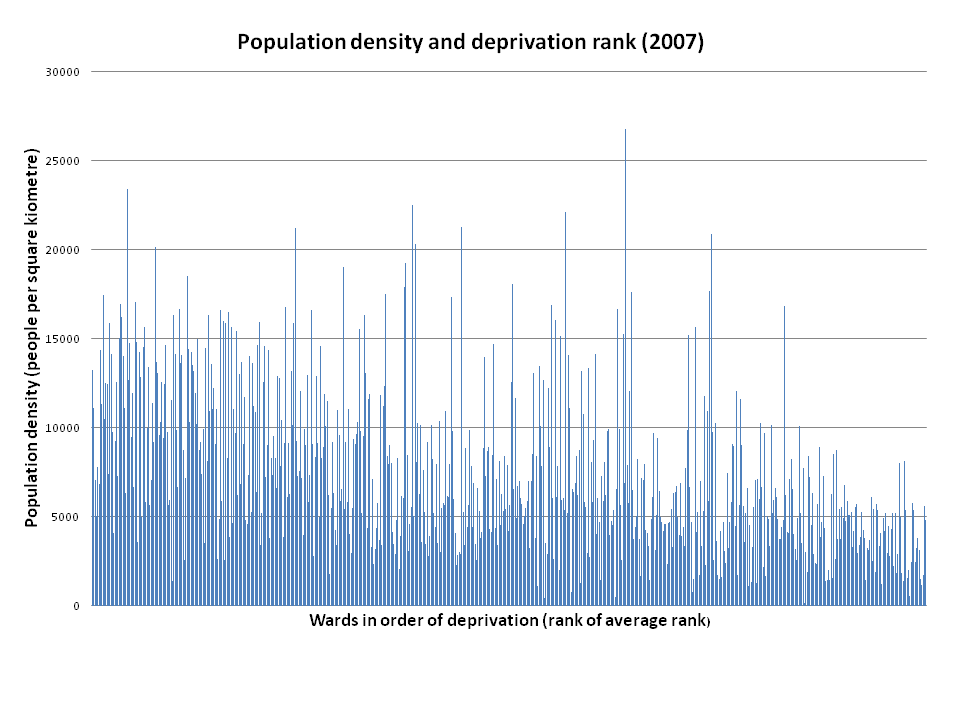
So how does density relate to deprivation?  In London, the most densely populated wards include both some of the richest and some of the poorest (Tachbrook and Green Street East (in Westminster and Newham respectively)), but the poorer wards are denser overall.  The graph below shows London\’s 620 wards grouped in order of their average rank in the 2007 Index of Deprivation, with their population density on the vertical axis. 

The co-efficient of correlation is -0.48, which implies some relationship between high deprivation rankings and high density, if not a precise one (IMPORTANT HEALTH WARNING: this blog post involves me using statistical formulae and large datasets, so should be treated with something between suspicion and disdain).  So far, so unsurprising.  Poorer areas are more likely to be in the inner city (so likely to be denser), and also likely to include fewer fripperies like parks that would detract from density (when measured as people per square kilometre, rather than as dwellings per hectare).  Prosperous areas that look dense because they are built up may actually be low density in terms of residents (from, for example, single people or couple living in larger flats with spare rooms).

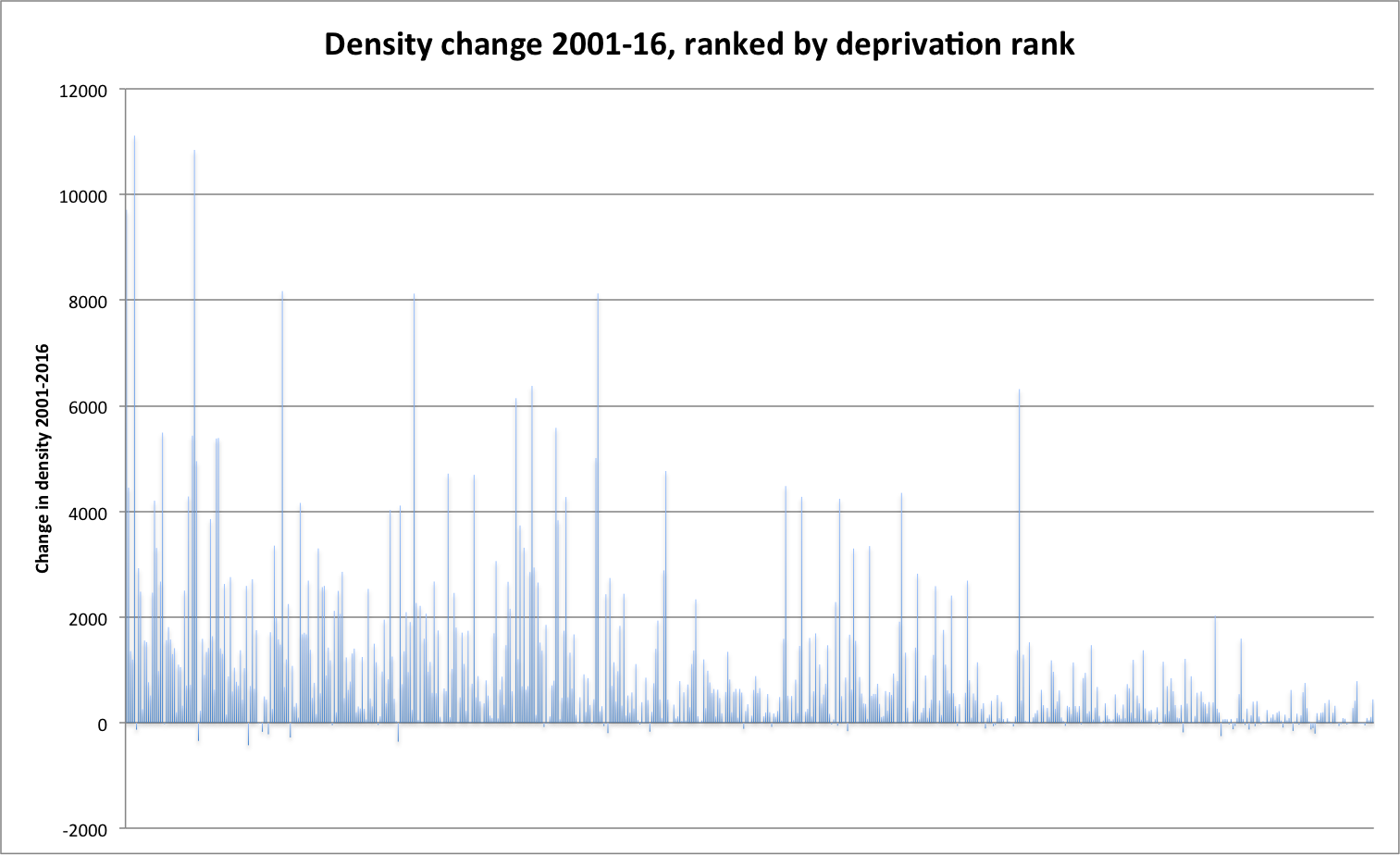
So, if that\’s our starting point, how has London been changing in recent years?  The chart below shows actual and projected changes in population density (2001-16), against deprivation rank.

Three things are immediately noticeable. The first is that London is becoming denser almost everywhere. Secondly, the curve is a lot more ragged: most wards are seeing a relatively steady change in population, but there are places (like Stratford New Town, Canning Town and Fairlfield) where density is more than doubling.  Finally, it is the poorer places that are densifying most intensively (with a correlation co-efficient of -0.40 between deprivation rank and absolute increase in density). These are the places that are densest, and getting denser: Northumberland Park, Bromley-by-Bow and Mile End are all among the places that are densifying by more than 20 per cent in fifteeen years.
So, what if anything does this all mean?  It means that we need to look at the numbers more closely.  How are inner and outer city areas differentiated, and how does densification relate to changes in prosperity and deprivation?   Is greater density a symptom of improving fortunes, or a cause of them?  Or does densification have the opposite impact on richer and poorer places, boosting prosperity in the former and amplifying the problems of poverty in the latter?  In the meantime, you can note that the densest, and poorest, areas in London are densifying fastest.  It\’s not clear that this is necessarily a good thing.
(Thanks to London\’s http://data.london.gov.uk/ site for the figures, and to Paula Hirst for the tip off)
DRAFT POST – TO BE REVIEWED

Old Flo, the Bamiyan of Bow*?

In a bland blog in the Huffington Post, Tower Halmets Mayor Lutfur Rahman defends his plans to sell off Draped Seated Woman, the Henry Moore sculpture erected in an east London housing estate in 1962.  The article runs through predictable bromide about ring-fenced funding, Tower Hamlets\’  record in providing affordable rented housing and his electorate\’s support for the sale.

But Mayor Rahman makes an interesting point in passing: \’if only there was as much national media interest in the fact that we are being forced to make £100million cuts by 2015, as there has been over the proposed sale of this sculpture to mitigate the effect of some of those cuts.\’  There is something slightly uneasy about the intense focus on the sale of this work of art, when the material conditions for the people of Tower Hamlets, where more than fifty per cent of children live in poverty, are so poor and receive so little coverage in the media.

Of course there is more to it than that (and you can worry about poverty and cultural deprivation).  The sale of the sculpture (affectionately known as \’Old Flo\’) is understood by both sides of the argument as symbolic.  On the one hand it betokens nostalgia for post-war \’nothing too good for the workers\’ social solidarity that also gave us the magnificence of the Royal Festival Hall.  On the other hand, there is impatience with this nostalgia, which is largely (but not exclusively) being expressed by middle-class liberals like me: when will we start protesting as loudly about poverty and exploitation; when will we value flesh and blood, as much as bronze?

The comparison needs to be cautiously made, as Tower Hamlets is not the Afghanistan, but the terms of the debate remind me of when the Taliban government of Afghanistan blew up the great Buddhas at Bamiyan in 2001 – an act that scandalised the world.  The Taliban said that they did so after Swedish scholars offered money to repair the statues, but refused to let it be used instead to provide food for starving children.  Their gratuitous act of vandalism was a dynamite retort to westerners worrying about material heritage more than current poverty.

The sale is probably a done deal now, and a scandal of sorts. The issue is what sort of scandal it is: one of a callous council ready to sell its heritage for a mess of pottage, or one of tough choices between selling artworks, or cutting back services, exposing to greater risk local people already leading precarious lives.

* or Stepney, actually, but the rhyme works better if shifted a little further eas

Gilded palaces

If there are two things I dislike with a moderate but consistent intensity, they are shopping malls and crowds.  So it was against all sorts of better judgement that I visited Westfield Stratford this evening.

As we walked through the thronged corridors of shops clad in gleaming marble, shiny glass and fashionably-distressed copper, my companion observed that the crowds really looked and sounded like East London – loud, ethnically mixed, not particularly well-heeled.

This reminded me of a middle-aged man I watched being interviewed when the Royal Festival Hall was refurbished in 2007.  When the building opened in the 1940s, the interviewee was growing up in South London, and vividly remembered his first visit to the venue: he could not believe that someone like him was not only allowed but encouraged to visit somewhere with this thickness of carpet, this richness of marble, this elegance of balustrade.

In many ways Westfield Stratford, the apotheosis of 21st century consumer capitalism, is the polar opposite of the Royal Festival Hall, with its high-minded aspirations towards \’culture for the masses\’.  But the buildings share something too: like the Festival Hall, Westfield Stratford isn\’t a dumbed-down version of something else.  It doesn\’t fob local people off with cheap finishes and \’value\’ retail outlets, but gives them as good a high-end shopping mall that it would build anywhere else.

There are plenty of criticisms to level at malls – their gaudy promotion of consumerist fantasy, their impact on neighbouring shops, their introverted street systems and privatised public space – and Westfield Stratford will probably be accused of many of these. But it doesn\’t patronise, or pander to presumed poverty of aspiration.  It deserves credit for that.

Step on

After the riots, the surge of opinion and analysis. As Aditya Chakrabortty observed in today\’s Guardian, this week\’s mayhem has acted like a tumultuous Rorschach Test in which everyone can see what they want to see. So, three quick thoughts on the week\’s events (please take \’nothing can justify\’, \’London is the poorer\’ and \’in a very real way, we are all guilty\’ as read):

As any halfway-decent engineer understands, suspension bridges wobble worst when crowds fall into step: the unified pace amplifies the sway, and bridges become perilous. This natural tendency to lock step scuppered the Millennium Bridge in 2000, and a sign on Albert Bridge still warns troops to break step. Social networking enabled the rioters to converge and focus their looting, but enabled the clean-up too. The cumulative impact was dramatic: just as rioters overwhelmed the police, volunteer street cleaners swamped Hackney and had to be redirected to Clapham Junction. The capacity of social networks to foment groupthink makes for a queasy feeling, like being on a ship that lurches, as its passengers rush first one way then another. This alleged anarchy was built upon systems and herd mentality.

The roll-call of closed roads on Tuesday\’s radio bulletins gave a trivial taste of what is must be like to live in a war zone, never sure from one morning to the next what districts remain intact. It showcased the precariousness of urban life: the actions of a few hundred teenagers can quickly disrupt the delicately-balanced metabolism of the ecosystem (as can a few days\’ fuel blockade, or a heavy snowfall). But Tuesday also showed the resilience of that ecosystem: people picked their way past burnt-out buildings to the tube, and shops continued to operate from behind smashed windows.

Finally, the riots may not have been explicitly political, but they were about power. Or at least about powerlessness. It may be as futile as it is presumptuous to speculate about individual rioters\’ motives, but it is not hard to read into the faces captured on CCTV the euphoric rush of suddenly and surprisingly being in control – of your life, of your neighbourhood, of your scared fellow citizens. The price to be paid for those moments will be harsh, but will the violent euphoria prove addictive?

My old haunts

More than any other part of London, Southwark remains medieval. Its narrow streets, hard against railway embankments, retain an eldritch flavour of their history, of their ghosts, that centuries of development cannot fully erase.

Turning down Redcross Way from Union Street a few days ago, I was immediately confronted by a faded Jubilee Line extension worksite hoarding, a ghost of my own past. Beyond this, a gate was strung with faded flowers and tributes, like the scene of a truly cataclysmic road traffic accident, or the streets of New York after 9/11.

The gate (photo, left, ProfDEH) leads into Cross Bones, an uncon- secrated burial ground first identified as a \’single women\’s church yard\’ in the 16th Century. That is to say, it was a burial site for prostitutes, known as \’Winchester Geese\’ after the Bishop of Winchester who licensed their trade, together with other unsavoury activities (bull and bear baiting, acting etc) that were only permitted south of the River.

Cross Bones subsequently became a general paupers\’ burial ground, and was closed owing to overcrowding in 1853. The Jubilee Line extension works required partial excavation of the site, though only 19th Century corpses (45 per cent of them less than a year old at time of death) were recovered.

Successive attempts by Transport for London and its predecessors to develop the site have faltered in the face of local opposition. Led by a playwright called John Constable, a local community group runs monthly remembrance rituals, and an annual event at Halloween. Despite the neo-pagan/psychogeographical hokum that these seem to involve, it is touching that some people still honour the memory of what they term \”the outcast dead\”, as the trains and lorries of the 21st Century rumble by oblivious.

Tales of antique power

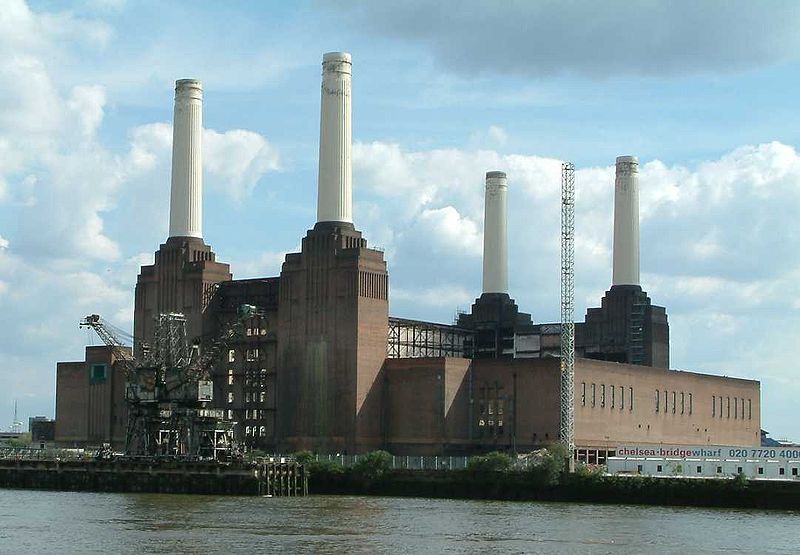
Another year, another scheme for redeveloping Battersea Power Station begins to wilt. The site is caught in a double bind. The listed power station (right, photo Tagishsimon) takes up so much space and requires so much investment to keep it safe, let alone equip it for re-occupation, that it is hard to make any scheme make commercial sense at the best of times.

Balancing the books requires a density of development on the rest of the site that cannot be reconciled with its poor public transport accessibility, and the costs of building new infrastructure (the most recent proposals include a spur from the Northern Line) just make marginally viable proposals more fragile still.

You could argue that the only way to bring the site into use would be to demolish the power station. That would be a shame. I have been lucky enough to visit the building, designed by Sir Giles Gilbert Scott and opened in 1933, and its interiors are as stunning as its looming form, if not more so. The turbine halls are elegantly tiled, and the control rooms truly magnificent. Crafted wooden fittings are surrounded by decorative wall and ceiling tiles, and bakelite switches are inscribed with the names of substations and districts. This, the interiors say, is a place where something important, and magical, takes place.

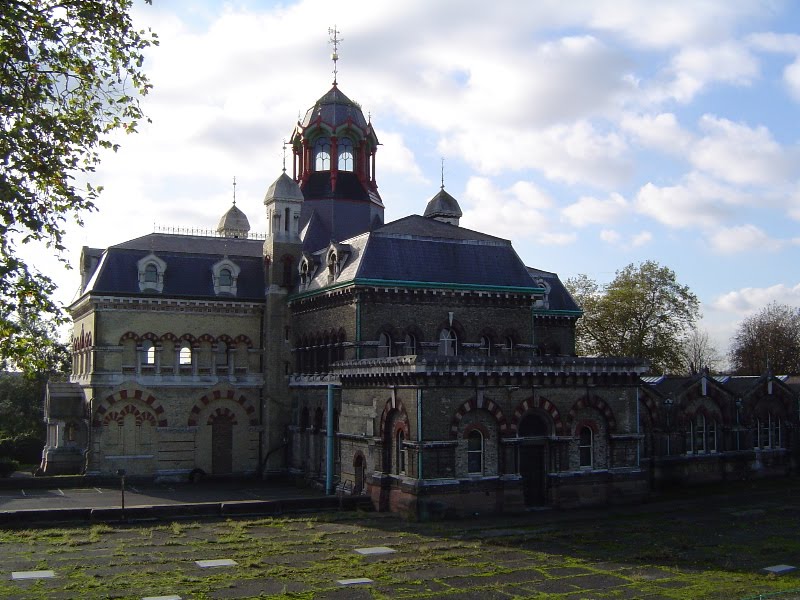
The overall impression is one of pride, pride in the modernism and progress that this temple of power once represented, a pride that can also be seen in elaborate Victorian shrines of sanitation, like Bazalgette\’s ornate pumping stations at Crossness and Abbey Mills (left, photo Gordon Joly).

This pride in utilities is something we have lost. As I walked through Redhill a couple of weeks ago, the contrast between the grandeur of the Royal Earlswood Hospital and the shabby incoherence of the East Surrey Hospital could not have been starker. While offices, libraries and civic centres can still win awards, it is almost as if the mundane necessities of power, health and sanitation have become embarassments, to be covered up and smothered, like a burp in polite company.

We are left with tacky trash, rendered all the more conspicuous by its artless attempts to blend in.