Remote control – AI and hybrid working

This decade is likely to see the biggest transformation of the workplace since the widespread adoption of the personal computer. Hybrid and remote working patterns adopted during the pandemic appear to be sticking, and a wave of disruption from artificial intelligence (AI) and large language models (LLMs) is following rapidly behind.

London is at the epicentre of these twin “workquakes”. The capital has persistently had the highest levels of home-working in the UK, with two thirds of Londoners saying they worked at home at least one day a week last summer. This reflects hybrid working’s dominance among professional and managerial staff, who make up 63 per cent of London’s resident workers, compared to 50 per cent of all England’s.

These people enjoy the flexibility, work-life balance and personal productivity that working from home can offer, though the impact on organisational or inter-organisational productivity is more contested. Nonetheless, speakers at a London Assembly meeting last week said that the era of “five days a week in the office” had gone for good, and that the task was to adapt central London to new ways of living, working and playing.

The accelerating pace of AI adoption looks likely to add turbulence. A recent UK government report found that workers in London were twice as exposed to AI as the UK average. This was not because of LLMs’ appetite for the diversity and vitality of the capital, but (like the prevalence of home-working) is largely a result of London’s occupational make-up. Unlike previous waves of automation, which affected manufacturing and routine clerical work, AI is coming for the professionals.

The report suggests that the most affected occupations include management consultants, financial managers, psychologists, economists, lawyers, project managers, market researchers, public relations professionals, authors and, perhaps surprisingly, clergy. The “safest” are jobs are those of such as sports professionals, roofers, plasterers, gardeners and car valets. The former occupations are over-represented in London, the latter are not.

However, before soft-handed metropolitan knowledge workers like me rush to retrain, ignoring our lack of aptitude, there are some caveats. The first is that the government report’s projections make no distinction between jobs that are augmented (those where workers can deploy AI to dramatically enhance their productivity), and those that are likely to be substituted (replaced, sooner or later, by new technology).

The second is that the analysis takes no account of the new jobs that will be created. We can see those that are at risk, but it is harder to identify the opportunities that will arise. A year ago, few people had any idea what a “prompt engineer” was. Today, demand for them is booming. And we can be re-assured by historical experience: the majority of jobs that Americans do today did not exist in 1940.

In any case, most professional jobs involve more than one activity, which is where the interaction between working from home and AI gets interesting. A management consultant, for example, may spend time meeting clients, preparing pitches, interviewing workers, analysing data, workshopping ideas and writing reports. A PR professional may write press releases, manage staff, research markets, pitch to clients and journalists, develop concepts, devise guest lists, plan and host events.

Some of these tasks are intrinsically social and best undertaken face-to-face. Others are more easily undertaken remotely, away from distraction and other people. Those in the latter group are also those that can be most easily supported by AI.

From this perspective, AI adoption and hybrid working will complement each other. Hybrid working has already accustomed us to working remotely with less social interaction; AI can provide a sounding board for ideas and be an orchestrator of collaboration, without the hassle and cost of a commute. Similarly, intelligent use of AI can boost productivity, improve co-ordination and reduce the “digital overload” of online meetings, emails and collaboration spaces that built up during lockdown.

But there may be a sting in the tail. Over time, people working remotely with AI support may find themselves edged out by their machine collaborators. Cost-conscious employers are already exploring whether some jobs undertaken remotely might be outsourced internationally. A task that can be completed in Leamington Spa rather than London can also be exported to Lisbon or Kuala Lumpur. Over time, it may also be undertaken by an AI.

Oxford University professors Michael Osborne and Carl-Benedikt Frey, who published a highly influential analysis of the potential impact of automation on the workforce in 2013, recently wrote a (very readable) update reflecting on the explosive growth in AI and how it may affect their original projections.

In 2013, they argued that tasks requiring social intelligence were unlikely to be automated. Now, they write, AI has challenged that “bottleneck” to automation: “If a task can be done remotely, it can also be potentially automated.” However, for sensitive tasks and relationships, face-to-face would retain primacy:

“The simple reason is that in-person interactions remain valuable, and such interactions cannot be readily substituted for: LLMs don’t have bodies. Indeed, in a world where AI excels in the virtual space, the art of performing in-person will be a particularly valuable skill across a host of managerial, professional and customer-facing occupations. People who can make their presence felt in a room, that have the capacity to forge relationships, to motivate, and to convince, are the people that will thrive in the age of AI. If AI writes your love letters, just like everybody else’s, you better do well when you meet on the first date.”

What does this all mean for cities like London? To start with, while we do not know precisely what new jobs will be created by the AI revolution, London is already one of a handful of hotspots for AI start-ups, so it is likely to be the location for many of the new jobs too. The capital is already home to Google Deepmind and many other high growth AI firms, and OpenAI have announced plans for their first international outpost in London.

The combination of AI and hybrid working may ironically strengthen London’s role as one of a few genuine global centres for face-to-face interaction. If remote work is increasingly dispersed or automated and in-person workers with social skills remain in demand, then diverse, globally-accessible, sociable cities such as London will provide the ideal setting for their relationships and collaborations.

There is a bigger picture too. A recent paper by Richard Florida and others talked of the rise of “metacities” based on long-distance networks of collaboration and intermittent commuting. This identified London and New York as the world’s two leading “superstar” hubs, sitting at the heart of networks of talent and interaction. London’s network, as measured by talent flows, includes Manchester, Birmingham, Edinburgh and Bristol, but also Dublin, Paris, Lagos and Bengaluru.

Florida and colleagues argue that the constellation of satellite cities will shift over time, but the importance of superstar cities will persist. This suggests that in coming years London will need to plan for growth in housing, in offices and in new forms of collaborative and social spaces.

The city will also need to be open and welcoming to global talent while helping local workers adapt to change, and to work more closely with its satellite cities to ensure that economic transformation can deliver prosperity and economic growth across the UK.

This is likely to be a turbulent decade for London’s economy, but it could also be one in which the capital’s national and global profile increase.

First published by OnLondon.

Spare us the cutter

To misquote Hunter S Thompson, “Levelling up is hard to know because of all the hired bullshit”. Is “levelling up” about the north-side divide, about regional infrastructure, about social inequality or about “London-centrism”? The concept is so slippery that there is plenty of space to pick your own perspective. So it’s a relief when the august Institute for Fiscal Studies (IFS) sheds some light on how money is being spent around the country.

Its report on public spending, published this week, looks at allocations for health services, police, local government, public health and schools across England – in total, around £245 billion in 2022/23. This is where the real money is. Spending on these services dwarves, for example, the £3 billion of Levelling Up Funds provided to England in the first two rounds.

The report breaks down spending by 150 local authority areas (with an interactive map), analysing expenditure per head but also as measured against need. At first glance, the capital’s boroughs fare relatively well, with six in inner London – Camden, Hackney, Islington, Kensington & Chelsea, Southwark and Westminster – among the ten highest-funded areas, each receiving more than £5,000 per head alongside Blackpool, Knowsley, Liverpool and Middlesbrough.

There are, of course, good reasons why spending in London is higher. For a start, wages, which make up around 45 per cent of NHS spending, 50 per cent of local government spending and around 75 per cent of police spending, reflect the city’s higher living costs. London weightings added to wages (seven per cent for police, 2-20 per cent for NHS workers, and 3-18 per cent for council staff) are set accordingly. So, you would expect higher costs in London for equivalent staffing and service levels elsewhere.

There’s a bigger issue too: the figures are based on 2021 population estimates. We know that London saw a sharp fall in population during the pandemic, and this was particularly acute in central London. The IFS shows how different spending per head would be if the calculation used 2020 estimates instead (which would also be more in line with the estimates used to allocate funding). It would fall by an average of £160 per head across London boroughs, and by more than £1,000 per head in Camden and Westminster. Mid-year estimates for 2022, due out next month, will give us some indication of how far London’s population has rebounded.

All that said, it’s no great surprise that urban areas in general spend more: they have higher levels of deprivation and higher levels of need (with a few countervailing areas such bin collections, where rural authorities spend more). This is why central government funding is allocated according to complex formulas intended to reflect need (and the cost of delivering services) as well as population levels. The IFS team has updated these formulas – the government has not done so for ten years – and compared them to spending per head.

Here the picture is a lot more mixed for London. The capital receives slightly higher funding relative to need for NHS services, though this is largely attributed to the differences between the GP registrations used to allocate NHS funding and the much lower 2021 ONS population estimates. Funding for the police is slightly lower than need, but not as low as it is in other large urban areas. But London’s local government looks very under-funded. Nine out of the ten councils with the biggest relative funding gaps are in London, forming an arc stretching from Barking & Dagenham to Hounslow.

Defunding deprived urban areas is at least partly the result of political choice. As Centre for London and the IFS have explored, cuts in central government funding for councils during the 2010s were applied as fixed percentages, which hit urban areas – with higher need and more dependency on grants rather than Council Tax – particularly hard. As the IFS report observes, needs assessments for local government have not been updated for a decade. But this too is a political choice.

You could conceivably argue that urban areas, which tend to vote Labour, have been over-funded in the past. The Prime Minister hinted at this at an event in Kent (funding eight per cent above relative need) last year when running for the Conservative Party leadership. In fact, the IFS report shows a swathe of well-funded local authorities in the Conservatives’ deep blue Home Counties and midlands heartlands.

Whether this is the result of reasonable policy or low politics is a matter of opinion. But you have to ask if it makes sense in the light of the government’s own proclaimed policy of building in city centres, including London’s. Cutting back public services in city centres, while seeking to grow their populations, does not seem like a sustainable approach to growth, let alone to “levelling up”.

First published by OnLondon

You Gove to see it?

In the sense that the only thing worse than being talked about is not being talked about, Michael Gove’s big housing speech had some grains of good news for London and Sadiq Khan.

Sure, there was a slightly formulaic spot of Khan-bashing – the allegation that “the Mayor’s failure on housing, like his failure on crime and his failure on transport, undermines the vitality and attractiveness of our capital.” We are coming up to an election and presenting Khan’s mayoralty as a cautionary example of Labour’s inability to deliver was clearly just too tempting, especially in the wake of the Uxbridge & South Ruislip by-election.

But alternately attacking and ignoring London and its Mayor have been a consistent government theme in recent years. Gove’s predecessor Robert Jenrick took more than a year to agree Khan’s 2020 London Plan, describing his housing delivery as “deeply disappointing”, demanding he water down protections for the Green Belt, open spaces and industrial sites, and allow lower densities and more car parking in suburban locations. And two years ago, in articulating his “levelling up” agenda, London’s previous Mayor, the then Prime Minister Boris Johnson, spoke of the capital only as the engine for an overheated housing market and as a drain on talent in the rest of the country.

So, while Gove may have been stating the obvious when he said making the most of the capital’s potential is “critical to the nation’s success”, the statement was nonetheless welcome. What’s more, the Secretary of State committed to working with the Mayor to “unlock all the potential of London’s urban centre, while preserving the precious low-rise and richly green character of its suburbs such as Barnet and Bromley”.

There’s quite a lot going on there, both lofty principles and low politics. At one level, Gove’s was a classic urban renaissance prescription: focusing new development in highly accessible central locations, where infrastructure such as school places is already present. But there was also electoral calculation. Ever since Johnson ran for Mayor in 2008, pledging to save the suburbs from the encroachment of high-rise apartment buildings, protecting the suburbs – and London’s safest Conservative seats – from new development has been at the heart of Conservative policy.

To unlock potential, Gove proclaimed the launch of “Docklands 2.0”, invoking Michael Heseltine, the patron saint of urban renaissance (who lost the Conservative whip in 2017 as a result of his opposition to Brexit). This “mission of national importance” would see 65,000 homes built in east London’s riverside, from Beckton and Silvertown to Charlton and Thamesmead.

Such plans have a rich heritage as part of the original Heseltine vision for the East Thames Corridor, as the heart of London Thames Gateway, and as the focus for the City East scheme developed by my former colleagues in Mayor Ken Livingstone’s architecture and urbanism unit.

Current London Plan targets already suggest that 65,000 homes are achievable in these “opportunity areas”, but realising that potential has been slow. Many sites lack the infrastructure needed to develop at scale, or need investment in remediation to make them suitable for housing. In that respect, Gove’s commitment to look at the transport investments needed, and to invest government money where it can make a difference, will be welcomed.

There is a catch, though. Gove offered the carrot of working with Khan, but also issued an explicit threat in bellicose terms: “I reserve the right to step in to reshape the London Plan if necessary and consider every tool in our armoury – including development corporations.” It doesn’t sound as if these would be mayoral development corporations, such as those set up by Johnson to oversee the Olympic Park and Old Oak projects, but 1980s-style impositions from Whitehall.

Gove’s political jabs at the Mayor have been reciprocated. Tom Copley, Deputy Mayor for Housing, has defended Khan’s record and described the government’s commitments as “thin gruel”, with funding decisions for vital infrastructure lost in the long grass of Treasury tactics. London Councils housing lead Darren Rodwell, also leader of east London borough Barking & Dagenham, has called for more funding for affordable housing and a permanent relaxation of rules on using Right-to-Buy receipts.

But behind the point-scoring and alongside genuine arguments about resource allocation, the Secretary of State’s speech does seem to mark a dawning awareness that ignoring the UK’s capital when seeking to grow the nation’s economy is a dead end. If Gove can back his vision for Docklands 2.0 with funds and facilitation, and can resist the temptation to take over and micro-manage, he may find himself in an awkward alliance with Khan, even as general and mayoral elections approach.

First published by OnLondon

I love you, you fix my rent

The Renters (Reform) Bill, which had its second reading in the House of Commons last week, should be particularly good news for Londoners. Twenty-nine per cent of households – just over one million – in the capital are private renters, compared to 17 per cent in the rest of England, so the measures in the Bill, including its centrepiece abolition of “no fault” evictions, will be welcomed by many.

The legislation has been a long time coming. The reforms were first announced by Theresa May in April 2019, towards the end of her government’s lifespan. Toby Lloyd, former Head of Policy at Shelter, had been recruited as the Prime Minister’s special advisor on housing the previous year, and he helped make the case for the reform.

“There was definitely interest in the problems in the private rental sector, both moral and electoral,” Lloyd says. “Morally, there were people at Number 10 who really cared about the ‘burning injustice’ of how the housing market operated, and electorally there was growing awareness of the difficulty the Conservatives had in attracting young people. And occasionally, when the clouds cleared on Brexit, the government was keen to advance social reforms, especially if they could also wrong-foot the Labour Party, who hadn’t declared their policies at that time.”

Four years and three prime ministers later, we have the Bill. One of its central measures will be ending “Section 21 evictions”, which allow landlords to terminate a tenancy for any reason after six months. These are currently one of the driving forces behind homelessness in London: just under half of the 5,850 households at risk of homelessness at the end of last year were in that position because of the end of an assured shorthold tenancy was approaching, and in more than half of these cases the tenancy was ending simply because the landlord wished to sell up or rent the property to someone else (presumably for a higher rent).

Under the reforms, landlords will still be able to end tenancies if they wish to live in their property or sell it, and will have enhanced rights to evict tenants who fall behind with their rent or display “anti-social behaviour”. Otherwise, tenancies will be open-ended, with landlords allowed to raise rents annually. To avoid “eviction by rent increase”, tenants will be able to challenge any proposed rent rises above “market value” at a tribunal. This provision always existed in theory, but the risk of arbitrary eviction made it toothless: landlords could simply use the Section 21 process to boot out any truculent tenants.

Taken together, these reforms begin to sound like a version of rent control, though Lloyd’s experience of selling the measures to sometimes sceptical Conservative ministers leads him to prefers the term “rent stabilisation”. They certainly falls short of what Sadiq Khan is calling for – a two-year rent freeze and a rent control commission to set rents thereafter (not least because market rents have begun to rise sharply in recent months after a period of slower growth). However, the Bill’s measures should act as a curb on the most egregious rent rises.

Not everyone is happy, however. Landlord representatives warn that the complexity of evicting tenants under the new rules may combine with a loss of tax breaks to push landlords to sell their properties. However, Toby Lloyd is sanguine: “Landlords have been saying this since I started to work in housing, but the truth is that the sector is still growing.”

And, if landlords did quit, would it matter? They would presumably sell their property, either to another landlord or to an owner-occupier. When I asked about this on Twitter recently, several respondents made the sensible point (Twitter isn’t what it used to be) that moving property from rental to owner-occupation might support a different market. One recalled, “when we sold our rental flat in Hackney, it went from being occupied by a young Bangladeshi family to a single white guy with a taste for modernist architecture.” And, she added, landlords might be more demanding in terms of references if they felt tenants would be harder to evict, which could “effectively bar a cohort of people on the financial margins.”

One solution, of course, would be to build more social housing, so that people at the margins had other options. But there are already different private rental models. Some professionalised “build-to-rent” landlords have endorsed the abolition of Section 21 evictions: Grainger, the UK’s largest listed landlord, welcomed the reforms, saying that “many of the proposals in the Bill align with Grainger’s business model.”

And maybe there is also room for what Lloyd, Rose Grayston and Neal Hudson called in a report published earlier this year an “ethical private rented sector” in which not-for-profit providers could buy property from smaller landlords who wanted to sell up, as community-based housing associations did in the 1960s.

The transition to the new system will inevitably be bumpy, leading to particular problems in specific cases (for example, for student rentals), and Londoners still need more homes and a better choice of affordable rental flats and houses. The Renters (Reform) Bill does not solve all of London’s housing problems, but remodelling the rental market to support responsible private landlords and squeeze out those whose behaviour is little short of criminal is a good start.

First published by OnLondon

Talking to the taxman about demographics

Recent figures suggest that London may already be bouncing back from the twin shocks of Brexit and the pandemic. The figures, based on pay-as-you-earn (PAYE) tax data, suggest that the number of working people living in London increased by just over three per cent between December 2019 and December 2022, an increase of around 138,000.

Tagged as “experimental statistics” by the Office for National Statistics (ONS), they count the “payroll population” – that is, the number of people on payroll, including those on furlough or sick leave, based on their home address. Therefore, they do not show the number of jobs in London (some of these people will commute out, while others commute in) nor do they show the whole population (they exclude self-employed people and people who are not working for whatever reason).

All that said, they provide another strong indication that whatever population exodus London saw during the first year of the pandemic has since gone into reverse. The chart below shows the trajectory of this change. March 2021, the month of the 2021 Census, is at the lowest point of the dip.

Screenshot 2023 04 18 at 19.56.13

The composition of London’s payroll population has changed over this period, reflecting the implementation of Brexit in 2020 and new immigration rules in 2021. London’s EU worker population has shrunk by about ten per cent (80,000 people), while its non-EU worker population grew by around 20 per cent (150,000 people). The UK national workforce fell by about five per cent during the pandemic, and is now two per cent higher than it was in late 2019. The chart below shows how the three populations have changed.

Screenshot 2023 04 18 at 19.58.48

The rest of England also saw growth in its non-EU workforce. Though this growth was largest in numerical terms in London, the proportionate increase in North East and North West England was much sharper: the number of non-EU workers living in these regions increased by 65 and 47 per cent respectively (and the number of EU workers fell less). This largely accounts for faster payroll population growth rates in these regions, as shown in the chart below. London’s growth is just above the English average, but higher than its southern neighbours’.

Screenshot 2023 04 18 at 20.02.25

At the moment, the rise in the number of workers from outside the EU has been spread across the country, reflecting the fact that growth has been sharpest in “nationwide” sectors such as health, construction and transport. As the economy recovers, that trend may continue or else immigration will become more concentrated in London (as suggested in a previous article).

What does this tell us? Despite their limitations, these ONS figures suggest that London has begun to adapt to and recover from the double whammy of the pandemic and Brexit. And they confirm the need for caution urged by the Greater London Authority and others over using the Census figures to argue against investing the capital’s services – 2021 was a very odd year.

First published by OnLondon

AI: reshaping the knowledge economy

Since their earliest days technology has shaped cities. The industrial revolution founded the great manufacturing centres of the 19th Century; trains fuelled London’s growth, replacing market gardens with metro-land; and global information and communication technology networks founded a network of global cities in the late 20th Century.

Right now, social media are clamorous with hype about artificial intelligence (AI), and the pace of change seems dizzying. Anyone who has played with “generative” AI tools such as OpenAI’s ChatGPT, Google’s Bard, or Midjourney’s image generators will have experienced the uneasy feeling that they are dealing with something sentient, however much they know that these systems merely aggregate and recombine information.

Prompt engineering is not straightforward, as this Midjourney representation of ‘futuristic London’ illustrates.

What impact is this wave of innovation likely to have in London, and on London’s economy in particular? In recent weeks, a few academic and commercial studies considering the labour market impact of generative AI have been published. This article tries to weave together some of their threads.

One piece of positive news is that London is the leading European city for AI. A 2021 survey by the government’s Digital Catapult identified the UK as the third most important centre for it after the USA and China, with more than 70 per cent of UK AI firms and – judging by 2020 job postings – around a third of all new advertised AI jobs based in London.

London’s tech sector has grown fast and is estimated to employ around 900,000 people. But the impact of generative AI is likely to extend beyond the capital’s silicon centres and suburbs. One team of researchers, Tyna Eloundou and colleagues, have looked at detailed task descriptions for US occupations to estimate the impact that generative AI technologies could have. Overall, they estimate that 80 per cent of the USA workforce could be affected by them, with around 20 per cent being heavily affected. The impact would be greatest for higher paid jobs and those held by graduates.

The research team has not published details of its analysis, but does summarise the impact on different industries. At the top of the list, with more than 40 per cent of tasks affected, are various financial services and IT subsectors, as well as a publishing and broadcasting (non-internet), and professional, technical and scientific services.

A Goldman Sachs report reaches similar conclusions. It argues that the impact of generative AI will be greatest in advanced western and far eastern economies. In Europe, it suggests the greatest impact will be on professionals, associate professionals, clerical support workers and managers, with legal service and office administration likely to be affected most heavily.

These findings map pretty squarely onto the three categories of professional services which dominate the London economy: information and communications; finance and insurance; and professional, scientific and technical services. These sectors have grown in importance in the capital. They made up 31 per cent of jobs in London in 2022 compared to 27 per cent in 2012. They are also concentrated in the capital, accounting for almost twice the proportion of jobs as across the UK as a whole.

Saying that these “knowledge economy” sectors are those most exposed to the impact of generative AI is more or less the precise opposite to what Centre for London colleagues and I found five years ago in our report on disruption to the capital’s labour market. Based on an analysis of how “automatable” different occupations were, we argued that London’s information and communications and its professional, scientific and technical services had the lowest automation potential (finance and insurance was slightly higher).

Why the difference? Were we wrong? Are these new analyses wrong? What has changed? Without re-running our analysis, I suspect part of the difference lies in occupational mix. Many London workers undertake more specialised and knowledge intensive tasks within particular industries. Underwriting risk at Lloyds of London is very different from working in a claims call centre.

But I think our expectations have shifted too. Generative AI is a qualitative change. When we wrote the Centre for London report, we were generally talking about the scope for specialised algorithms to automate specific routine tasks. These new technologies go further: they can draw on huge databases to generate new content. They can respond to simple user requests, writing and refining algorithms on demand. They can draft summaries, presentations, poems and speeches. They are creating visualisations. They are even being deployed in therapy. This is extending their reach much further into professional services than we envisaged.

Will this change destroy jobs? The traditional response is to say, “No! Every other technology has created jobs. This will too.” I think that is certainly right in the short term. The measure of impact used by the Eloundou study is whether generative AI could theoretically speed up tasks by more than half. A recent empirical study found that AI-enabled workers took an average of a third less time to complete certain standardised tasks and produced a better graded submission at the end. Workers also expressed more job satisfaction, spending more time coming up with ideas and editing, and less time drafting.

This sounds like a potential boost to productivity for London’s service sectors – one the capital and country urgently need. Productivity gains can, of course, be realised by cuts in wage bills, but that is only part of the story. AI may also unleash supply of and demand for new products and services. Economics blogger Noah Smith has compared its impact to that of machine tools, which displaced craft manufacture but led to ever increasing demand for goods and employment in manufacturing – at least for a century or so.

London is perfectly positioned to catch this wave of opportunity, creating new software to meet new demands and launching a new wave of hybrid services, following in the path of fintech and medtech. But the impact may go deeper still. Eloundou and colleagues argue that generative AI is already showing signs of being a “general purpose technology” like printing or steam engines, characterised by “widespread proliferation, continuous improvement, and the generation of complementary innovations”. If that is the case, AI will change our world in ways that we cannot yet comprehend.

All this is wildly speculative. At the extremes, London could be left unaffected by AI, though I fear that would be the stagnation option. Or AI may destroy humanity, making predictions moot. Between these poles, job destruction is by no means certain and if AI allows more leisure time alongside more equitably shared prosperity, that might not be a bad thing. But disruption probably is. London could be in for an exciting but choppy few years.

First published by OnLondon

Working it out

Local and regional employment statistics from the 2021 Census were released this week, giving a snapshot of who is working in London and how this compares with the rest of the country. There are caveats, given that the Census was undertaken in March 2021 at the end of the last Covid 19 lockdown when some Londoners had moved out of the city. Also, these figures are about residents’ economic activity as distinct from the jobs in London’s workplaces. Nevertheless, here are four observations about how Londoners are working, from a brief review of the data.

Employment rates are high in London, but partly for demographic reasons

At first glance, London boroughs are hives of economic activity. There are 331 English and Welsh local authority districts and five of the ten with the highest employment rates were in London. Wandsworth, Lambeth and the City of London took the top three slots, with Southwark and Merton not far behind. All had 65 per cent employment rates or higher.

But these numbers are skewed. Firstly, the headline Census figures look at the entire population over 16 years old, including those above retirement age. London has a younger population than the England and Wales average, and young people tend to work more than older people.

By this measure, therefore, you would expect to find higher employment rates in London. But if you look at employment rates only for those aged 16-64, London boroughs are towards the middle or bottom of the table.

The second factor that seems to have affected London’s figures surprised me. In addition to the effect of having a younger population, older Londoners are much more likely to be working than counterparts elsewhere.

Overall, 14 per cent of people in the capital aged 65 and over are still working, and London boroughs account for eight of the ten districts with the highest employment levels nationally.

The City of London, Kensington & Chelsea, Camden and Westminster all have more than 20 per cent of their older residents in work. London is not so much the city that never sleeps as the city that never retires.

There’s a big employment gap for disabled Londoners, but fewer are economically inactive than in other regions

The employment rate for disabled people over 16 living in London is just under 30 per cent. This is higher than in other regions, though there is a stark gap between employment for disabled and non-disabled people: the employment rate for the former group is 38 per cent lower than for the latter.

There is also a relatively high proportion of disabled Londoners who do not have a job but are looking for one. However, fewer disabled Londoners are economically inactive (ie, not in work, but not seeking work either) than in other regions.

Whether this pattern is because London’s labour market can work well for disabled people, or because economic circumstances and sanctions force more of them to keep looking for work in the capital, is not clear from these figures. Trust for London and other organisations have done extensive work on the subject.

Women’s employment rates are relatively high, but the gender employment gap varies markedly across the city

The employment rate for women in London aged 16 and over was around 57 per cent. That’s higher than in any other English region. Eight inner London boroughs had rates of above 60 per cent.

At the same time, and in common with every other English and Welsh local authority district, employment rates in London boroughs were higher for men than for women. However, there is a very mixed picture across the city.

Newham, Redbridge, Tower Hamlets, Harrow and Barking & Dagenham are five of the eight English and Welsh districts with employment gender gaps of more than 12 per cent, while Hackney, Lambeth and Lewisham have gaps of five per cent or less, which are some of the lowest.

This may partly result from demographics: the boroughs with low employment gaps have many young, single (or newly-coupled) professional people, while the boroughs with wider gender gaps have some of the highest birthrates in London and include communities in which, for cultural reasons, women may be less likely to work.

Worker growth is outstripping general population growth in East London

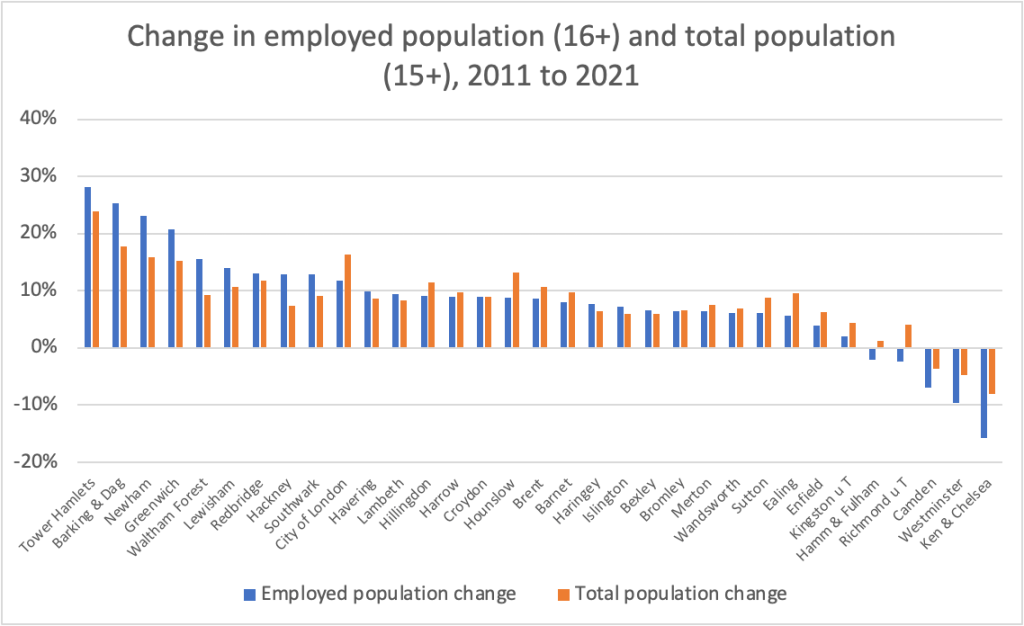
Between 2011 and 2021 London’s working adult population aged 16 and over and its total population aged 15 and over both rose by around 8.5 per cent. But growth was very unevenly distributed (see chart below).

The east London boroughs have seen rapid increases and in most cases their working population growth has outstripped their general population growth. Other boroughs, particularly in other parts of north and west outer London, have seen their working population grow more slowly than their overall population, and a handful of west-central boroughs have seen a decline in both groups.

Taken together, these figures suggest that London continues to contain extremes of employment and worklessness. Zooming into the ONS’s detailed map, you can find blocks where 15 per cent or more of people aged over 16 are unemployed and looking for work within boroughs that have grown their workforce by 25 per cent over the past ten years.

Londoners are unquestionably working hard. More women, more older people and more disabled people are in the workforce. To what extent this is a result of making positive choices and the general industriousness of urban life, and how far it is driven by the exorbitant costs of living in the capital is another question.

Originally published by OnLondon.
Re-do the Strand

Some cities do winter merriment better than others. They have the Christmas markets, they have the gluhwein, they have the blankets and hot chocolate outside ornate cafes. London is not like that. London’s winter life is interior: it’s the “the pubs and the bookies where you spend all your day”, as the Pogues’ Shane McGowan put it. All the more kudos then to the new Strand Aldwych public space scheme, which opened to the public last month.

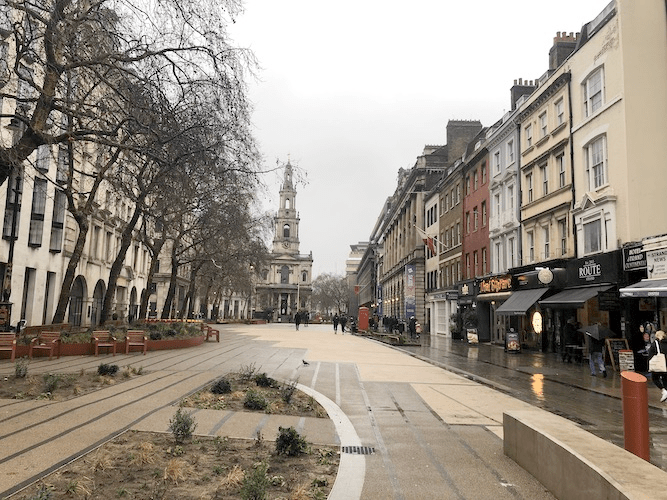
Image of public space from the west

Aldwych’s arc marks as abrupt a transition as any in London. To the west, Covent Garden and theatreland, to the east, universities, lawyers, consultants and bankers. It has a rich history – Aldwych was at the heart of the post-Roman city of Lundenwic – and fine buildings, including Marconi House and Bush House (birthplace and nursery of the BBC) and St Mary le Strand Church. But Aldwych and its hinterland can easily be shrugged off as an interspace, between the cities of London and Westminster, rebranded as Midtown or Northbank, identified by what it is not.

It was terrifying too. The traffic tearing round the gyratory made Aldwych and Strand a glorified roundabout, where pedestrians and cyclists risked their lives darting between buses and taxis. It was no place to linger.

The Strand Aldwych project is designed to change all that. In 2014 Northbank Business Improvement District, led by Ruth Duston, appointed research and urban design specialists Publica to rethink the public spaces on their patch, and then to develop the idea of reinstating two-way traffic on Aldwych, thereby allowing around 200 metres of Strand to be pedestrianised between Bush House, King’s College and Somerset House.

Traffic plans were refined, project boards set up, stakeholders engaged, options reviewed, visions workshopped, artists involved, traffic orders drafted, “meanwhile uses” planned and consultants appointed – including LDA Design – who led the Games-time and legacy landscape design of Queen Elizabeth Olympic Park – as lead designers of the new public spaces.

In 2020 Westminster City Council allocated funding for traffic rerouting and new public space. Works commenced in January 2021, with Strand closed to motor vehicles between Waterloo Bridge and Surrey Street from September of that year. From conception to opening the scheme took around eight years – lightning fast in London terms.

The new public space, which is (of course) “the size of a football pitch”, is divided into two by St Mary’s, an elegant early Baroque building whose vicar was enthusiastically welcoming visitors the afternoon I visited (and which has a ‘Sound and Light Installation’ explaining its history until the end of February).

Nighttime image of the public space from the east

To the east, between the King’s Strand Campus and Bush House, there are benches interspersed between flowerbeds and new street trees, and a slightly scruffy lawn in front of the church. A few cars and vans are still allowed in for servicing and for a hotel car park, with sliding bollards to control access. Watching these glide is hypnotic, though the paint scalps on their flanks suggest they have already encountered some over-confident drivers.

West of St Mary’s is a more expansive space in front of Somerset House formed of stripes and slabs of differently toned asphalts, feeling almost oversized. Tables and benches for summer carousing sit to one side – it will be interesting to see what rules will be applied – and spindly coloured chairs are bolted to the tarmac in a slightly awkward row, as if hanging around on the fringes of a teenage party. It is a stage waiting for a show and has been made big enough to accommodate temporary pavilions and installations.

But even on a grey January afternoon, with the temperature hovering close to freezing, these new spaces are busy. Students and workers sit around the church, chatting, smoking, eying phones and laptops. Cyclists weave between bollards (there has been some criticism of a lack of segregated cycle routes) and walkers saunter through the square with boulevardier relish rather than with the pace and momentum that drives most London journeys on foot.

Precise numbers are hard to come by, but I get the impression that the traffic rerouting took most of the budget. That is to say the landscaping, though well-designed, is functional rather than sumptuous. The flower beds and benches are edged by brown-painted steel, perhaps intended to look like costlier CORTEN from a distance, and most of the road surface is asphalt rather than stone paving.

This is not really a criticism. City centre spaces need to be robust and flexible rather than perfected and fragile, and Westminster City Council has already copped some criticism (including from Westminster Labour before they took over the Council in May) for spending money here rather than in needier parts of the borough. The expanses of tarmac can give these new spaces a bare look, more like the road they used to be than the public piazza they are becoming. However, the 45 new trees and 2,000 square metres of planting will soften them over time, as will more people spilling between the buildings as the days lengthen.

And I think they will come, drawn by temporary events and artworks such as Nick Ryan’s ‘The Voiceline’ – an audio installation drawing on 100 years of BBC archives – by new perspectives on previously half-glimpsed buildings and by the chance to watch the amazing gliding bollard show (or perhaps that’s just me).

The scheme creates a peaceful and breathable space, a pause on one of London’s major crosstown routes and an open-ended quadrangle for King’s College,   though it is a shame that, unlike other London universities, the King’s campus remains sealed off from passers-by.

My only remaining kvetch, which has dogged me in almost every paragraph of this piece, is that there doesn’t seem to be a name for the space or spaces. ‘Strand Aldwych’ is the project, and ‘Strand’ refers to a longer road. Is this to be Strand Place, Bush House Plaza, King’s Court, St Mary’s Walk? We need a name we can complain about, adapt and eventually adopt, for this well-conceived and promising new piece of city.

First published by OnLondon.

Drifting back

After the turbulence of recent months, many Londoners will be hoping for a return to normality, albeit under the shadow of a cost-of-living crisis and a looming recession. But is the city’s office economy returning to pre-pandemic patterns of commuting and working, or have we settled into a “new normal” of hybrid working, empty office blocks and diminished city centre businesses?

London’s streets certainly seem busier, and on the days that they are running, so do London’s tube trains. This is borne out by Transport for London data: trip volumes have been increasing since the summer and now average around 80% of pre-pandemic levels. There are some spikes and dips to this trend, (such as Jubilee celebrations and bank holidays elevating usage, and strikes and heat waves reducing it), but Tube use is now just 20% below pre-pandemic levels.

Screenshot 2022 11 13 at 22.06.03

There is a persistent rhythm emerging too. Weekends are still busiest, with nearly 90% of pre-pandemic trips. Monday, Tuesdays and Fridays are quieter with averages of 65-70%, and Wednesdays and Thursdays slightly busier with averages of 70-75%. However, since the beginning of September, the recovery in trip numbers has been particularly sharp around the City of London and Canary Wharf, suggesting that an increasing proportion of passengers are office workers, as opposed to leisure visitors or workers in other sectors.

Other figures confirm the impression of a gradual return to offices. Remit Consulting have been collecting data on office occupancy throughout the pandemic, based on access control systems (swipe cards and so on) from a sample of around 150 large office buildings in the UK. After advice to work from home was lifted at the end of January, office occupancy figures rose quickly to around 25% and stayed at that level throughout the summer, but since the beginning of October have climbed above 30%.

Screenshot 2022 11 13 at 22.08.27

Remit estimate that “normal” office occupancy levels were 60-80 % before the pandemic, so 30% occupancy in fact equates to offices being around “half full” on the average day. Remit also have a more detailed breakdown by London office ‘submarket’ which shows West End offices back to around 42% average occupancy in October, with City and Docklands offices lagging behind.

Further west, in the SW1 corridors of power, offices are busier. When Jacob Rees-Mogg told civil servants to return to their desks in April, there was an immediate, but amusingly short-lived, effect on behaviour. Office occupancy leapt up from a departmental average of less than 50% of capacity, hitting 65% in mid-May, but had fallen back again by the end of that month.

Jubilee celebrations, summer holidays and industrial action kept numbers low over the summer, but occupancy has been back above 65% since the beginning of October. This is not far off pre-pandemic levels – though to be fair there have been an awful lot of ministers to clap in and out of Whitehall offices over the past few weeks.

While the higher levels of civil service return may reflect a tougher line from ministers, it seems that the return to offices has in fact gathered pace just as politicians and newspapers stopped demanding it. But it remains a trickle rather than a surge. Where do we go from here?

Many workers welcomed more flexible working, and are keen to retain its benefits. The survey commissioned by Kings College London this spring as part of their Work/Place project (on which I worked) found London workers embracing hybrid working patterns enthusiastically: 61% reported hybrid working, defined as working from home at least one day a week (compared to less than 20% before the pandemic). A further 13% worked only from home.

Workers expected the changes to stick too: 75% said they were “never going back” to a five-day week in the workplace, with three days a week at home the most popular option. The results of a second phase of the King’s survey (undertaken in the summer) are due to be launched at a joint event with Central London Forward next week, so we will have some idea of whether these views have shifted over time.

But there is a big difference between these workers’ expectations and those of employers. The UK-wide Business Insights and Conditions Survey found that the proportion of employers (weighted by employee numbers) planning to use home-working as a permanent part of their business model rose from 16% in October 2021 to 24% in May 2022. It was much higher in the ‘office-based’ sectors (professional, scientific and technical services, and information and communications) that account for around one in five London jobs.

However, in the latest wave of the survey (August 2022) that proportion appears to have started to fall across the board, suggesting that bosses may be becoming cooler about long-term home-working (a finding which seems to be mirrored in trends tracked by the WFH Project, a consortium of north American universities).

Screenshot 2022 11 13 at 22.10.53

This gap between employer and employee expectations suggests that we have not yet reached equilibrium. Hybrid working certainly poses challenges – both for planned communication within and between organisations, and the “watercooler moments” of serendipity and casual interaction that form the foundations for corporate culture. Mixing digital and real-life interaction is tougher in many ways than the world of universal home-working during the pandemic.

Over time, new ways of working may diminish or overcome these challenges – through enhanced technology, or changes in culture or behaviour. Managers may tighten rules to ensure that teams can meet effectively and to prevent working from home becoming a perk for those with the privilege of controlling their own workflow (at the moment, it is overwhelmingly concentrated in more senior managerial and professional roles), or conversely to prevent a culture of office attendance and preferential treatment for those (mainly male) workers without caring responsibilities.

But as the recession bites, employers may feel emboldened to push for more presence in the office. There are already stories of companies such as Meta (formerly known as Facebook) retreating from the highly permissive approach they took during the pandemic, and some bosses may share Elon Musk’s views about home-working if not his cack-handed approach to employee relations. Even if returning to the office is not mandated, the threat of redundancy may boost presenteeism although, alternatively, tighter economic times may push employers to seek savings on property costs.

There may also be some polarisation: primarily remote working may become the norm in some sectors or companies, while being in the office becomes more established in others. The King’s College research showed that the biggest increase in home-working was among those who were already working from home at least one day a week before the pandemic.

Where more people are in the office, “fear of missing out” – on advancement, on collaboration, on gossip – may draw even more people in. Conversely, where online meeting and collaboration tools are the norm (perhaps augmented by periodic spells of intense in-person collaboration), employees will respond accordingly – not just in their daily habits, but in long-term decisions about where they live.

London’s office economy has not yet returned to its pre-pandemic state, but nor do I think it has settled into a “new normal”. Huge challenges for the real estate sector and the ecosystem of city-serving businesses remain, and some of these will be discussed at the King’s College/CLF event next week. But the future looks less bleak than it did during the pandemic, and any case for stripping back transport seems much weaker than it might have done even a few months ago. The debate about Crossrail 2 even seems to have restarted. Reports of London’s demise look to have been premature at best.

Originally published by OnLondon.