Big Bang and Grande Bouffe – the eateries that boosted London (March 2019)

 [Originally in OnLondon, 8 March 2019]

‘There’s a Big Bang in the City, We’re all on the make.” (Shopping, Pet Shop Boys, 1987).

The news this week that the Kensington Place restaurant is to shut its doors is more than just another restaurant closure. It completes a chapter in the incredible story of London’s 30 year resurgence.

The years 1986 and 1987 were pivotal for the capital and the high water mark for Thatcherism. In April 1986, amidst a blaze of fireworks and protests, the Greater London Council was abolished alongside other metropolitan councils, banishing the spectre of “socialism on the rates”. And in October – after years of wrangling – the “Big Bang” transformed financial services.

The details of the Big Bang are complex. Essentially it was a package of reforms that deregulated stockbroking, opened up London’s Stock Exchange to foreign-owned firms and enabled computerised trading to replace the frantic scrum of “open outcry” trading on its floor. But the Big Bang represented something more – the apotheosis of confident capitalism, personified by the mobile phone-toting Yuppie, in TV dramas such as Capital City, and by Harry Enfield’s Loadsamoney – conceived as satire, but sometimes treated as a role model.

The Big Bang was also cited as a factor in the revival in net international migration, which meant London’s population started to grow again – albeit just by a few thousand a year – after decades of decline. At the time, London’s return to growth was seen as an anomaly, or even a blip. Writing in early 1987, Tony Champion and Peter Congdon suggested that the “surge in net international migration for City jobs will settle down after Big Bang”.

In 1987, as the Conservatives celebrated their third consecutive election victory, and the City of London was rocked by the twin shocks of the “Black Monday” crash and the emergence of Canary Wharf to the east, the Big Bang was also having an impact to the west. Three restaurants opened to cater to London’s growing gang of globally mobile professionals with sophisticated palates. In doing so, they put London’s food scene on the road to transformation from international punchline to global draw.

In Hammersmith, Ruth Rogers and Rose Gray took over a disused warehouse building next door to Ruth’s husband’s firm, Richard Rogers Partnership. The River Café started by serving lunches to local workers, before gradually opening for longer hours and a wider clientele. But from the outset Ruth and Rose focused on fresh flavours and carefully chosen ingredients, an Italian cuisine that was a world away from the mounds of pasta, check table cloths and straw-covered chianti bottles of traditional trattorias.

In South Kensington, Terence Conran opened Bibendum in the opulent Michelin Tyre Company building on Fulham Road. Chef Simon Hopkinson’s cuisine was as deeply rooted in the rich sauces and offals of French country cooking as the River Café’s was in in the bright and earthy flavours of Tuscany. But, also like the River Café, Bibendum matched this respect for the classics with a stripped-back modernist ethos. Both restaurants were a world away from the tweezered pretension of 1980s nouvelle cuisine.

A little further west, Rowley Leigh opened Kensington Place, serving modern British food (almost a contradiction in terms at the time) in deliberately informal surroundings, dispensing with table cloths to create a London version of the neighbourhood brasseries that dotted Paris, and pioneering dishes such as scallops with pea puree that have now become gastropub standards.

By 1989, the “Lawson Boom” that had driven the ebullience of yuppie culture had run out of steam and the UK began to dip into a recession that hit London particularly hard, with soaring interest rates, a property market crash and thousands of homeowners facing negative equity. But the three restaurants that reinvented London’s food scene survived, and London’s population growth picked up pace. As Kensington Place closes, to be redeveloped for housing, it is caught in the undertow of the wave of change that it surfed.
S H O P P I N G (Sept 2018)

[Originally published OnLondon, 30 Sept 2018]

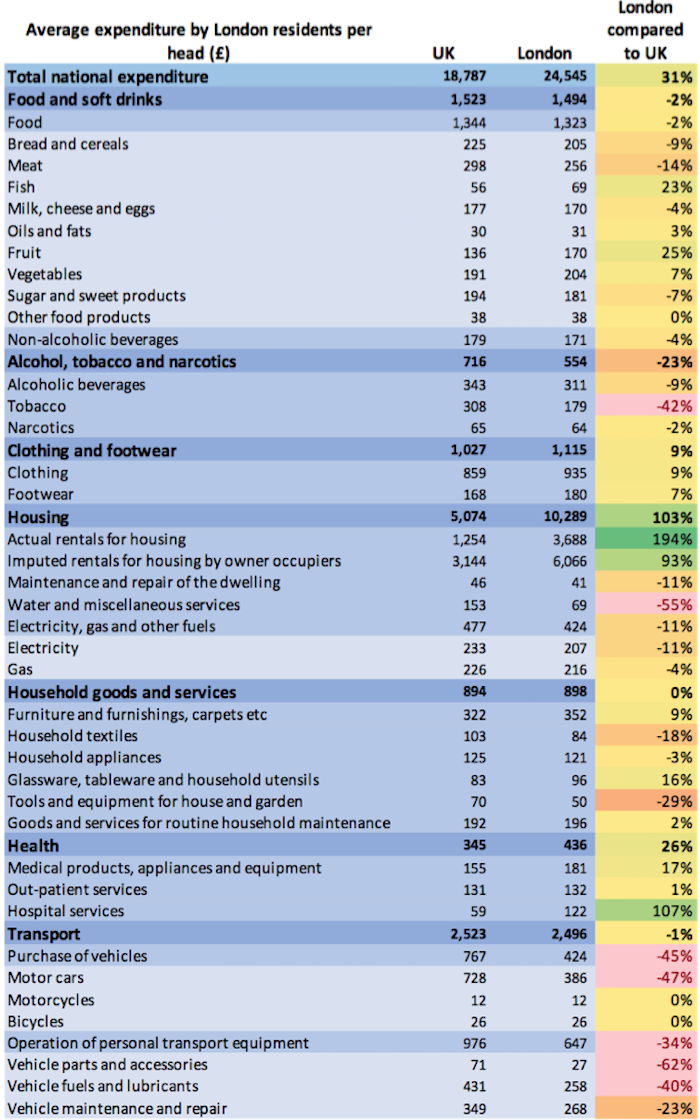
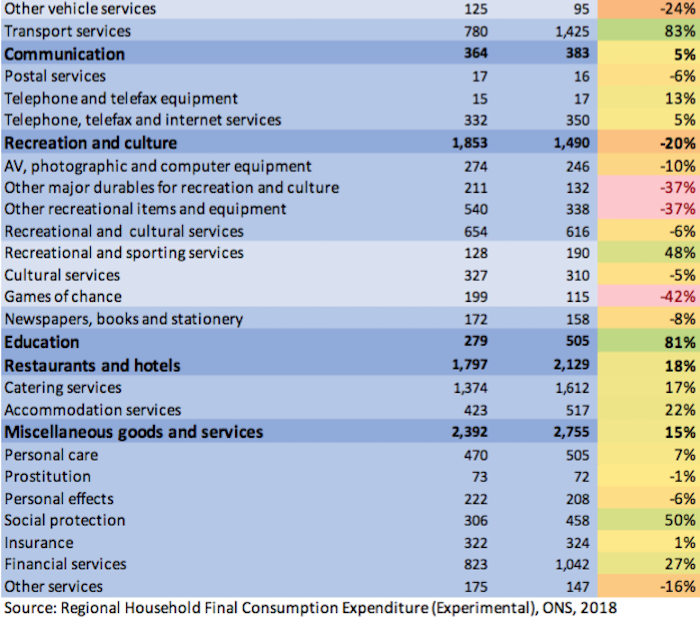
What are Londoners like? Judging by recently released experimental Office for National Statistics data on spending patterns, we are a surprisingly healthy, even ascetic bunch. We each spend around £25,000 each year, 30 per cent more than people across the UK as a whole. But we spend much more on fish and fruit and less on cigarettes and alcohol; more on gym memberships, less on consumer goods. What do these figures really tell us about life in London?

The data suggest some patterns that will be familiar to every Londoner.  We spend an outrageous amount on housing, which accounts for more than £10,000 of the average Londoner’s expenditure every year – twice as much as the UK average. Transport spending is around £2,500 per year across London and the UK alike, but Londoners spend 60 per cent of that sum on transport services such as tubes, buses and taxis, while 70 per cent of average UK transport spending goes on buying and maintaining private vehicles.

The focus on services as opposed to goods is a common thread, and probably arises from a mixture of lifestyle choice and necessity. Modern consumption, we are often told, focuses on experiences rather than on accumulating “stuff”, which is lucky for Londoners, given the insecure tenure and Lilliputian accommodation that many have to put up with.

Londoners spend nearly 30 per cent less than others in the UK on recreational durables – cameras, hi-fis, TVs etc – but more on recreational and sporting services (gym memberships and tickets), and on hotels and restaurants. We don’t have the space for giant TVs or time to watch them, but we do have the almost limitless possibilities of London on our doorstep. The one item of home furnishings that Londoners do spend significantly more on is cutlery and glasses – even the most bijou flat can accommodate a David Mellor teaspoon.

But other aspects of the figures prompt questions. Why do Londoners spend so little per head on vices such as drinking, smoking and gambling (while level-pegging with the rest of the UK on drugs and prostitution)? Wouldn’t you expect a young city with packed bars and pavements to be spending more? Is it simply that Londoners are too hard-up?

That may be part of the answer. But London is not one thing, and there is no such person as an average Londoner. The city that celebrates hedonism and liberation is also the UK’s most religious place. The city with the biggest lesbian, gay and bisexual population is also the city with the lowest proportion of births outside marriage. The millennials who foreswear alcohol or meat for reasons of health or expense live alongside those who do so for religious or cultural reasons.

London mixes conservatism and liberalism in its society as much as in its politics. Diversity and openness to the world make London a city where anyone can live the life they choose. The spending patterns of Londoners illustrate how these myriad lifestyles can contrast but also overlap with each other. Full data below.
Like1
Like2

Cool markets and hot debates – Housing in London

[Originally publiched in OnLondon, 23 Feb 2018]

The number of houses and flats in London grew by nearly 40,000 in the year ending March 2017 – faster than it has since the mayoralty was established in 2000 and only just short of the former Mayor’s annual housing target. Some of the growth was down to controversial conversions of offices to homes (“permitted development”), but 30,000 new homes were built too, which is an achievement to be celebrated.  

But what if this is as good as it gets? It seems almost churlish to make the point, but there is a pile up of indicators suggesting that new home building in London is about to slow down sharply. The first alarm bell is rung by falling house prices and transaction levels, as highlighted in Centre for London’s The London Intelligence bulletin at the end of January. 

House prices across London have fallen at their fastest rate since 2009, and the fall in prices and transaction levels has been particularly sharp in relation to flats in the centre of the city. A recent survey by Molior Consulting confirms this top-of-the-market slow down: less than half of the luxury flats that were started last year were sold (off-plan or on completion). 

Molior’s figures refer to flats selling at around £3 million and these may seem pretty remote from the concerns of most Londoners – luxury flat developers are pretty low on the league table of much-loved London professions. But all the moving parts are connected. As housing grant has reduced, more and more affordable housing in London is delivered through developer obligations. While the number of affordable housing starts supported by mayoral funding has been rising, as the £3.15 billion funding package agreed with the government in 2016 feeds into the system, developer contributions still account for 50 per cent or more of the total. If the flow of luxury flats slows, so will the flow of affordable housing.

And there are other factors suggesting that supply is slowing. NHBC – the National Housing Building Council – issues warranties for around 80 per cent of new build homes in the UK. These tend to be issued just before construction work starts and therefore give a good indication of future supply. The number of warranties issued in London fell from 26,000 in 2015, most of which will have been built in the bumper 2016/17 year, to 17,500 in 2016, and stayed at that level in 2017.  

While the market cools, the politics of housebuilding in London are heating up. Haringey’s proposed joint venture with Lendlease is only the most prominent of a number of controversial partnerships for housing estate redevelopment. Campaigning in Haringey has unseated council leader Claire Kober and probably sealed the fate of the Haringey Development Vehicle itself. Other councils and developers will at the very least be more cautious about joint ventures – which typically take years to plan and even longer to implement – and nothing will happen before local elections in May.

Finally, Sadiq Khan’s draft new London Plan presents a tough policy environment. The Mayor has tightened affordable housing targets, proposed residents’ ballots for estate redevelopment schemes, restricted use of industrial land and shifted the burden of development on to the Outer London boroughs, where new development is most controversial politically. Many Londoners would support most if not all of these policy positions, but the assumption that developers will live with them in return for a stake in London’s super soaraway property market may be outdated. There is already talk of some of London’s biggest housebuilders shifting their focus to Birmingham, Manchester and other places where the market seems more buoyant.

In short, the prospects of accelerating housing delivery to meet the new London Plan target of 66,000 homes a year are looking slimmer by the day. But perhaps a sharp slowdown of housebuilding would not be such bad news after all. “Never let a crisis go to waste,” in words variously attributed to Winston Churchill and Rahm Emanuel. For some years now, London’s housing market has hobbled along like a Heath Robinson contraption, with housing shortages driving land price inflation, social housing becoming an exercise in gamesmanship rather than provision of public goods, and housing targets always soaring ahead of supply like the stakhanovite fantasias of soviet planning.

Perhaps, if this model starts to look broken, we can look for alternatives. All sorts of magic bullets – housing estate redevelopment, Green Belt liberalisation, public sector land – have been aimed at and missed London’s housing targets to date, so we should be wary of singular solutions of blinding simplicity. But we could start to think about possibilities – about packages of measures that could fix London’s dysfunctional housing market.

This may indeed mean thinking about the Green Belt and estate redevelopment – ways of finding the land needed for new homes – but we also need fresh approaches to how homes are built and paid for. If slow sales are deterring traditional housebuilders, how can we rethink the institutional framework, funding structures and building methods?

Could housing benefit payments support borrowing to build, rather than being funnelled to private landlords? Could local authorities borrow more, directly or through central government bond issues, or work with pension funds and other long-term investors to find sites and build homes for rent, providing a stable income stream for both parties? Could off site construction be used at scale to supply local authorities and developers across the capital with low cost homes for vacant sites?
Tackling London’s housing crisis may mean going after some sacred cows: more focus on rent rather than sale; a positive approach to public investment and less worrying about how borrowing is treated in public accounts; more aggressive approaches to land hoarding; more direct public sector involvement; perhaps even a development corporation that can push through planning and construction across the capital.

Some of these options may be controversial – though a consensus for a radical package of reforms is growing among London’s politicians and housing experts – but watching as the market sputters to a halt seems even less attractive. To adapt Sherlock Holmes, “When we have eliminated the impossible, what remains, no matter how unpalatable, must be the housing delivery plan.”

But is there the political appetite and will to match the urgency of the challenge and the scale of the opportunity? Mayor Khan has already announced that he needs a five-fold increase in government funding for affordable housing, and roundly condemned the autumn 2017 budget for its failure to commit investment at this level. For its part, the government is cash-strapped, Brexit-blinkered, and unlikely to see much political capital in helping out a Labour mayor or London itself. The challenge – to Whitehall and City Hall – is to rise above the politics of the housing crisis, to take shared responsibility and shared credit for the bold steps needed to fix London’s broken housing market.

Urban growth forever?

[Original published on OnLondon, 3 January 2018]

In his foreword to his draft London Plan, Mayor of London Sadiq Khan writes of London’s population growing by 70,000 every year, to reach 10.5 million in 2041. Population growth has been London’s big story for the past 30 years. Growth assumptions underpin the business case, and increasingly the funding strategy, for everything from affordable housing delivery to major infrastructure projects like Crossrail 2. But could these be wrong? Could a toxic mix of falling immigration and priced-out professionals slow or even reverse London’s growth trajectory?

Population projections – like all predictions – tend to be either lucky or wrong. As Tony Travers observed in a recent edition of Centre for London’s London Essays, population projections underestimated London’s decline in the 1960s and 1970s, then missed the first signs of recovery in the mid-1980s when London’s shallow growth was dismissed as a blip in the pattern of decline that cities were expected to pursue. But growth continued, gathering pace through economic cycles of boom and bust.

London’s population growth is not a single process, but the product of great surges of people arriving and departing, at airports and stations, maternity wards and hospices. In mid-2016 London’s population was estimated, on the basis of passenger surveys and NHS registrations, to have grown by around 110,000 in the preceding 12 months. The components of this growth were as follows.

Births 130,000 80,000 110,000
Deaths -50,000
Domestic in-migrants 580,000 -95,000
Domestic out-migrants -675,000
International in-migrants 220,000 125,000
International out-migrants -95,000

This pattern has been pretty consistent in recent years: young UK residents move in to London from across the country, but more move out every year – generally to south east England. This domestic net migration from London is countered by international migration to London, and the city’s young age profile is reflected in a surplus of births over deaths.

There have been variations: in the years of the financial crisis, domestic out-migration slowed, perhaps because the credit crunch meant thirtysomethings were unable to get mortgages and so were stuck renting for longer. And the years since 2014 have seen a spike in international in-migration, potentially driven by the lifting of restrictions on Romanian and Bulgarian workers.

Could Brexit disrupt these flows? There are already some signs that things are changing. In November 2016, the Office for National Statistics’ latest estimates of net long-term international migration showed a sharp fall of 38 per cent in London. The figures are only estimates, with wide margins of error, but the ONS assessed the fall as being statistically significant. It may be a blip, but could it signal a longer-term change? Other indicators certainly suggest a slowdown: the number of foreign nationals registering for a national insurance number when they arrive to work in London dropped by 20 per cent between the beginning of 2016 and the beginning of 2017, with European nationals accounting for most of the decline.

Bringing the UK’s international migration down to “tens of thousands” as the Government has pledged would therefore have a big impact on London’s population, and it looks as if the mere prospect of tighter controls is already having an impact. Would this be offset by more people coming to London from the rest of the UK, and fewer leaving? Previous research has shown that when international migration declines (generally in recessions), domestic out-migration also slows, keeping population levels up.

But this depends on the balance of push and pull factors remaining constant: as long as London offers economic opportunity, people will come here; as long as it remains an expensive and tough city to live in, people will leave. Net out-migration has been rising since 2009 – from 30,000 to more than 90,000 – but it still has some way to go to attain its previous peak of 110,000 in 2004.

So what about births and deaths? The number of deaths in London has been pretty constant – around 50,000 Londoners die each year – but the annual number of births has climbed from around 100,000 to around 130,000 in the past 15 years. However, “natural increase” replenishment of London’s population has also been affected by immigration: 70 per cent of babies born in London in 2016 had one parent born overseas. Reducing immigration levels could, therefore, have an impact, in the long term, on that part of the picture too.

When London’s population started to recover in the mid-1980s after four decades of decline, it was driven first by domestic migration and then by accelerating international migration. Since then, momentum has grown, as freedom of movement, an internationalised economy and cheap air travel have combined to open London up, creating a city where 800,000 people – 10% of its population – arrive every year, and only slightly fewer leave.

But there is nothing inevitable about continued growth. It is perfectly possible to imagine a scenario where falling international in-migration and rising domestic out-migration combine to stop London’s growth in its tracks. If net international migration fell back by 20% a year, it would fall to around 65,000 in three years’ time – only slightly lower than its level in the early 2000s. If this was combined with a growth in internal out-migration to its previous peak, and a slight dip in births, London’s population growth could be reduced to just 17,000 by 2019 and could go into reverse the following year.

This is all highly speculative. We are still in the dark about the nature of Brexit, let alone its impact: London is still creating jobs and attracting inward investment, though business confidence remains fragile. The long-term change in international migration may be negligible, or may be counterbalanced by domestic movement.

London may continue to thrive economically, preserving and enhancing its offer to businesses and talented people from across the world, or its service sector economy may take a hit; academic research in recent months has suggested both that London will be hardest and least hard hit by Brexit. London property prices may resume their stellar trajectory, or may cool off to allow wages to catch up. It will only be in the next few years that we understand whether Brexit checks, stalls or amplifies the phenomenal population boom that London has experienced over the past 30 years.

Found in the suburbs

[Originally published online by the Guardian, 6 December 2017]

The London plan, the latest draft of which was published at the end of November, is the great ocean-going liner of London mayoral politics. It carries as its cargo all the mayor’s most important policies, as it sails from draft to adoption, navigating the choppy waters of public consultation and examination-in-public on its way.

As soon as the plan’s two to three-year journey is completed, it turns round to begin afresh the process of review and redrafting. It is the keystone of mayoral strategies, and one of the most powerful tools the mayor of London has to define the shape of London. It regulates the use of land – a scarce asset in a growing but constrained city – and over time all 33 London boroughs should ensure that their plans and planning decisions fall in line with its policies on what should be built where.

This concentration of mayoral powers in planning means many policies take on a spatial complexion: while the mayor cannot tax or ban unhealthy fast food shops, he can propose that they are located away from schools. He cannot license nightclubs, but he can require developers to meet the cost of soundproofing if they build alongside nightclubs. He does not manage financial services, but he can preserve land for offices in the Square Mile and Canary Wharf.

If you are a hammer, everything looks like a nail; and if you are a planning document, everything looks like a land use issue.

At the heart of the latest London plan is its focus on annual new housing supply, raised from its previous target of 42,000 to 66,000, with half being affordable. It’s an ambitious target, considering that the present supply of new homes, 29,000, is less than half the new target – but the mayor argues that the capital’s crisis over a lack of affordable homes requires a big step up. Few would disagree with that.

Some of the proposed homes may be built outside London – the plan commits to working more closely with neighbouring councils, a scheme that will be considered in a forthcoming report by Centre for London and the Southern Policy Centre – but the priority will be building homes within the capital.

Alongside investment in affordable homes, which Khan says needs to be increased to £2.7bn, and land at the Olympic Park and Old Oak Common, the mayor must rely on his planning powers to achieve his target. In some cases, he will be able to intervene himself in planning decisions, but can only do so where certain conditions are met, such as schemes with more than 150 housing units or buildings over 30 metres tall.

In most cases, he will have to rely on the policies and planning decisions made by individual London boroughs and some outer London boroughs, who are being asked to double or even treble their speed of housebuilding – and who may be reluctant to do so, given the concerns of local voters.

So the plan seeks to make it easier for boroughs to grant planning permission and harder to refuse it. High density in itself, for example, can no longer be a reason to turn a scheme down – although there is sensible provision for careful scrutiny of the design of the highest density schemes.

There is also a sharper focus on smaller sites, which are expected to account for 25,000 of the 66,000 new homes a year. The plan says smaller sites should be prioritised by boroughs, with design codes drawn up to identify opportunities for new development, particularly around transport hubs, and a presumption in favour of giving planning permission.

But all this relies on developers wanting to build. For 20 years, London’s housing market has boomed, so the challenge has been how much the mayor and boroughs can secure from developers in terms of social housing and other community benefits; where permission has been refused, developers have often come back with a better offer.

At the launch of the draft plan, London’s deputy mayor, Jules Pipe, was adamant that it would not stifle development or undermine viability of schemes. But planning as a tool works better at directing development than initiating it. There is already a growing backlog of planning consents that have been given, but where houses have not been built, and without a dramatic increase in funding, the mayor has only limited powers to get homes built.

The draft plan does want to find incentives for homes to be built faster, and a switch to more rental developments and smaller sites should help, but at a time when London’s housing market is cooling, planning permission will only be half the battle.

  • This article was corrected on 12 December to clarify the mayor’s target of £2.7bn to invest in affordable homes.

London Sounds

[Originally published in OnLondon, 13 November 2017]

Richard Brown is research director at think tank Centre for London and before that he worked for Mayor Ken Livingstone and on the transformation of the Olympic Park. So he knows this city. He also knows a few of its tunes.

Why don’t we sing about our city? Writing here recently, Westminster North MP Karen Buck observed how few songs celebrate London, when so many reference postcodes, districts or neighbourhoods, from Gerry Rafferty’s Baker Street to Wiley’s Bow E3.

Given London’s uneasy relationship with the rest of the UK, the capital may simply be reticent, loath to sing its own praises. Like a tall person at a party, London stoops to blend in. Also, as discussed at a recent Centre for London seminar, London identity is a slippery concept; many Londoners identify far more closely with their neighbourhood than with the unexplored miles and unknowable millions of the metropolis.

Newcomers are less coy about celebrating the city, still conceiving it as a singularity, rather than as the patchwork of places that residents navigate, and it is striking how many “London” songs are written by new arrivals or even in anticipation of arrival. One of the earliest, Lord Kitchener’s London is the Place for Me, was written before he arrived in Tilbury on the SS Empire Windrush as it brought the first wave of West Indian migrants to London in 1948.

The Smiths’ London is about the journey south from Manchester, and the Pet Shop Boys’ song of the same name depicts the Eastern European migrant experience. The Pogues’ early hymns to London, including the bleary Dark Streets of London and the boisterously offensive Transmetropolitan, were written from an adopted stance of London Irish rootlessness. Even two of the best-known London songs – The Kinks’ Waterloo Sunset and Ralph McTell’s Streets of London – were originally composed for other cities, Liverpool and Paris respectively.

But many more songs are unambiguously about London, while never naming the city. Karen Buck picks out her erstwhile constituents The Clash, whose songs are an A-Z of punk reference points, but Woking imports The Jam were also prolific in the key of London: In The City and Strange Town celebrate the giddy excitement and the nervous alienation of coming up from the suburbs, while Down in The Tube Station at Midnight and That’s Entertainment take a more jaundiced view of late 1970s London, and its “smell of pubs, and Wormwood Scrubs, and too many right wing meetings”.

When I arrived in London in the 1990s, punk was long gone, except for postcards of theme-park mohicans on King’s Road. Alongside St Etienne’s electric ballads and Pulp’s class satires, Underworld’s early albums are powerfully evocative of London at that time. In Dirty Epic, sounding like a blissed-out Iain Sinclair, Karl Hyde invokes “the sainted rhythms of the midnight train to Romford”, capturing the queasy hedonism of London clubbing as acutely as Soft Cell’s Bedsitter or the Pet Shop Boys’ West End Girls did in the 1980s.

The capital looms, even when unmentioned, over all the later phases of Britpop, when Oasis, Pulp and Blur abandoned their regional roots to celebrate the capital’s offer of sex, drugs and existential angst, and – as 2000s war clouds gather – is a powerful presence in Damon Albarn’s subsequent work with The Good The Bad and The Queen. Songs like The Libertines’ Time for Heroes, and Plan B’s Ill Manors chart London’s history as a centre for protest and of rage. They don’t mention the city by name, but they don’t need to. Where London is mentioned, in Lily Allen’s LDN or Elvis Costello’s London’s Brilliant Parade, it is sardonically or even bitterly.

Even among these anonymous appearances, as the backdrop for stories of love and hate, success and failure, positive portrayals of London seem sparse, as Karen Buck argues. We don’t rhapsodise the city; even Noel Coward’s elegant wartime London Pride is a casual and minor key ode to a “grey city, stubbornly implanted, taken so for granted for a thousand years”. But perhaps that’s right: London’s glitter, so keenly serenaded by new arrivals, soon loses its lustre. It is replaced by a deeper, more clear-eyed but less articulate attachment, even a quiet sense of tainted civic pride, which infects and informs whole genres of music.

You can follow Richard Brown on Twitter and read more of his work on London via here.

Transport of no delight

When does \’disruption\’ tip over into irresponsibility? That was one of the fundamental tensions underpinning the tech manifesto published by Centre for London, with Tech London Advocates and London First, in February 2016. The row over Uber\’s licence suspension in London shows that we are still some way from an answer.

The Tech Manifesto argued for an approach that balanced \”open innovation, with consideration of citizens\’ needs\”, and identified \”the disruption to the private hire markets caused by the introduction of Uber in London [as] a prime example of regulators failing to keep pace with the scale and speed of a particular innovation\”.

On Friday, it felt like regulators finally caught up, when Transport for London announced that Uber\’s licence to operate in London would be revoked from the end of September. But the racing metaphor quickly implodes: the events of the last few days look like an object lesson in how not to do digital regulation. Transport for London\’s decision to pull Uber\’s licence appears to have come out of the blue, with little opportunity for Uber to address the concerns about driver and passenger safety that have been raised.  At the same time, Uber, so rich in political networks, has responded with petitions and media campaigns about its 40,000 workers and millions of customers, blowing squid ink rather than trying to engage with the concerns about its systems and policies.

It may be that TfL has announced the \’surprise\’ revocation to force the pace with a company that would otherwise happily deploy lobbyists and lawyers to haggle for months over sanctions and compliance, and it may also be that Uber is sincere in the sentiment expressed by its CEO in a tweet on Saturday, asking London to \”work with us to make things right\”.

But this clash – more interesting because it is more textured than other cities\’ decision to ban Uber outright – does not inspire much faith in the future for intelligent discussions about regulating the digital economy. We cannot preserve business as usual for every element of city services, but we shouldn\’t give \’disruption\’ a free pass an unalloyed benefit to urban life – individually or in aggregate – either.

Sumday

[Originally published in Telegraph, 31 May 2017]
Almost a year after the EU Referendum, two sets of figures released by the Office for National Statistics seem to reinforce the idea of London as a place apart from the rest of the UK. Dig a little deeper, however, and it is convergence and mutual dependence that come to the fore.
The data on regional fiscal balances drew a sharp contrasts between London and the South East, and the rest of the UK, with the former paying nearly £250 billion on taxes, and receiving services costing almost £50 billion less in 2015/16, while the balance was reversed elsewhere.  This translates to a per capita ‘subsidy’ of £3,000 in the year from London to the rest of the UK.
This shouldn’t be too surprising. The capital’s economy and its population have been growing as fast as ever since the financial crisis, fuelled by cheap money, openness to talent and growing trade in services. This economic growth means that London accounts for disproportionate levels of corporation tax, higher wages are reflected in higher income tax and national insurance payments, and soaring property prices are reflected in stamp duty receipts – half of which are derived in London.
In terms of expenditure, London costs more per head in terms of economic development, transport and technology costs, but significantly less in terms of social protection (ie, benefits). The balance between welfare costs and economic infrastructure costs is interesting, though there’s a limit to what you can conclude from a one-year snapshot of figures.
But, however successful London looks in terms of tax revenues, for many Londoners, the city’s gravity-defying boom feels like something that is happening to someone else.  The second set of figures, on gross disposable household income, seems at first to confirm the sense of London excpetionalism.  The figures, for 2015, show the average gross income of Londoners to be more than £30,000, almost twice as much as in the North East.  Taxes and benefits bring the numbers closer together: the London average is £25,000 and the North East average is £16,000. 
The gap is still significant.  But, as any Londoner or tourist will tell you, it’s amazing how fast the money goes. Throw housing costs into the mix – neither mortgage capital repayments nor rent are included in the figures – and the gap closes further.  Deducting the average 2015 rent for a one-bed flat in each region, you are left with residual income of £12,000 in London, and £11,000 in the North East. And that £1,000 ‘London premium’ will quickly be eaten by the higher costs of transport, childcare and beer in the capital. 
Life is tough for many people in London – and it’s been getting tougher as income grew more slowly between 2014 and 2015 than in other regions, even before spiralling rental costs were taken into account. Also, of course, there is no such person as an average Londoner, and the differences within the city are as stark as those between London and other regions.  Income per head (after taxes and benefits but before housing costs) in Kensington and Chelsea has nearly £60,000 per head, while the average resident of Barking and Dagenham has £16,500.
So these figures don’t show that Londoners are a bunch of effete metropolitans rolling in lucre, or that other UK regions are free-riding on the capital’s coat tails. But they do show, in line with Centre for London reports, the leading role played by housing costs in the persistent poverty that many Londoners face, and the importance to the whole UK of sustaining the openness to talent and trade that supports London’s growth. 

Lamé, Duckie

I don’t get to Duckie as often as I used to, partly the result of moving to Brighton, and partly just getting older.  But, for several years in the late 1990s, Duckie was the hub round which my week revolved.  Friends’ parties, gigs and meals out could come and go, but from 10pm on a Saturday night, I would be at the Royal Vauxhall Tavern.
Duckie was founded in 1995 by Amy Lamé (appointed this week as Sadiq Khan’s new ‘Night Czar’), together with producer Simon Strange, DJs the (London) Readers Wifes, and door whores Jay and Father Cloth.  London’s gay scene at the time was pretty conformist, dominated by identikit shirts-off techno sweatboxes, with only a few alternatives (like Popstarz, which was always a bit too fixated on Britpop for my taste).  Duckie brought something new, mixing performance art, political activism, northern soul, electro, grunge and glam, all delivered with wit and intelligence. 
Compered by Amy, a modern dance troupe would be followed on stage by an alternative drag act, or by striking Liverpool dock workers urging solidarity and collecting for a hardship fund.  In between acts, you could spend half an hour swaying and struggling through the friendly crowd to bar or loo, as Kate Bush, The Damned, Suede, Pet Shop Boys, X-Ray Spex, The Smiths, and Althea and Donna  boomed from the turntables (the Wifes were loath to indulge in DJ-ish gimmicks like ‘mixing’). 
After the ever-changing roster of “the Readers’ Wifes’ favourite record OF ALL TIME!”, the never-changing refrain of John Travolta and Olivia Newton-John’s ‘Xanadu’ would close the show, as the lights came up, and the crowd spilled out onto Vauxhall pavements.  For five years, Duckie rocked my world. 
Duckie was/is open and welcoming, challenging but safe, intelligent but amiable, arty but not po-faced, boozy but not lairy, crowded but not claustrophobic, raucous but not rough, sexy but not self-obsessed. As Amy Lamé settles into her new role, that sounds like a pretty good vision for what London’s nightlife could and should be.

Block-ed

Redeveloping council estates has become a popular way for boroughs to build more houses in London, where land is at a premium, but it is a high-wire act, conducted over a shark tank, with volleys of custard pies being hurled from the sidelines.

Build at too low densities and the numbers won\’t add up; go too high and you create a lumpy enclave out of keeping with its surroundings. Spend too much buying out existing residents and you kill the business case; spend too little and you will have to resort to compulsory purchase. Build too much market housing and you\’re accused of driving poor people from their homes; build too little and you won\’t make enough to cross-subsidise more affordable housing. Offer too little to developers and they won\’t take on the risk; offer too much and you look like an easy touch.

One of London\’s largest such schemes began to wobble on Friday, when the Secretary of State turned down Southwark\’s Council\’s application for a compulsory purchase order to enable the demolition and redevelopment of the Aylesbury Estate, planned to increase total housing numbers from 2,700 to 4,000.  The scheme has been intensely controversial, with accusations of \’social cleansing\’, occupations and forcible evictions providing a stormy backdrop to the slow-grinding legalities of planning and public enquiries.

It is hard to avoid boggling at the politics of a Conservative minister seemingly siding with anti-gentrification protestors against a major development scheme promoted by a Labour council. Is this a sign of the May government\’s commitment to helping the poorest in society? Is this dismissal of the public-private partnerships that have dominated public projects for so many years another sign of the \’end of liberalism\’?

You can imagine Conservative spin doctors savouring some of these interpretations, but the politics of this decision are probably fortuitous rather than intentional. The process of confirming (or not) compulsory purchase orders is a quasi-judicial one, made on the basis of an inspector\’s report and carefully worded official advice, not for political positioning.

And, when you look a bit deeper, the decision is a very conservative one.  It was not the rights of council tenants that were the central consideration, but eight remaining leaseholders, owners of property bought under right-to-buy legislation.  The compensation offered to them was judged to be inadequate, and their human rights likely to be breached if their homes were requisitioned. It was actually the very conservative defence of private property rights, and the Conservative policy of selling off council housing, that has knocked the project off course.