Who needs remote control, from the City Hall?

This is a big year for London government anniversaries. The London boroughs are celebrating their 60th birthday this month and the Greater London Authority (GLA) will be 25 in May or July, depending on whether you choose the date of the inaugural elections for a Mayor of London and the London Assembly in May 2000 or the formal “vesting” of powers that took place in July of that year.

By way of a birthday greeting, London Councils has proposed joining the Mayor’s party by establishing something similar to the mayoral “combined authorities” that operate elsewhere in the country. In Greater Manchester, West Yorkshire, the West Midlands and the seven other mayoral combined authority areas, a directly-elected metro mayor presides over a council of local authority leaders and mayors and needs to secure its agreement for budgets, strategies and plans.

In London, a council of 34 members – the Mayor and the capital’s 33 local authorities – would be unwieldy, so London Councils has proposed a “combined board”, comprising the Mayor and its own 12 “executive members”, a party-proportional cross-section of council leaders holding specific Londonwide remits. This board could take decisions on “relevant powers and funding”.

Such a change would be a big deal, perhaps bigger than London Councils is admitting. The GLA model of a strong executive mayor and a scrutinising assembly was specifically designed to minimise overlap with borough remits. Although this principle has been eroded over time – for example, by giving the Mayor more powers on housing and land – establishing a London Mayoral Combined Board suggests something rather different.

For a start, it would call into question the role of deputy mayors. The original Greater London Authority Act (1999) gave Mayors limited powers to appoint staff. Ken Livingstone used these powers to appoint senior advisors on economics, housing, transport, the environment and other relevant policy areas.

Under Boris Johnson these were renamed “deputy mayors” (there is also a “statutory deputy mayor”, a London Assembly member appointed to succeed a Mayor unable to continue in office). If there was a deputy mayor for housing and a London Councils executive member for housing, who would speak for the Mayoral Combined Board on the issue?

A similar issue arises with the London Assembly. London Councils argue that there would be no change to the Assembly’s role, but this doesn’t feel right. As well as scrutinising the Mayor, the Assembly signs off his budget and strategies and has other powers which, though quite modest, give it authority and influence which can be significant, if judiciously used.

Were the Assembly to continue in its current form under the London Councils proposals, there would be a situation in which a (directly-elected) Mayor proposed a budget or strategy to be first agreed by a Mayoral Combined Board (representing 32 elected boroughs plus the City of London Corporation) and then passed to a (proportionately elected) London Assembly for confirmation.

This would seem to be an onerous exercise in triple-handling and a recipe for disputes over mandates and remits. But if the Assembly lost those powers it would lose much of its bite. In which case, why not replace it with a borough grouping like the Overview and Scrutiny Committee in Greater Manchester?

In such respects, the London Councils plan is more radical than it might appear to be at first glance. But most importantly of all, is it a good plan?

London Councils argue that London’s current arrangements have become anomalous in the new devolution order. With mayoral or other strategic authorities set to be established across England, London’s “could become the only upper-tier council leaders in the country without a formal say over the decisions of their region’s Strategic Authority”.

It is true that London’s arrangements are different, but so is London. The Devolution White Paper published in December appears to acknowledge this. It pledges to apply an integrated financial settlement for London “while retaining pe-existing bespoke London arrangements…[and] existing ways of working with London Councils”.

Ironically, Sir Sadiq Khan has gone a lot further than his two antecedents in working closely with the boroughs. The recent London Growth Plan was developed in partnership with them, building on the work of the jointly-chaired London Recovery Board and London Partnership Board during and after the pandemic.

Mayoral strategies and budgets are all subject to consultation with the boroughs, but there are some areas where the Mayor has, by design, an independent and overriding role. The main example is powers over planning policy, where borough local plans must reflect London Plan policies (following consultation) and the Mayor retains a right to take strategic decisions over the heads of individual boroughs. (The White Paper, by the way, pledges that all metro mayors will receive similar powers, which seems hard to square with the “collegiate” model of combined authority government.)

It is true that Greater Manchester has prepared a joint plan, Places for Everyone, which was adopted last year. But the document took ten years to finalise, one borough (Stockport) withdrew from the process, and the plan has been criticised as merely drawing together unambitious local housing plans rather than seeking to take a strategic – and sometimes disputed – view of need and opportunity.

But maybe there’s a bigger picture approach that might be taken to reform in London. Perhaps new arrangements could be devised that would allow London’s boroughs to have greater formal involvement in the development of the city’s economic strategies and plans, but also enable the Mayor to have more say in overseeing and co-ordinating council services and regulatory functions – from licensing to social care to street cleaning.

It might also be an opportunity to look again at the structure of the boroughs themselves. One thing that the West Midlands and, to a lesser extent, Greater Manchester have is a single local authority overseeing the whole of the core of the cities they serve. The LSE’S Greater London Group suggested such an authority for London to the Herbert Commission in the early 1960s, but this was not followed through when the 1965 reforms were put into place.

The Greater London Authority has already outlived the Greater London Council by five years. While few would wish to repeat the chaotic and politically-motivated abolition of the GLC, the 60th and 25th anniversaries may be a time for reflection on how well current set-ups are serving London. But whether the London Councils proposals are a basis for a new settlement, a contribution to a more far-reaching debate or destined to be just a footnote in London government history remains to be seen.

First published by OnLondon.

Where will they go to, the robotaxis, when we’re asleep in our beds?

The Automated Vehicles Act 2024 received royal assent on 20 May last year, but was rather overshadowed by a rain-soaked Rishi Sunak announcing, two days later, that he was calling a general election. While the Act leaves a lot of detail to secondary legislation (an explainer by Scarlett Milligan of 39 Essex Chambers  is helpful), it sets out a structure for regulating the use of self-driving cars, which could see them on Britain’s roads as early as next year, according to a Department for Transport press release.

The year 2026 is suddenly very near, and it seems unlikely that regulations will be in place by then. But there have already been London trials of autonomous vehicles – in the Queen Elizabeth Olympic Park and in Woolwich – and Waymo self-driving taxis are commonplace in several US cities, including San Francisco, where the urban environment is as almost complex as London’s. This particular future seems to be drawing closer.

You can debate whether self-driving cars (more likely to operate as “robotaxis” than as individually-owned vehicles, for the next few years at least) are a good thing. Advocates say they could reduce accidents and congestion, and offer liberating point-to-point transport for people who are currently excluded by price, location or physical conditions – a case argued in an excellent blog by James O’Malley, which set me thinking about what abundant robotaxis would mean for London.

Not everyone is so positive. Sceptics argue that robotaxis could divert people from healthier walking and cycling, lead to more sprawl, congestion and pollution, reduce social interaction, and undermine the viability of mass public transport. Transport for London’s 2019 position statement takes a fairly guarded view, pointing to the Mayor’s strategic priority – that 80 per cent of journeys should be made by walking, cycling and public transport by 2041.

Progress towards that target has been slow: around 63 per cent of journeys were made by walking, cycling and public transport in 2023, a level that has barely changed over ten years. But in any case, it seems to me that readily-available and cheap robotaxis would be very attractive to people – including those who do not like walking, cycling or using public transport, or are not able to use those ways of getting around.

So, unless the government chooses a highly restrictive approach (essentially banning autonomous vehicles), the question becomes one of what policies cities such as London should adopt in order to manage their impact on urban mobility, on the built environment and on public health.

At the moment, it costs more – in time and money – to use Waymo taxis than to use Ubers in San Francisco, but that gap is likely to narrow and reverse as the technology improves; McKinsey estimate that by 2030 in the US the cost per mile will be little more than  using your own car. If the cost fell that low or further, the challenge for public transport systems and for urban streets would be acute. People could switch to robotaxis en masse – causing gridlock and stripping London’s trains and buses of paying customers (even if gridlock would eventually choke demand).

One inevitable policy response to the arrival of autonomous vehicles is the (much discussed and much can-kicked) introduction of road user charging. As my former colleagues at Centre for London have suggested, this could be targeted so that using roads (and robotaxis) is made more expensive where journeys can be easily made by public transport, walking or cycling, and cheaper in places where those options are not available, and for people to whom they are not accessible.

Switching from car ownership to robotaxi use could also potentially free up road space. Car ownership is already declining faster than car use in London, and abundant robotaxis could accelerate this, with many privately-owned cars disappearing from kerbsides and suburban driveways, opening up new public spaces across the city.

But where would the robotaxis go, while we’re asleep in our beds? A dystopian, polluting and congesting, scenario would see empty cars cruising London roads until summoned by passengers, like electric Marie Celestes. A better option would be to place limits on empty circulation, and to provide local parking hubs with charging facilities and waiting space.

This would require some adaptation of existing car parks (which could hold many more cars if no human drivers needed to get in and out), and perhaps transport hubs being incorporated into new developments; again, Centre for London has undertaken research in this area.

From a public health perspective, you might go further, requiring or incentivising most users to walk to a transport hub to pick up a car, rather than to expect door-to-door service. This might be too nanny-ish for some tastes. But not only would it incorporate a (minimal) level of walking into most journeys, it would also discourage people from using cars for shorter, walkable or cyclable, trips.

The 20th Century city was shaped by private car ownership. If robotaxis become commonplace, their impact on the 21st Century city could be just as great. Policy action will be needed, and soon, to make that impact positive.

First published by OnLondon.

Housing in London – every cloud has a cloudy lining

There’s a German word, “dunkelflaute”, which translates as “dark doldrums” – periods when there is no wind or sun to generate electricity (making you reliant on coal and Russian gas, if you happen to have shut down all your nuclear power plants). London’s housing market seems to be facing dark doldrums at the moment: prices are stuck in a rut, residential planning permissions are at half the level they were five years ago, and transaction volumes and new building have slowed to a crawl.

Property prices in London shot up after the financial crisis, but have risen far less dramatically since 2016, as a result, property analyst Neal Hudson suggests, of tougher regulation of residential mortgages and more taxation of property investment. The market boomed briefly from 2020 to 2022, but has fallen back since then. According to the Nationwide Building Society’s index, average prices were ten per cent higher in 2024 than eight years earlier, but that is a 15 per cent fall once inflation is taken into account.

After decades of soaring prices, surely cheaper housing is good news for somebody? The Nationwide data show that the average price paid by a first-time buyer in London is now less than nine times median earnings, the lowest ratio for ten years. Rental affordability also seems to be improving, with government figures showing average rents taking up around 40 per cent of median income of renting households in 2022/23, compared to 57 per cent in 2016/17.

But neither of these figures tells the whole story. To paraphrase Withnail, living in London is becoming cheaper for those who can afford it, but remains prohibitively expensive to those who can’t.

Cheaper houses are only cheaper if you don’t need to borrow money. For first-time buyers, rising interest rates have gobbled up any savings from price falls: in 2020-22 Nationwide calculated that mortgage payments accounted for around 50 per cent of first-time buyers’ take-home pay.

Rising interest rates pushed that up to 66 per cent at the end of last year, though it has fallen back to around 60 per cent since then (a similar level to 2016). And, even with lower prices, London buyers still need to find deposits of £110,000 – a gargantuan sum for anyone without blockbuster bonuses, access to the Bank of Mum and Dad, or at least somewhere to live rent-free (and possibly holiday and fun-free too) while they scrimp and save.

As Paul Johnson of the Institute for Fiscal Studies recently observed, this means that anyone without wealthy parents or somewhere to stay rent-free will find it much more difficult to move into their own property in London and to enjoy everything the capital offers.

This might not matter if the Levelling Up dream of excellent jobs everywhere had been realised. But it hasn’t, and London should be able to offer opportunities for all, not just those lucky enough to have been born within the M25.

Apparent improvements in rental affordability also obscure a less positive reality. Government figures show that between 2016/17 and 2022/23, rents fell from 57 to 40 per cent of household income for people renting. But for someone earning median wages in London, rent fell from 59 per cent to 53 per cent of gross earnings over the same period – a significant drop, but much smaller than that implied by the official figures.

Why have renters’ household incomes increased faster than median wages? It could be a result of an increasing number of renting households having more than one earner, or maybe lower earners being squeezed out of the private rental market altogether.

Every cloud has a cloudy lining. If stagnant house prices are not doing much for renters or first-time buyers, they are doing even less for housebuilding. In 2023/24, around 32,000 dwellings were added to London’s housing stock, the lowest level since 2014/15, when the city was still emerging from the financial crisis. These include conversions and changes of use (including the dwindling number of office-to-residential conversions). And only 33,000 new residential units were given planning permission in 2023/24 – way below the peak of 80,000 plus each year between 2014/15 and 2018/19.

When prices fall, housebuilding slows, almost as a thermostatic reaction. Developers base their business plans on a range of projections, including changes in house prices and build costs. If prices go up faster than costs, building goes ahead. But in a stagnant market with high construction inflation, plans are paused or slow-pedalled.

After the financial crisis, housing associations were able to take up some of the slack, completing an average 7,000 homes each year in the five years from 2008/09. But their output in the past five years has been half that, as the need to fund safety improvements and squeezed grant levels have reduced capacity. Local authorities have started building more, completing 3,000 units in the past two years alone, but there is still a gap.

The dark doldrums cannot last forever. Interest rates are forecast to fall next year (if not as fast as previously predicted), which may help more first-time buyers to take advantage of lower prices. In addition, while provisional figures for housing starts in 2023/24 are the lowest since 2020/21, construction economist Noble Francis has observed that brick deliveries, a good leading indicator for housebuilding activity, were 21 per cent higher in October than a year earlier.

There is also Deputy Prime Minister Angela Rayner’s shake-up of planning, heavily trailed in interviews and newspaper pieces last weekend. Will this be enough to treble London’s house building rate in order to achieve its 80,000 homes a year target? What other changes might be needed? Watch this space.

First published by OnLondon.

Licence too ill

London’s nightlife has been taking a pasting: a recent (not very scientific) survey suggested that the city has the worst nightlife in the UK; pubs and clubs are being closed down, their numbers falling by eight and 30 per cent respectively since 2010 according to UK business counts; industry bodies say that London is losing nightlife faster than other regions; and social media reports frequently bewail empty pubs, dead streets and early closing times.

What is to blame for this thinning out? There is a grim alignment of factors: changing drinking habits, higher prices and constrained wages, staff shortages following Brexit, changed working and commuting patterns following the pandemic, cautious licensing authorities and the rise in take-away (or delivery) culture.

Some critics point the finger at Amy Lamé (pictured, front left), the Night Czar appointed by Sadiq Khan in 2016. How, they ask, can her six-figure salary can be justified when London’s nightlife is crumbling? More recently, Conservative mayoral candidate Susan Hall has weighed in, presenting Lamé’s appointment as symptomatic of Khan’s “chumocracy” approach to administration and promising to bring in “real experts committed to reviving our city’s night economy” if she is elected.

Lamé has mounted a vigorous defence of her record, both in keeping venues open and making nightlife safer for all. And I don’t think it is fair to blame her every time the shutters roll down on another London venue (full disclosure: I don’t really know Lamé, but I did spend many 1990s Saturday nights at Duckie, the arty club night she co-founded). But there is a deeper problem too: neither she nor Khan have access to the levers that can keep venues open or close them.

This seems strange, given the wide-ranging remit of London’s Mayors. Nightlife is an essential part of a city’s economy and culture, but licensing late night entertainment and hospitality remains a local authority function.

Licenses are granted by the 33 local authorities in London and governed by central government policy objectives focused on preventing crime, nuisance and negative impacts on children or public health rather than on fostering cultural or economic vitality.

Furthermore, substantial areas of central London are subject to “cumulative impact” policies, which restrict the opening of new premises and extensions of opening hours in order to minimise strains on local infrastructure and the risks of disorder.

The deck is stacked against the hospitality industry. Some boroughs, such as Camden, have sought to relax policies in response to headwinds that have battered the sector since the pandemic, though this has been controversial. In many other cases, restrictions either haven’t been reviewed since 2020 or have been reaffirmed. At the heart of the issue is a balancing act. How does licensing weigh the concerns of local residents, who vote, against the interests of local businesses and visitors, who don’t, and the representations made by the police, who are in the front line when things go wrong?

There’s a similar challenge in town planning – balancing local community interests and the strategic needs of the city. This is why the Mayor was given powers to set policies on issues such as density and use mix, and to intervene in significant cases where local decisions might undermine those policies. Indeed, Khan has already used his planning powers to support London’s nightlife through the “agent of change principle”, which makes developers rather than pre-existing entertainment venues responsible for sound insulation and other mitigation measures.

Should London’s Mayors, who already have oversight of the capital’s police force, take a greater role in licensing, setting a framework for local decisions and perhaps intervening where there is a strategic case for doing so? Giving them more power in this area could take the heat out of local debates and allow for a more consistent and strategic approach to the capital’s night-time economy.

Such an extension of mayoral power might be restricted to central London, where nightlife serves capital city and world city functions, as well as the needs of local communities. Again, there’s a read-across to town planning: the Mayor already has an enhanced planning role in the Central Activities Zone, though interestingly many of London’s nightlife hotspots are distributed around its fringe.

All that said, licensing is difficult. I’m not sure whether the current Mayor or his successors would welcome responsibility for decisions that almost invariably annoy someone. But if we want London to be a successful, liveable and thriving 24-hour city, intelligent licensing has a vital part to play.

First published by OnLondon.

Come together

Interviewed on Radio 4 for the launch of his re-election campaign on Monday, Sadiq Khan said this year offered “a moment of maximum opportunity for Londoners, for there’s the prospect not just of a Labour Mayor, but of a Labour government working together [with a Labour Mayor].”

Even if the tone was more bullish than the Labour leadership might like, Mayor Khan has a point. Since he was first elected in 2016, he has lived with a chaotic kaleidoscope of Conservative governments. When these have shown any interest in the capital, it has generally been to frame it as an overheated reservoir of “wokery”, or to attack Khan’s record on policing and planning – most recently through directing a review of industrial land and opportunity area policy, announced the day before the pre-election period formally began.

Khan’s predecessors were luckier. Ken Livingstone’s first term started with him politically homeless, expelled from Labour for running as an Independent against their official candidate, Frank Dobson. The early days, when I was working in the Mayor’s office, were notably scratchy: Livingstone’s first meeting with Deputy Prime Minister John Prescott was cryogenically chilly, his battle against the London Underground public private partnership poisoned relations with HM Treasury, and I remember the air turning blue as he offered London minister Keith Hill his frank thoughts on provisional spending settlements.

But Livingstone benefitted from coming to power when the public spending taps were being turned on, and when the Labour government led by Tony Blair wanted to show that its new devolutionary settlement was a success. By 2004, following back-channel discussions with Number 10 and a more publicly visible collaboration with culture secretary Tessa Jowell over the London 2012 Olympics bid, he was back in the party.

Buoyed by London’s unexpected success in winning the Games, Livingstone’s second term saw substantial public spending in London, government and parliamentary approval for Crossrail – today’s Elizabeth line – and new legislation that extended the Mayor’s powers on housing, planning, culture and waste.

Boris Johnson benefitted from this legacy following his election in 2008. And from 2010 Livingstone’s Conservative successor had the following winds of a Conservative-led coalition in his sails.

He too secured more powers, through the Localism Act and and the Police Reform and Social Responsibility Act, both passed in 2011. And although London boroughs’ budgets were cut heavily – as were those of other urban councils – the government was surprisingly generous in investing in the Olympic Park legacy, including Johnson’s pet project, Olympicopolis (now East Bank), perhaps aware that just as a successful Olympics can show off a city, a tumbleweed-strewn legacy can show it up.

The only initiative that failed to make any headway was the London Finance Commission, a deliberately non-partisan campaign for fiscal devolution, which was beached on the sands of Treasury insouciance in 2013, and again in 2017 when Khan had a second go.

Khan came to power in spring 2016, as the five years of public spending cuts started to take their toll and the European Union referendum campaign slouched to its self-harming conclusion. The years since have been dominated by a grim procession of crises – Brexit contortions, the Covid pandemic and spiralling inflation – which have seen the Mayor and the government on the opposite sides of arguments, with spending decisions marked by public spats and denunciations rather than the private haggling and public consensus that operates between political allies.

While the “metropolitan elites” of London became useful villains, “levelling up”, the regional policy boondoggle Johnson wielded in the 2019 general election campaign, has little to show by way of results apart from cancelled and delayed projects, funding and tax decisions that do down the capital, and occasional outbreaks of opportunistic culture war posturing.

So Mayor Khan can be forgiven for believing, in words that still carry a faint resonance from the 1990s, that “things can only get better” if he wins a historic third term. Labour have said little about their plans for devolution beyond a promise of legislation and speeches focused on bringing some consistency to the patchwork quilt of devo deals spread across England. Furthermore, the UK’s dismal fiscal outlook suggests that “turning on the taps” of public spending is still a distant prospect. But Labour’s economic growth mission cannot pass over the opportunities London offers.

There could be a golden moment ahead. By the end of the year, a Labour Mayor and a Labour Prime Minister could be simultaneously in post, short of cash but rich in political capital. Starmer and Khan have their differences – on relations with the EU and Green Belt development, for example – but must be able to agree a shopping list of measures that are cheap and capable of having a real impact on growth and prosperity, even if some are controversial.

Such measures might include selected urban extensions in the Green Belt, more fluid European work permit arrangements for young people, performers and professionals, rail devolution in London, and maybe one more push for a system of fiscal devolution that enables London (and other English cities) to manage local taxes and local development.

Sadiq Khan has been quick – on occasion too quick – to point the finger at central government for everything wrong in London. A double win in the capital this year would give Labour a chance to show just how much better the relationship between City Hall and Whitehall could work.

Originally published by OnLondon.

You Gove to see it?

In the sense that the only thing worse than being talked about is not being talked about, Michael Gove’s big housing speech had some grains of good news for London and Sadiq Khan.

Sure, there was a slightly formulaic spot of Khan-bashing – the allegation that “the Mayor’s failure on housing, like his failure on crime and his failure on transport, undermines the vitality and attractiveness of our capital.” We are coming up to an election and presenting Khan’s mayoralty as a cautionary example of Labour’s inability to deliver was clearly just too tempting, especially in the wake of the Uxbridge & South Ruislip by-election.

But alternately attacking and ignoring London and its Mayor have been a consistent government theme in recent years. Gove’s predecessor Robert Jenrick took more than a year to agree Khan’s 2020 London Plan, describing his housing delivery as “deeply disappointing”, demanding he water down protections for the Green Belt, open spaces and industrial sites, and allow lower densities and more car parking in suburban locations. And two years ago, in articulating his “levelling up” agenda, London’s previous Mayor, the then Prime Minister Boris Johnson, spoke of the capital only as the engine for an overheated housing market and as a drain on talent in the rest of the country.

So, while Gove may have been stating the obvious when he said making the most of the capital’s potential is “critical to the nation’s success”, the statement was nonetheless welcome. What’s more, the Secretary of State committed to working with the Mayor to “unlock all the potential of London’s urban centre, while preserving the precious low-rise and richly green character of its suburbs such as Barnet and Bromley”.

There’s quite a lot going on there, both lofty principles and low politics. At one level, Gove’s was a classic urban renaissance prescription: focusing new development in highly accessible central locations, where infrastructure such as school places is already present. But there was also electoral calculation. Ever since Johnson ran for Mayor in 2008, pledging to save the suburbs from the encroachment of high-rise apartment buildings, protecting the suburbs – and London’s safest Conservative seats – from new development has been at the heart of Conservative policy.

To unlock potential, Gove proclaimed the launch of “Docklands 2.0”, invoking Michael Heseltine, the patron saint of urban renaissance (who lost the Conservative whip in 2017 as a result of his opposition to Brexit). This “mission of national importance” would see 65,000 homes built in east London’s riverside, from Beckton and Silvertown to Charlton and Thamesmead.

Such plans have a rich heritage as part of the original Heseltine vision for the East Thames Corridor, as the heart of London Thames Gateway, and as the focus for the City East scheme developed by my former colleagues in Mayor Ken Livingstone’s architecture and urbanism unit.

Current London Plan targets already suggest that 65,000 homes are achievable in these “opportunity areas”, but realising that potential has been slow. Many sites lack the infrastructure needed to develop at scale, or need investment in remediation to make them suitable for housing. In that respect, Gove’s commitment to look at the transport investments needed, and to invest government money where it can make a difference, will be welcomed.

There is a catch, though. Gove offered the carrot of working with Khan, but also issued an explicit threat in bellicose terms: “I reserve the right to step in to reshape the London Plan if necessary and consider every tool in our armoury – including development corporations.” It doesn’t sound as if these would be mayoral development corporations, such as those set up by Johnson to oversee the Olympic Park and Old Oak projects, but 1980s-style impositions from Whitehall.

Gove’s political jabs at the Mayor have been reciprocated. Tom Copley, Deputy Mayor for Housing, has defended Khan’s record and described the government’s commitments as “thin gruel”, with funding decisions for vital infrastructure lost in the long grass of Treasury tactics. London Councils housing lead Darren Rodwell, also leader of east London borough Barking & Dagenham, has called for more funding for affordable housing and a permanent relaxation of rules on using Right-to-Buy receipts.

But behind the point-scoring and alongside genuine arguments about resource allocation, the Secretary of State’s speech does seem to mark a dawning awareness that ignoring the UK’s capital when seeking to grow the nation’s economy is a dead end. If Gove can back his vision for Docklands 2.0 with funds and facilitation, and can resist the temptation to take over and micro-manage, he may find himself in an awkward alliance with Khan, even as general and mayoral elections approach.

First published by OnLondon

Richard Rogers

“Did you really just tell Richard Rogers to buy you a pint of Guinness? Do you even know who you’re talking to?” my partner Alex said down the phone.

It was 2001, and I was following Richard into the Marquess of Granby, round the corner from the Mayor of London’s temporary offices in Marsham Street. I had just started working with Richard and knew he was an eminent architect, but don’t think I got quite how important he was to a whole generation of architects and designers (of whom Alex is one).

That’s probably a good indication of why I’m not the right person to write an appreciation of his buildings, even though I had rushed to see Centre Pompidou in Paris on a teen holiday with two schoolfriends, a sole moment of cultural enrichment in a week that passed in a haze of gauloises and gut-rot red.  His best buildings are effervescent with ideas, imagination and delight, engaged in playful if sometimes spikey dialogue with their surroundings, and opening their arms wide to users and passers-by. I find them entrancing to this day.

But I’m not going to write about them here. I want to write instead about working with and becoming friends with a truly incredible man.

Nicky Gavron, London Assembly member and tireless advocate for better urban planning, had brought Richard into see the newly-elected Ken Livingstone. Ken waved a copy of Richard’s Urban Task Force report, which had been published the previous year, saying “I want you to do this in London.” I had been working in the Mayor’s Office, and Ken asked me to work with his new Chief Advisor on Architecture and Urbanism (“Big Richard and Little Richard!” he grinned) to make that happen.

Together with Ricky Burdett, Director of LSE Cities, and Gale Valentine, we set up shop as the Architecture + Urbanism Unit (A+UU), recruiting Mark Brearley, John Fannon, Emily Greeves, Jamie Dean, Tobi Goevert and Eleanor Fawcett.  Richard had been an advisor to the Mayor of Barcelona, whose City Architect was a powerful figure overseeing large departments, and saw this as his model. We didn’t have the battalions for that, so had to persuade him to adopt a more subtle approach. We tried to intervene selectively in projects being promoted by the boroughs, Transport for London and the London Development Agency to push them to a better place, “catch and steer” in Mark’s phrase.

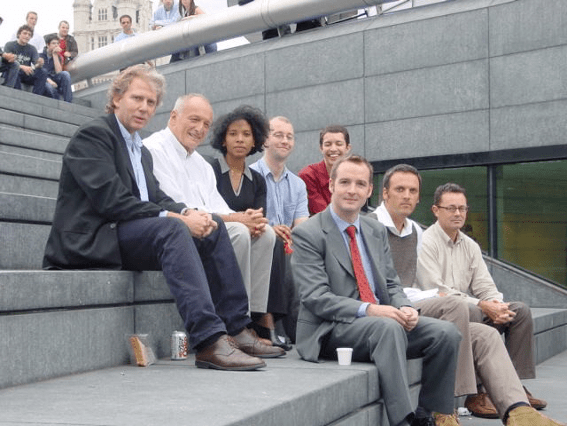
Architecture + Urbanism Unit at City Hall in 2002 or 2003. 
Top: Ricky Burdett, Richard Rogers, Gale Valentine, Jamie Dean, Eleanor Fawcett. 
Bottom: me, Mark Brearley, John Fannon.
Architecture + Urbanism Unit at City Hall in 2002 or 2003.
Top: Ricky Burdett, Richard Rogers, Gale Valentine, Jamie Dean, Eleanor Fawcett.
Bottom: me, Mark Brearley, John Fannon.
Photo: Tobias Goevert

Faced with the trundling beasts of public sector procurement, Richard often became frustrated (“Where are my million trees? Where are our 100 Public Spaces?”), exploding that he was wasting his time, or more amiably deciding he had had enough, and we all needed to go out for lunch or to the pub. He took no salary, but came in two days a week, chasing progress but also deploying all his skill and persistence at meetings with the Mayor and other bigwigs – to do deals on how architects would be selected and briefed, on what role design would play in the planning process, on how east London could fulfil its promise.

He stuck with it too, continuing to harry projects long after the rest of us had sounded the retreat, and showing patience and persistence with a bureaucracy that could be unfathomable even to insiders, where other architects would have packed up and retreated to the studio. Quite often, he would ask me to draft him a ‘tough’ (favourite term) note to the Mayor, demanding a project be stopped or an official sacked. As is the way of bureaucracies, these notes would then find their way back down to me from the Mayor’s Office, with a request for me to draft a response for the Mayor to sign off. I could keep these correspondence volleys going for weeks.

From 2004, I became increasingly involved in the London 2012 project, so saw less of Richard for a few years. A characteristic encounter was at the Venice Architecture Biennale, where he was awarded a Golden Lion in 2006. We greeted him in the street, and were scooped up and led to a lunch in a wood-panelled restaurant, down a side street I have never found since.

Flying back that evening, we were on the same plane as Richard and Ruthie, though they were in Business Class. I said hello as we got on, and expected they’d be long gone by the time we got out – that’s why you pay for Business Class after all. Instead, I found them waiting as we came through baggage reclaim, to see if we needed a lift anywhere. When we got into the Addison Lee, Richard told the driver “Chelsea, via Brixton.”  The driver muttered that Brixton wasn’t really on the way to Chelsea. “It is now,” replied Richard with a familiar mix of charm and steel which precluded much argument.

Richard continued to advise Ken, and then Boris Johnson for a couple of years, though took less of an active role as the A+UU morphed into the larger Design for London, headed by Peter Bishop. I think Richard saw his time at the GLA as something of a missed opportunity. We did not build his 100 public spaces or plant his million trees, and City East did not transform Docklands.

This is all true. But, as I said to him, those concepts had a long afterlife, and the cultural changes in how design and planning are done in London government were subtle but profound. The legacy of A+UU is still there in the current Mayor’s Good Growth by Design programme, in his panel of ‘Design Advocates’, in boroughs’ design review panels, in the Public Practice scheme that places newly qualified architects in public sector jobs, and in the inspiration he gave to a generation of planners.

After Richard left the GLA, I started working with him again, intermittently helping him to write articles or letters to the papers protesting against suburban sprawl, against toy town designs, and against the impact of austerity on the public realm – the ‘Continuity Urban Task Force’ as I used to call it. And it was very hard to pay for a meal at the River Café if he spotted us eating there. Richard enjoyed the good life – the River Café, the holidays in Mexico and Italy, opera and art – but he sought to share it as widely as possible, and was genuinely upset and angry when people were denied access to decent housing, food and healthcare.

In 2013, the Royal Academy hosted Richard Rogers: Inside Out, an exhibition that was as much about Richard’s political and civic beliefs as it was about his buildings. This caught the interest of Katy Follain, an editor at Canongate, and she asked Richard to write a book with the same blend of the personal, professional and political. I was trying to find something new to do after ten years on the Olympic treadmill, so was flattered when Richard and Ruthie asked me to help (especially given Canongate’s offer of some real writers).

The experience was hard going to begin with, when some early draft chapters came back covered in red scrawl. Richard’s dyslexia may have meant that he struggled to write long-form prose, but he knew what he wanted and knew what was good. We played around with structure, between timelines and topics, and ended up with a book that started narrow – focusing on a boy’s birth in Florence and his arrival in cold grey England in the 1930s – then widened its scope, using projects as jumping off points for discussions of urban development, public space, politics, inequality.

At first, Richard was reticent about the autobiographical elements; he wanted to look forward not back. But over time, he relaxed into the process, with long interviews where he reflected on his life, influences and ideas, recorded in his house in Chelsea, in his Hammersmith offices, on the terrace of the Tuscan farmhouse he and Ruthie rented every summer. The conversations were inspiring, a comfort to me as my own parents slid into ill-health, and often great fun. One taped interview, on the train back from Manchester after a party conference, starts structured and gradually dissolves into giggles as the free Virgin Rail Rosé takes effect.

As the chapters of A Place for All People were edited and finalised, Richard turned his attention to the design. I think Canongate were used to authors who would turn over a manuscript, fret a bit about the cover photo, then shut up until the proofs arrived. Richard had other ideas. He called up Andy Stevens, the graphic designer who had worked with him and his son Ab on the Inside Out exhibition design, and negotiations with Canongate began (Tracing paper? No. Different coloured papers for different sections? No. Spiral binding? No.) Once a format was agreed, pages would be laid out and reviewed again and again, by Richard, Ruthie and Ab, until Richard was happy with the flow and interplay of the textual and photographic narratives.

And this, I think, was at the heart of Richard’s genius. He was notoriously bad at drawing and struggled with writing, but he had brilliant ideas, acute judgement, and – an overused word but right in his case – a vision for what places and societies could be. He searched out the right partners and collaborators, and used all his powers of charm, persuasion, encouragement and menace to bring out the best in them and make the results of their work together as good as it could be.

Richard was so full of life, so endlessly curious, so excited about the possibility of a better world, and so tireless in trying to bring it about, that the world seems to have lost a little of its colour with his death. I’ll miss him enormously.

Ten years after

Making the case for London has been complicated during the pandemic. It risks conflict with the ‘metropolitan elite’ myths so fondly fostered by government (and so ably skewered by my former colleague Jack Brown on Monday’s Start the Week). And, like many civic leaders, Sadiq Khan has been trying to tell a story of devastating impact to a seemingly indifferent government, but also to entice workers and tourists back into a renascent capital by reminding them of all London has to offer.

The pandemic has indeed had a particularly brutal impact on London’s citizens and economy, but recent figures suggest that the tide may be beginning to turn. Tube and bus ridership is higher than any time since March 2020, though still up to 50 per cent below pre-pandemic levels. Google mobility data also shows a slight return to central London, though more for retail and recreation than for work (which accords with higher public transport use at weekends).

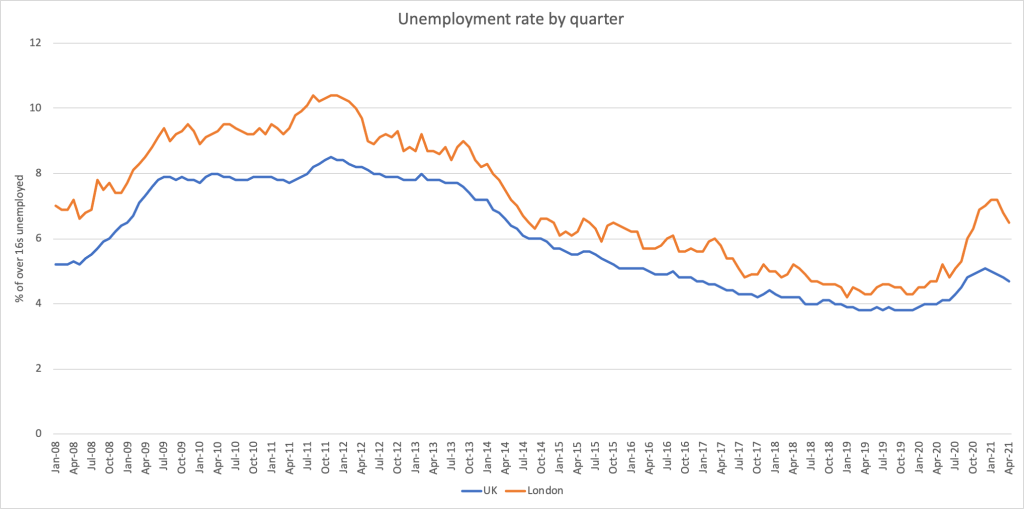
And, according to the latest ONS figures, London’s unemployment rate has also dropped, falling from 7.5 per cent in the three months to January, to 6.5 per cent in the three months to April. Unemployment is still higher than any other region’s, London boroughs still have some of the highest claimant counts and furlough rates in the country, and the economic impact of coronavirus has hit specific demographic groups hardest, but there are glimmers of hope.

So, it’s worth looking back to the last recession and recovery when London has hit hardest but recovered fastest. Could history repeat itself? As the chart below shows, London’s unemployment rate rose sharply ten years ago, and was more than two points higher than the UK’s in mid-2011, but then fell much more quickly, roughly tracking the national rate from 2014. A similar gap opened up last year, but has begun to narrow since January.

Unfortunately for London there were specific features of the 2011/12 recovery that favoured the capital. Quantitative easing, Government’s response to the financial crisis, diverted investment into booming equity and housing markets. And the London 2012 Olympic and Paralympic Games may have had a minimal direct impact on spending (most of the construction was complete by 2012, and Olympic Games years displace normal tourism expenditure), but were a powerful showcase for the UK internationally, and for London in particular.

Added to this, ten years ago, Boris Johnson (then Mayor of London) was keen to make the case for the capital, and able to persuade the Coalition Government that starving London of cash was no way to help the rest of the country, so projects such as Crossrail and the Olympic Park legacy development went ahead.

None of these factors are present today. Rather than being boosted by cheap money, financial services have been sidelined in Brexit negotiations in favour of more picturesque and politically salient (but far less productive) industries like fisheries. Big infrastructure projects, such as the redevelopment of Euston Station for HS2, are being squeezed, hopes of a swift return to international travel are receding, and the narrative of ‘levelling up’ looks pretty hostile to London and its nine million citizens.

At the G7 Summit last weekend, Boris Johnson warned against repeating the mistakes of the ten years ago, when (as he didn’t quite say) austerity extended and deepened the impact of the recession for many people and places. This is right, but the correct lesson is to extend support wherever it is needed to ‘level up’ the prosperity and life chances of citizens and communities, not to stall the UK’s economic engine in pursuit of headlines or electoral advantage.

Now is time for a TfL deal

Transport for London (TfL) is the seat of the Mayor of London’s most significant power and responsibility. Welded together in 2000 from an assortment of public corporations, government agencies and joint committees, TfL spends more than £10 billion every year and employs more than 25,000 people. While London’s Mayor is underpowered in many respects, their control of this integrated transport authority is envied by many other cities in the UK and beyond.

Right now, transport is also Sadiq Khan’s biggest headache and biggest priority. TfL’s revenues collapsed during the pandemic, as passengers stayed home, and the network has only been saved from bankruptcy by government support packages, repeatedly agreed at the last minute and accompanied by terms and conditions that have nibbled away at the Mayor’s authority.

The latest support package is due to expire on 18 May, so the next cliff-edge is approaching fast. TfL have been arguing for a longer-term settlement, and their scenario planning predicts suppressed income till 2024/25 in almost any conceivable future. With neither mayoral or general elections scheduled till 2024, and the pandemic in what we all hope is irreversible retreat, obstacles towards striking a longer-term deal should now be surmountable.

Doing the right deal will require radical thinking from the mayor and government alike. Pushed to find new sources of funding for infrastructure investment as well as operations, Sadiq Khan has argued that TfL should receive the £500 million that Londoners pay in vehicle excise duty (VED), which is currently ring-fenced to pay for road repairs outside the capital. Alternatively, there have been discussions of a charge for people driving into London from outside.

Neither proposal bears much scrutiny: the VED settlement is indeed unfair to London, but is a declining revenue source, and allocating more to London would mean allocating less outside the capital (or government making up the balance). A boundary charge would be another way of making those who live outside the capital pay towards the services that they use, but would likely have a negative effect on people living and working around the edge of London, and could generate more hostility to the capital at a time when it needs support and visitors.

A more equitable approach would be London-wide road user charging, to replace the increasingly complex hierarchy of charging zones and fees, as recommended in Centre for London’s 2019 report, Green Light. A pay-by-the-mile scheme, which reflected congestion, pollution and the availability of public transport alternatives, could raise substantial sums. For example, an average charge of 5p/mile for cars and light goods vehicles, and 50p/mile for HGVs, could raise as much as £1.5 billion every year – twice as much as is currently raised by the congestion charge.

Such a scheme would also make policy sense. It creates incentives for lower carbon transport options, rather than using public transport revenues to cross-subsidise highways maintenance, as is currently the case. The Green and Lib Dem candidates both argued the case for road user charging during the mayoral election campaign, but Sadiq Khan was more cautious, committing only to “ask TfL to consider other ways of raising income to make up for the loss of VED” if the Government refuses to pay up. And you can see why – the politics of restrictions on car use have become a hot button issue in this election. But now, at the beginning of a three-year term, is the time to make the case for bolder action.

But if transport funding is the elephant sat solidly in Sadiq Khan’s in-tray, it should have at least one foot planted in Government’s. Under a deal negotiated with Boris Johnson, when he was Mayor, central government grant support for TfL was phased out, with business rates and fares plugging the gap. All very well when London’s economy was booming, but even the most optimistic scenarios see business rate revenues and fares alike suppressed in the short- to medium-term.

London’s transport system could be allowed to decline, and this is one the scenarios explored by TfL, but this would be a hugely retrograde step, which would deal a substantial blow to the capital’s chances of recovery and of achieving zero carbon targets, and to tax revenues from London supporting public services across the country.

Government knows this, so they know how costly it could be to starve London’s transport system of resources. If the Mayor can show he has the vision to transform London’s public transport funding model, the Government should make available the funding to support him during an economic crisis that has hit London particularly hard.

[First published by Centre for London, 10 May 2021]

Book Review: Red Metropolis by Owen Hatherley

Owen Hatherley’s book springs from an honourable impulse – to rescue London from lazy stereotyping as an elitist hothouse of privilege, distant from the more authentic social and economic struggles of the northern cities. He aims to rekindle pride in London’s rich heritage as a radical trailblazer of social progress, and for the most part he succeeds.

Hatherley’s previous books have covered everything from the ersatz urbanism of Blair-era ‘regeneration’ projects, to the communist architecture of eastern Europe, to the commodified nostalgia of Cameron’s austerity years. Most recently he has focused his gaze on London (he is also editor of the fascinating Alternative Guide to the London Boroughs, published by Open House last year). A self-described communist, Hatherley began writing Red Metropolis in December 2019, and describes the book as an “attempt to write myself out of the feeling of numb horror” caused by Labour’s defeat in that month’s general election.

Red Metropolis is a work in three acts, focusing in particular on London’s perennial housing crisis and on public housing, one area of social welfare that has consistently had a local dimension. The first part traces the history of London County Council (LCC) from the messy politics and patchy administration of the late 19th Century to 1965, the second records the ascendancy of the New Left in the Greater London Council of the 1980s, the third looks (sorrowfully) at the record of the three mayors of London since 2000. 

The LCC took over from the unelected Metropolitan Board of Works in 1889, and for nearly twenty years, under a shifting “progressive” leadership comprising liberals and various left groups that would later merge into the Labour Party, was a pioneer of municipal socialism. Directly employed labourers built council housing in the Boundary and Millbank estates, which Hatherley praises for their “high-quality materials, urbanity and spaciousness”, and the LCC’s borough allies (including Battersea, where John Archer, the first Black mayor of a borough, was elected in 1913) built smaller-scale schemes such as the Latchmere Estate. 

The Progressive alliance faltered and the Conservatives dominated the LCC for the next 25 years, but by the 1920s, the Labour Party had begun to build a power base (particularly in the “Five Red Boroughs” – Battersea, Bermondsey, Deptford, Poplar and Woolwich). In 1922, Poplar councillors, led by George Lansbury withheld rates from the LCC in order to fund social programmes, arguing that it was “Better to Break the Law than to Break the Poor”. Thirty were briefly jailed in an episode which is a precursor to the 1980s rate-setting protests and the legal challenges to the GLC’s “Fares Fair” policy.

Poplarism stirred up persistent debates within the Labour Party between advocates of constitutional change and those seeking more direct action. Herbert Morrison, who dominated the London Labour Party from the 1920s, and led the LCC from 1934 to 1940, was a vociferous opponent of the latter approach. Morrison has been a controversial figure in left politics, at times criticised (like his grandson Peter Mandelson) for his focus on “electability”, but also for his model of ‘bureaucratic nationalisation’, with professional managers in control rather than workers themselves. 

Hatherley is more generous in his assessment. Even though 1950s schemes such as the Alton Estate are more to his taste architecturally than the “staid and stiff brick tenements” of the 1930s, he argues that Morrison prefigured the post-war settlement by offering free healthcare, building housing, schools and parks, and by establishing London’s own nationalised transport board, and also praises the sometimes-maligned Abercrombie plans that were developed in the heat of the War. Like Robert Moses in New York, Morrison remade his city, and made plenty of enemies along the way.

LCC puritanism – they built estates without pubs and Morrison wanted lidos closed at night to stop “people fucking in them” –was roundly rejected by the “New Left” leadership of the Greater London Council in the 1980s. Hatherley brings to life the carnivalesque egalitarianism of County Hall under Ken Livingstone, its corporate wood-panelled corridors thronging with punks, Rastafarians, gay rights activists, artists, radical feminists and communards. One of the ironies of the past 30 years is how the anti-racist and gay rights campaigns led by the GLC, which led to vitriolic tabloid attacks at the time, have become entirely mainstream, while its economic programmes, such as the “People’s Plans” for reindustrialisation of London’s docks, look positively quaint.

The importance attached by the New Left to community-based politics and participation above all things led, Hatherley argues, to its rejection of Morrisonian housebuilding programmes. Partly as a result of this and partly because the city was still depopulating through the early to mid-1980s, the Livingstone-era GLC built little housing and what it did build was often “twee and flimsy” – pockets of suburban semis that can still be seen dotted around inner London. The antipathy towards grand schemes led to renowned architects such as Neave Brown in Camden and Ted Hollamby in Lambeth being pushed out of their local authority jobs. (In another nice irony, the communist Hollamby went on to work at London Docklands Development Corporation, the epitome of Thatcherite laissez-faire urban policy).

Despite this, Hatherley sees the GLC’s record as a “social democratic Paris Commune” as a guiding light for the Corbynista left in 2015-19: “so successful was it that London’s governing body had to be abolished out of existence.” But he identifies a wider legacy too: the GLC’s focus on cultural policy was foundational to London’s 21st Century character, and its abolition in 1986 alongside the ‘Big Bang’ of financial services deregulation, helped define the politics and economics of London today. 

Hatherley is less impressed with – and I think less fair to – the three Mayors in City Hall since 2000. He gives Ken Livingstone and Sadiq Khan some credit, for transport projects and policies in particular, but excoriates all three for their failure to tackle London’s housing crisis. In particular he sees them as in thrall to a faustian pact with private sector developers to build affordable housing through Section 106 agreements, designed to mitigate the impacts of new development and to reflect the value created by the grant of planning permission. This approach, he argues, has fanned London’s red-hot property market, encouraged speculation by landlords, and widened inequality in the capital.

The narrative is powerful, but some details are smudged. Hatherley writes that Livingstone failed to define what “affordable housing” meant; but the 2004 London Plan gives broad definitions, and supplementary guidance published in 2005 goes into some detail in defining “social”, “intermediate” and “low cost market” housing, and specifying in what proportions these should be built. He says that the 2012 Olympics resulted in more social housing being lost than was built; but even the social housing provision in the Olympic Village (around 700 homes), exceeds the number that were lost at Clays Lane, the housing co-op that was demolished on the north of the site. And he damns Sadiq Khan’s efforts with faint praise, saying there has been “some encouragement” of councils to build housing; but Mayors need to agree affordable housing funding with national government and Khan has allocated £1 billion of the capital grants he has secured to councils to build 11,000 social rented homes.

But these and a few others are errors of detail. The central accusation stands, against the local government leaders who did deals with private developers as well as against the three Mayors themselves. In recent years the “cross subsidy model” of affordable housing provision, which has also been adopted by councils themselves as well as housing associations, has come in for increasing criticism: it requires rising prices to work, so fuels the pressures that it seeks to address, and creates an industry of opaque and gameable viability assessments. 

What else could the Mayors have done? Housing was explicitly excluded from their functions until 2007 (the GLA was designed to have minimal overlap with borough powers), and control over capital grants for affordable housing was only handed over in 2011. Restrictions on councils’ ability to borrow against their rent rolls in order to build have also only been relaxed in recent years. Hatherley reports Alex Salmond suggesting that Ken Livingstone should have demanded the right to charge more Council Tax on the wealthy to build more social housing, but the right to reform Council Tax was in the Scottish Parliament’s gift from the outset. It was never on the table for London. Two reports from the London Finance Commission, under Boris Johnson and Sadiq Khan respectively, have sought more powers over property taxes for London but been studiously ignored.

The approach of the mayoral administrations could also do with some interregnal context. The abolition of the GLC (and other metropolitan counties) came near the high point of conflict between central and local government. As Thatcher was replaced by Major, more centrist borough leaders such as Haringey’s Toby Harris built consensus with businesses and across party lines – until 1995, there were separate membership organisations for Conservative and Labour boroughs. The 2000 version of Ken Livingstone was as much part of this détente as John Major and Tony Blair were. Even bust-ups such as the London Underground public private partnership were about the nature of private sector involvement in the running of the Tube, not the principle of it.

Red Metropolis is an informative, lively and punchy read, at once optimistic about London’s possibilities and angry at its realities. Hatherley brings to it his perceptive and humane architectural sense (equally damning of both the “chilly Piranesian grandeur” of County Hall and the “grub-like” City Hall), an ear for a quote, and an eye for the curiosities and ironies of London’s evolution. The captions under artless urban photographs (by the author and Daniel Trilling) provide a wry running commentary on the text, and on the persistent gaps between rhetoric and reality.

Hatherley closes by observing that, unlike the 1980s when the left captured Labour municipalities across the country but remained shut out from the commanding heights of the party, the Corbyn years saw the party’s leadership shift sharply to the left, without this being reflected in councils, which generally continued to be run by pragmatic/compromised (delete to taste) centrists. Even those, such as Haringey and Newham, that saw leadership changes during the “Momentum years” have failed to implement the Poplarist programmes that Hatherley would like to see. 

The final pages argue, uncontroversially, for more devolution, for decentralisation of government and for more openness to international examples, as well as for an end to growth and a more confrontational attitude towards central government. He believes that London government can acquire powers by staking claims – “Better Break the Law than Break the Poor” still. This is a high-risk strategy, though it did recently work when Mayor Boris Johnson decided to sack the Metropolitan Police Commissioner without the power to do so or reference to the Labour Home Secretary.

Red Metropolis is a salutary reminder of the sense of possibility that can and should infuse London politics, despite the conflicts and compromises that governing a city of nine million people involve. If London is in Henry James’ words “only magnificent”, this magnificence is partly the result of the striving and the strife so well described in this book.

[First published in OnLondon, 8 February 2021]