I can’t get no…

Record levels of dissatisfaction with the NHS‘ seems to have become an annual headline fixture, dusted off each year around this time, when the King’s Fund and Nuffield Trust publish the health findings from British Social Attitudes.

This year was no exception, with just 21 per cent of people expressing themselves ‘satisfied’. But what exactly are people dissatisfied about, and what do they want done about it? Given the importance of debates about the NHS, it is worth diving into the figures to understand a bit more.

1. Wait in vain

Dissatisfaction is rife across services – from dentistry, to GPs, to A&E, to hospital care, to social services. But it is the time spent waiting – in A&E or for GP or hospital appointments – that rankles most. Only 25 per cent are unhappy with the quality of care or the range of treatments available; around 50 per cent are satisfied.
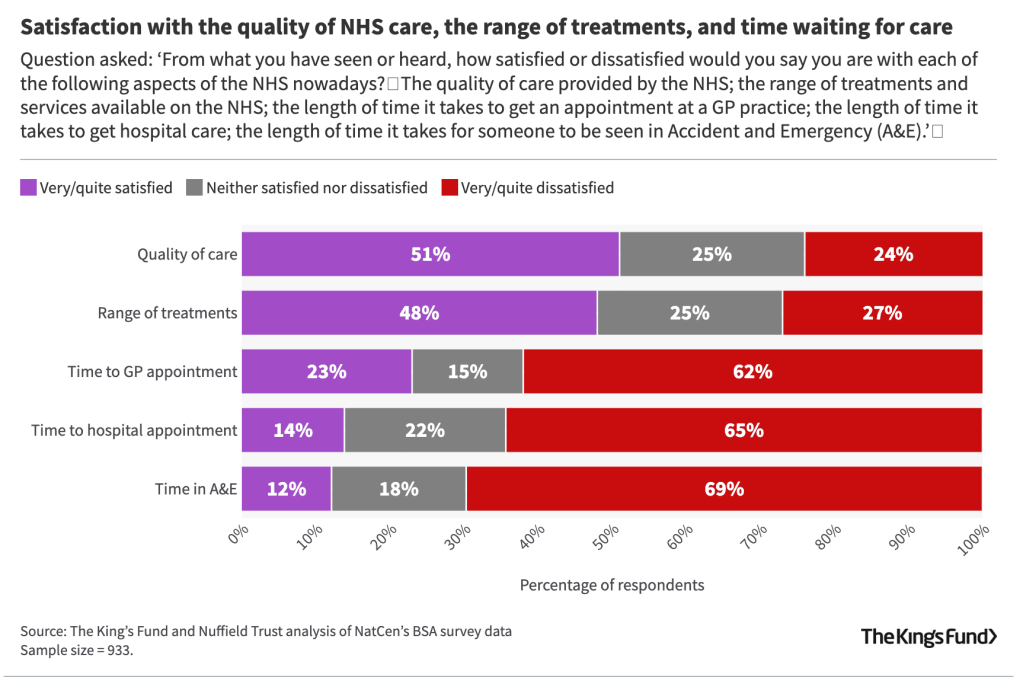
The problem with NHS care is the quantity provided not the quality – as is also reflected in 75 per cent saying the NHS is understaffed. Produtivity and enhanced outcomes are important, but unless these lead to more responsive services, they may do little to shift public perceptions.

2. No tax, only spend

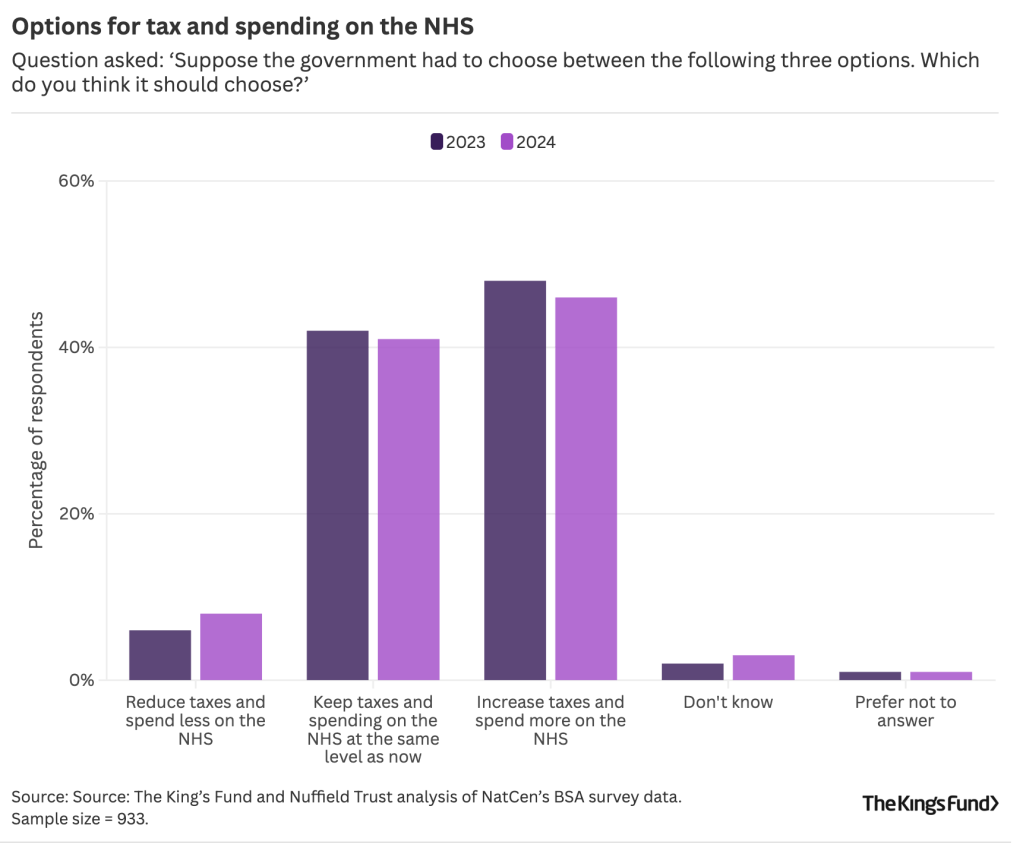
Nearly 70 per cent of people think that the government should spend more on the NHS, but only 46 per cent think taxes should go up to do this, a very slight fall from 2023. These views are not necessarily inconsistent with each other, or with the government’s policy, which has been to spend more on the NHS without raising personal taxes.
But I wish that British Social Attitudes would ask a follow up question, both on this specific issue and on their more general finding that the public wants to pay more tax for better public services, and has done for almost a decade. ‘Which taxes do people wish to see rise?’, they should ask or even ‘Do you think you should pay more tax?’ I suspect that there is far more enthusiasm for tax rises in the abstract than there is for the specific, let alone the personal. I may be wrong, but it would be useful to know.

3. Shaky foundations?

British Social Attitudes also asks about whether people sign up to three ‘founding principles’ of the NHS – universality, freedom at point of use, and funding through taxes. Bea Taylor from Nuffield Trust is quoted as saying, “support for the core principles of the NHS – free at the point of use, available to all and funded by taxation – endures despite the collapse in satisfaction.”

Well, up to a point. Support for the NHS being free of charge at the point of use has been sustained. But there are signs of change elsewhere. The proportion of people saying the NHS should be definitely available to everyone has fallen from 67 to 56 per cent since 2021, and the saying taxpayer funding definitely applies has fallen from 55 to 42 per cent. These are pretty substantial shifts.

The biggest gains have been both those opposing the propositions, and those feeling that the propositions ‘probably’ apply. It seems support for these core propositions, while still broadly intact, is less fervent than it once was – a change that could be attributed to anti-immigrant feeling (for the ‘universal’ principle), to a rise in Reform-driven debate about ‘insurance-based models’ (which the party is rather coy about), or simply to people thinking that something has to give.

As the Government prepares to launch its Ten Year Plan for the NHS, it will be interesting to see what that might be.

(I can’t get no) NHS satisfaction

Ask British people what they are proud of, and the National Health Service (NHS) will come near the top of the list. But, as the NHS celebrates its 75th birthday, it does not seem to be in the best of health.

The National Centre for Social Research (NatCen)’s British Social Attitudes survey, supported by the King’s Fund and Nuffield Trust, has been asking about public satisfaction with the NHS for almost 40 years. Our 2022 survey, conducted last autumn, found the lowest levels of satisfaction since 1983. Only 29 per cent of people were ‘very’ or ‘quite’ satisfied with the NHS, and 51 per cent were ‘very’ or ‘quite’ dissatisfied.

More than two thirds of those expressing dissatisfaction cited the time taken to get a GP or hospital appointment as one of their main concerns. This reflects the worsening waiting list situation: nearly 2.9 million people had been on hospital waiting lists for longer than the Government’s 18-week target when the survey was undertaken in September 2022, four times as many as in September 2019 and nearly a million more than in September 2021. Other widespread reasons for dissatisfaction were the NHS not having enough staff and government not spending enough money on the NHS (mentioned by 55 and 50 per cent of people respectively).

Satisfaction levels have fallen across all services – general practice, inpatient and outpatient services, NHS dentists, and accident and emergency – but in most cases satisfaction was higher for those who had recent use of or contact with the service in question. One exception was social care (generally provided by local authorities rather than the NHS), where those who had used the service were far more likely to express dissatisfaction.

Faced with these deteriorations in performance and public perception, with the challenge of an ageing population, and with the opportunities presented by rapid medical advances, it is no surprise that the NHS is at the forefront of political debate. Cutting NHS waiting lists is one of the Prime Minister’s five priorities, and the Labour leader has pledged to “fix [the NHS’s] fundamentals, renew its purpose and make it fit for the future.”

But what public appetite is there for fundamental reform? Despite declining satisfaction, support for the founding principles of the NHS remains strong. 75 per cent of people said that the principle of the NHS being free at the point of use should still apply, while 69 per cent supported the NHS being available to everyone, and 51 per cent backed the NHS being funded primarily through taxes. There was majority support for each of these principles from supporters of the three main national parties, with some convergence: Labour supporters used to be much more supportive of funding through taxes, but their support for this principle fell from 68 to 55 per cent between 2021 and 2022, while Conservative support rose from 48 to 52 per cent.

There was widespread acknowledgement that the NHS has a funding problem, with 85 per cent of people describing this as ‘major’ or ‘severe’, but there was little agreement on how this should be tackled. When asked what policies would be acceptable if the NHS needed more money, the most popular response (chosen by 28 per cent) was to say that the NHS needed to live within its means, up from 15 per cent five years earlier.

Support for more taxes remains substantial but not overwhelming: 23 per cent and 20 per cent respectively support new ring-fenced taxes and an increase in general taxes; in both cases support has dropped since 2017. These responses may reflect the Government’s announcement of a health and social care levy (now shelved) in autumn 2021, and a feeling that funding had been ‘sorted’, but they do not show huge backing for higher taxes.

But nor is there much support for charging patients for GP visits, as suggested by former health secretary Sajid Javid and as implemented in countries such as France and Ireland. Just 13 per cent of respondents endorsed this idea, with even fewer backing accommodation charges for hospital stays, or rethinking current exemptions such as free prescriptions for some patients.

Public opinions on the NHS are contradictory. People love and are proud of it, but are deeply frustrated with how it is working at the moment. People want to see more staff and shorter waiting times, but they do not want to pay more taxes or to see new charges introduced. And they attach a higher priority to taking on more staff and getting waiting times down, than they do to helping people to stay healthy, which is at the heart of the Government’s long-term plan for the NHS.

But the challenges facing the NHS are too urgent to allow politicians the luxury of having their cake and eating it, of avoiding or postponing difficult debates and decisions. They need to talk to voters about how money can be spent most effectively, and about which funding systems, reforms, investments, and initiatives will promote national health and wellbeing, at a time of rapid technological and demographic change.

First published by NatCen