Fade to Grey (Belt)

Last week, Angela Rayner gave Marks and Spencer permission to demolish and rebuild their flagship Marble Arch store, in line with plans first submitted to Westminster City Council in February 2021. In between those dates, the proposal was considered by Westminster and by Sadiq Khan (both of whom approved it), by a public enquiry and by Michel Gove (who overruled them all and turned it down), by the High Court (which overturned Gove’s decision) and by Rayner (who gave the go-ahead). Whatever view you take of the proposals, these layers of decision-taking and months of delay cannot be right – the reconstruction phase of the Notre Dame project took less time.

Against this backdrop, you can see why the Deputy Prime Minister has announced major reforms of planning this week – a consultation on planning decision processes on Monday and now a new National Planning Policy Framework. The consultation paper proposes a national “scheme of delegation” to ensure that more planning decisions are taken by planning officers, rather than by planning committees. The paper also proposes smaller strategic committees to agree documents such as opportunity area planning frameworks, and seeks to beef up training for planning committee members.

The proposals have been widely welcomed as a helpful act of streamlining, which reduces the risk of capricious committee decisions to reject proposals even when they are in line with local planning policy. Such refusals may lead to amendment and a new application, or to appeals to the planning inspectorate, but cause delay and incur cost either way.

For some commentators, this approach is also a helpful first step towards a “zoning” process that shifts the political focus from considering individual applications to agreeing policies and design codes. “Shouldn’t we be aiming for a system which makes [planning committees] redundant entirely?” architect Russell Curtis asked. If proposals comply with policies and codes, they can go ahead with minimal paperwork, though agreeing local plans and policies would become more complex and contested were they to give an automatic green light to compliant proposals.

As ever, London is a bit different. The capital already leads the way in delegating planning decisions and in processing applications fast. The most recent government stats show that in the year to June 2024, 97 per cent of decisions were delegated to officers, more than in any other region. Some boroughs delegated nearly all decisions.

London boroughs work fast too, deciding an average of 93 per cent of major applications within government-mandated deadlines (or other deadlines agreed with applicants) in the two years to June 2024, compared to 90 per cent or fewer in other regions. The capital also has lower rates of decisions being overturned on appeal than most other regions. The system works efficiently.

But it is not enabling the homes London needs to be built. London planning authorities turned down more applications than in other regions: 20 per cent across the capital compared to 15 per cent across England, and as many as a third in some outer London boroughs. Total application numbers are for around 60,000 homes per year, and their number has fallen by a third since 2016, significantly faster than in other regions.

This fall off in planning activity and low rate of approval feed off each other – if it is difficult to get planning permission in London, some developers stop trying or look elsewhere. London’s problems look like problems of policy as well as process.

That is where the new National Planning Policy Framework (NPPF) comes in. It confirms binding targets for local authorities across England. London’s new target is around 88,000 homes per year. That’s higher than the 80,000 target proposed after the general election, but lower than the 99,000 target that the Conservative government set in 2020 (though in 2022 the Conservatives also made targets “advisory”). It is, nonetheless, a huge jump from the current London Plan target of 52,000 homes per year, let alone the average 38,000 net additional homes built over the past five years.

The big policy change in the NPPF is its very careful relaxation of Green Belt rules. The Framework says that if a council is unable to meet its target through using previously developed land and densification, and if it is unable to collaborate with a neighbour to plug the gap, then it can consider using Green Belt land.

It must first look at previously developed land in the Green Belt, then at “grey belt” land which does not strongly contribute to the Green Belt’s core purposes – checking unrestricted sprawl, preventing urban areas merging into each other and preserving the setting of historic towns.

Other rules, relating to affordable housing, new and enhanced green space, design quality and infrastructure provision, still have to be followed, and land that is protected for special scientific interest or outstanding natural beauty, as a “local green space” or as part of a national park is excluded.

Even with all those caveats, the new policy makes London’s edges ripe for review. The definition has helpfully moved on from an aesthetic focus on “poor quality” Green Belt (which may be in entirely the wrong place), to considering whether Green Belt land actually does what it is meant to do.

On the face of it, a lot of the inner Green Belt within Greater London could meet the criteria for consideration: there’s still plenty left to separate London and surrounding towns, and a managed release is not unconstrained sprawl. But governance and geography are tricky: some of the boroughs facing the biggest shortfall don’t have much Green Belt land, and even when they do the land may not meet the government’s tests.

That could be a recipe for mess and disagreement but could also be the opportunity for a metropolitan solution. The Mayor could work with boroughs to marginally redefine London’s edges, to share the load of housebuilding, and to plan for urban extensions that make the most of existing and new infrastructure.

Could that happen? Khan opposed Green Belt reviews in the past (when a Conservative government would have vetoed them anyway), but times have changed. Khan’s 2024 manifesto was silent on the Green Belt, and a London-wide review would be a good way of demonstrating the value of a Labour Mayor to a Labour government, and vice versa.

But Green Belt extensions will not solve all of London’s housing delivery problems. London needs more planning permissions and more building, including of the around 300,000 homes that already have permission. But a viability crisis is holding back both. Former Southwark leader Peter John has argued that affordable housing requirements without sufficient grant subsidy are stifling development in some cases, and pushing up prices of market homes to enable cross-subsidy in others: “a vicious circle of non-affordability is made worse by demanding ever higher levels of affordable housing without some other grant subsidy being provided.”

Other commentators, such as Beacon Partnership’s Steve Beard, have argued that it is the sheer weight of design, carbon offset and infrastructure obligations imposed in London that is making schemes unviable. Centre for Cities’ Ant Breach argues that the London Plan duplicates local plans and suppresses development, pointing to the London Plan review commissioned by the last government, which found “persuasive evidence that the combined effect of the multiplicity of policies in the London Plan now works to frustrate rather than facilitate the delivery of new homes, not least in creating very real challenges to the viability of schemes”.

Given London’s slowing rate of housing delivery, and its stock of permitted but stalled developments, these arguments should be taken seriously. Are the policies that worked in a boom, when rising prices washed away the costs of planning obligations, also the right ones for when house prices are stagnant and delivery is stuck? After the financial crisis, quantitative easing, a cheap pound and open borders helped fuel a property boom, but these engines have fallen silent.

At the same time, affordable housing provision has become increasingly dependent on market housing. Around 50 per cent of affordable housing in London is now delivered as a planning obligation, so when private housebuilding slows, so does affordable housebuilding. Recent Greater London Authority (GLA) analysis shows the impact of this. In 2023, 38 per cent of the homes granted planning permission in London were affordable – a total of 11,725 units. In 2015, only 26 per cent were affordable, but this totalled a higher 14,000 units.

If a system based on cross-subsidy has stalled both affordable and market provision, either policy or funding need to shift. London has an urgent need for more affordable housing, so lowering targets too far seems perverse. But 35 per cent of something is still better than 50 per cent of nothing.

Alternatively, higher grant levels would enable boroughs, housing associations and private developers to build more affordable homes. A recent Centre for Cities report suggests that the government’s £500 million Affordable Homes Programme (administered by the GLA within London) would need to triple in size to get public housebuilding rates back up to their mid-20th Century levels. A tall order, but maybe one that could be justified as an investment to save on long-term housing benefit and temporary accommodation costs.

Finally, central government should recognise that it too needs to be part of the solution. Successive governments’ accumulation of policy prescriptions (including new duties such as “biodiversity net gain”) represent a tax on development, adding to those imposed by local and regional government.

Everything is introduced for good reason, but maybe the time has come for an open discussion of where other policies and stakeholder interests are strangling the government’s declared growth imperative. And, to end where we started, if an application has been considered by London’s elected local authorities and by its Mayor, does Whitehall really need to have a go too?

First published by OnLondon.
Housing in London – every cloud has a cloudy lining

There’s a German word, “dunkelflaute”, which translates as “dark doldrums” – periods when there is no wind or sun to generate electricity (making you reliant on coal and Russian gas, if you happen to have shut down all your nuclear power plants). London’s housing market seems to be facing dark doldrums at the moment: prices are stuck in a rut, residential planning permissions are at half the level they were five years ago, and transaction volumes and new building have slowed to a crawl.

Property prices in London shot up after the financial crisis, but have risen far less dramatically since 2016, as a result, property analyst Neal Hudson suggests, of tougher regulation of residential mortgages and more taxation of property investment. The market boomed briefly from 2020 to 2022, but has fallen back since then. According to the Nationwide Building Society’s index, average prices were ten per cent higher in 2024 than eight years earlier, but that is a 15 per cent fall once inflation is taken into account.

After decades of soaring prices, surely cheaper housing is good news for somebody? The Nationwide data show that the average price paid by a first-time buyer in London is now less than nine times median earnings, the lowest ratio for ten years. Rental affordability also seems to be improving, with government figures showing average rents taking up around 40 per cent of median income of renting households in 2022/23, compared to 57 per cent in 2016/17.

But neither of these figures tells the whole story. To paraphrase Withnail, living in London is becoming cheaper for those who can afford it, but remains prohibitively expensive to those who can’t.

Cheaper houses are only cheaper if you don’t need to borrow money. For first-time buyers, rising interest rates have gobbled up any savings from price falls: in 2020-22 Nationwide calculated that mortgage payments accounted for around 50 per cent of first-time buyers’ take-home pay.

Rising interest rates pushed that up to 66 per cent at the end of last year, though it has fallen back to around 60 per cent since then (a similar level to 2016). And, even with lower prices, London buyers still need to find deposits of £110,000 – a gargantuan sum for anyone without blockbuster bonuses, access to the Bank of Mum and Dad, or at least somewhere to live rent-free (and possibly holiday and fun-free too) while they scrimp and save.

As Paul Johnson of the Institute for Fiscal Studies recently observed, this means that anyone without wealthy parents or somewhere to stay rent-free will find it much more difficult to move into their own property in London and to enjoy everything the capital offers.

This might not matter if the Levelling Up dream of excellent jobs everywhere had been realised. But it hasn’t, and London should be able to offer opportunities for all, not just those lucky enough to have been born within the M25.

Apparent improvements in rental affordability also obscure a less positive reality. Government figures show that between 2016/17 and 2022/23, rents fell from 57 to 40 per cent of household income for people renting. But for someone earning median wages in London, rent fell from 59 per cent to 53 per cent of gross earnings over the same period – a significant drop, but much smaller than that implied by the official figures.

Why have renters’ household incomes increased faster than median wages? It could be a result of an increasing number of renting households having more than one earner, or maybe lower earners being squeezed out of the private rental market altogether.

Every cloud has a cloudy lining. If stagnant house prices are not doing much for renters or first-time buyers, they are doing even less for housebuilding. In 2023/24, around 32,000 dwellings were added to London’s housing stock, the lowest level since 2014/15, when the city was still emerging from the financial crisis. These include conversions and changes of use (including the dwindling number of office-to-residential conversions). And only 33,000 new residential units were given planning permission in 2023/24 – way below the peak of 80,000 plus each year between 2014/15 and 2018/19.

When prices fall, housebuilding slows, almost as a thermostatic reaction. Developers base their business plans on a range of projections, including changes in house prices and build costs. If prices go up faster than costs, building goes ahead. But in a stagnant market with high construction inflation, plans are paused or slow-pedalled.

After the financial crisis, housing associations were able to take up some of the slack, completing an average 7,000 homes each year in the five years from 2008/09. But their output in the past five years has been half that, as the need to fund safety improvements and squeezed grant levels have reduced capacity. Local authorities have started building more, completing 3,000 units in the past two years alone, but there is still a gap.

The dark doldrums cannot last forever. Interest rates are forecast to fall next year (if not as fast as previously predicted), which may help more first-time buyers to take advantage of lower prices. In addition, while provisional figures for housing starts in 2023/24 are the lowest since 2020/21, construction economist Noble Francis has observed that brick deliveries, a good leading indicator for housebuilding activity, were 21 per cent higher in October than a year earlier.

There is also Deputy Prime Minister Angela Rayner’s shake-up of planning, heavily trailed in interviews and newspaper pieces last weekend. Will this be enough to treble London’s house building rate in order to achieve its 80,000 homes a year target? What other changes might be needed? Watch this space.

First published by OnLondon.

Density – free riders and secret sauce

Russell Curtis, architect, On London contributor and one-man spatial think tank, published a new paper, Towards a Suburban Renaissance, on his blog last week. Reflecting on their generally low and static densities, Curtis argues that London’s suburbs could accommodate many more homes near stations, by gentle densification of existing residential streets – an upwards extension here, a replacement of a house with a low-rise block of flats there, a new build in a back garden there.

Without even encroaching on protected industrial land or open spaces, Curtis calculates that London could accommodate around 900,000 more homes in this way. Current completions are much lower than the current London Plan target of 52,000 homes a year, and both government ministers and London think tanks say that target should be set higher still. Realising even a small part of the potential that Curtis identifies would be a big boon.

You might think that in a city with a rampant housing crisis and record levels of homelessness, such a modest proposal would be enthusiastically debated by mayoral candidates in an election year. Or…you might not actually, because if you are the sort of person who reads On London, you are probably aware just how politically tricky suburban densification is in a contest where every Outer London vote counts.

Politics confounds any attempt to boost housing supply in the capital through suburban densification. The result is that any vacant site is developed to the max and everything else remains untouched, leading to a lumpy cityscape and eerie juxtapositions such as the transition from towers around East Croydon Station to the two-storey terraces of surrounding streets. Everybody can see the dysfunctional results of this approach, but the politics of changing tack are too tough: as Curtis has written for On London before, both the Mayor of London and Croydon Council have backed down from suburban density-friendly policies.

There are ways to open up the conversation, at least. The “Street Votes” proposal, developed by Policy Exchange and championed by the Nicholas Boys Smith, chair of government’s Office for Place, proposes empowering local communities to redevelop their own neighbourhoods, sharing in economic benefits and ensuring that redevelopment is seen locally as an enhancement rather than a blow to quality of place. A government consultation on making this idea a reality has recently closed, and Street Votes could make a difference where communities can see the potential benefits.

But I think there’s a bigger strategic issue too, about how we talk about density and amenity. I was thinking about this recently over lunch in a small village on the edge of London. Our hosts, heavily involved in the parish council, were discussing how they hoped to use tree preservation orders to scotch any danger of new homes being built on adjacent land.

Their other big campaign was to find a way of re-opening the local pub, which was shutting down owing to dwindling trade. They were prospective clients of my partner so I bit my lip, but in my mind’s eye I was shaking them by the lapels and shouting, “Don’t you see the connection? No more people means no more pub!” To which you might add, no more primary school, no more bus service, no more local shop…

When I look on borough planning consultation portals, I can always find an option to comment on loss of amenity from a development. It’s much harder to comment on loss of amenity from not developing. Across London’s and other cities’ suburban high streets, shops, restaurants and bars are struggling to survive in the face of changing consumer habits and constrained spending.

One answer to this is to shrug, feel a twinge of sadness and let the market find more economically viable uses for the space. Another is to try to make sure these services have enough customers to keep going. You don’t have to go to the pub every evening or ride the bus every day yourself, but you shouldn’t prevent the people who might do so from moving into the area and then complain when the landlord shuts up shop or Transport for London cuts service frequencies.

In urban areas we are all free riders, locked into relationships of mutual reliance on other citizens, and their use of public and private services. If we seal off our neighbourhoods from newcomers, we don’t preserve their character so much as undermine it. We need more homes in London to address the housing crisis for sure, but also to sustain the urban services, quality and vitality that bring people here in the first place. Density is the secret sauce of our cities. We need to sing its praises.

First published by OnLondon.

Two directions home

The roots of the UK’s housing crisis run deep. Two reports published last week agree on this much, though the conclusions they draw from looking back over the past 70 years of supply, demand, policy and price changes are quite different.

Last week Samuel Watling and Ant Breach of Centre for Cities published their report on “the UK’s four million missing homes”. It analyses historic housebuilding stats and finds that the alleged golden age of post-war mass housebuilding was not so golden after all. Housebuilding rates actually fell from 1947 onwards compared with the pre-war period, and the UK underperformed many other European countries in terms of building enough homes to keep up with population growth.

From this, Watling and Breach argue that the fundamental blight on UK housebuilding has been the 1947 Town and Country Planning Act, which established the role of local authorities in setting local plans, identifying land for development and granting planning permissions, rather than the decline in council housebuilding after 1980. They argue that under the auspices of the Act and its successors land supply has been constrained by measures such as Green Belt protection. Furthermore councils’ discretion in granting planning permissions means that even what is proposed in plans may not be permitted in practice.

Consequently, the report proposes planning reform as the key to unlocking faster and more affordable housebuilding, particularly in London and south east England where supply has fallen furthest behind demand and prices and rents have risen most. The authors’ favoured solution is a zoning system, which would establish frameworks for development in local plans (including in Green Belt locations with good public transport). They would then allow developers to build in line with those frameworks without needing additional permissions. The government had plans to move towards a zoning system, but those were dropped in 2021. Centre for Cities urges it not to water down the more modest reforms now included in the Levelling Up and Regeneration Bill.

The other report, entitled Reboot, was published by the Joseph Rowntree Foundation (JRF) the day after the Centre for Cities report came out. Written by a veritable housing supergroup comprising Rose Grayston and Toby Lloyd, formerly of Shelter and the No Place Left Behind Commission, and analyst Neal Hudson, whose insights plot an assured path through the marshes of UK housing market data, it too looks back to the 20th Century to understand the housing crisis of the 21st.

However, rather than foregrounding planning, Reboot focuses primarily on how policy has shaped markets and what this means as we enter our fifth downturn in 50 years. The authors observe that every downturn prompts a response that may deal with the immediate crisis but entrenches chronic problems more deeply. For example, Help-to-Buy equity loans helped revive housebuilding after 2013, but also added inflationary pressure.

The net effect, though the report does not use the term, is moral hazard writ large. Homeowners get all the advantages of house price growth in the boom years, and when the going gets tough governments take action to bail them out and prop prices up, so they soar out of reach of first-time buyers without rich families or lucky lottery numbers.

We are now nearing the end of what Reboot’s authors call the “decadent era” of growth since the mid 2000s, with London at the forefront both of house price deceleration and of slowing construction. The report considers what might happen next – from a rapid return to growth to a fully-fledged crash – and identifies four potential problems: housebuilding drying up as builders wait for the market to revive; an investors’ market where interest rates make life difficult for first-time-buyers but offer rich pickings for buy-to-rent; serious impacts on vulnerable groups, particularly heavily-leveraged recent London buyers; and the market freezing up as sellers, accustomed to rising prices, delay selling or downsizing.

Unlike the Centre for Cities report, which focuses on one big recommendation, Reboot offers more than a dozen, looking at short-term action to protect the vulnerable, medium-term measures to sustain supply, and longer-term action to remodel the housing market. The planning system is only incidentally discussed. Instead the authors look at incentives to implement permissions, flexible funding for affordable housing, better support for low-income homeowners and renters, heavier taxes on landlord investment, and even restrictions on who can buy homes in some “housing pressure zones”.

Reboot sees the value of home ownership, but also prompts deeper questions about what sort of housing market we want – or need. The gains from runaway house price growth are curiously intangible, only realised when downsizing or passing wealth between generations, while the damages done are all too visible. As the authors write, “We must recognise that a housing system beset by regular booms and busts does not meet the needs of the national economy or those seeking safe, secure, affordable housing. A more sustainable, equitable and economically efficient housing system must obviously be one in which house prices do not continue to rise much faster than earnings.”

There are things to argue with in both the Centre for Cities and the JRF reports. Deregulating planning on its own, without substantial investment, is unlikely to build the affordable housing London needs. Conversely, a nationalised property tax, as recommended in Reboot, would impose an unfairly heavy tax burden on Londoners (even if partially offset by the abolition of stamp duty).

However, both reports seriously address the housing crisis as a product of more than half a century of well-intentioned but sometimes self-defeating interventions and policies, rather than as some sudden phenomenon. They are contrasting in analysis, but complementary in conclusion. London needs both planning that will enable growth (including in the Green Belt), and markets that are less stacked against new entrants and poor people in general. Our politicians should not let this crisis go to waste. These two reports offer them a credible programme for action.

Originally published by OnLondon.

More house, in the middle of our street

Michael Gove was on fizzy form yesterday morning as he sought to sell his package of housing and planning reforms over the airwaves. “Beauty! Infrastructure! Democracy! Environment! Neighbourhoods!” he proclaimed, arguing that local empowerment would lead to better homes being built and fewer new developments being opposed. Coming from a minister once described by David Cameron as “Maoist” this sounded positively Leninist – All Power To The Neighbourhoods!

“Street votes” are at the heart of Gove’s announcements, though there is almost no detail about them in the draft Levelling Up and Regeneration Bill. They respond to a question often aimed at those arguing for the regeneration of social housing estates – why are you picking on social tenants? Why don’t people living in privately-owned neighbourhoods have to densify? To which the obvious retort is, why would they when they would see the pain of new development, but none of the gain?

The idea of street votes, developed by Samuel Hughes and Ben Southwood at Policy Exchange but with broad-based political support, is to put in place a framework that will encourage such densification. Local residents would be able to prepare plans and design codes for making their streets more dense – through infill, through upwards extension, through demolition and rebuilding – resulting in more homes to meet need, profits for local property owners, and tax revenues for local authorities. Even if you excluded older and listed buildings, the Policy Exchange report estimated 800,000 homes in London would be eligible.

The proposal is not a cure-all for the housing crisis in the capital or anywhere else, but it could be a part of the solution (I was one of the many endorsers of the original report). Street votes align incentives locally and could stop London’s new development being so “lumpy” – miles of untouched terraced housing interrupted by occasional eruptions of towers.

Ominously, some media reported (or were spun?) the policy as an opportunity to veto new development, and the biggest risk is that neighbours are unable to agree how or even if they want their street to change. In that case, resident and council time has been wasted, but people would still have the option to seek to extend or subdivide their own homes. Street votes won’t work everywhere, but that’s no reason to reject an idea that could work somewhere.

The other major measure that has been reported is a standardised infrastructure levy to fund affordable housing, and the roads, schools and surgeries which new homes need but are often a bone of contention for their opponents. A clear tariff for new development would create more transparency for developers, councils and communities.

Background papers to the Queen’s Speech indicate that this will be set locally, responding to concern that a national tariff would stifle development in some places while not meeting the costs of new infrastructure in others. Nonetheless, in the age of “levelling up”, there is an understandable worry that a levy would be used to siphon money away from London, hobbling its ability to build the 100,000 homes a year that government still insists are needed, even though the draft Bill underlines that the levy is designed to meet local costs.

But the bigger problem with the new draft Bill is what it doesn’t do. Stripped out since the Planning White Paper is any idea of a national system of zoning, by which councils and communities would identify the sites for new development and agree the design codes that would manage this. Like standardised tariffs, these were intended put in place up-front public consultation rather than scheme-by-scheme negotiation, which favours larger housebuilders with deep pockets and serried ranks of consultants to support them.

Gone too (or maybe not) are the targets that would hold government’s and councils’ feet to the fire. “I don’t want us to be tied to a Procrustean bed,” Gove mused cryptically on Radio 4, referring to the Greek myth about an innkeeper who would stretch his guests to fit his bed, or lop bits off until they did, although a government spokesman later confirmed that the national target of 300,000 homes in England per year still stood.

Enabling local residents to shape new developments, pushing for better design and ensuring that new building can be backed by the infrastructure that makes places work, should help reduce opposition to new development, particularly in gently pushing up densities in cities such London. But it cannot be the entire response to an ever-worsening housing crisis. Even if Londoners become uncharacteristically excited about new development, gentle densification of 800,000 homes in London would not easily deliver 100,000 homes a year. Cities need big plans, as well as thousands of small ones.

First published by OnLondon.

Missions Aspirational

You have to feel for Michael Gove. Rarely has a document been freighted with as much expectation as the levelling up white paper, which has been promised in one form or another since 2019. But even as the Department for Levelling Up, Housing and Communities was being given its new remit the spending shutters came down, ruling out new money – at least on the scale needed to radically alter hundreds of years of economic development.

Without new money the white paper sets direction rather than powering engines, though it does offer a few enticing hints of change. It promises, for example, to push devolution further and to bring some clarity and consistency to England’s idiosyncratic patchwork quilt of local government, and it celebrates the role of local policy-making. It even suggests that mayoral combined authorities and the Greater London Authority might bid for “sweeping further powers”, though it stops short of any significant transfer of fiscal powers.

And it does at least tell us what the government thinks “levelling up” is. At the core of the paper are 12 targets for 2030, heroically rebranded as “missions”. Advocates of mission-thinking as a way of galvanising action often point to John F Kennedy’s commitment to put a man on the moon by the end of the 1960s. Note that JFK didn’t make 11 other commitments at the same time. But most of these targets are laudable, even if the lack of detail on delivery makes them feel rather “aspirational”.

It is notable that most of them focus broadly on national improvements in social and economic conditions – job numbers, productivity and pay, violent crime, wellbeing, pride in place, school standards, adult training and home ownership – rather than explicitly on closing the gap between “LondonAndTheSouthEast” and other regions, which can of course be achieved by levelling up or by levelling down. Essentially the missions argue that all should rise together, though several qualify this by specifying that the worst-performing places should see the sharpest improvements.

Some targets are more explicit in their focus on narrowing gaps. Public transport across the country is to be “significantly closer to the standards of London” by 2030, which is a slightly ambivalent pledge given the cutbacks being considered by Transport for London in the absence of a long-term funding deal. It also does prompt a raised eyebrow – can other cities, let alone less densely populated towns, really support services like London’s?

The focus on narrowing the gap in healthy life expectancies also stands out, though the detail remains to be filled out in a separate white paper on health disparities later this year. In the meantime, the question of what geographies you use to judge success will be vital. As previously remarked here, the difference between places within the same borough can be every bit as stark as those between different regions.

There is a little more meat in the two economic missions. One pledges to improve pay, employment and productivity in every area of the UK – which should be good news for London, where productivity growth has stalled in recent years. The other proposes rebalancing public expenditure on research and development (R&D) outside the Greater South East. This could be one of the strongest measures in the white paper. Public spending on R&D is heavily focused on the “golden triangle” of London, Oxford and Cambridge, and there is a good argument that this concentration is failing on the grounds of economic efficiency as well as fairness.

Rebalancing investment to where it can make a real difference both directly and through attracting private investment rather than insisting it is spread evenly throughout the country, could make a real difference. The promise of £100 million for three new “innovation accelerators” in Greater Manchester, the West Midlands and Glasgow suggests that the need for focus is understood. Any switch of resources from London to other parts of the UK is likely to feel harsh, but a rebalancing of R&D spending is worth contemplating as a way of building up the knowledge economy in other cities.

Much less helpful is the white paper’s restatement of the government’s plan to divert funding for housing away from the areas of lowest housing affordability – that is, London and the South East. Doing so seems to fly in the face of its protestations that “levelling up is not about making every part of the UK the same, or pitting one part of the country against another. Nor does it mean dampening down the success of more prosperous areas”.

Less money for affordable housing in London is not likely to be good for London or the UK. London’s housing crisis is likely to worsen, with one of two results or a mix of them. Either the capital’s economy will suffer, with consequences for the rest of the country, or living in London will become more exclusive, further detaching the capital from the rest of the country. Investing to lever growth into other cities is a worthwhile endeavour. Removing support for infrastructure in places that most need it seems short-sighted and even spiteful.

Originally published by OnLondon.

Living in The City

It is an unlikely proposition on the face of it – a new block to house 644 students nestled among the polished steel and plate glass of corporate lawyers’ and consultants’ offices on High Holborn, just opposite City Thameslink Station. But this is the planning application the City of London Corporation’s Planning Committee will consider on Tuesday, with officers recommending approval.

Student housing in the heart of the City? Is this a harbinger of changing times – even of decline – as London comes to terms with “life after Covid”?

City of London planning policies, backed by the London Plan, have always been stalwart in defending the Square Mile’s unique mix of “world city” commercial functions. Loss of office floor space, the corporation’s policy says, should be considered only in exceptional circumstances. And the recent boom in privately-developed student housing has been controversial. As this project indicates, it has generated good returns for investors but is often seen as disruptive to neighbourhood life and implicated in gentrification – but, then again, what isn’t? – and has spawned some of London’s ugliest new buildings.

The High Holborn block, designed by Stiff + Trevillion on a site previously occupied by solicitors Hogan Lovells, looks far from ugly in the artist’s impressions (see image). Developers Dominvs Group originally proposed a hotel on the site, but switched to student accommodation as the pandemic laid waste to international tourism. Dominvs are negotiating a deal with the London School of Economics to house their students, and their proposal includes community and cultural spaces on the ground floor and a public roof terrace alongside the student rooms (35 per cent of which will be “affordable”).

Still, the idea of student living in London’s financial district is a far cry from how the Square Mile felt when I first came to the capital almost 30 years ago. Back then the City was a closed-off place – literally so, as the police erected roadblocks (“the ring of steel”) as totemic protection against IRA bombers – showing a rather sombre face to the outside world, however dramatic and lucrative the global trading carried out behind closed doors. By 8.00 pm the pubs had closed and at weekends the narrow empty streets felt post-apocalyptic: beautiful, calm, but also rather eerie.

But the City has been changing. Their Covid recovery plan, which triggered quickly-quashed rumours of widespread conversions of offices to homes, talked of boosting the Square Mile’s visitor economy, of opening up more on evenings and weekends, of being a “City of culture and commerce”.

But this diversification predates the pandemic. Its roots go all the way back to the 1990s, when the construction of Canary Wharf offered an alternative business district (“Manhattan on Thames”) and gave financial institutions a choice. Having survived for more than a millennium the City can tend towards the conservative, but this new challenge forced the ancient institution’s aldermen and common councillors to think again about allowing the skyscrapers that global businesses wanted, but also about what goes on at ground level – what the area offers outside office hours.

The transformation has been gradual but profound, even if it has been accelerated by Covid and the changing dynamics of London’s property markets. You can see it in the expansion of restaurants and bars – hospitality jobs have almost doubled in the past 20 years – in the new shopping centre at One New Change, in plans for the Culture Mile that will stretch from the new Museum of London at Smithfield to the Barbican and in the rapid growth of new sectors such as fintech.

Seen from this perspective, building student housing on High Holborn is a logical progression not a departure. It is the next chapter in a story of reinvention as the City seeks to bring in different types of people, who will bring life to its streets and use its amenities when they might otherwise be quiet.

The planning officers’ report points to the benefits of an “influx of a new demographic of young people” and the proximity to Smithfield, where they will find clubs and bars as well as the new Museum of London. Officers also argue that the loss of office space is marginal (around 8,000 square metres, while 800,000 square metres is in the pipeline) and observes that the engineering complexity of working above and around Thameslink tunnels makes building and pre-letting high quality offices on the site difficult.

London’s Central Activities Zone (CAZ), its retail and hospitality sectors in particular, has had a tough couple of years, as commuters and international tourists stayed away. Cities with more people living in or around the centre have fared better, and GLA-commissioned reports have suggested that a bigger residential population could be part of central London’s future too.

My former colleagues at Centre for London are working on a project to explore where and how this might be realised. This will be a complex process, which will play out differently in different parts of the CAZ. But bringing a few hundred students in to add life, and maybe a bit of mess, to the capital’s ancient heart seems like a good place to start.

First published by OnLondon.

Richard Rogers

“Did you really just tell Richard Rogers to buy you a pint of Guinness? Do you even know who you’re talking to?” my partner Alex said down the phone.

It was 2001, and I was following Richard into the Marquess of Granby, round the corner from the Mayor of London’s temporary offices in Marsham Street. I had just started working with Richard and knew he was an eminent architect, but don’t think I got quite how important he was to a whole generation of architects and designers (of whom Alex is one).

That’s probably a good indication of why I’m not the right person to write an appreciation of his buildings, even though I had rushed to see Centre Pompidou in Paris on a teen holiday with two schoolfriends, a sole moment of cultural enrichment in a week that passed in a haze of gauloises and gut-rot red.  His best buildings are effervescent with ideas, imagination and delight, engaged in playful if sometimes spikey dialogue with their surroundings, and opening their arms wide to users and passers-by. I find them entrancing to this day.

But I’m not going to write about them here. I want to write instead about working with and becoming friends with a truly incredible man.

Nicky Gavron, London Assembly member and tireless advocate for better urban planning, had brought Richard into see the newly-elected Ken Livingstone. Ken waved a copy of Richard’s Urban Task Force report, which had been published the previous year, saying “I want you to do this in London.” I had been working in the Mayor’s Office, and Ken asked me to work with his new Chief Advisor on Architecture and Urbanism (“Big Richard and Little Richard!” he grinned) to make that happen.

Together with Ricky Burdett, Director of LSE Cities, and Gale Valentine, we set up shop as the Architecture + Urbanism Unit (A+UU), recruiting Mark Brearley, John Fannon, Emily Greeves, Jamie Dean, Tobi Goevert and Eleanor Fawcett.  Richard had been an advisor to the Mayor of Barcelona, whose City Architect was a powerful figure overseeing large departments, and saw this as his model. We didn’t have the battalions for that, so had to persuade him to adopt a more subtle approach. We tried to intervene selectively in projects being promoted by the boroughs, Transport for London and the London Development Agency to push them to a better place, “catch and steer” in Mark’s phrase.

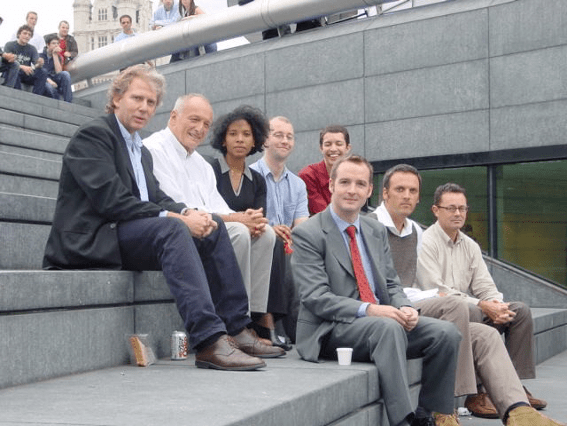
Architecture + Urbanism Unit at City Hall in 2002 or 2003. 
Top: Ricky Burdett, Richard Rogers, Gale Valentine, Jamie Dean, Eleanor Fawcett. 
Bottom: me, Mark Brearley, John Fannon.
Architecture + Urbanism Unit at City Hall in 2002 or 2003.
Top: Ricky Burdett, Richard Rogers, Gale Valentine, Jamie Dean, Eleanor Fawcett.
Bottom: me, Mark Brearley, John Fannon.
Photo: Tobias Goevert

Faced with the trundling beasts of public sector procurement, Richard often became frustrated (“Where are my million trees? Where are our 100 Public Spaces?”), exploding that he was wasting his time, or more amiably deciding he had had enough, and we all needed to go out for lunch or to the pub. He took no salary, but came in two days a week, chasing progress but also deploying all his skill and persistence at meetings with the Mayor and other bigwigs – to do deals on how architects would be selected and briefed, on what role design would play in the planning process, on how east London could fulfil its promise.

He stuck with it too, continuing to harry projects long after the rest of us had sounded the retreat, and showing patience and persistence with a bureaucracy that could be unfathomable even to insiders, where other architects would have packed up and retreated to the studio. Quite often, he would ask me to draft him a ‘tough’ (favourite term) note to the Mayor, demanding a project be stopped or an official sacked. As is the way of bureaucracies, these notes would then find their way back down to me from the Mayor’s Office, with a request for me to draft a response for the Mayor to sign off. I could keep these correspondence volleys going for weeks.

From 2004, I became increasingly involved in the London 2012 project, so saw less of Richard for a few years. A characteristic encounter was at the Venice Architecture Biennale, where he was awarded a Golden Lion in 2006. We greeted him in the street, and were scooped up and led to a lunch in a wood-panelled restaurant, down a side street I have never found since.

Flying back that evening, we were on the same plane as Richard and Ruthie, though they were in Business Class. I said hello as we got on, and expected they’d be long gone by the time we got out – that’s why you pay for Business Class after all. Instead, I found them waiting as we came through baggage reclaim, to see if we needed a lift anywhere. When we got into the Addison Lee, Richard told the driver “Chelsea, via Brixton.”  The driver muttered that Brixton wasn’t really on the way to Chelsea. “It is now,” replied Richard with a familiar mix of charm and steel which precluded much argument.

Richard continued to advise Ken, and then Boris Johnson for a couple of years, though took less of an active role as the A+UU morphed into the larger Design for London, headed by Peter Bishop. I think Richard saw his time at the GLA as something of a missed opportunity. We did not build his 100 public spaces or plant his million trees, and City East did not transform Docklands.

This is all true. But, as I said to him, those concepts had a long afterlife, and the cultural changes in how design and planning are done in London government were subtle but profound. The legacy of A+UU is still there in the current Mayor’s Good Growth by Design programme, in his panel of ‘Design Advocates’, in boroughs’ design review panels, in the Public Practice scheme that places newly qualified architects in public sector jobs, and in the inspiration he gave to a generation of planners.

After Richard left the GLA, I started working with him again, intermittently helping him to write articles or letters to the papers protesting against suburban sprawl, against toy town designs, and against the impact of austerity on the public realm – the ‘Continuity Urban Task Force’ as I used to call it. And it was very hard to pay for a meal at the River Café if he spotted us eating there. Richard enjoyed the good life – the River Café, the holidays in Mexico and Italy, opera and art – but he sought to share it as widely as possible, and was genuinely upset and angry when people were denied access to decent housing, food and healthcare.

In 2013, the Royal Academy hosted Richard Rogers: Inside Out, an exhibition that was as much about Richard’s political and civic beliefs as it was about his buildings. This caught the interest of Katy Follain, an editor at Canongate, and she asked Richard to write a book with the same blend of the personal, professional and political. I was trying to find something new to do after ten years on the Olympic treadmill, so was flattered when Richard and Ruthie asked me to help (especially given Canongate’s offer of some real writers).

The experience was hard going to begin with, when some early draft chapters came back covered in red scrawl. Richard’s dyslexia may have meant that he struggled to write long-form prose, but he knew what he wanted and knew what was good. We played around with structure, between timelines and topics, and ended up with a book that started narrow – focusing on a boy’s birth in Florence and his arrival in cold grey England in the 1930s – then widened its scope, using projects as jumping off points for discussions of urban development, public space, politics, inequality.

At first, Richard was reticent about the autobiographical elements; he wanted to look forward not back. But over time, he relaxed into the process, with long interviews where he reflected on his life, influences and ideas, recorded in his house in Chelsea, in his Hammersmith offices, on the terrace of the Tuscan farmhouse he and Ruthie rented every summer. The conversations were inspiring, a comfort to me as my own parents slid into ill-health, and often great fun. One taped interview, on the train back from Manchester after a party conference, starts structured and gradually dissolves into giggles as the free Virgin Rail Rosé takes effect.

As the chapters of A Place for All People were edited and finalised, Richard turned his attention to the design. I think Canongate were used to authors who would turn over a manuscript, fret a bit about the cover photo, then shut up until the proofs arrived. Richard had other ideas. He called up Andy Stevens, the graphic designer who had worked with him and his son Ab on the Inside Out exhibition design, and negotiations with Canongate began (Tracing paper? No. Different coloured papers for different sections? No. Spiral binding? No.) Once a format was agreed, pages would be laid out and reviewed again and again, by Richard, Ruthie and Ab, until Richard was happy with the flow and interplay of the textual and photographic narratives.

And this, I think, was at the heart of Richard’s genius. He was notoriously bad at drawing and struggled with writing, but he had brilliant ideas, acute judgement, and – an overused word but right in his case – a vision for what places and societies could be. He searched out the right partners and collaborators, and used all his powers of charm, persuasion, encouragement and menace to bring out the best in them and make the results of their work together as good as it could be.

Richard was so full of life, so endlessly curious, so excited about the possibility of a better world, and so tireless in trying to bring it about, that the world seems to have lost a little of its colour with his death. I’ll miss him enormously.

Some speculation…

In March 2020, UK office workers embarked on an unplanned and unprecedented experiment in home working. During 2020, home working rates were three times higher than before the pandemic; and four times higher for people employed in London. The experiment went pretty well, all things considered. The tech generally worked, even if the novelty of video meetings from cramped bedrooms quickly wore off, and productivity seems to have been sustained – at least in the short term.

A bigger and more complex experiment lies ahead. What will happen to ‘office jobs’ in the future, and what implications will this have for workers, for careers, for places – particularly places such as city centres?

This rather long article is an attempt to work through my thoughts on these questions, so is necessarily speculative (and at least in part inevitably wrong).

All in or all out?

Unlike the mandatory and largely uniform experiment of lockdown, the next experiment will see a variety of models, driven by shifting and varying patterns of government regulation, the needs and cultures of different industry sectors, and employer and worker preferences. With the exception of a few banks who still seem to be playing by Wall Street rules (“Lunch is for wimps” etc), it doesn’t look like many employers are ready to demand all staff are back in the office full time.

This would have felt like a regressive step even before the pandemic; home-working rates have been creeping up over the past ten years, encouraged by employers’ focus on ‘agility’, better technology for communication (and surveillance), and strengthened rights to work flexibly. Now that working habits and norms have caught up with the technology, reverting to the ‘nine to five’ presenteeism seems self-defeating as well as unfair – particularly for people looking after children (predominantly women) who would find themselves squeezed once again by childcare timetables.

At the other end of the spectrum, fully remote working coped during the crisis, but can this be sustained? Many workers felt that they were drawing down the reserves of social capital they had built with colleagues. Increases in task productivity are offset by more difficult team productivity. Online tools may help smooth collaboration and learning, particularly for younger ‘digital native’ workers, but in my last workplace, these were the very workers who wanted to be back in the office – to escape from parents and cramped flatshares, and to meet up with colleagues and peers.

Working away from the office may also make it harder for younger employees to learn the trick of the trade – how to behave in meetings, how to give and receive criticism, how to make a pitch, how to manage a difficult client – or for new employees to get to grips with all the unspoken aspects of corporate culture. All these can no doubt be taught formally, but for most of us they have been learned informally, even osmotically – by watching, listening and modelling.

Hybridities – beginning of a great adventure?

So, while most office workers are still at home, it is ‘hybrid working’ that is expected to dominate in the future, with people spending two or three days in the office and the rest working from home (or another remote workspace).

This could be entirely unstructured, allowing considerable discretion as to where and when employees work, and already is in many workplaces. But wider adoption could pose problems. First, most workers would choose to work from home on Mondays and Fridays, and in the office mid-week. If this approach was widely adopted it could lead to a sharp drop in demand for city centre services but would make it hard for firms to cut costs by reducing floorspace. Perhaps more seriously, it would risk reinstating a divide between those who were willing and able to be in the office more (principally men without caring responsibilities), and those who worked from home more (often women with caring responsibilities). The former have tended to do better in terms of career progression, even when the latter are more productive.

If these and other advantages are sustained, you could quite easily see a tipping point, as workers find it easier to collaborate, but also to compete, by being in the office. Hybrid working could remain permitted in theory, but become increasingly rare in practice,

Alternatively, management could decide who came in on which days. But this isn’t problem free either. Do you bring whole teams in together, or do you mix them up? Do shift patterns change so everybody gets some Mondays and Fridays at home? Can online tools work as well for informal as well as formal collaboration, when some people are in the office and others are at home? Is it really fair to force workers – particularly those for whom home working is difficult – to stay away?

But – to step back for a moment – why do we go into an office at all? We office worker types risk not only thinking everyone else is an office worker, but also that everybody’s office job is like our own. In fact, ‘office jobs’ contain multitudes – from conceptualising, designing and selling products, to talking to clients and collaborators, to analysing data, writing reports and coding, to monitoring service delivery, to managing staff, to maligning management and gossiping about Love Island. In varying proportions, even highly-skilled ‘knowledge economy’ jobs involve ‘relational’ work (essentially talking to other people) and more task-focused ‘programmable’ work.

There are some jobs dominated by ‘programmable’ work that can be carried out almost entirely autonomously, they are a minority. (And as a recent report argued such ‘work anywhere’ jobs can as easily move overseas as they can move out of UK city centres.) For the rest of us, adapting our workflows so that we can concentrate more ‘programmable’ work into days away from the office may require the type of flexibility that is hard to align with a structured approach to hybrid working.

In the short-term, therefore, I think we will see a period of experimentation. Different firms will try out different models of office, hybrid and remote working, testing out their impact on staff morale, retention and productivity. In an increasingly fluid labour market, you could see some employers targeting packages at younger workers, and some offering a deal that better suits people with children. It could be quite tumultuous.

But my hunch is that office and remote working models will begin to dominate in the medium term, because they have a coherence and support a common culture with which hybrid models struggle. Firms will reach tipping points where almost everyone is in all week, or almost nobody is; one of those will become the dominant model for particular firms or whole sectors, and decisions on leases and employment terms will reflect that. Neither model will be entirely pure: office-based jobs will probably allow more flexible working than before the pandemic, and remote-working employers will still bring staff together for structured collaboration sessions. But my guess is that working patterns will be 90:10 rather than 60:40.

Cities and centres – inertia counts

So, what does this all mean for our cities, and for London in particular? I suspect there are three scenarios: decline, dispersal and doubling down. Cities could see their centres decline in absolute and relative terms, losing jobs and population – particularly wealthier people, who can afford choice and are less tied to lower-paid service sector jobs. This would be disastrous in economic and environmental terms, as car-dependent sprawl spread through the countryside, and the problems of poverty and dereliction increased in cities. However, while there are some signs of ‘de-urbanisation’ in recent UK population figures, this feels the least likely option, not only because of the continuing appetite for some office working discussed above, but also because of the polutical risks involved in allowing this to happen.

A less dramatic variant would be dispersed patterns of working in and around core cities – perhaps realising the ‘fifteen-minute city’ vision that has caught the imagination of many city planners. I can see this taking hold, particularly for some sectors and some job types. More ‘relational’ jobs (consulting and advisory services, advertising, publishing) may stay in the city, benefitting from all the visible and invisible spillovers of agglomeration, while more ‘programmable’ jobs (coders, technicians, web designers) move out (or, as mentioned earlier, maybe even go offshore).

A recent OECD report suggested corporations would seek to relocate offices out of city centres. But how much would an employer gain by moving out of a city such as London (or Birmingham, or Manchester) with highly developed radial public transport systems and ecosystems of business services. Moving from London to Colchester, Crawley or Cranfield would inconvenience many more workers than it would help, at a time when businesses follow talent rather than vice versa. Inertia has an impact. So I suspect that most firms that retain office-based working will remain in city centres, and that the savings to be made from reducing footprints will be limited – though you can expect tenants to negotiate hard when leases come up.

There is still a longer-term question: will new start-ups see the value in city centre offices, or will they naturally adopt a more dispersed business model? Designing in dispersed working from the outset makes a lot more sense than trying to retrofit corporate structures, processes and cultures. But there’s a paradox here. The young people who work in such businesses are also the young people who are drawn to cities for the richness of professional and personal opportunity, for culture and recreation, and often to be with their peer group after university. If dispersed working is adopted by a new generation of firms, it may be dispersal within rather than dispersal from big cities.

The ‘doubling down’ scenario, where city centre working intensifies, seems the least likely at first glance. The co-incidence of a pandemic and technological change has created both a driver and an enabler for more dispersed working. But in the long-term, policy will make a difference and policy should be favouring urban growth (despite the electoral politics of ‘levelling up’).

We know that cities are more efficient than sprawl in terms of their carbon impact, and we know that government policy is refocusing new housing into cities, after a flirtation with more dispersed settlement. We can also expect business travel by air to decline, as carbon targets bite. All of these factors suggest that economic growth may concentrate in a few densely-mixed urban centres, well connected by lower carbon transport, rather than being spread through a network of offices within a country or a global region. The role of these cities and of offices within them will change – with extended commuting patterns, less generic retail, and offices that are platforms for collaboration and meeting rather than for routine administration – but they have successfully changed before.

The UK’s cities have borne the brunt of the health and economic harms arising from a pandemic. They will face the steepest road to recovery, and some may struggle to get back on their feet. But over time, I think our sociable natures will combine with the continuing strength of agglomeration, the inertia of infrastructure and the growing urgency of climate action, to enable cities to bounce back. It will be a choppy few years. Businesses need to be ready to experiment and adapt, without betting the house prematurely on any particular model. Governments need to respond with the policies and investments to make this recovery economically dynamic, socially just and environmentally sustainable.

Inner city life, inner city pressure

As the weather improves and lockdown restrictions are relaxed, life is ebbing back onto the streets of central London. People who were commuting in daily just over a year ago are beginning to revisit a city centre that is both familiar and utterly transformed. And to think about its future.

There are still more questions than answers about that future. How much remote working will persist, and how will much-discussed models of ‘hybrid working’ play out? Will employers reduce their demands for workspace, and will any surplus space be picked up by new arrivals attracted by lower rents? How quickly can tourist and international student numbers recover, and how will shops, pubs and restaurants cope if both commuting and tourism remain suppressed?

These uncertainties are likely to persist for some months, but some slackening in demand for office and retail space is widely expected, as working and consumption patterns change, and employers rethink their needs. Some premises might be adapted by cultural and community organisations, for experimental pop-ups and meanwhile uses, but it is likely that new residential development will play a part too.

This could actually help build the city’s resilience. As Centre for London set out just before the pandemic bit, central London’s population has been growing fast over the past decade, but the city centre is still less densely populated than Paris or New York. So when coronavirus brought commuting and tourism to a standstill, central London and its businesses were particularly hard hit by the loss of trade, and have continued to struggle as restrictions have been successively relaxed, re-imposed and relaxed again.

So more people living in the city centre is not only likely but desirable, as was underlined in Arup’s recent report for the Greater London Authority on the future of the Central Activities Zone (CAZ):

“A higher CAZ residential population, to offer more sustainable lifestyles, resilience, increased vibrancy and ‘stewardship’ of the CAZ’s resources for others, and bringing London more into line with its global rivals.”

But allowing more residential development or conversion in central London is not straightforward. The current London Plan and borough planning documents give the CAZ and Canary Wharf special status, to protect the clustering and density of ‘strategic functions’ (for example global commerce, education, culture, government and tourism) and give these uses priority over housing. This protection, the argument goes, preserves the essential character of central London as a truly global city centre and the economic powerhouse of the UK.

How could more housing be brought into the mix without diluting these qualities and this global draw? Should new build and conversions be pepper-potted through the CAZ, or focused in a few neighbourhoods? And can office and retail conversions retain flexibility, or is any switch to housing a permanent change?

Some parts of central London and some building types look a lot more inhabitable than others. Big open-plan offices, as found in the heart of the City and Canary Wharf, are unlikely to be adapted as easily as older buildings in the West End, Clerkenwell, Bloomsbury and the South Bank, which have switched from houses to flats to offices and now perhaps back to housing over the years.

There are also issues of management and services. How would potential disputes between residents and businesses be resolved over night-time deliveries, late-night crowds leaving bars and nightclubs, parking and vehicle access? And where will health services and schools be located, as well as everyday shops?

All of these factors suggest that a remixing of London’s city centre will need to be carefully managed, not left to the free-for-all of ‘permitted development’ from office to residential uses that government is proposing – and which has led to some truly atrocious conversions of commercial buildings. Central London currently has exemptions from permitted development, but these expire in summer 2022, and London’s boroughs will soon need to start making the case for renewing them.

Central London is a dynamic and creative place. As we emerge from the pandemic into a world that is still being reshaped, Centre for London hopes to explore how we can apply that dynamism and creativity to refresh its mix of uses, as well as to support the national recovery.

[Published by Centre for London, 26 May 2021]