Unfinished evolution – ten years of change around the Olympic Park

“Gentrification” is always front and centre of debates about the impact on east London of the London 2012 Olympic and Paralympic Games. Legacy sceptics claim the “regeneration” of the Lower Lea Valley has resulted only in long-established working-class communities being driven out of their own neighbourhoods by more affluent incomers. Its champions take a different view, pointing to new amenities, a better environment, more jobs and homes, and rising educational attainment.

Yet Census and other data suggest that neither of these sharply opposed positions reflects the complex realities of rapid demographic and social change in this part of the capital.

To declare my interest, I worked on the project – mainly the “legacy” elements of the Queen Elizabeth Olympic Park, as it was renamed – from around 2004 to 2014. What interested me at the time was the idea of the project achieving the “regeneration of the area for the direct benefit of everyone that lives there”, in the wording of the aims agreed between the government, the Mayor of London and the event organisers.

Some commentators consider that promise to have been comprehensively betrayed. They argue that Park facilities have done nothing for local communities, with homes, workplaces and leisure centres being built for middle-class newcomers, while accelerating the displacement and victimisation of locals.

But there is a potentially positive story to be told too. In 2009, the four boroughs around the Olympic Park – Tower Hamlets, Newham, Waltham Forest and Hackney, plus Greenwich and, at a later stage Barking & Dagenham, set out a plan for “convergence”. Their aim was that on a range of indicators – from school attainment to employment to crime – these six “growth boroughs” would stop underperforming the London average.

Achieving this deceptively modest-sounding goal would be a big deal. It would involve disrupting patterns of migration that have operated for decades, if not centuries. As successive waves of new arrivals have moved into east London, its population has changed. But when newcomers prospered, they tended to move on and out, often further east, meaning that patterns of disadvantage persisted. East London saw displacement, but without gentrification.

Could this be reversed? Could the area around the Olympic Park experience a more inclusive process of change that enabled local people to stay and succeed – “gentrification from within”, as I glibly termed it when working for the London Legacy Development Corporation (LLDC)?

There has certainly been change. As OnLondon has previously reported, many of the 2020 convergence targets were met well ahead of schedule. Surprisingly, beyond saying the Growth Borough Partnership was “put into hibernation” in 2018, the website is quiet about this progress. This is unusual, as it is normally when targets are likely to be missed that they are quietly dropped by government bodies, rather that when they are on course to being achieved.

Perhaps one reason “convergence” has been sidelined is that it is too blunt-edged a metric, measured at too wide a scale. Lower unemployment, for example, could be achieved by displacing and replacing communities, instead of by helping them flourish. Nor does convergence distinguish between the impact of the London 2012 Games and other grand projects, including the London Overground extension and the completion of Crossrail, let alone wider socio-economic changes such as the impact of austerity across London.

The 2021 Census makes a more granular exploration of change possible. It has flaws, not least because it took place when many Londoners were temporarily out of town as a result of the pandemic. Furthermore, the data only captures aggregate rather than individual outcomes, and does not look back to 2001-11, when anticipation of and preparations for the 2012 Games were already having an impact. However, datasets comparing the 2021 results with those from 2011 do allow us to look in a greater level of detail at how the area round the Olympic Park has changed (the comparison datasets are collected here).

What follows first looks at the extent of population change around the Queen Elizabeth Olympic Park and then explores what we can infer about the components of that change – and specifically whether it represents a displacement of or an addition to existing communities. The “Olympic Park and Fringe” is defined by the following “middle-layer super output areas” (census tracts with a population of 2,000-6,000 people):

Screenshot 2024 03 24 at 18.47.55

*Not included in some comparisons as no 2011 data available.

A decade of population growth and churn

The sheer pace of population change is striking. Between 2011 and 2021, London’s population grew by around eight per cent (though many inner London areas saw a fall, largely attributable to the temporary impact of the pandemic). Growth in the Olympic Park and Fringe was around 25 per cent, concentrated in Bromley-by-Bow and Fish Island to the west (34 and 36 per cent), in Stratford New Town and Carpenters, and in Mills Meads to the east and south (71 and 73 per cent).

The Census figures only show net change – the combined impact of myriad arrivals and departures over a ten-year period. Another data source, the Residential Mobility Index, which draws on sources such as electoral registers and land registry, estimates population “churn” – the proportion of households that have changed over a period of time. For the average London borough, around 50 per cent of households changed between 2011 and 2023. Hackney and Newham saw similar levels, while Tower Hamlets had a 76 per cent change and Waltham Forest a 43 per cent change.

But the areas immediately around the Olympic Park experienced more dramatic change, with over 90 per cent churn around Fish Island, East Village and Carpenters. Perhaps this should not be surprising, given the comprehensive redevelopment of these areas during and since the 2012 Games. As you move further east in Waltham Forest and Newham, and further west in Hackney, the degree of churn falls quite sharply: areas such as Leytonstone, Maryland, West Ham, Clapton Park and Homerton saw churn at or below the London average. Tower Hamlets is a notable exception: there was extensive population churn across the borough, with rates of 70 per cent or more all along Mile End Road and even higher around Whitechapel and Bethnal Green.

So, population growth has been intense in the immediate hinterland of the Olympic Park, though not that much higher than in other “regeneration” areas, such as Elephant and Castle, Kings Cross and Wembley. However, both growth and churn have been much more limited as you move further away from the park.

Qualifications and occupations

The harder question to answer is whether population growth and churn represent a replacement of or an addition to existing communities, in particular a displacement of working-class people and communities by more middle-class ones. Census data doesn’t really address class, but we can try to paint a picture using some proxy indicators, and by looking at the actual changes in numbers of people with particular characteristics, rather than the change in the mix. Has growth in one community been accompanied by another becoming smaller, both in itself and in comparison to trends across London?

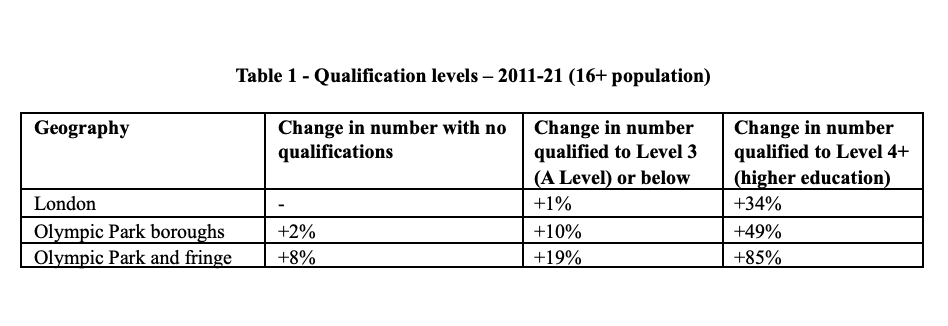
The first proxy indicator is qualification levels. The past decade has seen a rapid increase in the proportion of Londoners who have degrees or other higher education qualifications. This has risen from 38 to 47 per cent of the 16+ population across the city, and from 34 to 49 per cent in the Olympic Park and Fringe. The number of higher-qualified residents in these areas increased by 85 per cent and doubled around Stratford High Street, Stratford Town Centre, Bromley-by-Bow and Fish Island.

However the number of people without any qualifications has also increased, suggesting that in this case the change has been one of addition rather than substitution. Even if low-qualified people have moved out, other low-qualified people have moved in. The exceptions are the areas to the west of the Park – Bow, Fish Island, Hackney Wick and Hackney Marshes – where the number of low qualified people has fallen over time, suggesting a more permanent displacement.
Screenshot 2024 03 24 at 17.58.01

A similar analysis has been undertaken by Duncan Smith at CityGeographics, looking at changes in occupational mix. He finds that the Lower (and Upper) Lea Valley has been at the forefront of change: the proportion of workers in managerial, professional and associate professional jobs in Waltham Forest rose from 40 to 51 per cent between 2011 and 2021, the most rapid change in England, and in Newham from 32 to 42 per cent. Analysis of numbers rather than proportions is not available by borough, but across London the number of people working in lower status occupations has not changed, suggesting that changes are additional not substitutional.

Housing tenure

Housing is another proxy: do tenure changes indicate gentrification and displacement? The Olympic Park and Fringe bucks London trends on housing tenure, with a sharp rise in owner-occupation (mortgaged and owned outright) particularly concentrated in Mill Meads, Stratford New Town and Carpenters, Bow and Fish Island, where new construction has been intense. So far, so gentrifying.

However, perhaps counter-intuitively, the number of households in social rented accommodation has also grown in the Olympic Park and Fringe, and at a faster than the London or local borough average. If social tenants around the Park have been displaced – and estate redevelopment projects in locations such as the Carpenters Estate have been highly controversial – they have also been replaced with more social tenants. Meanwhile, private renting has grown as it has across London. It is now the most widespread tenure in the Olympic Park and Fringe.

Screenshot 2024 03 24 at 18.26.21

Ethnic diversity and employment

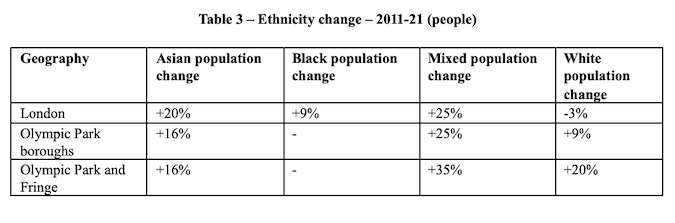
Another lens for examining change in and around the Olympic Park is ethnicity, which has a strong overlap with poverty and intersects with class disadvantage. The areas around the Olympic Park have always been some of London’s most diverse, with a non-white population of around 57 per cent in 2021, compared to 46 per cent across the capital.

As the table below shows, compared to London as a whole the Olympic Park boroughs and the Olympic Park and Fringe areas saw faster growth in their white and mixed-race populations, slightly slower growth in their Asian population and almost no net change in their black population. Black and Asian populations fell in Waltham Forest’s fringe areas, and all populations grew fastest in Tower Hamlets’ fringes, along Stratford High Street and into the Town Centre. This suggests that even if rapid growth in white and mixed-race populations around the Park did not actually lead directly to displacement of people from Asian and black populations, it may have constrained growth in those populations to lower levels than in other parts of London.
Screenshot 2024 03 24 at 18.29.52

Another perspective on ethnicity can be seen in employment rates. In the Olympic Park boroughs these rose from 59 to 62 per cent of people aged 16+ over the decade, bringing them above the London average. The rise has been sharper still in the Olympic Park and Fringe, with rates rising from 60 to 65 per cent of the population. But, while employment rates have improved for all groups relative to the London average, employment has risen fastest for white people, while it changed much less for black and Asian people, widening the employment gap between these communities.

Screenshot 2024 03 24 at 18.36.04

Unfinished evolution

Taken together, these figures suggest that the London 2012 programme has had varying and complex impacts on the local area. While there have been some signs of displacement of existing populations, particularly to the west where legacy has butted up against “Hoxtonisation”, the more widespread pattern seems to have been one of densification enabling the arrival of new and different communities. These demographic changes, along with the programmes run by the Olympic Park boroughs and LLDC, have driven convergence in employment rates, in tenure, and in occupational and educational profile.

That said, the differences in improvement in employment rates, alongside recent depressing news about falling life expectancy, suggests that structural disadvantage continues to hit some east London communities hard. Twenty years after London was awarded the Games and as the boroughs, the Mayor of London and the LLDC develop inclusive economy plans, London 2012’s legacy is an unfinished evolution.

First published by OnLondon.
Missions Aspirational

You have to feel for Michael Gove. Rarely has a document been freighted with as much expectation as the levelling up white paper, which has been promised in one form or another since 2019. But even as the Department for Levelling Up, Housing and Communities was being given its new remit the spending shutters came down, ruling out new money – at least on the scale needed to radically alter hundreds of years of economic development.

Without new money the white paper sets direction rather than powering engines, though it does offer a few enticing hints of change. It promises, for example, to push devolution further and to bring some clarity and consistency to England’s idiosyncratic patchwork quilt of local government, and it celebrates the role of local policy-making. It even suggests that mayoral combined authorities and the Greater London Authority might bid for “sweeping further powers”, though it stops short of any significant transfer of fiscal powers.

And it does at least tell us what the government thinks “levelling up” is. At the core of the paper are 12 targets for 2030, heroically rebranded as “missions”. Advocates of mission-thinking as a way of galvanising action often point to John F Kennedy’s commitment to put a man on the moon by the end of the 1960s. Note that JFK didn’t make 11 other commitments at the same time. But most of these targets are laudable, even if the lack of detail on delivery makes them feel rather “aspirational”.

It is notable that most of them focus broadly on national improvements in social and economic conditions – job numbers, productivity and pay, violent crime, wellbeing, pride in place, school standards, adult training and home ownership – rather than explicitly on closing the gap between “LondonAndTheSouthEast” and other regions, which can of course be achieved by levelling up or by levelling down. Essentially the missions argue that all should rise together, though several qualify this by specifying that the worst-performing places should see the sharpest improvements.

Some targets are more explicit in their focus on narrowing gaps. Public transport across the country is to be “significantly closer to the standards of London” by 2030, which is a slightly ambivalent pledge given the cutbacks being considered by Transport for London in the absence of a long-term funding deal. It also does prompt a raised eyebrow – can other cities, let alone less densely populated towns, really support services like London’s?

The focus on narrowing the gap in healthy life expectancies also stands out, though the detail remains to be filled out in a separate white paper on health disparities later this year. In the meantime, the question of what geographies you use to judge success will be vital. As previously remarked here, the difference between places within the same borough can be every bit as stark as those between different regions.

There is a little more meat in the two economic missions. One pledges to improve pay, employment and productivity in every area of the UK – which should be good news for London, where productivity growth has stalled in recent years. The other proposes rebalancing public expenditure on research and development (R&D) outside the Greater South East. This could be one of the strongest measures in the white paper. Public spending on R&D is heavily focused on the “golden triangle” of London, Oxford and Cambridge, and there is a good argument that this concentration is failing on the grounds of economic efficiency as well as fairness.

Rebalancing investment to where it can make a real difference both directly and through attracting private investment rather than insisting it is spread evenly throughout the country, could make a real difference. The promise of £100 million for three new “innovation accelerators” in Greater Manchester, the West Midlands and Glasgow suggests that the need for focus is understood. Any switch of resources from London to other parts of the UK is likely to feel harsh, but a rebalancing of R&D spending is worth contemplating as a way of building up the knowledge economy in other cities.

Much less helpful is the white paper’s restatement of the government’s plan to divert funding for housing away from the areas of lowest housing affordability – that is, London and the South East. Doing so seems to fly in the face of its protestations that “levelling up is not about making every part of the UK the same, or pitting one part of the country against another. Nor does it mean dampening down the success of more prosperous areas”.

Less money for affordable housing in London is not likely to be good for London or the UK. London’s housing crisis is likely to worsen, with one of two results or a mix of them. Either the capital’s economy will suffer, with consequences for the rest of the country, or living in London will become more exclusive, further detaching the capital from the rest of the country. Investing to lever growth into other cities is a worthwhile endeavour. Removing support for infrastructure in places that most need it seems short-sighted and even spiteful.

Originally published by OnLondon.

Fund for all the family?

Five days after the 2021 Budget, are we any clearer what “levelling up” means?

One thing is clear. It doesn’t mean investing to tackle London’s problems, even after the damage done to the capital by the pandemic. Only two of London’s boroughs (Newham and Barking & Dagenham) are included in the priority tier of local authorities eligible for the new £4.8 billion Levelling Up Fund. The three prioritising ‘place characteristics’ set out in the Fund’s Prospectus could have been designed to exclude the capital:

  • Need for economic recovery and growth;
  • Need for improved transport connectivity; and
  • Need for regeneration.

It’s not yet clear how these are quantified and compared (or precisely what “regeneration” means), but the first two work well enough to rule out London, which is distinguished by a persistent mixture of dynamism and deprivation alongside an enviable transport network. Boroughs like Westminster and Tower Hamlets have intense poverty among their residents, but also have three times the economic output per head of the UK as a whole, and twice that of other big cities like Manchester, Belfast and Edinburgh.

So this is not a fund for London, or for investing in the needs of people rather than place. And there is a case to be made for that: even London’s most fervent advocates would recognise that there are places in the UK that urgently need investment in connectivity and economic activity. You could even see a precursor in Michael Heseltine’s City Challenge programme of the early 1990s: selecting and investing heavily in a few urban centres, following a bidding process, which would in turn power up new enterprise and opportunity around them.

But that doesn’t seem to be how this Fund will be applied. The prospectus invites local authorities to submit one bid each for up to £20 million (£50 million in exceptional cases for big transport projects). Twenty million is a substantial sum, but hardly transformative – and significantly less than was allocated to City Challenge bidders 30 years ago, when 20 cities received £37.5 million each (around £72 million in today’s money). Assuming £2 billion is handed out in the first round, this would enable 100 bids to be funded. It looks as if spreading the jam wide and thin is the priority.

This may also explain the variety of places in the priority tier. It includes most major city centres (apart from London and also struggling smaller cities like Sheffield, Plymouth and Portsmouth). But it also comprises “Red Wall” marginals and prosperous suburbs and rural areas such as Richmondshire (I suspect to the Chancellor’s embarrassment), Lewes and Trafford.

Poverty is not confined to the inner cities, but not every smaller town and rural area is struggling either. Some lack economic powerhouses and transport hubs, but nevertheless have prosperous populations of commuters and retired people. You can see the government’s problem here: it is hard to distinguish struggling from successful smaller towns without giving a higher weighting to deprivation measures, and  doing that would have pushed the focus back towards London and the other big cities.

The language of the prospectus seems to fudge things further. It makes a very tentative and non-economic case for infrastructure investment:

“Investing in infrastructure has the potential to improve lives by giving people pride in their local communities; bringing more places across the UK closer to opportunity; and demonstrating that government can visibly deliver against the diverse needs of all places and all geographies.”

Elsewhere, the prospectus talks about funding projects that “bring pride to a local area”, about “infrastructure that has a visible impact on people and their communities”. It starts to sound as if the purpose of the fund is performative. It aims to give the appearance of activity and impact in the next three years, redeeming the electoral promise made to “Red Wall’ constituencies, rather than seeking any lasting change, let alone the type of economic rebalancing that has evaded ministers for decades.

Either I’m being deeply cynical or the Levelling Up Fund is. There’s no sense of strategy, of how “levelling up” might be achieved, or even of what it is. A bold government could focus a critical mass of investment on the places and projects that could maximise prosperity and opportunity, or it could hand funding over to local politicians to allocate in line with local priorities. Instead, we have the continuation of centralised munificence, infrastructure investment by supplication.

The Mayor of London and borough leaders have expressed anger at how the Levelling Up Fund has ignored London’s needs. If I was leader of a northern city, I might be angrier still.

[First published in OnLondon, 7 March 2021]

Big Bang and Grande Bouffe – the eateries that boosted London (March 2019)

 [Originally in OnLondon, 8 March 2019]

‘There’s a Big Bang in the City, We’re all on the make.” (Shopping, Pet Shop Boys, 1987).

The news this week that the Kensington Place restaurant is to shut its doors is more than just another restaurant closure. It completes a chapter in the incredible story of London’s 30 year resurgence.

The years 1986 and 1987 were pivotal for the capital and the high water mark for Thatcherism. In April 1986, amidst a blaze of fireworks and protests, the Greater London Council was abolished alongside other metropolitan councils, banishing the spectre of “socialism on the rates”. And in October – after years of wrangling – the “Big Bang” transformed financial services.

The details of the Big Bang are complex. Essentially it was a package of reforms that deregulated stockbroking, opened up London’s Stock Exchange to foreign-owned firms and enabled computerised trading to replace the frantic scrum of “open outcry” trading on its floor. But the Big Bang represented something more – the apotheosis of confident capitalism, personified by the mobile phone-toting Yuppie, in TV dramas such as Capital City, and by Harry Enfield’s Loadsamoney – conceived as satire, but sometimes treated as a role model.

The Big Bang was also cited as a factor in the revival in net international migration, which meant London’s population started to grow again – albeit just by a few thousand a year – after decades of decline. At the time, London’s return to growth was seen as an anomaly, or even a blip. Writing in early 1987, Tony Champion and Peter Congdon suggested that the “surge in net international migration for City jobs will settle down after Big Bang”.

In 1987, as the Conservatives celebrated their third consecutive election victory, and the City of London was rocked by the twin shocks of the “Black Monday” crash and the emergence of Canary Wharf to the east, the Big Bang was also having an impact to the west. Three restaurants opened to cater to London’s growing gang of globally mobile professionals with sophisticated palates. In doing so, they put London’s food scene on the road to transformation from international punchline to global draw.

In Hammersmith, Ruth Rogers and Rose Gray took over a disused warehouse building next door to Ruth’s husband’s firm, Richard Rogers Partnership. The River Café started by serving lunches to local workers, before gradually opening for longer hours and a wider clientele. But from the outset Ruth and Rose focused on fresh flavours and carefully chosen ingredients, an Italian cuisine that was a world away from the mounds of pasta, check table cloths and straw-covered chianti bottles of traditional trattorias.

In South Kensington, Terence Conran opened Bibendum in the opulent Michelin Tyre Company building on Fulham Road. Chef Simon Hopkinson’s cuisine was as deeply rooted in the rich sauces and offals of French country cooking as the River Café’s was in in the bright and earthy flavours of Tuscany. But, also like the River Café, Bibendum matched this respect for the classics with a stripped-back modernist ethos. Both restaurants were a world away from the tweezered pretension of 1980s nouvelle cuisine.

A little further west, Rowley Leigh opened Kensington Place, serving modern British food (almost a contradiction in terms at the time) in deliberately informal surroundings, dispensing with table cloths to create a London version of the neighbourhood brasseries that dotted Paris, and pioneering dishes such as scallops with pea puree that have now become gastropub standards.

By 1989, the “Lawson Boom” that had driven the ebullience of yuppie culture had run out of steam and the UK began to dip into a recession that hit London particularly hard, with soaring interest rates, a property market crash and thousands of homeowners facing negative equity. But the three restaurants that reinvented London’s food scene survived, and London’s population growth picked up pace. As Kensington Place closes, to be redeveloped for housing, it is caught in the undertow of the wave of change that it surfed.

Block-ed

Redeveloping council estates has become a popular way for boroughs to build more houses in London, where land is at a premium, but it is a high-wire act, conducted over a shark tank, with volleys of custard pies being hurled from the sidelines.

Build at too low densities and the numbers won\’t add up; go too high and you create a lumpy enclave out of keeping with its surroundings. Spend too much buying out existing residents and you kill the business case; spend too little and you will have to resort to compulsory purchase. Build too much market housing and you\’re accused of driving poor people from their homes; build too little and you won\’t make enough to cross-subsidise more affordable housing. Offer too little to developers and they won\’t take on the risk; offer too much and you look like an easy touch.

One of London\’s largest such schemes began to wobble on Friday, when the Secretary of State turned down Southwark\’s Council\’s application for a compulsory purchase order to enable the demolition and redevelopment of the Aylesbury Estate, planned to increase total housing numbers from 2,700 to 4,000.  The scheme has been intensely controversial, with accusations of \’social cleansing\’, occupations and forcible evictions providing a stormy backdrop to the slow-grinding legalities of planning and public enquiries.

It is hard to avoid boggling at the politics of a Conservative minister seemingly siding with anti-gentrification protestors against a major development scheme promoted by a Labour council. Is this a sign of the May government\’s commitment to helping the poorest in society? Is this dismissal of the public-private partnerships that have dominated public projects for so many years another sign of the \’end of liberalism\’?

You can imagine Conservative spin doctors savouring some of these interpretations, but the politics of this decision are probably fortuitous rather than intentional. The process of confirming (or not) compulsory purchase orders is a quasi-judicial one, made on the basis of an inspector\’s report and carefully worded official advice, not for political positioning.

And, when you look a bit deeper, the decision is a very conservative one.  It was not the rights of council tenants that were the central consideration, but eight remaining leaseholders, owners of property bought under right-to-buy legislation.  The compensation offered to them was judged to be inadequate, and their human rights likely to be breached if their homes were requisitioned. It was actually the very conservative defence of private property rights, and the Conservative policy of selling off council housing, that has knocked the project off course.

Tales of antique power

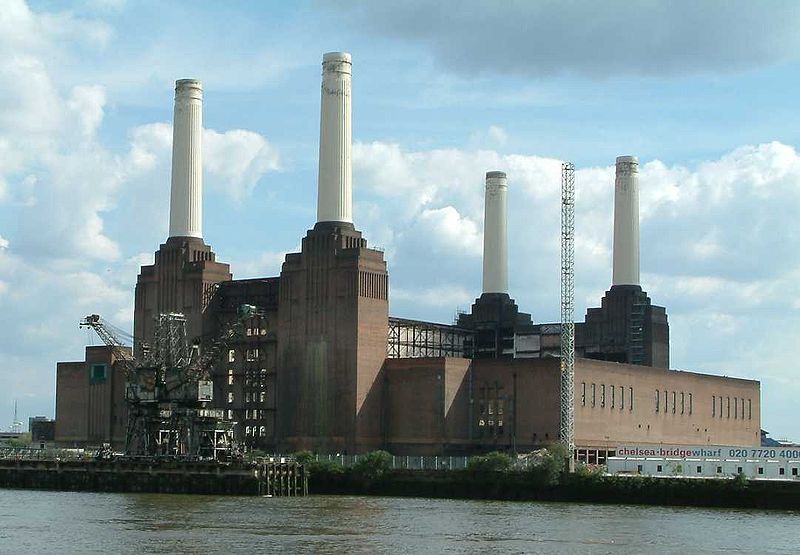
Another year, another scheme for redeveloping Battersea Power Station begins to wilt. The site is caught in a double bind. The listed power station (right, photo Tagishsimon) takes up so much space and requires so much investment to keep it safe, let alone equip it for re-occupation, that it is hard to make any scheme make commercial sense at the best of times.

Balancing the books requires a density of development on the rest of the site that cannot be reconciled with its poor public transport accessibility, and the costs of building new infrastructure (the most recent proposals include a spur from the Northern Line) just make marginally viable proposals more fragile still.

You could argue that the only way to bring the site into use would be to demolish the power station. That would be a shame. I have been lucky enough to visit the building, designed by Sir Giles Gilbert Scott and opened in 1933, and its interiors are as stunning as its looming form, if not more so. The turbine halls are elegantly tiled, and the control rooms truly magnificent. Crafted wooden fittings are surrounded by decorative wall and ceiling tiles, and bakelite switches are inscribed with the names of substations and districts. This, the interiors say, is a place where something important, and magical, takes place.

The overall impression is one of pride, pride in the modernism and progress that this temple of power once represented, a pride that can also be seen in elaborate Victorian shrines of sanitation, like Bazalgette\’s ornate pumping stations at Crossness and Abbey Mills (left, photo Gordon Joly).

This pride in utilities is something we have lost. As I walked through Redhill a couple of weeks ago, the contrast between the grandeur of the Royal Earlswood Hospital and the shabby incoherence of the East Surrey Hospital could not have been starker. While offices, libraries and civic centres can still win awards, it is almost as if the mundane necessities of power, health and sanitation have become embarassments, to be covered up and smothered, like a burp in polite company.

We are left with tacky trash, rendered all the more conspicuous by its artless attempts to blend in.

(Not) going down the pub

Raised on concrete stilts, the Docklands Light Railway affords a privileged view of East London to its passengers. Amidst austerely functional blocks of post-war housing, churches and pubs stand out – richly tiled and decorated relics of a Victorian past. Owned by the breweries, they (the pubs, that is) were left standing on street corners as the slums of Poplar, Shadwell and Whitechapel were demolished.

But changes in the pub trade are now conspiring with London\’s insanely effervescent property market to dismantle what the Luftwaffe and the planners left intact. The Evening Standard recently reported that around a quarter of pubs near the Olympic site in Bow are closing. It\’s unfair to blame the Olympics for this – a changing population (more muslim in East London), the smoking ban and changing attitudes to drinking all contribute – but London 2012 is accelerating the process that kills boozers.

As the market value for new-build flats goes through the roof, the new pub-owning companies – nowadays as canny as property speculators as they are at managing licensed premises – are quick to take advantage. Depending on your views, you can call this regeneration or gentrification, but the outcome is the same – a gradual retreat from the ideal of mixed-use neighbourhoods to which modern planners and developers must at least claim to aspire.

It\’s not just happening in East London. Urban 75 lists some of the shabbier (and I mean that as a compliment) drinking dens that have closed around Brixton in recent years, to be replaced by \’luxury apartments\’. Fight backs can work: the Pineapple in Kentish Town managed to see off developers a few years ago, but it\’s probably easier in NW5, where stars like Rufus Sewell will rush to your aid, than in E3 or SW9.

Councils are taking notice, and several (including Tower Hamlets) have put in place policies to protect viable pubs in residential areas, but it may already be too late. The city is zoning itself, making a mockery of mixed use. As brutal \’vertical drinking\’ districts spread like a rash, neighbourhood pubs are in retreat, before the relentless march of housing-led \’regeneration\’.

From Canary Wharf to Canvey Island

Thames Gateway: environmental disaster in the making, bleak repository for the worst of ticky-tacky volume housebuilding, or an unrivalled offer of increased prosperity, enhanced environment and vibrant quality of life? Only one of these asssessments is drawn from a Government website. You can probably guess which.

In the wake of a recent National Audit Office (NAO) report, commentators have been lining up to give ‘the Thames Gateway project’ a comprehensive monstering. The NAO criticised the project for having too many organisations involved, and for lacking clear leadership, a costed delivery plan and performance indicators.

This is all fine as far as it goes (though as an ex-researcher for the Audit Commission, the NAO’s local government equivalent, I know that these criticisms are audit boilerplate, applicable to almost any area of public life), but it’s worth keeping a sense of scale.

The Thames Gateway is vast: more than 700 square miles of land, stretching from London’s East End to the Isle of Sheppey (as far as the distance from Marble Arch to Oxford). It contains multitudes: marshland and power stations, wharfs and wild horses, factories and new towns, Canary Wharf and Canvey Island. Should there be – could there be – a single vision or plan for such a place?

Architect Sir Terry Farrell thinks there should. He has been decrying the Government’s failure to adopt his ‘vision’ in the media. He thinks we could accommodate not hundreds of thousands, but millions of home in London’s built up areas, leaving the rest of the Gateway as a national park and creating new islands at the mouth of the Thames. But these proposals are more a welcome provocation than the sort of plan the NAO are seeking.

I should declare an interest. In a previous life, I helped develop plans for London’s slice of Thames Gateway. These were profoundly modest in their scope, and even then took more than a year of debate between multiple agencies and layers of government. It’s hard to see what the alternative is, in a pluralistic and complex society. Which organisations should be knocked out of the way: county councils, the Mayor of London, regional development agencies?

To an extent, the Government is a victim of its own hype, or even of hubris. They trumpeted Thames Gateway as the biggest regeneration project in the world and said that they were in charge. Their bluff is now being called. They have a small team in Whitehall, some new urban regeneration bodies, and a budget of £700 million over three years. This is a lot of money, but looks smaller spread across 700 miles; it’s probably only about twice the build costs of London’s Olympic stadium. To be honest, government can only tinker at the edges, while Barratt, Persimmon and Bellway Homes get on with business as usual.

There is a growing debate about whether the state should become more interventionist, and should start to manage house building and urban regeneration more directly, rather than seeking to regulate and plan a market over which they have little real control. This is a subject for another day, but in the meantime we might ask: is the problem that Thames Gateway is too big, or that government is too small?

What\’s in a name?

It\’s very rare these days for a story to appear and disappear, without leaving a digital trail somewhere on the internet.

Last Thursday (14 June 2007), London\’s three evening papers picked up the same story: that the International Olympic Committee Co-ordination Commission (the group of IOC members sent over to check on London\’s progress in preparing for the 2012 Games) had said that they were uncomfortable with the Olympic Delivery Authority\’s name.

Why? Because the bulk of the ODA\’s £9bn budget is now to be spent on cleaning up land and putting infrastructure into East London\’s Lea Valley, rather than on erecting Olympic venues. The panjandrums of the IOC are nothing of not assiduous in defending the value of their brand, and they were reported to be unhappy with the association of the \’O-word\’ with such extensive public spending (and some of the unavoidable but unpleasant side-effects of development, like displacement of businesses and residents).

The story had a ring of truth, however odd it might seem at first glance. The IOC is very keen to emphasise that the Olympic Games are self-funding (from ticketing, sponsorship and merchandising revenues). Their view is that, if a city has to build new facilities to accommodate the Games, then that is their business, and a demonstration of the catalytic effect that the whole circus can have on nations that host it.

But you can\’t have it both ways. It is a truth insufficiently acknowledged that \’regeneration\’ is not the one way street that its shiny name implies. Regeneration displaces, and regeneration costs. The Olympics have made the Government do what they would never have done otherwise: make the heavy investment needed to turn round one of the poorest areas in the UK. The IOC should be proud to be associated with this investment, and should take its share of the knocks too.

The story had vanished by Thursday night. Perhaps it was untrue. Or perhaps it was seen as too damaging to the brand…