Come together?

There\’s a piece by urban maven Richard Florida on The Atlantic Cities blog, summarising some research on the link between urban density and productivity.  What is perhaps more interesting than the fact that there is a link (talented people and businesses benefit from \’agglomeration\’ and are drawn to the locations that support it) is the fact that this only works for cities with high levels of skills:

\”[the report] notes that density plays a bigger role in cities where levels of skill and human capital are higher. Metro areas with below average levels of human capital realize no productivity gains from density, the study finds, while doubling density in metros with above average human capital gain productivity benefits that are roughly twice the average. This \”negative net agglomeration effect\” found in less skilled metros leads the authors to conclude that the negative effects of congestion swamp the positive effects of urbanization in less skilled places.\”

That is to say, densification works for you if you live – put bluntly – in a middle-class professional city, but less well if you are in a low-skilled working class city.  This seems to highlight something that is little remarked on by professional density fans like me, even if it is about people and communities within cities, rather than cities as economic entities.  For all the benefits (viability of local services, lower car dependency, lower carbon impact) that high density urban living can offer, high density means different things for different classes: living in the Barbican and living in the Heygate Estate are different experiences, even if cast from the same concrete.  Notting Hill is not Canning Town.

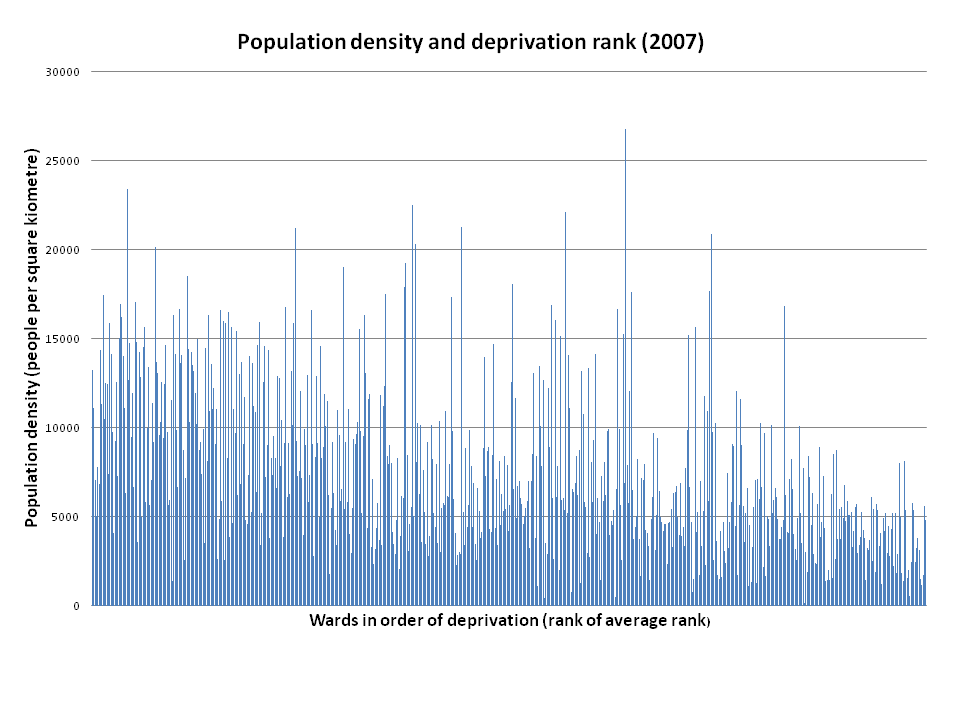
So how does density relate to deprivation?  In London, the most densely populated wards include both some of the richest and some of the poorest (Tachbrook and Green Street East (in Westminster and Newham respectively)), but the poorer wards are denser overall.  The graph below shows London\’s 620 wards grouped in order of their average rank in the 2007 Index of Deprivation, with their population density on the vertical axis. 

The co-efficient of correlation is -0.48, which implies some relationship between high deprivation rankings and high density, if not a precise one (IMPORTANT HEALTH WARNING: this blog post involves me using statistical formulae and large datasets, so should be treated with something between suspicion and disdain).  So far, so unsurprising.  Poorer areas are more likely to be in the inner city (so likely to be denser), and also likely to include fewer fripperies like parks that would detract from density (when measured as people per square kilometre, rather than as dwellings per hectare).  Prosperous areas that look dense because they are built up may actually be low density in terms of residents (from, for example, single people or couple living in larger flats with spare rooms).

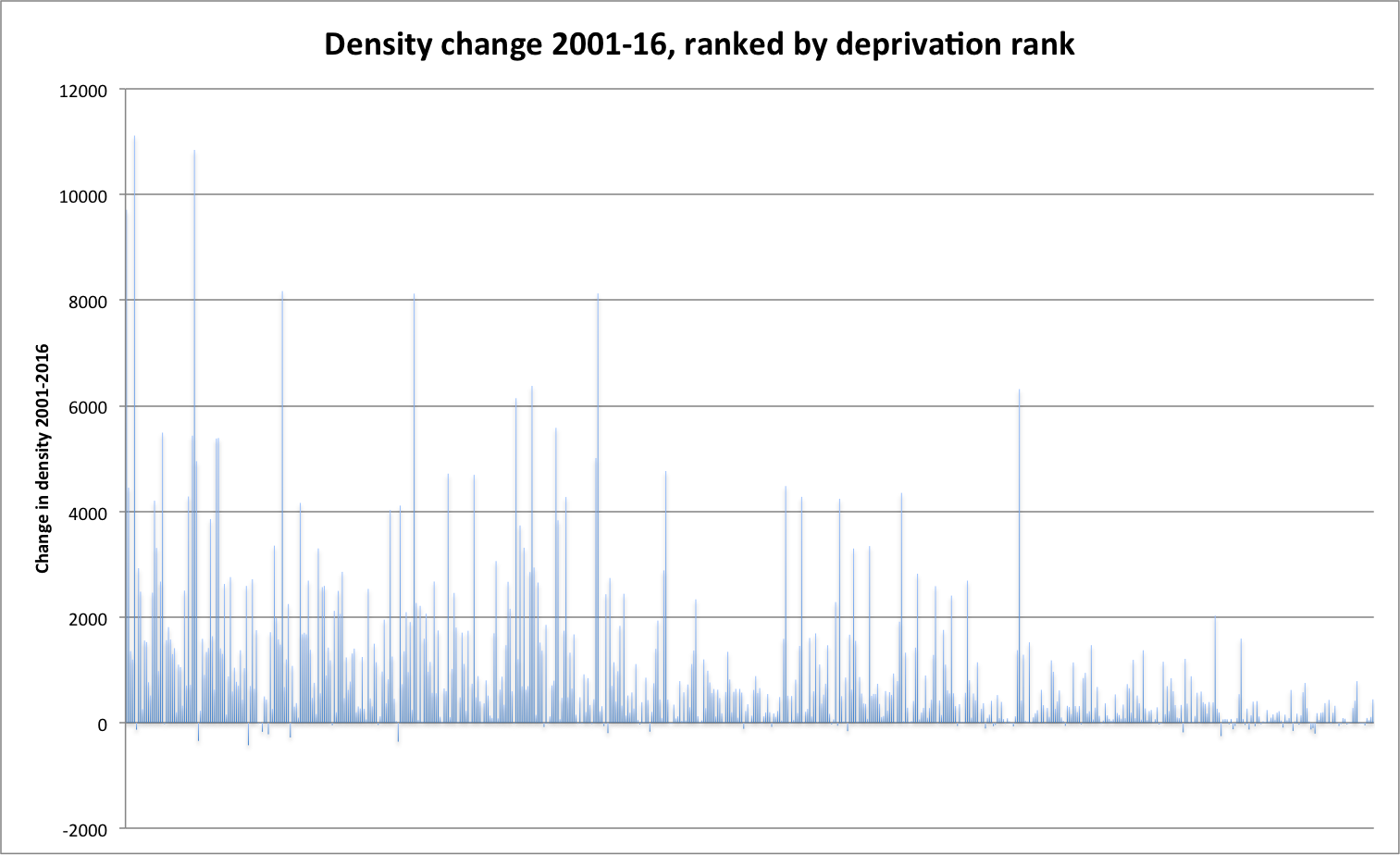
So, if that\’s our starting point, how has London been changing in recent years?  The chart below shows actual and projected changes in population density (2001-16), against deprivation rank.

Three things are immediately noticeable. The first is that London is becoming denser almost everywhere. Secondly, the curve is a lot more ragged: most wards are seeing a relatively steady change in population, but there are places (like Stratford New Town, Canning Town and Fairlfield) where density is more than doubling.  Finally, it is the poorer places that are densifying most intensively (with a correlation co-efficient of -0.40 between deprivation rank and absolute increase in density). These are the places that are densest, and getting denser: Northumberland Park, Bromley-by-Bow and Mile End are all among the places that are densifying by more than 20 per cent in fifteeen years.
So, what if anything does this all mean?  It means that we need to look at the numbers more closely.  How are inner and outer city areas differentiated, and how does densification relate to changes in prosperity and deprivation?   Is greater density a symptom of improving fortunes, or a cause of them?  Or does densification have the opposite impact on richer and poorer places, boosting prosperity in the former and amplifying the problems of poverty in the latter?  In the meantime, you can note that the densest, and poorest, areas in London are densifying fastest.  It\’s not clear that this is necessarily a good thing.
(Thanks to London\’s http://data.london.gov.uk/ site for the figures, and to Paula Hirst for the tip off)
DRAFT POST – TO BE REVIEWED

The wrong sort of community

A few years ago, I visited one of the poorer districts of Sao Paulo.  Not a chaotic favela, but a cluster of housing projects in an isolated location on the edge of town, as grim as a concrete structure can be under the blazing Brazilian sun.

The Paulistanos – architects, urbanists, social scientists etc – who were showing us round explained how areas like this suffered from very weak social capital, with few organisations in place apart from well-organised gangs like PCC. What about the huge buildings by the side of the highway? one of our party asked.  Ah, they were just evangelical churches, we were told.  There was a brief pause, and then the conversation moved on, avoiding any further mention of what are clearly some of the most powerful players in Brazil\’s civil society.

I remembered this a couple of days ago when I read, in Zoe Williams\’ comment piece in the Guardian, that London Citizens had been one of the few success stories in the Government\’s dismal Work Programme, getting 1,500 people into work.  I have had dealings with London Citizens over the years; they are an effective community organising and campaigning organisation, which has been assiduous in securing solid commitments from local authoirities and other public bodies, by offering public adulation or denunciation.

But you\’d have to look reasonably closely at London Citizens\’ website to see that this is a group with deep roots in the churches and mosques of London.  My first meetings with the group, almost ten years ago now, tended to involve an Muslim imam or two as well as a multi-denominational smorgasbord of Christian ministers (though one of my colleagues remarked sotto voce as their list of demands were read out, \”They\’re not priests, they\’re fucking Trotskyites\”).

These religious roots are politely ignored on all sides, not only because the unified front would fracture if theological matters were brought to the surface.  There is a faint feeling of embarassement among secular middle class liberals (like those sitting the other side of the table in City Hall) when dealing with religion.  The awkwardness increases when the religious belief is manifested fervently, as a central plank of identity, rather than as a private hobby that goes unmentioned in polite company.

But travel on any tube in east London, and you quite quickly see people (usually poorer, ethnic minority people) poring over their copies of the Qu\’ran, Bible or other religious text.  And the big razzle dazzle evangelical churches (some, like UCKG, imported from Brazil) can pack out auditoria every weekend.  So I\’m not surprised that London Citiens succeeded where private contractors have failed: they are reported to have preached the scheme in church and mosque and to have intervened directly (dressing unemployed people up, and driving them to job interviews).

However unsavoury some of their teachings to liberal ears, these \’faith communities\’ still seem to be able to touch the parts of society that the best-intentioned outreach programmes fail to get anywhere near.  It seems perverse to ignore them, then to talk of \’hard to reach communities\’.

Old Flo, the Bamiyan of Bow*?

In a bland blog in the Huffington Post, Tower Halmets Mayor Lutfur Rahman defends his plans to sell off Draped Seated Woman, the Henry Moore sculpture erected in an east London housing estate in 1962.  The article runs through predictable bromide about ring-fenced funding, Tower Hamlets\’  record in providing affordable rented housing and his electorate\’s support for the sale.

But Mayor Rahman makes an interesting point in passing: \’if only there was as much national media interest in the fact that we are being forced to make £100million cuts by 2015, as there has been over the proposed sale of this sculpture to mitigate the effect of some of those cuts.\’  There is something slightly uneasy about the intense focus on the sale of this work of art, when the material conditions for the people of Tower Hamlets, where more than fifty per cent of children live in poverty, are so poor and receive so little coverage in the media.

Of course there is more to it than that (and you can worry about poverty and cultural deprivation).  The sale of the sculpture (affectionately known as \’Old Flo\’) is understood by both sides of the argument as symbolic.  On the one hand it betokens nostalgia for post-war \’nothing too good for the workers\’ social solidarity that also gave us the magnificence of the Royal Festival Hall.  On the other hand, there is impatience with this nostalgia, which is largely (but not exclusively) being expressed by middle-class liberals like me: when will we start protesting as loudly about poverty and exploitation; when will we value flesh and blood, as much as bronze?

The comparison needs to be cautiously made, as Tower Hamlets is not the Afghanistan, but the terms of the debate remind me of when the Taliban government of Afghanistan blew up the great Buddhas at Bamiyan in 2001 – an act that scandalised the world.  The Taliban said that they did so after Swedish scholars offered money to repair the statues, but refused to let it be used instead to provide food for starving children.  Their gratuitous act of vandalism was a dynamite retort to westerners worrying about material heritage more than current poverty.

The sale is probably a done deal now, and a scandal of sorts. The issue is what sort of scandal it is: one of a callous council ready to sell its heritage for a mess of pottage, or one of tough choices between selling artworks, or cutting back services, exposing to greater risk local people already leading precarious lives.

* or Stepney, actually, but the rhyme works better if shifted a little further eas

Nothing but flowers

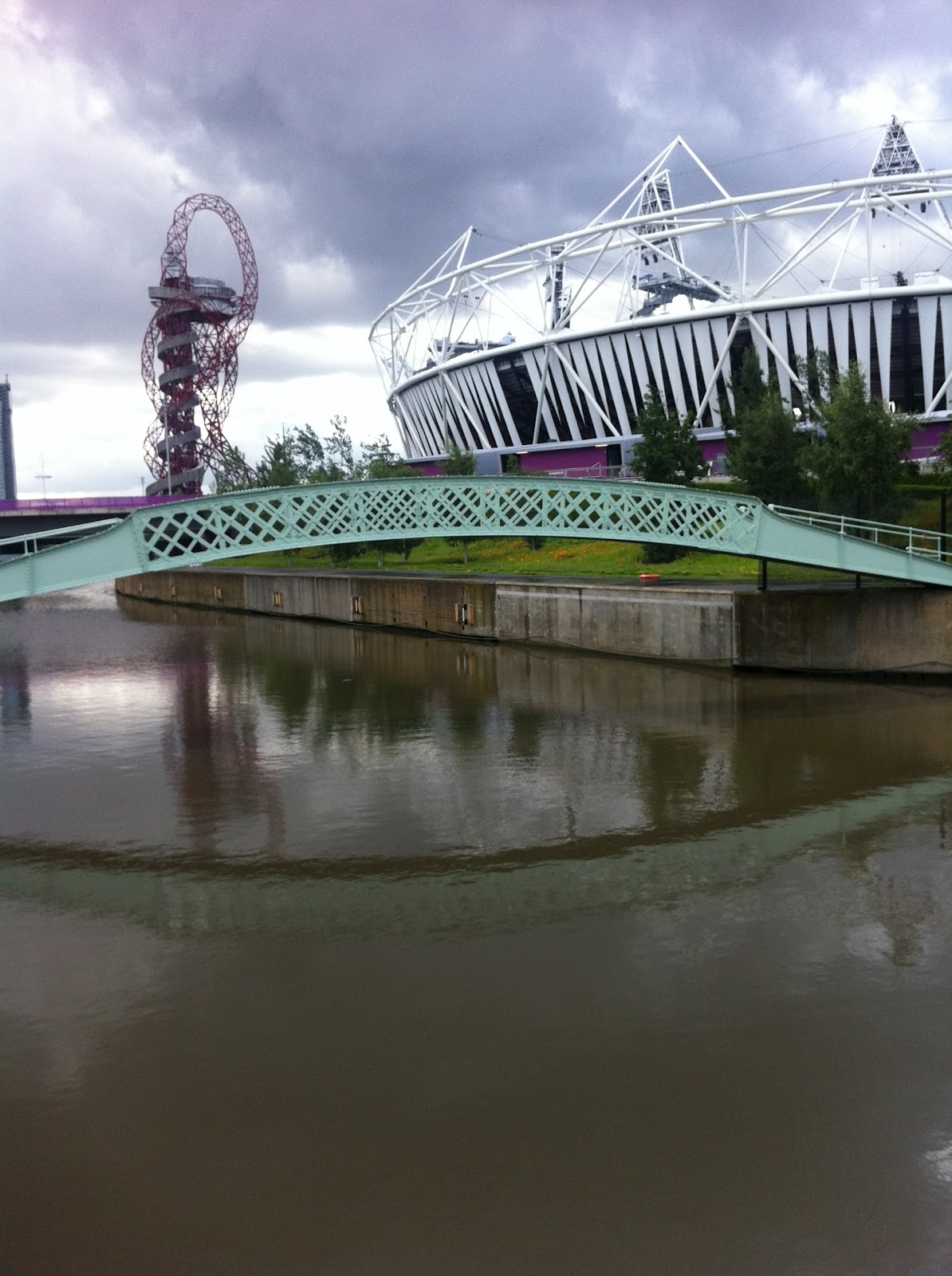
As I walked along the river bank past the bright flower beds, it was the pale green bridge that provoked a dizzy rush of rememberance, more flashback than madeleine.  The bridge had been there in 2006, when we passed by on an Easter weekend walk up the Lee Navigation.  Just past the \’Big Breakfast House\’ at Old Ford Lock, opposite blank-sided factories, a tributary ran down to a small green bridge, overgrown and inaccessible, on which someone had scrawled \’Fuck Seb Coe\’, in futile protest against the approaching Olympic juggernaut. 

Seeing the bridge again, now cleansed of its off-message graffiti, made me remember how much had changed.  Around this solitary remnant of the pre-Olympic Startford Marsh, hoardings had been erected and replaced by fences, now patrolled by soldiers on cycles.  The waterways beneath it had been cleaned of their colonies of invasive crabs and knotweed.  The roads that had woven between bus garages, factories, print works, fridge mountains, car breakers yards and evangelical churches had been uprooted, and the land levelled, creating a moonscape occupied by giant yellow construction vehicles, their manufacturers\’ logos obscured to satisfy the strictures of Olympic sponsors.  On this boundless and bare terrain, sites had been pegged out, their labels (Handball Arena, Stadium) looking like an optimistic child\’s fantasy of a construction site.

But the fantasy had quickly become real: earth had been cleaned and moved, piles were sunk, and slowly the uncanny structures of the Olympic Park venues had emerged from the mud.  Now, days before the opening ceremony, I had the chance to walk again across the site, without hard hat or steel-toecapped boots, past venues familiar from countless bus tours.  What is amazing, and delightful, is the verdant landscape.  

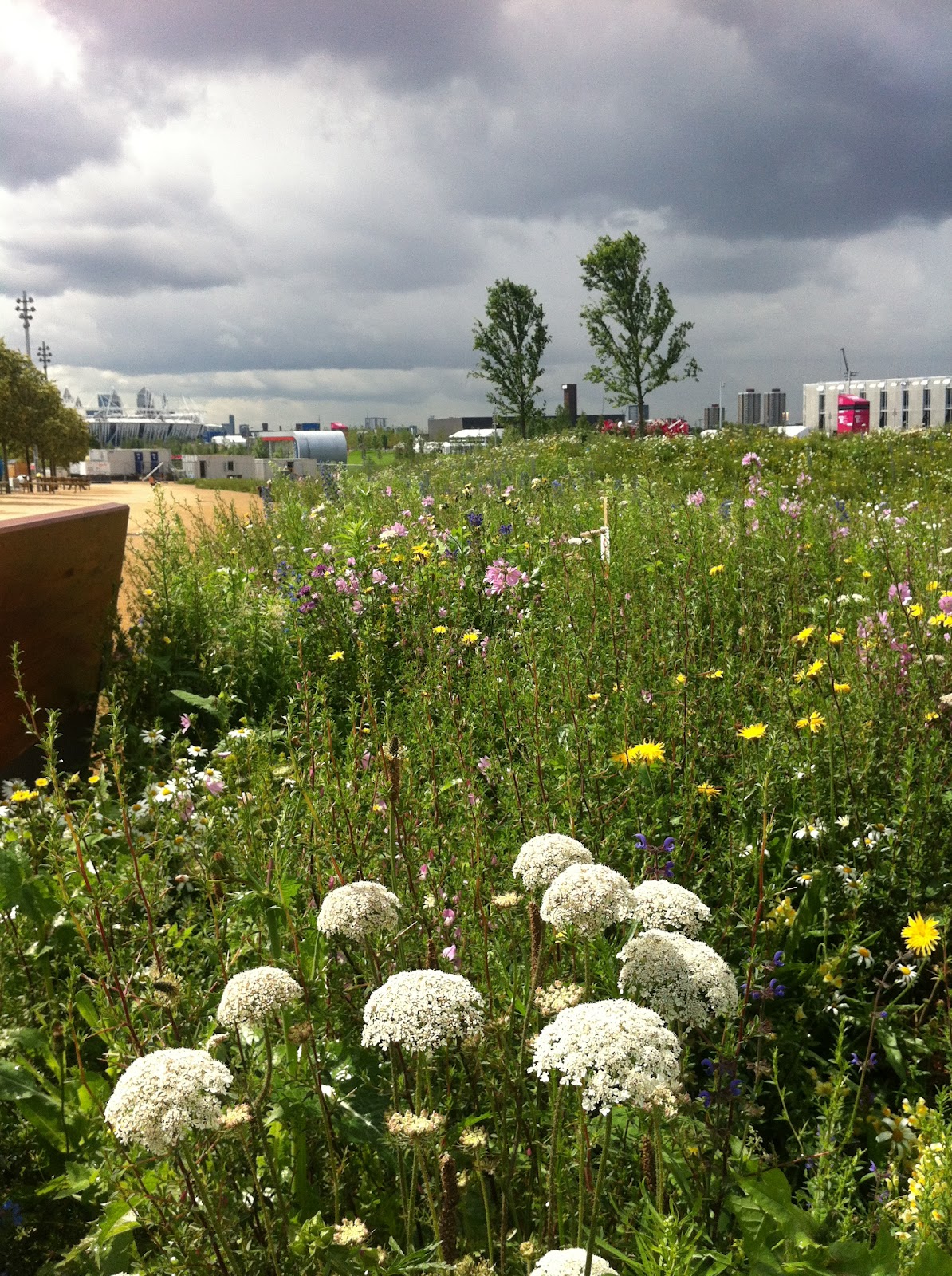
Between the hard angular shapes of the venues, and the wide walkways and concourses, great banks of flowers have erupted: Ox-eye Daisy, Purple Loostrife, Ragged Robin, Cornflower, Corn Marigold, Star of The Veldt, Pot Marigold, Tickseed, Red-hot Pokers, to name a few identified on the website of Nigel Dunnett, consultant horticulturalist.

The flowers and lush green lawns – well-watered in our rainy season –  soften the hard spaces of the Park, creating a genuinely beautiful landscape.  It\’s idyllic, but slightly ersatz, in stark contrast to the gritty pictures of Stratford that the Daily Mail delights in publishing.

The title of this blog post refers to a Talking Heads\’ song, a satire on arcadian nostalgia, which I couldn\’t get out of my head as I wandered round:

\”There was a factory; now there are mountains and rivers…there was a shopping mall; now it\’s all covered with flowers…once there were parking lots, now it\’s a peaceful oasis; this was a Pizza Hut, now it\’s all covered with daises.\”

Nostalgia for the grubby Lower Lea Valley of six years ago is tempting, but would be foolish.  The area was dirty, inaccessible and polluted, even though it hid secret jewels of natural beauty between car breakers, fridge mountains and other post-industrial drek.  What has replaced it is extraordinary, alien even. Perhaps that is what makes for an uneasy feeling; this lurching contrast with the world \’outside\’.

After the Games, and the remodelling and construction work that follows, London Legacy Development Corporation (who I work for) hopes that the Olympic Park will be a jewel in east London, and a force for change in one of the poorest areas of London.  But perhaps the traffic needs to be two-way, so that east London can also return to the Park, stretching to embrace it like tendrils of ivy, and blending the everyday and the extraordinary.


Gilded palaces

If there are two things I dislike with a moderate but consistent intensity, they are shopping malls and crowds.  So it was against all sorts of better judgement that I visited Westfield Stratford this evening.

As we walked through the thronged corridors of shops clad in gleaming marble, shiny glass and fashionably-distressed copper, my companion observed that the crowds really looked and sounded like East London – loud, ethnically mixed, not particularly well-heeled.

This reminded me of a middle-aged man I watched being interviewed when the Royal Festival Hall was refurbished in 2007.  When the building opened in the 1940s, the interviewee was growing up in South London, and vividly remembered his first visit to the venue: he could not believe that someone like him was not only allowed but encouraged to visit somewhere with this thickness of carpet, this richness of marble, this elegance of balustrade.

In many ways Westfield Stratford, the apotheosis of 21st century consumer capitalism, is the polar opposite of the Royal Festival Hall, with its high-minded aspirations towards \’culture for the masses\’.  But the buildings share something too: like the Festival Hall, Westfield Stratford isn\’t a dumbed-down version of something else.  It doesn\’t fob local people off with cheap finishes and \’value\’ retail outlets, but gives them as good a high-end shopping mall that it would build anywhere else.

There are plenty of criticisms to level at malls – their gaudy promotion of consumerist fantasy, their impact on neighbouring shops, their introverted street systems and privatised public space – and Westfield Stratford will probably be accused of many of these. But it doesn\’t patronise, or pander to presumed poverty of aspiration.  It deserves credit for that.

The chronic

There\’s a wonderful scene in Generation Kill, the HBO mini-series following a battalion of US Marines through the confusion of the 2003 invasion of Iraq, when the embedded journalist asks Lt Col Stephen \’Godfather\’ Ferrando why he speaks with such gravelly whisper.

\”Throat cancer,\” Godfather rasps laconically.

\”You a smoker?\” asks the journalist.

\”No,\” a long pause, \”just lucky, I guess.\”

I\’ve been thinking of this exchange as conversations with friends and acquaintances have touched on the various illnesses – heart disease, liver problems, cancers, degenerative conditions – that are beginning to intrude on forty-something lives. Almost invariably, the first reaction is, \”But s/he doesn\’t smoke/drink that much/eat turkey twizzlers/[insert bad habit of choice].\”

I wonder whether this surprise at people becoming ill despite their virtuous lifestyles is a peculiarly modern way of thinking. Medical science has made huge advances in digging beneath the symptoms to identify the underlying epidemiology, physiology and causes of diseases, and equally great strides in identifying the environmental or behavioural factors that can increase or decrease susceptibility to particular diseases.

But only very rarely has science identified a straightforward and un-varying causation: if you do x, you will contract y; if not, not. \’Luck\’ (which is actually how we describe causal factors that we don\’t understand) continues to play a part: only an idiot would deny the links between smoking and lung cancer, but 10 per cent of lung cancer cases still arise in non-smokers. We prefer certainty, and not to acknowledge that \”time and chance happeneth to all\” (hence, I suspect, the scrabble to blame non-smokers\’ cancers on \’passive smoking\’). And governments collude in the process, understanding that preventing the damage caused by unhealthy lifestyles works better, and probably costs less, than medical intervention to reverse or mitigate it in later life.

But is this assumption that our lifestyles can protect us from illness really a symptom of modernism, or does it represent the atavistic resurgence of something much older – a perception of disease as a punishment for moral iniquity? This view broke cover in the early days of HIV (memorably satirised in Brasseye\’s distinction between \’good AIDS\’ and \’bad AIDS\’), and persists in the absurd economic debates about whether smokers pay more in excise duty than they cost in medical care, and in the vilification of poor people for their diets. In understanding epidemiology, have we slipped back to attributing blame?

Control

My understanding of life as a poor teenager on an inner city housing estate is about as sophisticated as the Downing Street cat\’s take on politics: I can see it, where I live and where I work, but my analysis is superficial at best. Nonetheless, a few days after riots in London, thoughts and analyses race through my head, as the muttering backbeat of commentary – both banal and insightful – grows in volume. So, here\’s what I think today.

On Wednesday, Boris Johnson told the Today Programme, \”Over 20 or 30 years we have got into a situation where young people have a massive sense of entitlement.\” Leaving aside trite scoffs about his own Eton-educated sense of entitlement, he\’s on to something here. A sense of entitlement and benefit dependency are a reality for many poor people today, but the deeper tragedy is when this becomes the only reality.

From where I stand (and my limited perspective may be part of the problem), this world of entitlement and dependency looks pretty bleak – alienated from the sense of self-worth that work can generate, with weak family and social networks (apart from the toxic ties of gang culture), in grim environments illuminated only by the iconography of consumption. Russell Brand, writing in yesterday\’s Guardian, was typically eloquent: \”The only light in their lives comes from these luminous corporate messages. No wonder they have their fucking hoods up.\”

Benefits and precarious rights are the only stake that this class has in society. Should it surprise us that threats to these residual rights are regarded as an assault? Should we wonder that any fleeting opportunities to seize control and to share in consumer culture are embraced? We\’d like to think that education and employment initiatives can create those opportunities. For the lucky few they do, but that path looks increasingly steep, rocky and uncertain.

If you take a left perspective – and it\’s increasingly hard to find any others that make sense – you start to wonder what the role of the benefits system actually is. In the era when the spectre of communism was seen as a real threat to burgeoning capitalism, was social security used, like \’liquid cosh\’ in an old people\’s home, to pacify the masses and prevent them from rising up to seize control of a system that loaded the dice against them?

Perhaps the road to this week\’s riots is a long one, leading back through the last forty years, as working class culture wilted in a post-industrial economy, as the soviet regime faltered and fell, and as capitalism\’s leash was loosened by successive governments. The demented bout of speculation that ensued took the system to the brink of collapse, but the banks were bailed out, like rich kids in magistrates\’ courts, while welfare spending tightened and jobs became fewer and fewer – \’socialism for the rich, capitalism for the poor\’. Seen through this lens, it is not the riots that are remarkable, but the fact that peace was not breached far earlier.

In this uncertain state of crisis, the dependency relationship created by benefits may be one of the few ties that continue to bind the poor to the rest of society. The irony of the current situation may be that, by cutting benefits across the board (let alone withdrawing them from those involved in rioting), the Government may be undermining one of the few bulwarks that continue to defend a decadent and discredited capitalism.

Step on

After the riots, the surge of opinion and analysis. As Aditya Chakrabortty observed in today\’s Guardian, this week\’s mayhem has acted like a tumultuous Rorschach Test in which everyone can see what they want to see. So, three quick thoughts on the week\’s events (please take \’nothing can justify\’, \’London is the poorer\’ and \’in a very real way, we are all guilty\’ as read):

As any halfway-decent engineer understands, suspension bridges wobble worst when crowds fall into step: the unified pace amplifies the sway, and bridges become perilous. This natural tendency to lock step scuppered the Millennium Bridge in 2000, and a sign on Albert Bridge still warns troops to break step. Social networking enabled the rioters to converge and focus their looting, but enabled the clean-up too. The cumulative impact was dramatic: just as rioters overwhelmed the police, volunteer street cleaners swamped Hackney and had to be redirected to Clapham Junction. The capacity of social networks to foment groupthink makes for a queasy feeling, like being on a ship that lurches, as its passengers rush first one way then another. This alleged anarchy was built upon systems and herd mentality.

The roll-call of closed roads on Tuesday\’s radio bulletins gave a trivial taste of what is must be like to live in a war zone, never sure from one morning to the next what districts remain intact. It showcased the precariousness of urban life: the actions of a few hundred teenagers can quickly disrupt the delicately-balanced metabolism of the ecosystem (as can a few days\’ fuel blockade, or a heavy snowfall). But Tuesday also showed the resilience of that ecosystem: people picked their way past burnt-out buildings to the tube, and shops continued to operate from behind smashed windows.

Finally, the riots may not have been explicitly political, but they were about power. Or at least about powerlessness. It may be as futile as it is presumptuous to speculate about individual rioters\’ motives, but it is not hard to read into the faces captured on CCTV the euphoric rush of suddenly and surprisingly being in control – of your life, of your neighbourhood, of your scared fellow citizens. The price to be paid for those moments will be harsh, but will the violent euphoria prove addictive?

Communing wth locale

The random public sector buzz-word generator has been at work again, this time supporting the conference industry. I am invited to a conference that is entitled \’The Next Steps in Localising Communities: Localising Power, Empowering Citizens and Building Communities\’

This babbling brook of gibberish is actually quite impressive in that it manages to combine New Labour\’s vacuous \’communities\’ rhetoric with the Coalition\’s equally inchoate commitment to \’localism\’. A genuinely historic alignment.

It is also, at heart, almost entirely meaningless: how on earth does one localise a community? The words could be re-arranged at will – like a syntactical anagram – to make no more or less sense. \’Building the Locale: Empowering Communities, Localising Citizens and Localising Power\’, anyone? It makes no more sense and no less.

The attraction of laws

Tbings fall apart and you wonder – increasingly – whether the centre can hold. Just as one part of the Government is offering to repeal laws on demand, in the name of \’cutting red tape\’, other ministers are promising to introduce some of silliest-sounding laws in history: a law to guarantee a level of overseas aid equivalent to 0.7 per cent of gross national income, and a law to put the \’military covenant\’, which recognises the sacrifices made by the armed services and commits to fair treatment, on a statutory footing.

The issue is not fair treatment for service personnel or to generous overseas aid. Both are laudable aims. But neither needs laws. Proper treatment of the armed services is a budgetary and administrative matter, as is overseas aid. These laws will not create new offences, new rights or new statutory powers. So why take parliamentary time up with them?

Three explanations suggest themselves. One is that the Government is grand-standing; using legislation to make these administrative commitments is simply a way of underlining their importance, of inscribing press releases on vellum. A second explanation is that the Government is simply trying to wrong foot any of its successors who would want to govern differently; what they could do by fiat, they will make their successors do by law (or face the consequences of trying to repeal legislation).

A third explanation is perhaps more disturbing, if less cynical. As our constitution forms the executive from the legislature, it must be easy to confuse making laws with governing the country. This must pose a particular problem to a Conservative/LibDem coalition. They are pledged to roll back the frenzied law-making of which they accuse the previous government. But they can\’t stop legislating, any more than a shark can stop swimming as it sleeps. Making laws is what Parliament does, what governments do. So, instead of seeking to meddle in the every day behaviour of citizens, they have turned their gaze inwards, and apply the harsh discipline of statute to themselves and their successors.