Impossible pasts

The sun was skulking on Saturday morning when I got off the DART (Dublin’s suburban rail), and started walking along the promenade towards Clontarf, to see if I could spot the other me.

I’m never sure who he is (I guess he is still a he). Is he that earnest-looking academic type, coffee in hand, chatting with his husband as they stroll towards town? Is he that be-scarfed Leinster fan heading to Croke Park with his son? Is he (please not) that ruin, wheezing along blearily to see if The Yacht is open for morning pints?

He doesn’t really exist, of course, as these people or anyone else. He’s the counterfactual me, the one who might have grown up and stayed in north Dublin if my mother, Aileen, hadn’t given me up for adoption in 1970. I met her in the 1990s, so have been visiting Clontarf now for more than 30 years. I’ve been going ‘back’ there for longer than I’ve been going back anywhere else. It feels like going back home, but it’s not back and it’s not home.

But still. Every time I am there, I wonder who he/I would have been, how different life might or might not have been. Tough for Aileen in the early 1970s, I guess, when having a child ‘out of wedlock’ was still stigmatised. She would not have been treated as brutally as the working-class women sent to mother and baby homes, but it would not have been easy for her. And what would I have become? Looking like myself – same eyes and chin/s, I guess – but a similar person approached through a different route; or someone shaped very differently by his life and times? A long-lost twin or a distant cousin?

Aileen’s been dead for two years now, and in her absence the alternate me is also fading from view. I miss her, and I miss him too. But if I walk along the promenade to Clontarf, past the bathing shelters and the churches, glancing out at the Poolbeg chimneys and at the waders pecking at the Dublin Bay mud, I can still sometimes catch a glimpse of him.

Who needs remote control, from the City Hall?

This is a big year for London government anniversaries. The London boroughs are celebrating their 60th birthday this month and the Greater London Authority (GLA) will be 25 in May or July, depending on whether you choose the date of the inaugural elections for a Mayor of London and the London Assembly in May 2000 or the formal “vesting” of powers that took place in July of that year.

By way of a birthday greeting, London Councils has proposed joining the Mayor’s party by establishing something similar to the mayoral “combined authorities” that operate elsewhere in the country. In Greater Manchester, West Yorkshire, the West Midlands and the seven other mayoral combined authority areas, a directly-elected metro mayor presides over a council of local authority leaders and mayors and needs to secure its agreement for budgets, strategies and plans.

In London, a council of 34 members – the Mayor and the capital’s 33 local authorities – would be unwieldy, so London Councils has proposed a “combined board”, comprising the Mayor and its own 12 “executive members”, a party-proportional cross-section of council leaders holding specific Londonwide remits. This board could take decisions on “relevant powers and funding”.

Such a change would be a big deal, perhaps bigger than London Councils is admitting. The GLA model of a strong executive mayor and a scrutinising assembly was specifically designed to minimise overlap with borough remits. Although this principle has been eroded over time – for example, by giving the Mayor more powers on housing and land – establishing a London Mayoral Combined Board suggests something rather different.

For a start, it would call into question the role of deputy mayors. The original Greater London Authority Act (1999) gave Mayors limited powers to appoint staff. Ken Livingstone used these powers to appoint senior advisors on economics, housing, transport, the environment and other relevant policy areas.

Under Boris Johnson these were renamed “deputy mayors” (there is also a “statutory deputy mayor”, a London Assembly member appointed to succeed a Mayor unable to continue in office). If there was a deputy mayor for housing and a London Councils executive member for housing, who would speak for the Mayoral Combined Board on the issue?

A similar issue arises with the London Assembly. London Councils argue that there would be no change to the Assembly’s role, but this doesn’t feel right. As well as scrutinising the Mayor, the Assembly signs off his budget and strategies and has other powers which, though quite modest, give it authority and influence which can be significant, if judiciously used.

Were the Assembly to continue in its current form under the London Councils proposals, there would be a situation in which a (directly-elected) Mayor proposed a budget or strategy to be first agreed by a Mayoral Combined Board (representing 32 elected boroughs plus the City of London Corporation) and then passed to a (proportionately elected) London Assembly for confirmation.

This would seem to be an onerous exercise in triple-handling and a recipe for disputes over mandates and remits. But if the Assembly lost those powers it would lose much of its bite. In which case, why not replace it with a borough grouping like the Overview and Scrutiny Committee in Greater Manchester?

In such respects, the London Councils plan is more radical than it might appear to be at first glance. But most importantly of all, is it a good plan?

London Councils argue that London’s current arrangements have become anomalous in the new devolution order. With mayoral or other strategic authorities set to be established across England, London’s “could become the only upper-tier council leaders in the country without a formal say over the decisions of their region’s Strategic Authority”.

It is true that London’s arrangements are different, but so is London. The Devolution White Paper published in December appears to acknowledge this. It pledges to apply an integrated financial settlement for London “while retaining pe-existing bespoke London arrangements…[and] existing ways of working with London Councils”.

Ironically, Sir Sadiq Khan has gone a lot further than his two antecedents in working closely with the boroughs. The recent London Growth Plan was developed in partnership with them, building on the work of the jointly-chaired London Recovery Board and London Partnership Board during and after the pandemic.

Mayoral strategies and budgets are all subject to consultation with the boroughs, but there are some areas where the Mayor has, by design, an independent and overriding role. The main example is powers over planning policy, where borough local plans must reflect London Plan policies (following consultation) and the Mayor retains a right to take strategic decisions over the heads of individual boroughs. (The White Paper, by the way, pledges that all metro mayors will receive similar powers, which seems hard to square with the “collegiate” model of combined authority government.)

It is true that Greater Manchester has prepared a joint plan, Places for Everyone, which was adopted last year. But the document took ten years to finalise, one borough (Stockport) withdrew from the process, and the plan has been criticised as merely drawing together unambitious local housing plans rather than seeking to take a strategic – and sometimes disputed – view of need and opportunity.

But maybe there’s a bigger picture approach that might be taken to reform in London. Perhaps new arrangements could be devised that would allow London’s boroughs to have greater formal involvement in the development of the city’s economic strategies and plans, but also enable the Mayor to have more say in overseeing and co-ordinating council services and regulatory functions – from licensing to social care to street cleaning.

It might also be an opportunity to look again at the structure of the boroughs themselves. One thing that the West Midlands and, to a lesser extent, Greater Manchester have is a single local authority overseeing the whole of the core of the cities they serve. The LSE’S Greater London Group suggested such an authority for London to the Herbert Commission in the early 1960s, but this was not followed through when the 1965 reforms were put into place.

The Greater London Authority has already outlived the Greater London Council by five years. While few would wish to repeat the chaotic and politically-motivated abolition of the GLC, the 60th and 25th anniversaries may be a time for reflection on how well current set-ups are serving London. But whether the London Councils proposals are a basis for a new settlement, a contribution to a more far-reaching debate or destined to be just a footnote in London government history remains to be seen.

First published by OnLondon.

I can’t get no…

Record levels of dissatisfaction with the NHS‘ seems to have become an annual headline fixture, dusted off each year around this time, when the King’s Fund and Nuffield Trust publish the health findings from British Social Attitudes.

This year was no exception, with just 21 per cent of people expressing themselves ‘satisfied’. But what exactly are people dissatisfied about, and what do they want done about it? Given the importance of debates about the NHS, it is worth diving into the figures to understand a bit more.

1. Wait in vain

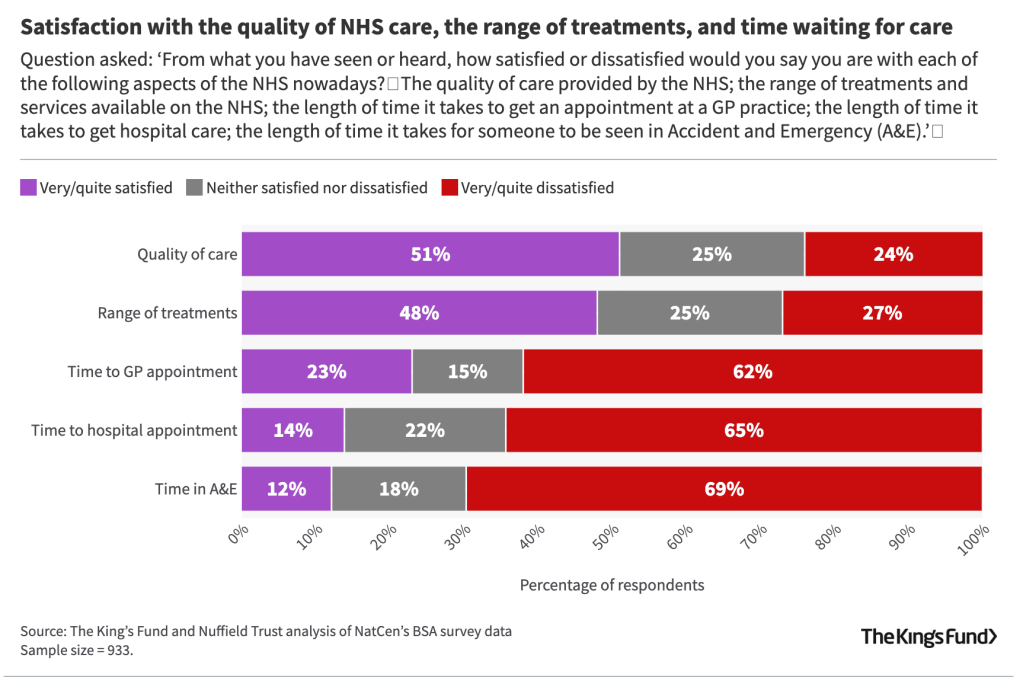
Dissatisfaction is rife across services – from dentistry, to GPs, to A&E, to hospital care, to social services. But it is the time spent waiting – in A&E or for GP or hospital appointments – that rankles most. Only 25 per cent are unhappy with the quality of care or the range of treatments available; around 50 per cent are satisfied.

The problem with NHS care is the quantity provided not the quality – as is also reflected in 75 per cent saying the NHS is understaffed. Produtivity and enhanced outcomes are important, but unless these lead to more responsive services, they may do little to shift public perceptions.

2. No tax, only spend

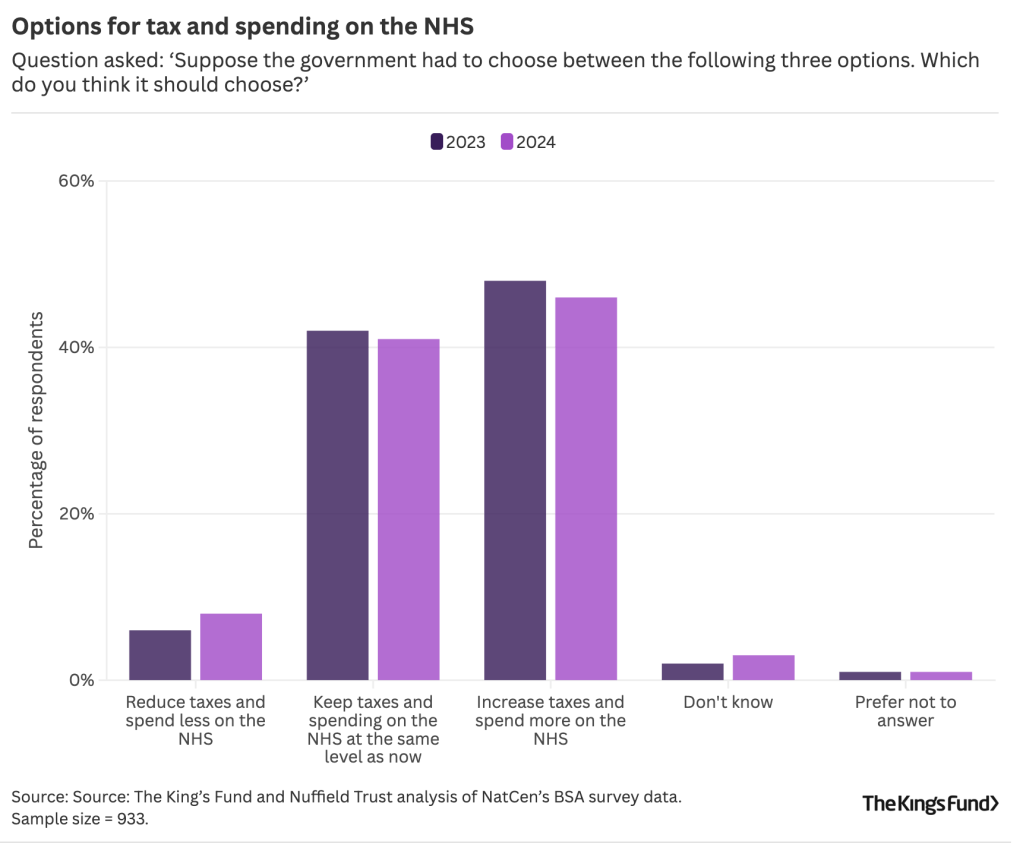
Nearly 70 per cent of people think that the government should spend more on the NHS, but only 46 per cent think taxes should go up to do this, a very slight fall from 2023. These views are not necessarily inconsistent with each other, or with the government’s policy, which has been to spend more on the NHS without raising personal taxes.

But I wish that British Social Attitudes would ask a follow up question, both on this specific issue and on their more general finding that the public wants to pay more tax for better public services, and has done for almost a decade. ‘Which taxes do people wish to see rise?’, they should ask or even ‘Do you think you should pay more tax?’ I suspect that there is far more enthusiasm for tax rises in the abstract than there is for the specific, let alone the personal. I may be wrong, but it would be useful to know.

3. Shaky foundations?

British Social Attitudes also asks about whether people sign up to three ‘founding principles’ of the NHS – universality, freedom at point of use, and funding through taxes. Bea Taylor from Nuffield Trust is quoted as saying, “support for the core principles of the NHS – free at the point of use, available to all and funded by taxation – endures despite the collapse in satisfaction.”

Well, up to a point. Support for the NHS being free of charge at the point of use has been sustained. But there are signs of change elsewhere. The proportion of people saying the NHS should be definitely available to everyone has fallen from 67 to 56 per cent since 2021, and the saying taxpayer funding definitely applies has fallen from 55 to 42 per cent. These are pretty substantial shifts.

The biggest gains have been both those opposing the propositions, and those feeling that the propositions ‘probably’ apply. It seems support for these core propositions, while still broadly intact, is less fervent than it once was – a change that could be attributed to anti-immigrant feeling (for the ‘universal’ principle), to a rise in Reform-driven debate about ‘insurance-based models’ (which the party is rather coy about), or simply to people thinking that something has to give.

As the Government prepares to launch its Ten Year Plan for the NHS, it will be interesting to see what that might be.

Where will they go to, the robotaxis, when we’re asleep in our beds?

The Automated Vehicles Act 2024 received royal assent on 20 May last year, but was rather overshadowed by a rain-soaked Rishi Sunak announcing, two days later, that he was calling a general election. While the Act leaves a lot of detail to secondary legislation (an explainer by Scarlett Milligan of 39 Essex Chambers  is helpful), it sets out a structure for regulating the use of self-driving cars, which could see them on Britain’s roads as early as next year, according to a Department for Transport press release.

The year 2026 is suddenly very near, and it seems unlikely that regulations will be in place by then. But there have already been London trials of autonomous vehicles – in the Queen Elizabeth Olympic Park and in Woolwich – and Waymo self-driving taxis are commonplace in several US cities, including San Francisco, where the urban environment is as almost complex as London’s. This particular future seems to be drawing closer.

You can debate whether self-driving cars (more likely to operate as “robotaxis” than as individually-owned vehicles, for the next few years at least) are a good thing. Advocates say they could reduce accidents and congestion, and offer liberating point-to-point transport for people who are currently excluded by price, location or physical conditions – a case argued in an excellent blog by James O’Malley, which set me thinking about what abundant robotaxis would mean for London.

Not everyone is so positive. Sceptics argue that robotaxis could divert people from healthier walking and cycling, lead to more sprawl, congestion and pollution, reduce social interaction, and undermine the viability of mass public transport. Transport for London’s 2019 position statement takes a fairly guarded view, pointing to the Mayor’s strategic priority – that 80 per cent of journeys should be made by walking, cycling and public transport by 2041.

Progress towards that target has been slow: around 63 per cent of journeys were made by walking, cycling and public transport in 2023, a level that has barely changed over ten years. But in any case, it seems to me that readily-available and cheap robotaxis would be very attractive to people – including those who do not like walking, cycling or using public transport, or are not able to use those ways of getting around.

So, unless the government chooses a highly restrictive approach (essentially banning autonomous vehicles), the question becomes one of what policies cities such as London should adopt in order to manage their impact on urban mobility, on the built environment and on public health.

At the moment, it costs more – in time and money – to use Waymo taxis than to use Ubers in San Francisco, but that gap is likely to narrow and reverse as the technology improves; McKinsey estimate that by 2030 in the US the cost per mile will be little more than  using your own car. If the cost fell that low or further, the challenge for public transport systems and for urban streets would be acute. People could switch to robotaxis en masse – causing gridlock and stripping London’s trains and buses of paying customers (even if gridlock would eventually choke demand).

One inevitable policy response to the arrival of autonomous vehicles is the (much discussed and much can-kicked) introduction of road user charging. As my former colleagues at Centre for London have suggested, this could be targeted so that using roads (and robotaxis) is made more expensive where journeys can be easily made by public transport, walking or cycling, and cheaper in places where those options are not available, and for people to whom they are not accessible.

Switching from car ownership to robotaxi use could also potentially free up road space. Car ownership is already declining faster than car use in London, and abundant robotaxis could accelerate this, with many privately-owned cars disappearing from kerbsides and suburban driveways, opening up new public spaces across the city.

But where would the robotaxis go, while we’re asleep in our beds? A dystopian, polluting and congesting, scenario would see empty cars cruising London roads until summoned by passengers, like electric Marie Celestes. A better option would be to place limits on empty circulation, and to provide local parking hubs with charging facilities and waiting space.

This would require some adaptation of existing car parks (which could hold many more cars if no human drivers needed to get in and out), and perhaps transport hubs being incorporated into new developments; again, Centre for London has undertaken research in this area.

From a public health perspective, you might go further, requiring or incentivising most users to walk to a transport hub to pick up a car, rather than to expect door-to-door service. This might be too nanny-ish for some tastes. But not only would it incorporate a (minimal) level of walking into most journeys, it would also discourage people from using cars for shorter, walkable or cyclable, trips.

The 20th Century city was shaped by private car ownership. If robotaxis become commonplace, their impact on the 21st Century city could be just as great. Policy action will be needed, and soon, to make that impact positive.

First published by OnLondon.

Fade to Grey (Belt)

Last week, Angela Rayner gave Marks and Spencer permission to demolish and rebuild their flagship Marble Arch store, in line with plans first submitted to Westminster City Council in February 2021. In between those dates, the proposal was considered by Westminster and by Sadiq Khan (both of whom approved it), by a public enquiry and by Michel Gove (who overruled them all and turned it down), by the High Court (which overturned Gove’s decision) and by Rayner (who gave the go-ahead). Whatever view you take of the proposals, these layers of decision-taking and months of delay cannot be right – the reconstruction phase of the Notre Dame project took less time.

Against this backdrop, you can see why the Deputy Prime Minister has announced major reforms of planning this week – a consultation on planning decision processes on Monday and now a new National Planning Policy Framework. The consultation paper proposes a national “scheme of delegation” to ensure that more planning decisions are taken by planning officers, rather than by planning committees. The paper also proposes smaller strategic committees to agree documents such as opportunity area planning frameworks, and seeks to beef up training for planning committee members.

The proposals have been widely welcomed as a helpful act of streamlining, which reduces the risk of capricious committee decisions to reject proposals even when they are in line with local planning policy. Such refusals may lead to amendment and a new application, or to appeals to the planning inspectorate, but cause delay and incur cost either way.

For some commentators, this approach is also a helpful first step towards a “zoning” process that shifts the political focus from considering individual applications to agreeing policies and design codes. “Shouldn’t we be aiming for a system which makes [planning committees] redundant entirely?” architect Russell Curtis asked. If proposals comply with policies and codes, they can go ahead with minimal paperwork, though agreeing local plans and policies would become more complex and contested were they to give an automatic green light to compliant proposals.

As ever, London is a bit different. The capital already leads the way in delegating planning decisions and in processing applications fast. The most recent government stats show that in the year to June 2024, 97 per cent of decisions were delegated to officers, more than in any other region. Some boroughs delegated nearly all decisions.

London boroughs work fast too, deciding an average of 93 per cent of major applications within government-mandated deadlines (or other deadlines agreed with applicants) in the two years to June 2024, compared to 90 per cent or fewer in other regions. The capital also has lower rates of decisions being overturned on appeal than most other regions. The system works efficiently.

But it is not enabling the homes London needs to be built. London planning authorities turned down more applications than in other regions: 20 per cent across the capital compared to 15 per cent across England, and as many as a third in some outer London boroughs. Total application numbers are for around 60,000 homes per year, and their number has fallen by a third since 2016, significantly faster than in other regions.

This fall off in planning activity and low rate of approval feed off each other – if it is difficult to get planning permission in London, some developers stop trying or look elsewhere. London’s problems look like problems of policy as well as process.

That is where the new National Planning Policy Framework (NPPF) comes in. It confirms binding targets for local authorities across England. London’s new target is around 88,000 homes per year. That’s higher than the 80,000 target proposed after the general election, but lower than the 99,000 target that the Conservative government set in 2020 (though in 2022 the Conservatives also made targets “advisory”). It is, nonetheless, a huge jump from the current London Plan target of 52,000 homes per year, let alone the average 38,000 net additional homes built over the past five years.

The big policy change in the NPPF is its very careful relaxation of Green Belt rules. The Framework says that if a council is unable to meet its target through using previously developed land and densification, and if it is unable to collaborate with a neighbour to plug the gap, then it can consider using Green Belt land.

It must first look at previously developed land in the Green Belt, then at “grey belt” land which does not strongly contribute to the Green Belt’s core purposes – checking unrestricted sprawl, preventing urban areas merging into each other and preserving the setting of historic towns.

Other rules, relating to affordable housing, new and enhanced green space, design quality and infrastructure provision, still have to be followed, and land that is protected for special scientific interest or outstanding natural beauty, as a “local green space” or as part of a national park is excluded.

Even with all those caveats, the new policy makes London’s edges ripe for review. The definition has helpfully moved on from an aesthetic focus on “poor quality” Green Belt (which may be in entirely the wrong place), to considering whether Green Belt land actually does what it is meant to do.

On the face of it, a lot of the inner Green Belt within Greater London could meet the criteria for consideration: there’s still plenty left to separate London and surrounding towns, and a managed release is not unconstrained sprawl. But governance and geography are tricky: some of the boroughs facing the biggest shortfall don’t have much Green Belt land, and even when they do the land may not meet the government’s tests.

That could be a recipe for mess and disagreement but could also be the opportunity for a metropolitan solution. The Mayor could work with boroughs to marginally redefine London’s edges, to share the load of housebuilding, and to plan for urban extensions that make the most of existing and new infrastructure.

Could that happen? Khan opposed Green Belt reviews in the past (when a Conservative government would have vetoed them anyway), but times have changed. Khan’s 2024 manifesto was silent on the Green Belt, and a London-wide review would be a good way of demonstrating the value of a Labour Mayor to a Labour government, and vice versa.

But Green Belt extensions will not solve all of London’s housing delivery problems. London needs more planning permissions and more building, including of the around 300,000 homes that already have permission. But a viability crisis is holding back both. Former Southwark leader Peter John has argued that affordable housing requirements without sufficient grant subsidy are stifling development in some cases, and pushing up prices of market homes to enable cross-subsidy in others: “a vicious circle of non-affordability is made worse by demanding ever higher levels of affordable housing without some other grant subsidy being provided.”

Other commentators, such as Beacon Partnership’s Steve Beard, have argued that it is the sheer weight of design, carbon offset and infrastructure obligations imposed in London that is making schemes unviable. Centre for Cities’ Ant Breach argues that the London Plan duplicates local plans and suppresses development, pointing to the London Plan review commissioned by the last government, which found “persuasive evidence that the combined effect of the multiplicity of policies in the London Plan now works to frustrate rather than facilitate the delivery of new homes, not least in creating very real challenges to the viability of schemes”.

Given London’s slowing rate of housing delivery, and its stock of permitted but stalled developments, these arguments should be taken seriously. Are the policies that worked in a boom, when rising prices washed away the costs of planning obligations, also the right ones for when house prices are stagnant and delivery is stuck? After the financial crisis, quantitative easing, a cheap pound and open borders helped fuel a property boom, but these engines have fallen silent.

At the same time, affordable housing provision has become increasingly dependent on market housing. Around 50 per cent of affordable housing in London is now delivered as a planning obligation, so when private housebuilding slows, so does affordable housebuilding. Recent Greater London Authority (GLA) analysis shows the impact of this. In 2023, 38 per cent of the homes granted planning permission in London were affordable – a total of 11,725 units. In 2015, only 26 per cent were affordable, but this totalled a higher 14,000 units.

If a system based on cross-subsidy has stalled both affordable and market provision, either policy or funding need to shift. London has an urgent need for more affordable housing, so lowering targets too far seems perverse. But 35 per cent of something is still better than 50 per cent of nothing.

Alternatively, higher grant levels would enable boroughs, housing associations and private developers to build more affordable homes. A recent Centre for Cities report suggests that the government’s £500 million Affordable Homes Programme (administered by the GLA within London) would need to triple in size to get public housebuilding rates back up to their mid-20th Century levels. A tall order, but maybe one that could be justified as an investment to save on long-term housing benefit and temporary accommodation costs.

Finally, central government should recognise that it too needs to be part of the solution. Successive governments’ accumulation of policy prescriptions (including new duties such as “biodiversity net gain”) represent a tax on development, adding to those imposed by local and regional government.

Everything is introduced for good reason, but maybe the time has come for an open discussion of where other policies and stakeholder interests are strangling the government’s declared growth imperative. And, to end where we started, if an application has been considered by London’s elected local authorities and by its Mayor, does Whitehall really need to have a go too?

First published by OnLondon.

Housing in London – every cloud has a cloudy lining

There’s a German word, “dunkelflaute”, which translates as “dark doldrums” – periods when there is no wind or sun to generate electricity (making you reliant on coal and Russian gas, if you happen to have shut down all your nuclear power plants). London’s housing market seems to be facing dark doldrums at the moment: prices are stuck in a rut, residential planning permissions are at half the level they were five years ago, and transaction volumes and new building have slowed to a crawl.

Property prices in London shot up after the financial crisis, but have risen far less dramatically since 2016, as a result, property analyst Neal Hudson suggests, of tougher regulation of residential mortgages and more taxation of property investment. The market boomed briefly from 2020 to 2022, but has fallen back since then. According to the Nationwide Building Society’s index, average prices were ten per cent higher in 2024 than eight years earlier, but that is a 15 per cent fall once inflation is taken into account.

After decades of soaring prices, surely cheaper housing is good news for somebody? The Nationwide data show that the average price paid by a first-time buyer in London is now less than nine times median earnings, the lowest ratio for ten years. Rental affordability also seems to be improving, with government figures showing average rents taking up around 40 per cent of median income of renting households in 2022/23, compared to 57 per cent in 2016/17.

But neither of these figures tells the whole story. To paraphrase Withnail, living in London is becoming cheaper for those who can afford it, but remains prohibitively expensive to those who can’t.

Cheaper houses are only cheaper if you don’t need to borrow money. For first-time buyers, rising interest rates have gobbled up any savings from price falls: in 2020-22 Nationwide calculated that mortgage payments accounted for around 50 per cent of first-time buyers’ take-home pay.

Rising interest rates pushed that up to 66 per cent at the end of last year, though it has fallen back to around 60 per cent since then (a similar level to 2016). And, even with lower prices, London buyers still need to find deposits of £110,000 – a gargantuan sum for anyone without blockbuster bonuses, access to the Bank of Mum and Dad, or at least somewhere to live rent-free (and possibly holiday and fun-free too) while they scrimp and save.

As Paul Johnson of the Institute for Fiscal Studies recently observed, this means that anyone without wealthy parents or somewhere to stay rent-free will find it much more difficult to move into their own property in London and to enjoy everything the capital offers.

This might not matter if the Levelling Up dream of excellent jobs everywhere had been realised. But it hasn’t, and London should be able to offer opportunities for all, not just those lucky enough to have been born within the M25.

Apparent improvements in rental affordability also obscure a less positive reality. Government figures show that between 2016/17 and 2022/23, rents fell from 57 to 40 per cent of household income for people renting. But for someone earning median wages in London, rent fell from 59 per cent to 53 per cent of gross earnings over the same period – a significant drop, but much smaller than that implied by the official figures.

Why have renters’ household incomes increased faster than median wages? It could be a result of an increasing number of renting households having more than one earner, or maybe lower earners being squeezed out of the private rental market altogether.

Every cloud has a cloudy lining. If stagnant house prices are not doing much for renters or first-time buyers, they are doing even less for housebuilding. In 2023/24, around 32,000 dwellings were added to London’s housing stock, the lowest level since 2014/15, when the city was still emerging from the financial crisis. These include conversions and changes of use (including the dwindling number of office-to-residential conversions). And only 33,000 new residential units were given planning permission in 2023/24 – way below the peak of 80,000 plus each year between 2014/15 and 2018/19.

When prices fall, housebuilding slows, almost as a thermostatic reaction. Developers base their business plans on a range of projections, including changes in house prices and build costs. If prices go up faster than costs, building goes ahead. But in a stagnant market with high construction inflation, plans are paused or slow-pedalled.

After the financial crisis, housing associations were able to take up some of the slack, completing an average 7,000 homes each year in the five years from 2008/09. But their output in the past five years has been half that, as the need to fund safety improvements and squeezed grant levels have reduced capacity. Local authorities have started building more, completing 3,000 units in the past two years alone, but there is still a gap.

The dark doldrums cannot last forever. Interest rates are forecast to fall next year (if not as fast as previously predicted), which may help more first-time buyers to take advantage of lower prices. In addition, while provisional figures for housing starts in 2023/24 are the lowest since 2020/21, construction economist Noble Francis has observed that brick deliveries, a good leading indicator for housebuilding activity, were 21 per cent higher in October than a year earlier.

There is also Deputy Prime Minister Angela Rayner’s shake-up of planning, heavily trailed in interviews and newspaper pieces last weekend. Will this be enough to treble London’s house building rate in order to achieve its 80,000 homes a year target? What other changes might be needed? Watch this space.

First published by OnLondon.

Back to work

Londoners have been slow to get back to their desks compared to workers in other large cities, according to Return to the Office, the latest report from think tank Centre for Cities. Why is that, does it matter and what can be done?

The report’s polling, carried out in June, finds that central London office workers are spending an average of 2.7 days per week in the office, less than their counterparts in Paris, New York and Singapore, though pretty similar to those in Sydney and Toronto. As in  those other cities, their office days are concentrated in the middle of the week, with London showing the sharpest drop-off on Fridays, when just 40 per cent are traveling in to work.

London’s sluggish return is explained by two main factors, the report suggests. On the management side, London bosses seem more reluctant than those in other cities to specify when workers need to be in. And while workers and bosses alike value the chance to develop relationships and collaborate in person, London’s workers particularly also appreciate the cost savings and time flexibility offered by working from home – more than those in other cities.

The Centre for Cities findings reflect those of the King’s College Policy Institute’s London Returning survey of 2022. This found that most London workers felt positive about being in the office, but that 80 per cent said that avoiding the commute, its costs and its time demands was a good reason to continue working from home.

London government has sought to address this issue through the “Off Peak Friday” trial that ran from March until May on Underground, Overground, DLR, Elizabeth line and some National Rail services. It led to a modest increase in commuting on Fridays, but awareness and take-up was limited. Speaking at the Centre for Cities launch event on Tuesday evening, Deputy Mayor for Business Howard Dawber said City Hall was still mulling the outcomes of the trial.

However, while London commuting costs are high compared to most of the other cities in the study, I suspect the bigger problem lies outside the capital. On commuter lines beyond Sadiq Khan’s control, both expense – despite the paltry savings offered by flexi season tickets – and chaotic performance, worsened by rolling strikes in recent years, make a trip to London a pricey roll of the dice.

These costs and inconveniences may explain one area where London bucks the trend: in London, unlike the other cities, younger workers were spending most days in the office and saying they work most effectively there. They are also the workers most likely to live in London, while many older ones commute in from the Home Counties – a trend that was accentuated during the pandemic – or at least used to. Anyone who has joined an online call with younger workers balancing laptops on washbasins in shared flats with iffy WiFi while older workers dial in from their immaculately-restored half-timber country cottage may understand why the former are keener than the latter to get back.

At the launch event, panel members Dawber, Kat Hanna (Managing Director at Avison Young) and David Wreford (Partner at Mercer) agreed that the return to the office seemed to have plateaued in London, and that the pandemic had accelerated and intensified trends towards more flexibility. But there was less consensus among panellists and audience members on whether this was a good thing, and about what if anything could be done about it.

A fundamental question was, against the backdrop of government’s “Growth Mission”, how does hybrid working affect productivity? Intriguingly, Return to the Office finds that most workers could see individual productivity benefits from working at home, but were concerned about the long-term impacts on skills, pay and promotion prospects, all of which affect organisational productivity. The skills gap could particularly affect younger workers, unable to learn from working alongside more experienced staff, if the latter continued to stay home for most of the week.

The evidence on productivity is still emerging and tentative, though face-to-face interactions and proximity are the lifeblood of the agglomeration benefits that cities offer – even if these apply more for some teams and some sectors than for others. The report recommends that more research be done on the productivity impacts of hybrid working, but the risk is that we will only know the impacts when looking in the rear-view mirror; that we won’t know what we’ve got till it’s gone. So we need to make some informed judgement calls and watch for early signs of long-term effects.

In the meantime, more flexible working patterns were transforming working life for people with caring responsibilities – generally women, who the London Returning survey found were more positive about working from home and more reluctant to be told to work more days in the office. Reduce flexibility and these workers might once again be excluded from the workforce. The Mercer research confirmed this, Wreford added: women were most likely to switch or stay in jobs as a result of flexible working incentives, while men were more likely to be motivated by financial rewards.

Furthermore, while parts of central London’s economy were struggling with new work patterns, suburban areas might be thriving (though ONS analysis suggests local spending patterns have returned to their pre-Covid levels). And Hanna observed that a broader shift to mixed use might strengthen central London’s offer as a place of leisure, as well as work: “It’s called the Central Activities Zone; that doesn’t tell you what those activities need to be.” While peak hours Tube use remains below 2019 levels, evening and weekend riderships are already higher, suggesting that London’s offer to visitors – short and long distance – is stronger than ever.

Finally, what, if anything, should be done to change the situation? Mayor Khan wants central London to be busy, Dawber said, but can only offer incentives and encouragement. British bosses are reluctant to impose tougher “back to the office” mandates according to the polling, and government policy is pointing in the direction of more flexibility, not less.

So, is this the much discussed “new normal” – neither citypocalypse nor a snap back to the heady days of February 2020? It may be an equilibrium for the moment, but perhaps not a stable one. As panellists noted, climate change and artificial intelligence may dramatically change where, how and by whom office work is performed in the future. We may be only at the beginning of a period of rapid change.

First published by OnLondon.

The Lady Kennaway’s last voyage

This is a family story, an unexceptional but striking vignette of the British Empire.

On 20 November 1857, The Lady Kennaway made anchor at East London, South Africa, having sailed from Plymouth, England, two months earlier. The ship was a rough passenger ship (in poor shape by then, judging by the fact that it had been refused insurance that year), about 121 ft long. Following its launch in Calcutta in 1817, it had been chartered by the East India Company, and subsequently transported convicts and settlers to Australia.

East London River Port, 1870s

The Lady Kennaway was wrecked a few days after landing, but not before its passengers had been disembarked. They included 153 women and girls, collected from orphanages and workhouses across Ireland (filled to bursting point by the Great Irish Famine of 1845-49), and taken to South Africa to marry demobilised soldiers.

These soldiers were not British, but mainly German mercenaries, recruited to fight for Britain in Crimea, and relocated to South Africa after the war (which they had barely fought in) had concluded. The British governor’s idea was that they could form the basis of a colonial settlement (and be rescued from the twin perils of intermarriage and homosexuality) by bringing out marriageable women. One of those women was my great-great-grandmother, Margaret Gallagher.

What must it have been like for her, plucked from the trauma of Ireland aged 20, where she had probably seen friends and family die from hunger, transported across the ocean in an ageing hulk and dropped into the heat of East London, the bright sunshine of a Cape spring, with the uncertain prospect of being married off to a soldier she had never met?

Margaret seems to have been lucky. She took up with Patrick Lowry, one of soldiers escorting them to King William’s Town, the provincial capital (now called Qonce). They married and had numerous children (family sources seem unsure of precise numbers), the second-youngest of whom, Annie, was born in Gibraltar, presumably a new posting for Patrick. Annie subsequently married and settled in Essex, where our lives overlapped for a year in the early 1970s.

As I said above, the story is far from exceptional – there must be 152 others like it from that one journey – but it is one little instance of how the great machine of the British Empire scooped people up and moved them halfway across the world, like so many pieces on a chess board.

It recruited foreign mercenaries for a Black Sea war, found it couldn’t use them, and shipped them to settle the lands from which the British had displaced Dutch settlers (who had in turn displaced the indigenous Khoikhoi through warfare and disease). It created orphans through negligent famine in one place, and sent them halfway across the world as soldiers’ concubines. It could be a surprisingly mobile and inter-connected world, but a cruel one too.

Right on target, most direct?

Perhaps the most noteworthy aspect of Angela Rayner’s housing announcement on Tuesday was its tone. Revealing the surprise reduction in London’s annual target, from 100,000 to 80,000, the Deputy Prime Minister said this was “still a huge ask, but I know it is one that the Mayor is determined to rise to and I met him last week about this”. Warm words and a sense of common cause and deals to be done, rather than brickbats, blame games and bunker mentalities. It may be just a honeymoon, but it’s a refreshing change.

What of the changes themselves? Are they an acknowledgement of London’s persistent failure to fulfil its potential or a token of a more reasonable ambition? The first thing to note is that London’s target is still more than twice the capital’s historic delivery rate – averaging 38,000 homes in the three years to 2022/23 – and requires a much higher jump from these rates than is expected from any other English region. It also represents more than two per cent of existing stock being built every year, which, as Jim Gleeson shows, is a much bigger ask than in any other region. London contains 16 per cent of England’s population, yet is still being asked to contribute 22 per cent of its new housing.

The reduced target should not be seen in isolation either. As Nick Bowes has observed, the new housing targets reflect the challenges of accommodating London’s population growth within its boundaries – challenges that were noted by London Plan inspectors ten years ago. South East England’s annual target has risen by the same number as London’s has fallen, with particularly sharp rises in some areas on the capital’s periphery.

The new targets could be said to reflect the reality of London being part of a southern conurbation, rather than a city alone. It will be interesting to see whether the New Towns Taskforce proposes urban extensions that straddle the M25 to help meet this combined need, and to see how London and surrounding local authorities might work together on these.

There are some anomalies within London too. Targets have been halved for the eastern boroughs of Tower Hamlets, Newham and Barking & Dagenham, even though these areas have been the policy focus for London’s growth for two decades and accounted for more than 20 per cent of its new homes in the last three years. On the other side of town, Kensington & Chelsea’s target has trebled, reflecting the impact that high house-price-to-earnings ratios have on how targets are generated.

We can expect these quirks to be ironed out as city-wide targets are fed through to borough targets in the new London Plan. The bigger question is whether London has any chance of actually building 80,000 new homes a year. Recent indicators show that build rates are still struggling to recover to pre-pandemic levels. Registrations of energy performance certificates for new homes, usually taken as a leading indicator of housebuilding, numbered 36,000 in the year to June 2024 and have been falling since 2021, though may have started to turn round in the past six months.

The big problem, as On London recently reported, is not planning permissions – London has planning permission in place for 300,000 homes – but the money, materials and muscle to build them out. The government has had less to say about this so far. There is a reference in the Rayner’s speech to allowing the Greater London Authority more flexibility within its Affordable Homes Programme, but this only helps supply a small proportion of homes in the capital.

In the medium term there may be more policy support and more money. Funding for infrastructure and affordable housing might be found as fiscal conditions improve, skills shortages may ease and changed perceptions may bring more investment to London and the UK. The National Planning Policy Framework consultation also starts to grapple with one of the knottiest issues in development: how the land market can be better managed to stop inflated value expectations making development unviable.

Meanwhile, London’s housing affordability challenges persist. The lowered housing target has been criticised, including by some of the YIMBY activists who have been the loudest cheerleaders for the government’ town planning reforms, but it is a nod towards realism about the scale of the task facing London.

Maybe the Mayor, boroughs and government can join forces with developers to double London’s building rates. It’s a Herculean task, but the will to work together is there, even if resources remain sparse. When London gets near to building 80,000 homes a year, then we can start debating whether 100,000 would be a better target.

First published by @OnLondon.

My back pages

I was going through newspaper archives (researching the London restaurant boom of the late 1980s, if you really want to know), when I stumbled upon a double-page spread I wrote for The Times in 1994 on Britain’s university cities. I did have a paper copy, long since lost, so hadn’t read it for decades.

I had been working at The Times, having failed to secure a place on their graduate programme, researching its Good Universities Guide league tables, and ringing round universities to find out what spare places they had in clearing (to ‘spoil’ the official clearing deal agreed between UCAS and The Independent). I think they let me write this piece as a treat. (I remember being swollen with pride when The Times’ terrifying chief subeditor told me it had needed very little work. “You write like a sub,” he said. My boss, John O’Leary, looked at me sorrowfully: “The trouble is, you think that’s a compliment, don’t you?”)

The tone is cringe and patronising in places, but I was 23 and had just graduated from a university that specialised in affectless snydery (or maybe that was just me and my friends). I don’t think I had even visited most of the towns and cities profiled, so my write-ups were derived from a mixture of received opinion, cheap one-liners, and I seem to remember some desultory ‘research’ phone-calls to student unions.

All that said, it’s an interesting flashback to thirty years ago, when the ‘binary line’ between universities and polytechnics had just been abolished: the piece deliberately looks at the ‘two uni’ towns and cities as places for students, rather than at the institutions themselves. One or two sentences even made me smile.