Perhaps the most noteworthy aspect of Angela Rayner’s housing announcement on Tuesday was its tone. Revealing the surprise reduction in London’s annual target, from 100,000 to 80,000, the Deputy Prime Minister said this was “still a huge ask, but I know it is one that the Mayor is determined to rise to and I met him last week about this”. Warm words and a sense of common cause and deals to be done, rather than brickbats, blame games and bunker mentalities. It may be just a honeymoon, but it’s a refreshing change.
What of the changes themselves? Are they an acknowledgement of London’s persistent failure to fulfil its potential or a token of a more reasonable ambition? The first thing to note is that London’s target is still more than twice the capital’s historic delivery rate – averaging 38,000 homes in the three years to 2022/23 – and requires a much higher jump from these rates than is expected from any other English region. It also represents more than two per cent of existing stock being built every year, which, as Jim Gleeson shows, is a much bigger ask than in any other region. London contains 16 per cent of England’s population, yet is still being asked to contribute 22 per cent of its new housing.
The reduced target should not be seen in isolation either. As Nick Bowes has observed, the new housing targets reflect the challenges of accommodating London’s population growth within its boundaries – challenges that were noted by London Plan inspectors ten years ago. South East England’s annual target has risen by the same number as London’s has fallen, with particularly sharp rises in some areas on the capital’s periphery.
The new targets could be said to reflect the reality of London being part of a southern conurbation, rather than a city alone. It will be interesting to see whether the New Towns Taskforce proposes urban extensions that straddle the M25 to help meet this combined need, and to see how London and surrounding local authorities might work together on these.
There are some anomalies within London too. Targets have been halved for the eastern boroughs of Tower Hamlets, Newham and Barking & Dagenham, even though these areas have been the policy focus for London’s growth for two decades and accounted for more than 20 per cent of its new homes in the last three years. On the other side of town, Kensington & Chelsea’s target has trebled, reflecting the impact that high house-price-to-earnings ratios have on how targets are generated.
We can expect these quirks to be ironed out as city-wide targets are fed through to borough targets in the new London Plan. The bigger question is whether London has any chance of actually building 80,000 new homes a year. Recent indicators show that build rates are still struggling to recover to pre-pandemic levels. Registrations of energy performance certificates for new homes, usually taken as a leading indicator of housebuilding, numbered 36,000 in the year to June 2024 and have been falling since 2021, though may have started to turn round in the past six months.
The big problem, as On London recently reported, is not planning permissions – London has planning permission in place for 300,000 homes – but the money, materials and muscle to build them out. The government has had less to say about this so far. There is a reference in the Rayner’s speech to allowing the Greater London Authority more flexibility within its Affordable Homes Programme, but this only helps supply a small proportion of homes in the capital.
In the medium term there may be more policy support and more money. Funding for infrastructure and affordable housing might be found as fiscal conditions improve, skills shortages may ease and changed perceptions may bring more investment to London and the UK. The National Planning Policy Framework consultation also starts to grapple with one of the knottiest issues in development: how the land market can be better managed to stop inflated value expectations making development unviable.
Meanwhile, London’s housing affordability challenges persist. The lowered housing target has been criticised, including by some of the YIMBY activists who have been the loudest cheerleaders for the government’ town planning reforms, but it is a nod towards realism about the scale of the task facing London.
Maybe the Mayor, boroughs and government can join forces with developers to double London’s building rates. It’s a Herculean task, but the will to work together is there, even if resources remain sparse. When London gets near to building 80,000 homes a year, then we can start debating whether 100,000 would be a better target.
I was going through newspaper archives (researching the London restaurant boom of the late 1980s, if you really want to know), when I stumbled upon a double-page spread I wrote for The Times in 1994 on Britain’s university cities. I did have a paper copy, long since lost, so hadn’t read it for decades.
I had been working at The Times, having failed to secure a place on their graduate programme, researching its Good Universities Guide league tables, and ringing round universities to find out what spare places they had in clearing (to ‘spoil’ the official clearing deal agreed between UCAS and The Independent). I think they let me write this piece as a treat. (I remember being swollen with pride when The Times’ terrifying chief subeditor told me it had needed very little work. “You write like a sub,” he said. My boss, John O’Leary, looked at me sorrowfully: “The trouble is, you think that’s a compliment, don’t you?”)
The tone is cringe and patronising in places, but I was 23 and had just graduated from a university that specialised in affectless snydery (or maybe that was just me and my friends). I don’t think I had even visited most of the towns and cities profiled, so my write-ups were derived from a mixture of received opinion, cheap one-liners, and I seem to remember some desultory ‘research’ phone-calls to student unions.
All that said, it’s an interesting flashback to thirty years ago, when the ‘binary line’ between universities and polytechnics had just been abolished: the piece deliberately looks at the ‘two uni’ towns and cities as places for students, rather than at the institutions themselves. One or two sentences even made me smile.
London’s population reached a historic high of 8,945,300 in the middle of last year, according to new estimates released by the Office for National Statistics. After slower growth at the end of the 2010s and a slight decline between 2019 and 2021, the number of people living in the city rose by 0.9 per cent – around 75,000 – between 2022 and 2023, the fastest growth rate since 2015-16.
Does this suggest that London has escaped the twin shadows of the Covid-19 pandemic and Brexit and is returning to its turbo-charged growth of the late 2000s and early 2010s? Well, maybe and up to a point.
Certainly, the capital has defied some of the more apocalyptic predictions that emerged during lockdown – of the age of cities stuttering out in an “urban doom loop”. But it is still growing more slowly than other UK regions and metropolitan areas, most of which grew by one per cent or more in 2022-23. London’s growth rate is in fact more like what other regions were experiencing ten years ago, when the capital’s population was surging by 100,000 or more every year – a growth rate of up to 1.4 per cent.
London is also growing a bit more slowly than experts forecast. The mid-2023 estimate is very slightly lower than that of the most cautious Greater London Authority (GLA) population projection, which was based on the 2021 Census and projecting forward the slower growth trends from 2017-21.
Borough patterns suggest a mixture of recovery and longer-term trends. In some places, the return to growth looks like a post-pandemic rebound. This is most notable in Camden, which saw one of the steepest declines in population at the beginning of the pandemic but has now more than recovered, with 2.9 per cent population growth between 2020 and 2023.
But there appear to be broader trends operating too. Hillingdon, Tower Hamlets and Newham have each shown persistent growth, adding at least four per cent to their populations between 2020 and 2023. On the other side of the equation, Lambeth, Lewisham, Haringey and Waltham Forest all have populations that remain two to three per cent below their pre-pandemic levels.
Even if London’s growth has slowed, its population dynamics remain distinct from those of other parts of England and Wales. The capital continues to see much higher international inward migration (around 154,000 in the year to mid-2023) and domestic outward migration (130,000 in the same year) than other regions.
The capital’s population is also buoyed by natural change – the surplus of births over deaths – which accounts for growth of 50,000 in the year to mid-2023. Meanwhile, across England and Wales this has dwindled to nothing or gone into reverse, with as many people dying as being born for the first time in 42 years.
London is still younger than average (both a factor in and a result of its natural growth rate): its median age is 35.9, compared to 40 or older in every other region in England and Wales. The age groups that have seen the fastest growth since the pandemic abated (2021) are people in their twenties and in their sixties. However, longer-term (since 2011) the twenty-something population has declined, and the fastest growth has been among Londoners in their fifties and sixties – maybe those who lucked out by buying property in the 1980s and 1990s.
International comparisons suggest that London is not alone in its population growth patterns. Slow recovery is the norm following Covid, and other large northern hemisphere cities were already seeing a slowdown before 2020. US Census Bureau estimates suggest that in 2023 New York City’s population was still six per cent below its April 2020 total, though population loss is slowing. Paris has also seen a long-term decline, largely as a result of falling birth rates, which accelerated during the pandemic.
Cities have not gone away, but their slow recovery perhaps reflects the unexpected “stickiness” of changes in working habits and a sedate return to international migration patterns. If that is so, London’s slow growth may just be a delayed bounce-back. Comparisons with the GLA projections suggest this might be the case: those projections modelled growth slowing in 2022-23, whereas in fact it speeded up.
It may also be that growth is constrained as the cost of living in the capital remains sky-high and London struggles to meet the London Plan’s housebuilding targets, let alone the more ambitious goals suggested by the last government and think tanks such as Centre for London.
This should be a cause for guarded optimism. If policy and delivery are constraining growth we can turn that round, adopting the “Get Britain Building” mantra of the new government. London can build its way back to sustainable growth as a liveable and exciting destination for UK citizens and international visitors – provided of course that other measures, such as arbitrary immigration restrictions, do not stifle the UK’s world city.
In a small Midlands town at the weekend recently, I saw a stall for NONPOL, the ‘New Open Non-Political Organised Leadership’. This non-party party, whose leader Neil O’Neil won 166 votes in the 2024 General Election, presents party politics as a blight that distracts our leaders from common-sense solutions.
Disregarding the fact that many of these ‘common-sense’ solutions appeared on the flakier fringes of the paranoid right, it reminded me of how I used to rail against the idea of political parties. They made no sense, I thought, they were an impediment to true democracy and freedom of thought (too much classical education, you might say).
I didn’t like first-past-the-post voting either, whereby a party could – as Labour just have – win a huge majority of seats with only a plurality of votes. Monarchies and unelected second chambers I saw as ridiculous throwbacks. The idea of owning land seemed absurd, as did private property more generally. How could individuals lay claim to these things that pre-existed them and would live on for many years after?
All these opinions (and many more) were pretty average for a young person, and all were founded on reasoning from (not unreasonable) first principles. At one level, our system of government is deeply undemocratic, inherited political power is an absurdity, and the foundations of capitalist economics are hard to justify.
But these are no longer the principles that animate me. It’s not so much that I no longer believe what I once did; it’s more that other considerations – of what seems to work practically in creating a viable state – have gained more prominence. I’m sure others have had a similar experience. Some people call it ‘growing up’; teenage me would call it ‘selling out’; I prefer to think about it as adapting your perspectives as you see how things work.
Thinking about this made me think about the much-reported failure of younger generations to shift rightwards as they get older. This is often attributed to their inability to buy houses in early middle-age, and therefore to adopt the more conservative views that naturally accompany property ownership. That’s part of it, for sure, but there’s a bit more to it. All the things that seemed to work OK in the 1990s and 2000s, when I was in my twenties and thirties – capitalism, economic growth, government – have been rocked since 2008. The ensuing chaos has not given people a few years younger than me any reason to think that the system does actually work.
And I can’t help thinking, they may be right. But I hope the new government can prove them wrong.
The 2024 Labour manifesto stands in curious contrast to the Conservatives’. Rather than wacky suggestions for turning inner London into Paris, we have a document with more than 130 mentions of “change” but tantalisingly few specifics about how this change will be realised. A Labour government “will introduce effective new mechanisms”, “will strengthen”, “will take steps to ensure”, “will review”, “will work with partners to drive”.
You have to think/hope that the Labour front bench has some idea how they will actually achieve these aims, but they are certainly not telling us what they are – understandably so when they are riding so high in the polls and staring down queasily at the rocks below.
On housing, the target of 1.5 million new homes over the next Parliament is 100,000 less than the Conservatives have pledged to “deliver”, but still way ahead of build rates in the past 25 years. With the exception of a crowd-pleasing stamp duty surcharge for foreign buyers there is not much detail, but the manifesto does sketch out some of the bottom-up carrots and top-down sticks that will “get Britain building again”.
These carrots and sticks are presented as working together in single-minded pursuit of Labour’s mission to “kickstart economic growth”, but you can see some internal tensions. There will be more money for planners, but also tougher sanctions where local plans are absent or outdated. Communities will shape housebuilding, but a Labour government will intervene where necessary. Development will be “brownfield first”, but there will also be a “strategic approach” to Green Belt designation and release. There will be new towns, but planned and built in partnership with local communities.
There is a commitment to “exemplary development” and a careful pledge that, in some cases, compulsory purchase prices will be based on “fair compensation” rather than on the values that could be achieved once planning permission is granted. The Levelling Up and Regeneration Act introduced limited provision for this at the discretion of the Secretary of State, so Labour would presumably extend this. A wider application will be particularly important for new towns or planned urban extensions in the Green Belt, where unknown speculators are rumoured to buy up options on “strategic land” in the hope of untold rewards if planning permission should ever be granted.
Metro Mayors and combined authorities will be given a role in planning for housing growth, perhaps modelled on the powers that the Mayor of London has today. This looks like a good way of bridging between the central and local priorities, but could also create clashes between elected Labour Mayors and an elected Labour government. Sadiq Khan has already taken a stronger line against Green Belt development than the Labour leadership does, and the London Plan has been criticised by Michael Gove’s department for overloading developers with planning obligations. There are good reasons to be optimistic about what Khan can achieve with a Labour government, but there may still be storms ahead.
Renters will get protection from unfair Section 21 eviction and arbitrary rent rises (as promised but not delivered by the Conservatives). In addition, the manifesto pledges “the biggest boost in social and affordable housebuilding in a generation” – somehow achieved with existing Affordable Homes Programme funding – and to reduce the scope of Right-to-Buy.
The flagship policy to help first-time homebuyers – a mortgage guarantee scheme to reduce the deposits needed – is not described in any detail. However, if it is anything like the one introduced by the current government in 2021, it will have limited impact in London: buyers still need to put down a minimum five per cent, which can easily be £20,000 or more in the capital. Recent government statistics show that the scheme was only used by around 1,500 London first-time buyers (with an average household income of £95,000) between April 2021 and September 2023, fewer than any other English region. The deposit gap will remain a huge challenge for many Londoners.
This general election campaign has been odd in many ways, and the main parties’ manifestos underline this. The Conservatives’ document reads like a challenger’s – full of shiny, eye-catching initiatives gleaned from think tanks and special advisors. By contrast, for all its change-y vibes, Labour’s is cautious, sensible and careful not to leave a flank exposed to enemy fire, but with some inherent tensions half-glimpsed beneath the surface.
Serious discussion of London and its problems is absent from either manifesto (Labour only mention the capital twice: once as a case study voter’s workplace and once as the party’s postal address), but this may not be a bad thing after a decade when the capital has been used as a general purpose scapegoat for everything from regional inequality, to Brexit division, to populist discontent. Maybe that type of debate feels a bit beside the point given the challenges the whole country faces today. It would be good if we could use this election to move beyond it.
The 2024 Conservative Manifesto, like the RMS Titanic’s Spring 1913 entertainment programme, should probably be seen as “aspirational” at best. There’s an insouciance in the way it raises the quota for annual housing delivery in England to 320,000 from the 300,000 promised in 2019 – a target that has been undershot by at least 50,000 in each of the past five years – which suggests they are not really engaged.
The manifesto is not all bad. There are glimmers of light in the housing section. Leasehold reform and the abolition of Section 21 evictions are good ideas, just as they were in 2019, though the fact that the pledges need to be repeated does not reflect well on the government’s record in office.
The manifesto also proposes temporary Capital Gains Tax relief for landlords who sell to their tenants – a good incentive for those who want to quit the sector, though some mechanism for sharing the benefit with tenants would help bridge the huge deposit gap that renters face, in London above all.
The document’s references to London are sparse and generally weird. They largely focus on attacking Sadiq Khan (recently re-elected with an increased majority) and his deputies: Night Czar Amy Lamé is held culpable for the closure of 3,000 pubs bars and nightclubs since March 2020, as if nothing else of note has happened since then.
But on housing the manifesto’s grasp of reality becomes shakier still. To achieve its super-Stakhanovite target for housebuilding, it promises “gentle densification” of urban areas – apart from inner London, where densities will be raised to “those of European cities like Paris and Barcelona”.
I’m a big fan of density, and of Paris and of Barcelona, but this is loopy. Comparative density is tricky to measure, but a rough read-across is possible using Tom Forth’s Circle Populations website, which calculates populations around particular points. The 5km radius around London’s centre, traditionally the statue of King Charles I at Charing Cross, has around 1.1 million residents.
The equivalent area in Paris, drawn from outside Notre Dame, has around 2.1 million. Barcelona is harder to compare because of its position on a strip between mountains and sea, but scaling up a 3km-radius circle around Eixample, which includes most of the city centre, yields a population of around 2.4 million.
The idea of doubling the number of people living in central London within five years seems even more of a stretch than the national housing target, and the manifesto contains no clues about how this would be achieved.
The population of the capital’s Central Activities Zone (an area slightly smaller than a 5km-radius circle) only increased by a quarter between 2010 and 2020. Even looking at a wider, 10km-radius, circle would require population growth of around 30 per cent to match Paris compared to ten per cent population growth in inner London between 2011 and 2022.
Central London could certainly be denser. Delivery on some opportunity areas has been slow – though in the case of Euston the government is hardly clean-handed – and as working patterns change there are opportunities to re-allocate some lower-grade commercial space. But short of razing the City of London – which the manifesto pledges to “support as the leading global market” – and other business districts, or lifting conservation area restrictions from the capital’s historic core, it is hard to see how these uplifts are achievable in the next decade, let alone the next Parliament.
In any case, who will be able to afford to live, or at least to buy their own home, in the capital? The manifesto also pledges to relaunch the Help to Buy scheme, which offered government loans to help first-time buyers of new builds to afford their deposit. The scheme’s subsidies have been much derided for boosting house prices and/or being scooped up by developers.
Personally, I think the scheme could be refocused to help those without family wealth, rather than to boost new build, but that’s another issue. The previous scheme allowed a maximum loan for 20 per cent of value across England. This was raised to 40 per cent in London from 2016, following very low take-up. The new version makes no such special provision, so it is hard to see who will be able to use it to buy property in any newly tower-lined streets of the city centre.
Perhaps the plan is for a cataclysmic property price collapse so that London’s house prices are levelled down to those beyond the capital? Perhaps all the buyers would be those few lucky foreigners who the new “legally binding” cap on immigration allows in? Yes, we know the Conservatives will struggle to win seats in inner London, but treating the capital and its housing crisis so casually seems irresponsible. If this is all they can come up with, how on earth can they expect to be taken seriously?
London’s nightlife has been taking a pasting: a recent (not very scientific) survey suggested that the city has the worst nightlife in the UK; pubs and clubs are being closed down, their numbers falling by eight and 30 per cent respectively since 2010 according to UK business counts; industry bodies say that London is losing nightlife faster than other regions; and social media reports frequently bewail empty pubs, dead streets and early closing times.
What is to blame for this thinning out? There is a grim alignment of factors: changing drinking habits, higher prices and constrained wages, staff shortages following Brexit, changed working and commuting patterns following the pandemic, cautious licensing authorities and the rise in take-away (or delivery) culture.
Some critics point the finger at Amy Lamé (pictured, front left), the Night Czar appointed by Sadiq Khan in 2016. How, they ask, can her six-figure salary can be justified when London’s nightlife is crumbling? More recently, Conservative mayoral candidate Susan Hall has weighed in, presenting Lamé’s appointment as symptomatic of Khan’s “chumocracy” approach to administration and promising to bring in “real experts committed to reviving our city’s night economy” if she is elected.
Lamé has mounted a vigorous defence of her record, both in keeping venues open and making nightlife safer for all. And I don’t think it is fair to blame her every time the shutters roll down on another London venue (full disclosure: I don’t really know Lamé, but I did spend many 1990s Saturday nights at Duckie, the arty club night she co-founded). But there is a deeper problem too: neither she nor Khan have access to the levers that can keep venues open or close them.
This seems strange, given the wide-ranging remit of London’s Mayors. Nightlife is an essential part of a city’s economy and culture, but licensing late night entertainment and hospitality remains a local authority function.
Licenses are granted by the 33 local authorities in London and governed by central government policy objectives focused on preventing crime, nuisance and negative impacts on children or public health rather than on fostering cultural or economic vitality.
Furthermore, substantial areas of central London are subject to “cumulative impact” policies, which restrict the opening of new premises and extensions of opening hours in order to minimise strains on local infrastructure and the risks of disorder.
The deck is stacked against the hospitality industry. Some boroughs, such as Camden, have sought to relax policies in response to headwinds that have battered the sector since the pandemic, though this has been controversial. In many other cases, restrictions either haven’t been reviewed since 2020 or have been reaffirmed. At the heart of the issue is a balancing act. How does licensing weigh the concerns of local residents, who vote, against the interests of local businesses and visitors, who don’t, and the representations made by the police, who are in the front line when things go wrong?
There’s a similar challenge in town planning – balancing local community interests and the strategic needs of the city. This is why the Mayor was given powers to set policies on issues such as density and use mix, and to intervene in significant cases where local decisions might undermine those policies. Indeed, Khan has already used his planning powers to support London’s nightlife through the “agent of change principle”, which makes developers rather than pre-existing entertainment venues responsible for sound insulation and other mitigation measures.
Should London’s Mayors, who already have oversight of the capital’s police force, take a greater role in licensing, setting a framework for local decisions and perhaps intervening where there is a strategic case for doing so? Giving them more power in this area could take the heat out of local debates and allow for a more consistent and strategic approach to the capital’s night-time economy.
Such an extension of mayoral power might be restricted to central London, where nightlife serves capital city and world city functions, as well as the needs of local communities. Again, there’s a read-across to town planning: the Mayor already has an enhanced planning role in the Central Activities Zone, though interestingly many of London’s nightlife hotspots are distributed around its fringe.
All that said, licensing is difficult. I’m not sure whether the current Mayor or his successors would welcome responsibility for decisions that almost invariably annoy someone. But if we want London to be a successful, liveable and thriving 24-hour city, intelligent licensing has a vital part to play.
Russell Curtis, architect, On London contributor and one-man spatial think tank, published a new paper, Towards a Suburban Renaissance, on his blog last week. Reflecting on their generally low and static densities, Curtis argues that London’s suburbs could accommodate many more homes near stations, by gentle densification of existing residential streets – an upwards extension here, a replacement of a house with a low-rise block of flats there, a new build in a back garden there.
Without even encroaching on protected industrial land or open spaces, Curtis calculates that London could accommodate around 900,000 more homes in this way. Current completions are much lower than the current London Plan target of 52,000 homes a year, and both government ministers and London think tanks say that target should be set higher still. Realising even a small part of the potential that Curtis identifies would be a big boon.
You might think that in a city with a rampant housing crisis and record levels of homelessness, such a modest proposal would be enthusiastically debated by mayoral candidates in an election year. Or…you might not actually, because if you are the sort of person who reads On London, you are probably aware just how politically tricky suburban densification is in a contest where every Outer London vote counts.
Politics confounds any attempt to boost housing supply in the capital through suburban densification. The result is that any vacant site is developed to the max and everything else remains untouched, leading to a lumpy cityscape and eerie juxtapositions such as the transition from towers around East Croydon Station to the two-storey terraces of surrounding streets. Everybody can see the dysfunctional results of this approach, but the politics of changing tack are too tough: as Curtis has written for On London before, both the Mayor of London and Croydon Council have backed down from suburban density-friendly policies.
There are ways to open up the conversation, at least. The “Street Votes” proposal, developed by Policy Exchange and championed by the Nicholas Boys Smith, chair of government’s Office for Place, proposes empowering local communities to redevelop their own neighbourhoods, sharing in economic benefits and ensuring that redevelopment is seen locally as an enhancement rather than a blow to quality of place. A government consultation on making this idea a reality has recently closed, and Street Votes could make a difference where communities can see the potential benefits.
But I think there’s a bigger strategic issue too, about how we talk about density and amenity. I was thinking about this recently over lunch in a small village on the edge of London. Our hosts, heavily involved in the parish council, were discussing how they hoped to use tree preservation orders to scotch any danger of new homes being built on adjacent land.
Their other big campaign was to find a way of re-opening the local pub, which was shutting down owing to dwindling trade. They were prospective clients of my partner so I bit my lip, but in my mind’s eye I was shaking them by the lapels and shouting, “Don’t you see the connection? No more people means no more pub!” To which you might add, no more primary school, no more bus service, no more local shop…
When I look on borough planning consultation portals, I can always find an option to comment on loss of amenity from a development. It’s much harder to comment on loss of amenity from not developing. Across London’s and other cities’ suburban high streets, shops, restaurants and bars are struggling to survive in the face of changing consumer habits and constrained spending.
One answer to this is to shrug, feel a twinge of sadness and let the market find more economically viable uses for the space. Another is to try to make sure these services have enough customers to keep going. You don’t have to go to the pub every evening or ride the bus every day yourself, but you shouldn’t prevent the people who might do so from moving into the area and then complain when the landlord shuts up shop or Transport for London cuts service frequencies.
In urban areas we are all free riders, locked into relationships of mutual reliance on other citizens, and their use of public and private services. If we seal off our neighbourhoods from newcomers, we don’t preserve their character so much as undermine it. We need more homes in London to address the housing crisis for sure, but also to sustain the urban services, quality and vitality that bring people here in the first place. Density is the secret sauce of our cities. We need to sing its praises.
“Gentrification” is always front and centre of debates about the impact on east London of the London 2012 Olympic and Paralympic Games. Legacy sceptics claim the “regeneration” of the Lower Lea Valley has resulted only in long-established working-class communities being driven out of their own neighbourhoods by more affluent incomers. Its champions take a different view, pointing to new amenities, a better environment, more jobs and homes, and rising educational attainment.
Yet Census and other data suggest that neither of these sharply opposed positions reflects the complex realities of rapid demographic and social change in this part of the capital.
To declare my interest, I worked on the project – mainly the “legacy” elements of the Queen Elizabeth Olympic Park, as it was renamed – from around 2004 to 2014. What interested me at the time was the idea of the project achieving the “regeneration of the area for the direct benefit of everyone that lives there”, in the wording of the aims agreed between the government, the Mayor of London and the event organisers.
Some commentators consider that promise to have been comprehensively betrayed. They argue that Park facilities have done nothing for local communities, with homes, workplaces and leisure centres being built for middle-class newcomers, while accelerating the displacement and victimisation of locals.
But there is a potentially positive story to be told too. In 2009, the four boroughs around the Olympic Park – Tower Hamlets, Newham, Waltham Forest and Hackney, plus Greenwich and, at a later stage Barking & Dagenham, set out a plan for “convergence”. Their aim was that on a range of indicators – from school attainment to employment to crime – these six “growth boroughs” would stop underperforming the London average.
Achieving this deceptively modest-sounding goal would be a big deal. It would involve disrupting patterns of migration that have operated for decades, if not centuries. As successive waves of new arrivals have moved into east London, its population has changed. But when newcomers prospered, they tended to move on and out, often further east, meaning that patterns of disadvantage persisted. East London saw displacement, but without gentrification.
Could this be reversed? Could the area around the Olympic Park experience a more inclusive process of change that enabled local people to stay and succeed – “gentrification from within”, as I glibly termed it when working for the London Legacy Development Corporation (LLDC)?
There has certainly been change. As OnLondon has previously reported, many of the 2020 convergence targets were met well ahead of schedule. Surprisingly, beyond saying the Growth Borough Partnership was “put into hibernation” in 2018, the website is quiet about this progress. This is unusual, as it is normally when targets are likely to be missed that they are quietly dropped by government bodies, rather that when they are on course to being achieved.
Perhaps one reason “convergence” has been sidelined is that it is too blunt-edged a metric, measured at too wide a scale. Lower unemployment, for example, could be achieved by displacing and replacing communities, instead of by helping them flourish. Nor does convergence distinguish between the impact of the London 2012 Games and other grand projects, including the London Overground extension and the completion of Crossrail, let alone wider socio-economic changes such as the impact of austerity across London.
The 2021 Census makes a more granular exploration of change possible. It has flaws, not least because it took place when many Londoners were temporarily out of town as a result of the pandemic. Furthermore, the data only captures aggregate rather than individual outcomes, and does not look back to 2001-11, when anticipation of and preparations for the 2012 Games were already having an impact. However, datasets comparing the 2021 results with those from 2011 do allow us to look in a greater level of detail at how the area round the Olympic Park has changed (the comparison datasets are collected here).
What follows first looks at the extent of population change around the Queen Elizabeth Olympic Park and then explores what we can infer about the components of that change – and specifically whether it represents a displacement of or an addition to existing communities. The “Olympic Park and Fringe” is defined by the following “middle-layer super output areas” (census tracts with a population of 2,000-6,000 people):
*Not included in some comparisons as no 2011 data available.
A decade of population growth and churn
The sheer pace of population change is striking. Between 2011 and 2021, London’s population grew by around eight per cent (though many inner London areas saw a fall, largely attributable to the temporary impact of the pandemic). Growth in the Olympic Park and Fringe was around 25 per cent, concentrated in Bromley-by-Bow and Fish Island to the west (34 and 36 per cent), in Stratford New Town and Carpenters, and in Mills Meads to the east and south (71 and 73 per cent).
The Census figures only show net change – the combined impact of myriad arrivals and departures over a ten-year period. Another data source, the Residential Mobility Index, which draws on sources such as electoral registers and land registry, estimates population “churn” – the proportion of households that have changed over a period of time. For the average London borough, around 50 per cent of households changed between 2011 and 2023. Hackney and Newham saw similar levels, while Tower Hamlets had a 76 per cent change and Waltham Forest a 43 per cent change.
But the areas immediately around the Olympic Park experienced more dramatic change, with over 90 per cent churn around Fish Island, East Village and Carpenters. Perhaps this should not be surprising, given the comprehensive redevelopment of these areas during and since the 2012 Games. As you move further east in Waltham Forest and Newham, and further west in Hackney, the degree of churn falls quite sharply: areas such as Leytonstone, Maryland, West Ham, Clapton Park and Homerton saw churn at or below the London average. Tower Hamlets is a notable exception: there was extensive population churn across the borough, with rates of 70 per cent or more all along Mile End Road and even higher around Whitechapel and Bethnal Green.
So, population growth has been intense in the immediate hinterland of the Olympic Park, though not that much higher than in other “regeneration” areas, such as Elephant and Castle, Kings Cross and Wembley. However, both growth and churn have been much more limited as you move further away from the park.
Qualifications and occupations
The harder question to answer is whether population growth and churn represent a replacement of or an addition to existing communities, in particular a displacement of working-class people and communities by more middle-class ones. Census data doesn’t really address class, but we can try to paint a picture using some proxy indicators, and by looking at the actual changes in numbers of people with particular characteristics, rather than the change in the mix. Has growth in one community been accompanied by another becoming smaller, both in itself and in comparison to trends across London?
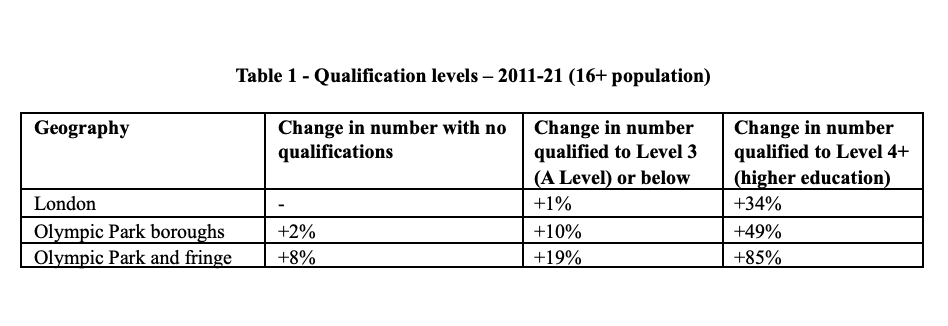
The first proxy indicator is qualification levels. The past decade has seen a rapid increase in the proportion of Londoners who have degrees or other higher education qualifications. This has risen from 38 to 47 per cent of the 16+ population across the city, and from 34 to 49 per cent in the Olympic Park and Fringe. The number of higher-qualified residents in these areas increased by 85 per cent and doubled around Stratford High Street, Stratford Town Centre, Bromley-by-Bow and Fish Island.
However the number of people without any qualifications has also increased, suggesting that in this case the change has been one of addition rather than substitution. Even if low-qualified people have moved out, other low-qualified people have moved in. The exceptions are the areas to the west of the Park – Bow, Fish Island, Hackney Wick and Hackney Marshes – where the number of low qualified people has fallen over time, suggesting a more permanent displacement.
A similar analysis has been undertaken by Duncan Smith at CityGeographics, looking at changes in occupational mix. He finds that the Lower (and Upper) Lea Valley has been at the forefront of change: the proportion of workers in managerial, professional and associate professional jobs in Waltham Forest rose from 40 to 51 per cent between 2011 and 2021, the most rapid change in England, and in Newham from 32 to 42 per cent. Analysis of numbers rather than proportions is not available by borough, but across London the number of people working in lower status occupations has not changed, suggesting that changes are additional not substitutional.
Housing tenure
Housing is another proxy: do tenure changes indicate gentrification and displacement? The Olympic Park and Fringe bucks London trends on housing tenure, with a sharp rise in owner-occupation (mortgaged and owned outright) particularly concentrated in Mill Meads, Stratford New Town and Carpenters, Bow and Fish Island, where new construction has been intense. So far, so gentrifying.
However, perhaps counter-intuitively, the number of households in social rented accommodation has also grown in the Olympic Park and Fringe, and at a faster than the London or local borough average. If social tenants around the Park have been displaced – and estate redevelopment projects in locations such as the Carpenters Estate have been highly controversial – they have also been replaced with more social tenants. Meanwhile, private renting has grown as it has across London. It is now the most widespread tenure in the Olympic Park and Fringe.
Ethnic diversity and employment
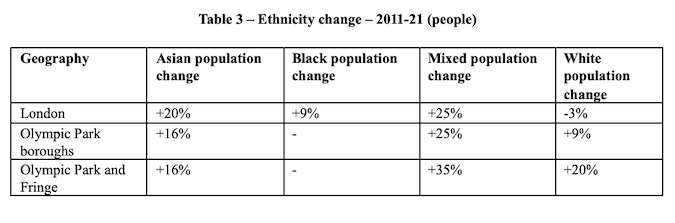
Another lens for examining change in and around the Olympic Park is ethnicity, which has a strong overlap with poverty and intersects with class disadvantage. The areas around the Olympic Park have always been some of London’s most diverse, with a non-white population of around 57 per cent in 2021, compared to 46 per cent across the capital.
As the table below shows, compared to London as a whole the Olympic Park boroughs and the Olympic Park and Fringe areas saw faster growth in their white and mixed-race populations, slightly slower growth in their Asian population and almost no net change in their black population. Black and Asian populations fell in Waltham Forest’s fringe areas, and all populations grew fastest in Tower Hamlets’ fringes, along Stratford High Street and into the Town Centre. This suggests that even if rapid growth in white and mixed-race populations around the Park did not actually lead directly to displacement of people from Asian and black populations, it may have constrained growth in those populations to lower levels than in other parts of London.
Another perspective on ethnicity can be seen in employment rates. In the Olympic Park boroughs these rose from 59 to 62 per cent of people aged 16+ over the decade, bringing them above the London average. The rise has been sharper still in the Olympic Park and Fringe, with rates rising from 60 to 65 per cent of the population. But, while employment rates have improved for all groups relative to the London average, employment has risen fastest for white people, while it changed much less for black and Asian people, widening the employment gap between these communities.
Unfinished evolution
Taken together, these figures suggest that the London 2012 programme has had varying and complex impacts on the local area. While there have been some signs of displacement of existing populations, particularly to the west where legacy has butted up against “Hoxtonisation”, the more widespread pattern seems to have been one of densification enabling the arrival of new and different communities. These demographic changes, along with the programmes run by the Olympic Park boroughs and LLDC, have driven convergence in employment rates, in tenure, and in occupational and educational profile.
That said, the differences in improvement in employment rates, alongside recent depressing news about falling life expectancy, suggests that structural disadvantage continues to hit some east London communities hard. Twenty years after London was awarded the Games and as the boroughs, the Mayor of London and the LLDC develop inclusive economy plans, London 2012’s legacy is an unfinished evolution.
Interviewed on Radio 4 for the launch of his re-election campaign on Monday, Sadiq Khan said this year offered “a moment of maximum opportunity for Londoners, for there’s the prospect not just of a Labour Mayor, but of a Labour government working together [with a Labour Mayor].”
Even if the tone was more bullish than the Labour leadership might like, Mayor Khan has a point. Since he was first elected in 2016, he has lived with a chaotic kaleidoscope of Conservative governments. When these have shown any interest in the capital, it has generally been to frame it as an overheated reservoir of “wokery”, or to attack Khan’s record on policing and planning – most recently through directing a review of industrial land and opportunity area policy, announced the day before the pre-election period formally began.
Khan’s predecessors were luckier. Ken Livingstone’s first term started with him politically homeless, expelled from Labour for running as an Independent against their official candidate, Frank Dobson. The early days, when I was working in the Mayor’s office, were notably scratchy: Livingstone’s first meeting with Deputy Prime Minister John Prescott was cryogenically chilly, his battle against the London Underground public private partnership poisoned relations with HM Treasury, and I remember the air turning blue as he offered London minister Keith Hill his frank thoughts on provisional spending settlements.
But Livingstone benefitted from coming to power when the public spending taps were being turned on, and when the Labour government led by Tony Blair wanted to show that its new devolutionary settlement was a success. By 2004, following back-channel discussions with Number 10 and a more publicly visible collaboration with culture secretary Tessa Jowell over the London 2012 Olympics bid, he was back in the party.
Buoyed by London’s unexpected success in winning the Games, Livingstone’s second term saw substantial public spending in London, government and parliamentary approval for Crossrail – today’s Elizabeth line – and new legislation that extended the Mayor’s powers on housing, planning, culture and waste.
Boris Johnson benefitted from this legacy following his election in 2008. And from 2010 Livingstone’s Conservative successor had the following winds of a Conservative-led coalition in his sails.
He too secured more powers, through the Localism Act and and the Police Reform and Social Responsibility Act, both passed in 2011. And although London boroughs’ budgets were cut heavily – as were those of other urban councils – the government was surprisingly generous in investing in the Olympic Park legacy, including Johnson’s pet project, Olympicopolis (now East Bank), perhaps aware that just as a successful Olympics can show off a city, a tumbleweed-strewn legacy can show it up.
The only initiative that failed to make any headway was the London Finance Commission, a deliberately non-partisan campaign for fiscal devolution, which was beached on the sands of Treasury insouciance in 2013, and again in 2017 when Khan had a second go.
Khan came to power in spring 2016, as the five years of public spending cuts started to take their toll and the European Union referendum campaign slouched to its self-harming conclusion. The years since have been dominated by a grim procession of crises – Brexit contortions, the Covid pandemic and spiralling inflation – which have seen the Mayor and the government on the opposite sides of arguments, with spending decisions marked by public spats and denunciations rather than the private haggling and public consensus that operates between political allies.
While the “metropolitan elites” of London became useful villains, “levelling up”, the regional policy boondoggle Johnson wielded in the 2019 general election campaign, has little to show by way of results apart from cancelled and delayed projects, funding and tax decisions that do down the capital, and occasional outbreaks of opportunistic culture war posturing.
So Mayor Khan can be forgiven for believing, in words that still carry a faint resonance from the 1990s, that “things can only get better” if he wins a historic third term. Labour have said little about their plans for devolution beyond a promise of legislation and speeches focused on bringing some consistency to the patchwork quilt of devo deals spread across England. Furthermore, the UK’s dismal fiscal outlook suggests that “turning on the taps” of public spending is still a distant prospect. But Labour’s economic growth mission cannot pass over the opportunities London offers.
There could be a golden moment ahead. By the end of the year, a Labour Mayor and a Labour Prime Minister could be simultaneously in post, short of cash but rich in political capital. Starmer and Khan have their differences – on relations with the EU and Green Belt development, for example – but must be able to agree a shopping list of measures that are cheap and capable of having a real impact on growth and prosperity, even if some are controversial.
Such measures might include selected urban extensions in the Green Belt, more fluid European work permit arrangements for young people, performers and professionals, rail devolution in London, and maybe one more push for a system of fiscal devolution that enables London (and other English cities) to manage local taxes and local development.
Sadiq Khan has been quick – on occasion too quick – to point the finger at central government for everything wrong in London. A double win in the capital this year would give Labour a chance to show just how much better the relationship between City Hall and Whitehall could work.



 Richard Brown