City sickness, urban recovery

[First published by onlondon, 6 April 2020]

Coronavirus has not been good news for fans of cities. How ever important urban centres will be to the recovery, the rapid spread of the pandemic from Wuhan to Milan and from London to New York revives deep-rooted suspicions of them as close-packed seedbeds for disease (“pestilential human rookeries” in the words of one Victorian pamphleteer) and as the stomping grounds of rootless cosmopolitan types, with lifestyles and habits remote from the more “authentic” concerns of their provincial countrymen.

The early spread of coronavirus in London probably played up to both stereotypes, reflecting both density and connectivity. Reported cases of infection first soared in Kensington & Chelsea. By 10 March, 14 per cent of London’s known cases were among residents of the borough, who account for just 1.8 per cent of London’s population. Kensington & Chelsea is one of London’s most densely populated boroughs, but also one of the most cosmopolitan: nearly half of its residents were born outside the UK, and research by transport campaigners suggests they are the country’s most frequent flyers. For good and ill, London is the UK’s gateway to the world.

In the following days, cases surged in Camden, Westminster, Lambeth and Southwark (as well as Barnet). Central London’s intensity of movements and interactions probably played a role here. With a day time population that grows by 80 per cent every day and intensive mixing on public transport, in offices and in pubs, the conditions for rapid spread were in place in the city centre.

By mid-March, the epidemic was spreading fast across almost every London borough, with reported cases growing by a third every day in the week of 16 March, while they grew by a fifth to a quarter across the rest of England. The newspapers were full of talk of a lockdown being imposed on the capital.

The restrictions imposed by the government at the end of that week were nationwide rather than restricted to London, but their effect appears to have been strongest here. The rate of increase in cases dropped sharply and has remained lower than in the rest of England’s since then, as the graph below shows. Over the past week, the growth in new cases appears to have slowed nationwide, but remains lower in London: in the capital it grew by an average of nine per cent over the three days to 4 April, compared to an average of 14 per cent in the rest of the country.


 Source: PHE website, updated to 8 April

There are all sorts of reasons not to get over-excited about these numbers. At best, they show that the disease is spreading more slowly. There are still hundreds more cases every day even in London, and that will translate to more deaths in the days and weeks to come. And it is quite possible that the slowdown has only been temporary, with a resurgent outbreak waiting in the wings.

But it is still worth considering why London has fallen back from the forefront of the epidemic’s spread. Are fewer tests being done in London? This is possible, but since mid-March testing has been undertaken for all patients requiring hospital admission, so the slow down in cases presumably reflects a slowdown in hospitalisations.

Maybe this is a result of London’s age profile. Londoners’ median age is 35 years, compared to 40 across the UK. Perhaps, after the initial surge, this relatively youthful population is being reflected in correspondingly slower growth in the number of serious cases. Or maybe Londoners, despite crowded housing conditions and continuing denunciations from the media, are actually sticking to the government restrictions and starting to suppress the spread of coronavirus: figures on transport use at the end of last month showed the steepest falls were for use of the Tube, compared to road travel and national rail.

Despite the tough weeks ahead, apparent slow-downs in infection rates in London and across England are good news. And if London can further stifle the spread of the disease, it may yet show how cities can be at the forefront of recovery as well as of infection.

Moving out of the crisis

[Originally published on Centre for London website, 30 March 2020]
 
Strange days, when a transport authority claims an 80 to 90 per cent drop in passenger numbers as a success, as Transport for London’s Mike Brown did on Thursday.  It’s a success which could take a £1 billion bite out of TfL’s annual income just over the next three months (together with the loss of congestion charging revenue) – at a time when Crossrail delays were already hitting the balance sheet (and will even more while works are at a standstill).
 
Making up that shortfall will be one of a million urgent negotiations over coming months (and given ministerial demands to keep the Tube and buses running, the Treasury will surely have to pay a fair share), but it also prompts a more fundamental question – is it right that the operation of London’s transport system is so heavily dependent on fares and other user charges?
 
As Table 1 below shows, fares account for about 72 per cent of TfL’s revenues, with a further four per cent coming from congestion charging. The rest is made up of other commercial revenues, plus just over £1 billion (15 per cent of the total) coming from taxes – mainly retained business rates, with smaller amounts from general taxation and mayoral council tax.
 
Table 1: London transport revenue sources
millions
Transport for London
(2020/21)
 
Fares
£5,124
72%
Congestion charge
£255
4%
Media and rental
£275
4%
Other
£515
7%
Retained business rates
£969
14%
Grants
£5
Council tax
£6
 
£7,149
100%
 
But is that the right balance?  Is transport a product to be bought by individual customers, or is it an urban service, something that is provided as much to the city as a whole as it is to individual passengers? Cities rely on mass transit just as tall buildings rely on lifts. Without transport systems that can move millions every day as efficiently as possible, cities grind to a halt – or hollow out as corporations flee congestion. In both cases, reliance on private cars rises, with all the pollution that entails.
 
Supporting mass transit is therefore in the interests of businesses, of the environment and of the city as a whole – whether or not individual citizens use the system, they rely to some extent on other people being able to move around the city (and on roads being kept free for freight). So there is a case for public sector support, of the system as a whole and for the people who cannot affordto pay full price.
 
But relying so heavily on passenger revenues does not just make TfL vulnerable to events such as the current crisis, but also makes revenue dependent on mass transit systems that are themselves under strain. To address those pressures and reduce carbon impacts, the Mayor and TfL have committed to promote ‘active travel’ (walking and cycling), but it is only public transport (and congestion charging) that makes money. With some of the highest fares in the world, TfL’s commercial and strategic interests are not well aligned.
 
It’s not always been this way. The reliance on passenger revenues is a relatively new phenomenon: as recently as 2010/11, more than 50 per cent of TfL’s revenues were in the form of a grant from central government.
 
And it’s not the way other cities operate either. Comparisons are imprecise and no city is perfect, but New York and Paris both have very different funding models (tables 2 and 3 below). Both cities have some subsidy from different tiers of government – around eight per cent of the NY total, and 18 per cent in Paris (or rather the larger region of Île de France). 
 
Table 2: New York transport revenue sources
millions
Metropolitan Transport Authority (2018)
 
Fares
$6,200
41%
Tolls
$1,900
12%
Media, rental etc
$685
4%
Fuel taxes
$2,300
15%
Mortgage and property taxes
$1,002
7%
Payroll taxes
$1,700
11%
Other taxes
$306
2%
City and state subsidies
$1,200
8%
 
$15,300
100%
 
Table 3: Paris (Île de France) transport revenue sources
millions
Île de France Mobilités (2017)
 
Fares
€3,664
36%
Media, fines etc
€249
2%
Fuel taxes (TICPE)
€94
1%
Payroll tax (VT)
€4,238
42%
Public subsidies
€1,893
18%
 
€10,085
100%
 
Both cities also draw some revenue from taxes on petrol and diesel: 15 per cent in New York compared to just one per cent in Paris. In the UK, fuel duty and vehicle excise duty are collected and retained nationally, with VED ring-fenced for road maintenance outside London.  Allocating London its share would give the city around £500m extra per annum, but both fuel duty and VED are set to decline in coming years, as more efficient vehicles proliferate. Centre for London has arguedfor a comprehensive approach to road user charging, rather than tethering London’s transport to an eroding tax base.
 
New York draws another 7 per cent of its revenues from taxes on mortgages and property transactions, but both comparator cities also rely heavily on payroll taxes. In New York, employers pay from 0.11 to 0.34 per cent of payroll costs (depending on payroll size); in Île de France, rates range from 1.4 to 2.6 per cent (depending on location).
 
The sums generated by these business taxes are higher than retained business rates in London, much higher in the case of Paris, and could be argued to relate more directly to how far companies rely on the public transport network to enable employees (and customers) to travel across the city. Payroll taxes may not be the right answer for London, though a devolved alternative to business rates is long overdue, but the current crisis should prompt longer-term thinking about the right mix of taxes for a 21stCentury transport system.
 
Seeking higher government grants is one way to reflect the civic value of London’s transport system, but seems likely to have limited mileage at a time of regional rebalancing (and persistent allegations that London already receives more than its share of transport funding). Even Paris draws less than 20 per cent of its funding from national, regional and local subsidies.
 
London should seek devolution to enable innovation, not a squabble about regional allocation. How much should businesses and residents pay for the infrastructure that keeps the city running? Should tourists and other visitors pay through a hotel tax? Should taxis and minicabs, and new arrivals such as electric bike and scooter companies, pay more for their use of London roads? 
 
When London’s economy and civic life begin to defrost, and the Tube once again feels the – once tiresome but now longed-for – strain of urban rush hours, it will be time to think again about who pays what for the hundreds of millions of journeys that take place in London every year.

Could tighter border controls boost London\’s population (July 2019)

[Published on Centre for London blog, 26 July 2019]

After easing off in 2017, London’s population growth picked up pace last year to hit 83,000, with a resurgence in international immigration the principal cause of the recovery, as illustrated in Centre for London’s most recent edition of The London Intelligence.

The latest ONS population projections suggest that London will continue to grow at around this level in the coming years, adding 774,000 residents over the period 2016-26; growth of 8.8 per cent. The capital will still be the fastest growing English region, but will not be growing as fast as it did in the ten years to 2017, when growth was estimated at 1.1 million residents (15 per cent). Net international immigration outstripped net domestic out-migration by around 10 per cent last year, but the ONS forecast the net impact to be more balanced in future with natural change (births minus deaths) continuing to account for the expanding population.

Looming over these projections, however, is the spectre of Brexit. Leaving the European Union will definitely have an impact, but what will it be? It could be that the UK’s departure will lead to an even sharper slowdown in migration; certainly immigration tailed off during the two years of limbo since the referendum, and remains much lower than it was in 2015 or 2016. Given London’s high migrant population, this could hit the capital, and its economy, particularly hard.

But beyond the current hiatus, post-Brexit immigration rules could do precisely the opposite. Notwithstanding the change of government (and any deals done as part of future trade negotiations), the plan appears to be for EU and other migrants to be on an equal footing. Immigration from within the EU may fall back, while immigration from further afield may rise or at least stay steady. The London Intelligence already shows a rebalancing in the number of national insurance numbers issued to EU and non-EU nationals: the former were six per cent lower in the year to March 2019 than in the previous year; the latter were 21 per cent higher.

This matters because immigration from beyond Europe tends to have a different geographic distribution from European migration. Specifically, it is more concentrated in London and – to a lesser extent – other cities. While London has just over twice as many EU migrants in its working age population as non-urban areas of England and Wales do, it has four times the proportion of people born beyond the EU. Similarly, while the largest ‘core cities’ (Birmingham, Bristol, Cardiff, Leeds, Liverpool, Manchester, Newcastle, Nottingham, Sheffield) have similar levels of EU-born working-age residents to the rest of the country, they have twice the proportion of people born further afield.

% of 16-64 year old population born in other EU countries % of 16-64 year old population born in non-EU countries
London 14 32
English and Welsh core cities 7 16
Rest of England and Wales 6 8

So more immigration from outside the EU, and particularly from emerging economies of the southern and eastern hemispheres, may mean more concentration in London and other big cities, where people from these countries will already find settled communities of their former compatriots.

And in London, this trend may be intensified by another element of the government’s proposals, a pay threshold for jobs held by foreign workers – designed to prevent the import of cheap unskilled labour. The government has not confirmed what this threshold should be but the Migration Advisory Committee recommended maintaining the current level of £30,000 (while abolishing other requirements such as the ‘resident labour market test’, which requires jobs to be advertised within the UK before recruiting overseas).

While many jobs in London, particularly in migration-dependent sectors such as restaurants, pay poorly, salaries are significantly higher overall. Government data on earnings show that 66 per cent of workers in London earn more than £30,000 pa, compared to 30 to 40 per cent of workers in other regions. So setting a minimum pay threshold – whether at £30,000 or at lower levels, as groups such as London First have argued – could further concentrate immigration in London, where more jobs would in theory be accessible for foreign workers.

Giving preference to immigrants with higher qualifications, through a more ‘points-based’ system as advocated by Boris Johnson during the Conservative leadership campaign, could further focus immigration in the capital, as immigrants who settle in London also tend to be more qualified.

These factors, together with perceptions of London as a city that is still open to immigrants, may serve to focus future international immigration on the capital, potentially turbo-charging population growth. This may look superficially serendipitous: London, the part of England most at ease with immigration and most opposed to Brexit, may see a resurgence in immigration, while changing demographics, and tougher salary and qualification requirements may curb immigration beyond the M25.

But it may also deepen economic as well as cultural differences between London, other cities and the rest of the UK. While London continues to make the case for infrastructure to support a growing population, other regions may start seeing population decline, as their economies struggle without the migrant workforce that farmers, restaurateurs and hoteliers rely on.

We may even, in time, see a shift in the tone of national debate, with politicians making the case for immigration rather than avoiding the subject – or even seeking to implement policies to encourage immigrants to look beyond the big cities as in Canada. As with so many aspects of Brexit, seemingly simple moves can have complex, surprising and far-reaching consequences.

My thanks to Professor Tony Travers of the LSE for his insights and help with this article.

Ceremony and memory (July 2019)

[Published OnLondon, 10 July 2019]

26 July, 2012 was a warm evening. I arrived to meet a friend at a pub in Brighton, which was hosting its annual visit from the Chanctonbury Ring Morris. As we sat outside, and the dancers whirled, jingled and clacked, I took a photo and tweeted – very drolly I thought – “Beat that, Danny Boyle.”

The next night, by common consent, he did. And how. After a slightly iffy handover in Beijing in 2008, featuring double-decker buses, bowler hats and a bemused-looking Boris Johnson, the London 2012 opening ceremony was a spectacular. It took in Brunel, Blake, Berners-Lee and Beckham; dancing nurses, lesbian kisses, and parachuting monarchs, Shakespeare and smokestacks. A nervous nation breathed a sigh of relief, and began to tell itself that maybe, just maybe, the London Olympic and Paralympic Games would go okay.

Seven years later, the lavish performance is still memorable, a very modern celebration of patriotism and pride, unity and diversity. But its meaning is now freighted with awareness of what followed, of the divisions that were triggered or laid bare by Brexit. We re-watch it through our fingers, like the opening scenes of a film where unsuspecting teens arrive for a party at a beautiful, isolated, cabin in the woods.

For many Remainers the ceremony stands for everything that Brexit threatens to destroy. Writing just after the EU referendum, Frank Cottrell-Boyce (who co-created the event with Boyle) made the contrast explicit: “The nation we saw in the opening ceremony and the nation we saw in the referendum are both real. They’re two parts of diptych. One holds out the possibility of inclusion and ease. The other might be seen as a kind of scream of pain and fury that tells us how it feels to be excluded from that ease.”

Similar sentiments are easily found on Twitter:

“The opening ceremony was the best of our gods, Brexit is the worst of our demons.”

“The optimism, pride and celebration of multiculturalism woven into that marvellous opening ceremony should have been a launchpad. Instead we made it a diving board.”

“On the night before Brexit I will be watching the 2012 London Olympics opening ceremony and wondering what the fuck went wrong…”

For some Leavers, on the other hand, the opening ceremony’s celebratory optimism remains a reminder of Britain’s potential, of what Brexit can recapture if only the nation would re-unite. In the recent words of Liz Truss: “We need to revive the Olympic 2012 spirit – a modern, patriotic, enterprising vision of Britain and we need to use Brexit to achieve that.” In 2016 – a few days after the referendum – Johnson wrote pointedly of the “gloomy predictions that were banished” by London 2012.

But not everyone is convinced. Writing in the Guardian this week, Dawn Foster identified the “false premises” underpinning “centrist thinking”; one was “that the 2012 London Olympic ceremony represented an idyllic high-point of culture and unity in the UK, rather than occurring amid the brutal onslaught of austerity, with food bank use growing and the bedroom tax ruining lives”.

Others have argued that the ceremony’s reprise of a rosy national story fostered a sense of “Britain can make it” nostalgia that stoked anti-EU sentiment. Conversely – and as hinted by Cottrell-Boyce – its inclusive vision has been seen as deepening the resentment of those who felt alienated from the multicultural zeitgeist – a resentment which would later find expression in some Brexit votes.

Certainly the ceremony’s narrative – The internet! The NHS! Britpop! – can sound like a Tony Blair conference speech, but with better dancing and more verbs. And the golden glow of our memories can blind us to what else was happening in the early years of this decade: the first austerity budgets, recession, riots on the streets of London, divisions that were perhaps as deep as they are today but less visible.

But fact that the meaning and significance of a sport festival’s opening ceremony is still so keenly contested is a tribute to its persisting power – as a symbol of what we are losing, as a reminder of what we could be, or simply as a powerful piece of propaganda for a national unity that was always illusory.

In 2016, scheduled “four years on” reflections on the opening ceremony collided with the disruptive shock of the EU referendum result. I suspect we will still be debating both on 24 July next year, as Tokyo 2020 gets underway.

Belts, lumps and extensions (June 2019)

[Published OnLondon, 7 June 2019]

Nothing ignites a policy debate like the subject of London’s Green Belt. You might think Brexit had eclipsed it, but the discussion at a recent roundtable on the issue showed that the flame still burns bright.

On one side, the Green Belt was held up as an anachronism, restricting land supply, thereby pushing up house prices in the capital, pulling the lower rungs of the property ladder further and further out of reach and deepening London’s affordability crisis. The Green Belt isn’t even that green, the argument went, accommodating as it does golf courses, haulage yards, and other economically or aesthetically dubious uses.

On the other side, the Green Belt’s defenders argue that all of this is premature, or even beside the point. London still has plentiful and oft-replenished stocks of “brownfield’’ (previously developed) land. Allowing London to spread into the Green Belt rather than making the most of these inner city sites would be socially and environmentally disastrous; it would hollow out the capital and lead to the pattern of urban dereliction and car-dependent sprawl that has blighted many US cities. We should focus – first and last and always – on building out the brownfield sites within the M25.

These positions are entrenched and passionately defended, though it is worth noting that some of the arguments seem to be at cross-purposes. Defenders of the Green Belt do not actually hold it to be an arcadian idyll. For them, its primary purpose is containment, not beauty. Neither do (most) advocates for change argue for wholesale abandonment of any constraints on development, and for the frenzy of speculation and sprawl that would likely ensue.

But the real problem with both strongly-held position is that they do not allow for nuance, or the complexity inherent in a system where planning, consumer choice, housing finance, urban design, international investment and local politics intertwine. So here are six see-saw statements – each balanced on a “but” – exploring whether London really has a land shortage and whether the Green Belt might help address this.

The Green Belt is not all green, but that’s not really the point

When a “green belt” was first proposed by the Greater London Regional Planning Committee in 1935, it was described both as a recreational amenity and as a constraint on growth, and was envisaged as being a few miles wide. When the first green belts were introduced in the mid-1950s, the focus shifted to the latter function – to checking metropolitan growth, stopping towns merging with each other and preserving their character. Leisure and nature conservation were secondary. And as the population of south east England has grown, London’s Green Belt has been defensively extended in stages to cover more than 500,000 hectares, three times the area of Greater London. The “belt” is at least as important as the “green”.

London has accommodated huge population growth, but at a price

In the post-war period, as Inner London lost population, the Green Belt prevented the city from sprawling out as many US cities did, although many Londoners settled – by choice or dispersal – in the new and old towns that surrounded the capital. Since the tide turned in the late 1980s, London has housed a population that has grown by a third, from 6.7 to 8.8 million, within its boundaries. And it has done this while persistently failing to build the number of new homes that planners say are needed.

How so? Overcrowding has increased and the number of vacant homes has fallen but, most dramatically, house prices have shot up – accelerated by speculative frenzy and in recent years cheap credit – both in London itself and in the surrounding towns and cities that have seen commuting increase. If London is to continue to grow, this approach is not sustainable: building more homes, and in particular more low-priced homes, has to be part of the solution to what is becoming a crisis for young Londoners and a threat to London’s economy.

There are ‘sites’ for London’s population growth, but their deliverability is debatable.

The draft London Plan, published in late 2017, maintains that London can accommodate the vast majority of the 66,000 homes per year that it needs to built. The Strategic Housing Land Availability Assessment that underpins the Plan estimates that sites for 65,000 of these can be found on a mixture of identified and “windfall” sites, many of them in Outer London.

The Plan has just completed its “examination in public” (a form of public enquiry) and the planning inspectors will report on their findings in September. It is fair to say that the examination saw debate about the realism of housing targets. How could London double the rate of building, given the current track record, the controversial nature of building more in Outer London, and the Plan’s clampdown on release of industrial land (which has supplied 100 hectares a year for development in recent years, three times the level anticipated)?

Getting planning permission for small sites around Outer London town centres is likely to be tough, but planning permission is only the start. London already has a backlog of permissions, with 300,000 homes – ten years’ supply at current build rates – in the pipeline. Some of these permissions may be scuppered by planning obligations, or by the need for investment in infrastructure or remediation. Others may be being held back by developers nervous about London’s shaky-looking market. And some may have been secured solely to establish value for a site, by landowners who have no intention of building.

Finally, high land prices mean that even when new housing is built, the viability of affordable housing becomes a matter for intense negotiation, often stalling schemes. Capital programmes for affordable housing have been cut to the bone, so without more funding in the system, it is hard for affordable housing to be built at scale without market housing to cross-subsidise it.

Density is good for cities, but maximising density isn’t always best

But if London’s remaining sites are scarce and/or difficult, the city can surely build at higher densities. Within its boundaries, London is much less densely built than New York, Paris or Barcelona, and the importance of urban density – to create vitality, make efficient use of land, and support public transport and other services – has come to the fore recently. Density is good for cities and citizens.

Yet density cannot be increased across the city simply by turning a dial. Barcelona has incredibly high density because of its characteristic block formation. Creating this type of density in London would require wholesale demolition and reconstruction of a city that remains dominated by two to three storey terraces and semi-detached houses. New developments are being built much more densely than in the past, surging past planning guidelines and taking advantage of lower levels of car ownership. But this uneven pattern of “lumpy” development is not only creating community controversy, it is not even making much difference to the speed of housebuilding. Developers are simply releasing land more slowly.

Unbuckling the Green Belt would likely be a disaster, but that’s not the only way

Watching the glacial pace of development within London, you can’t help but wonder whether to be radically disruptive. Ditching the Green Belt designation would likely lead to a frenzy of activity but maybe not to so much building.

Many local authorities would still seek to protect former Green Belt land from development, while the planning system would see a flurry of applications and appeals, agricultural land prices would spiral upwards and urban land prices would fall. Some landowners – maybe those with the deepest pockets and the sharpest lawyers – would secure planning permission for new development, and some of that development might even be built, pockmarking the hills and plains around the M25 with new settlements. So how many new houses would actually be built is pretty moot, and whether they would be decently designed or planned even more so.

But there are other ways to open up more housing land. One, which has been promoted by the Centre for Cities and Barney Stringer from planning consultancy Quod, looks to areas around railways stations to provide capacity. Taking a two kilometre catchment area around stations, they estimate that such sites could provide room for 1.4 million homes within Greater London’s boundary, or 3.4 million if the whole Green Belt was included. This would be a more rational form of development, with public transport access reducing car dependency and enabling “compact city” development. But there’s still no guarantee that any of these homes would be built, particularly around Outer London centres where the Green Belt has been enthusiastically embraced as a brake on new build.

An alternative approach would be that advocated by David Rudlin, Nicholas Falk and colleagues from urban designers Urbed, in their winning submission to the 2014 Wolfson Prize. Looking at an imaginary city (loosely modelled on Oxford), they proposed that “rather than nibbling into the fields that surround the city and all its satellite villages, we should take a good confident bite out of the green belt to create sustainable urban extensions”. National government and the Mayor of London could agree to identify and designate a location for an urban extension, take control of the land, develop a master plan, and use value capture to invest in roads, rails and social infrastructure. They could also drive the pace of development, sharing risks and proceeds with developers willing to commit to the quality, mix and speed of development required.

Urban extensions might look like a soft option, but they could boost the inner city too

But would an urban extension also drive dereliction, diverting investment and resources from urban sites? This argument is powerful, uniting green belt defenders and urban renaissance advocates, but it is not the inevitable outcome. Firstly, construction and investment capacity is not fixed; London continues to be a favoured destination for investment, and workforce capacity can be addressed over time. Secondly, city centre and urban extension could be made to work together – some of the value generated within the extension could be earmarked for reinvestment in city centre sites where infrastructure needs and market conditions undermine viability. And while an urban extension was being planned, developers would have every incentive to complete their work within the city.

Timing is critical, given the years that debating, planning and building a new piece of city would require. Our first priority should still be delivering the major planning applications that are within London’s pipeline. Together with the new sites identified in the London Plan, these may meet London’s needs for ten years or more, depending on whether and when “windfall” sites, such as car parks, become available. But we should be starting work on a Green Belt review now if we are to have any chance of seeing new homes built by 2030.

This approach may look heavy-handed and statist – and it is – but the government has assumed powers to build new towns in the past when it has taken the need for new homes seriously. Legislation to set up new town development corporations and urban and mayoral development corporations remains in place. These public bodies can buy up land (including through compulsory purchase), grant planning permission, and build homes and infrastructure. Land would need to be bought at existing (mainly agricultural) prices – rather than “hope values” based on its end use – in order for value uplifts to fund infrastructure, but this is a policy change that is already being advocated by Civitas among others. The main losers would be players in the shadowy land options market, for whom few tears would be shed.

An abrupt switch in policy on the Green Belt would probably be as disastrous as it is unlikely, but that shouldn’t rule out a sensible, long-term review or at least a more nuanced debate. The housing crisis in London and the wider south east is too deeply entrenched and complex for a single magical solution. A Green Belt review, backed by a clear commitment to take powers over planning and land ownership, should form a part of the toolkit for building more homes for the next million Londoners.
Big Bang and Grande Bouffe – the eateries that boosted London (March 2019)

 [Originally in OnLondon, 8 March 2019]

‘There’s a Big Bang in the City, We’re all on the make.” (Shopping, Pet Shop Boys, 1987).

The news this week that the Kensington Place restaurant is to shut its doors is more than just another restaurant closure. It completes a chapter in the incredible story of London’s 30 year resurgence.

The years 1986 and 1987 were pivotal for the capital and the high water mark for Thatcherism. In April 1986, amidst a blaze of fireworks and protests, the Greater London Council was abolished alongside other metropolitan councils, banishing the spectre of “socialism on the rates”. And in October – after years of wrangling – the “Big Bang” transformed financial services.

The details of the Big Bang are complex. Essentially it was a package of reforms that deregulated stockbroking, opened up London’s Stock Exchange to foreign-owned firms and enabled computerised trading to replace the frantic scrum of “open outcry” trading on its floor. But the Big Bang represented something more – the apotheosis of confident capitalism, personified by the mobile phone-toting Yuppie, in TV dramas such as Capital City, and by Harry Enfield’s Loadsamoney – conceived as satire, but sometimes treated as a role model.

The Big Bang was also cited as a factor in the revival in net international migration, which meant London’s population started to grow again – albeit just by a few thousand a year – after decades of decline. At the time, London’s return to growth was seen as an anomaly, or even a blip. Writing in early 1987, Tony Champion and Peter Congdon suggested that the “surge in net international migration for City jobs will settle down after Big Bang”.

In 1987, as the Conservatives celebrated their third consecutive election victory, and the City of London was rocked by the twin shocks of the “Black Monday” crash and the emergence of Canary Wharf to the east, the Big Bang was also having an impact to the west. Three restaurants opened to cater to London’s growing gang of globally mobile professionals with sophisticated palates. In doing so, they put London’s food scene on the road to transformation from international punchline to global draw.

In Hammersmith, Ruth Rogers and Rose Gray took over a disused warehouse building next door to Ruth’s husband’s firm, Richard Rogers Partnership. The River Café started by serving lunches to local workers, before gradually opening for longer hours and a wider clientele. But from the outset Ruth and Rose focused on fresh flavours and carefully chosen ingredients, an Italian cuisine that was a world away from the mounds of pasta, check table cloths and straw-covered chianti bottles of traditional trattorias.

In South Kensington, Terence Conran opened Bibendum in the opulent Michelin Tyre Company building on Fulham Road. Chef Simon Hopkinson’s cuisine was as deeply rooted in the rich sauces and offals of French country cooking as the River Café’s was in in the bright and earthy flavours of Tuscany. But, also like the River Café, Bibendum matched this respect for the classics with a stripped-back modernist ethos. Both restaurants were a world away from the tweezered pretension of 1980s nouvelle cuisine.

A little further west, Rowley Leigh opened Kensington Place, serving modern British food (almost a contradiction in terms at the time) in deliberately informal surroundings, dispensing with table cloths to create a London version of the neighbourhood brasseries that dotted Paris, and pioneering dishes such as scallops with pea puree that have now become gastropub standards.

By 1989, the “Lawson Boom” that had driven the ebullience of yuppie culture had run out of steam and the UK began to dip into a recession that hit London particularly hard, with soaring interest rates, a property market crash and thousands of homeowners facing negative equity. But the three restaurants that reinvented London’s food scene survived, and London’s population growth picked up pace. As Kensington Place closes, to be redeveloped for housing, it is caught in the undertow of the wave of change that it surfed.

S H O P P I N G (Sept 2018)

[Originally published OnLondon, 30 Sept 2018]

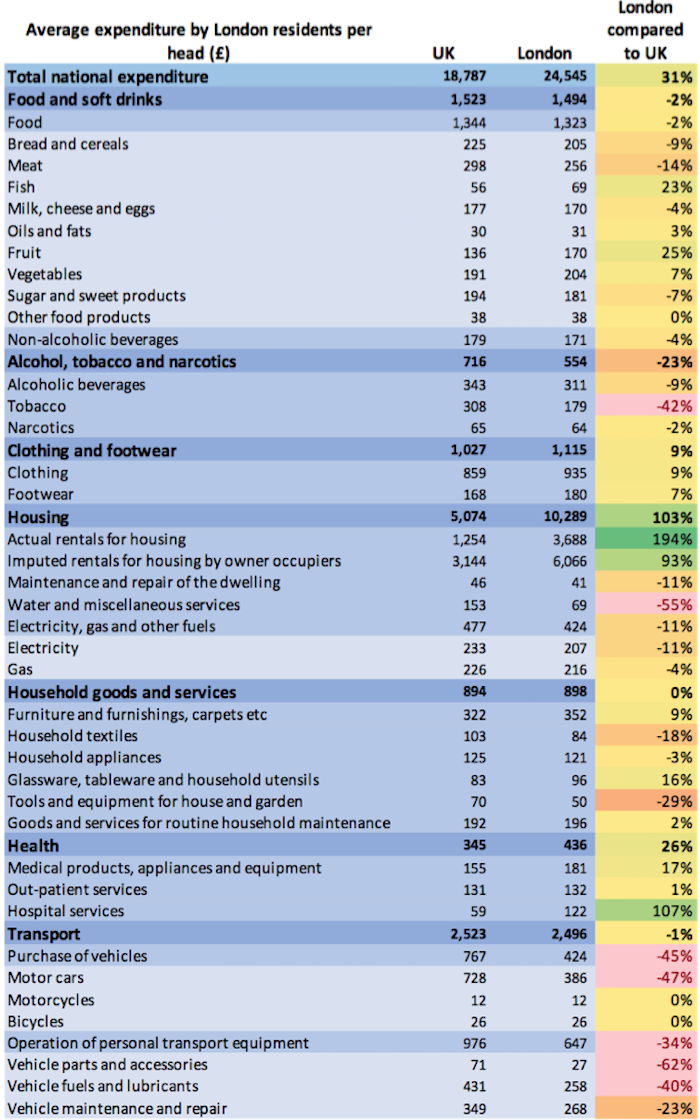
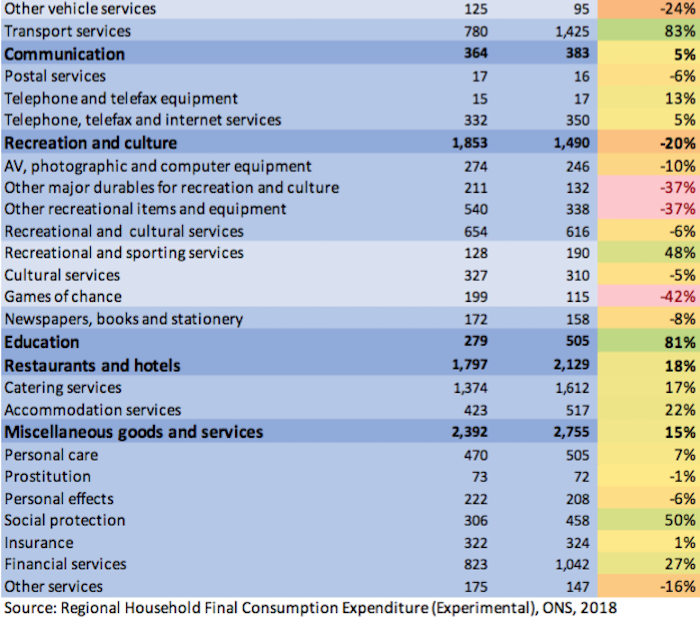
What are Londoners like? Judging by recently released experimental Office for National Statistics data on spending patterns, we are a surprisingly healthy, even ascetic bunch. We each spend around £25,000 each year, 30 per cent more than people across the UK as a whole. But we spend much more on fish and fruit and less on cigarettes and alcohol; more on gym memberships, less on consumer goods. What do these figures really tell us about life in London?

The data suggest some patterns that will be familiar to every Londoner.  We spend an outrageous amount on housing, which accounts for more than £10,000 of the average Londoner’s expenditure every year – twice as much as the UK average. Transport spending is around £2,500 per year across London and the UK alike, but Londoners spend 60 per cent of that sum on transport services such as tubes, buses and taxis, while 70 per cent of average UK transport spending goes on buying and maintaining private vehicles.

The focus on services as opposed to goods is a common thread, and probably arises from a mixture of lifestyle choice and necessity. Modern consumption, we are often told, focuses on experiences rather than on accumulating “stuff”, which is lucky for Londoners, given the insecure tenure and Lilliputian accommodation that many have to put up with.

Londoners spend nearly 30 per cent less than others in the UK on recreational durables – cameras, hi-fis, TVs etc – but more on recreational and sporting services (gym memberships and tickets), and on hotels and restaurants. We don’t have the space for giant TVs or time to watch them, but we do have the almost limitless possibilities of London on our doorstep. The one item of home furnishings that Londoners do spend significantly more on is cutlery and glasses – even the most bijou flat can accommodate a David Mellor teaspoon.

But other aspects of the figures prompt questions. Why do Londoners spend so little per head on vices such as drinking, smoking and gambling (while level-pegging with the rest of the UK on drugs and prostitution)? Wouldn’t you expect a young city with packed bars and pavements to be spending more? Is it simply that Londoners are too hard-up?

That may be part of the answer. But London is not one thing, and there is no such person as an average Londoner. The city that celebrates hedonism and liberation is also the UK’s most religious place. The city with the biggest lesbian, gay and bisexual population is also the city with the lowest proportion of births outside marriage. The millennials who foreswear alcohol or meat for reasons of health or expense live alongside those who do so for religious or cultural reasons.

London mixes conservatism and liberalism in its society as much as in its politics. Diversity and openness to the world make London a city where anyone can live the life they choose. The spending patterns of Londoners illustrate how these myriad lifestyles can contrast but also overlap with each other. Full data below.
Like1
Like2

Cool markets and hot debates – Housing in London

[Originally publiched in OnLondon, 23 Feb 2018]

The number of houses and flats in London grew by nearly 40,000 in the year ending March 2017 – faster than it has since the mayoralty was established in 2000 and only just short of the former Mayor’s annual housing target. Some of the growth was down to controversial conversions of offices to homes (“permitted development”), but 30,000 new homes were built too, which is an achievement to be celebrated.  

But what if this is as good as it gets? It seems almost churlish to make the point, but there is a pile up of indicators suggesting that new home building in London is about to slow down sharply. The first alarm bell is rung by falling house prices and transaction levels, as highlighted in Centre for London’s The London Intelligence bulletin at the end of January. 

House prices across London have fallen at their fastest rate since 2009, and the fall in prices and transaction levels has been particularly sharp in relation to flats in the centre of the city. A recent survey by Molior Consulting confirms this top-of-the-market slow down: less than half of the luxury flats that were started last year were sold (off-plan or on completion). 

Molior’s figures refer to flats selling at around £3 million and these may seem pretty remote from the concerns of most Londoners – luxury flat developers are pretty low on the league table of much-loved London professions. But all the moving parts are connected. As housing grant has reduced, more and more affordable housing in London is delivered through developer obligations. While the number of affordable housing starts supported by mayoral funding has been rising, as the £3.15 billion funding package agreed with the government in 2016 feeds into the system, developer contributions still account for 50 per cent or more of the total. If the flow of luxury flats slows, so will the flow of affordable housing.

And there are other factors suggesting that supply is slowing. NHBC – the National Housing Building Council – issues warranties for around 80 per cent of new build homes in the UK. These tend to be issued just before construction work starts and therefore give a good indication of future supply. The number of warranties issued in London fell from 26,000 in 2015, most of which will have been built in the bumper 2016/17 year, to 17,500 in 2016, and stayed at that level in 2017.  

While the market cools, the politics of housebuilding in London are heating up. Haringey’s proposed joint venture with Lendlease is only the most prominent of a number of controversial partnerships for housing estate redevelopment. Campaigning in Haringey has unseated council leader Claire Kober and probably sealed the fate of the Haringey Development Vehicle itself. Other councils and developers will at the very least be more cautious about joint ventures – which typically take years to plan and even longer to implement – and nothing will happen before local elections in May.

Finally, Sadiq Khan’s draft new London Plan presents a tough policy environment. The Mayor has tightened affordable housing targets, proposed residents’ ballots for estate redevelopment schemes, restricted use of industrial land and shifted the burden of development on to the Outer London boroughs, where new development is most controversial politically. Many Londoners would support most if not all of these policy positions, but the assumption that developers will live with them in return for a stake in London’s super soaraway property market may be outdated. There is already talk of some of London’s biggest housebuilders shifting their focus to Birmingham, Manchester and other places where the market seems more buoyant.

In short, the prospects of accelerating housing delivery to meet the new London Plan target of 66,000 homes a year are looking slimmer by the day. But perhaps a sharp slowdown of housebuilding would not be such bad news after all. “Never let a crisis go to waste,” in words variously attributed to Winston Churchill and Rahm Emanuel. For some years now, London’s housing market has hobbled along like a Heath Robinson contraption, with housing shortages driving land price inflation, social housing becoming an exercise in gamesmanship rather than provision of public goods, and housing targets always soaring ahead of supply like the stakhanovite fantasias of soviet planning.

Perhaps, if this model starts to look broken, we can look for alternatives. All sorts of magic bullets – housing estate redevelopment, Green Belt liberalisation, public sector land – have been aimed at and missed London’s housing targets to date, so we should be wary of singular solutions of blinding simplicity. But we could start to think about possibilities – about packages of measures that could fix London’s dysfunctional housing market.

This may indeed mean thinking about the Green Belt and estate redevelopment – ways of finding the land needed for new homes – but we also need fresh approaches to how homes are built and paid for. If slow sales are deterring traditional housebuilders, how can we rethink the institutional framework, funding structures and building methods?

Could housing benefit payments support borrowing to build, rather than being funnelled to private landlords? Could local authorities borrow more, directly or through central government bond issues, or work with pension funds and other long-term investors to find sites and build homes for rent, providing a stable income stream for both parties? Could off site construction be used at scale to supply local authorities and developers across the capital with low cost homes for vacant sites?
Tackling London’s housing crisis may mean going after some sacred cows: more focus on rent rather than sale; a positive approach to public investment and less worrying about how borrowing is treated in public accounts; more aggressive approaches to land hoarding; more direct public sector involvement; perhaps even a development corporation that can push through planning and construction across the capital.

Some of these options may be controversial – though a consensus for a radical package of reforms is growing among London’s politicians and housing experts – but watching as the market sputters to a halt seems even less attractive. To adapt Sherlock Holmes, “When we have eliminated the impossible, what remains, no matter how unpalatable, must be the housing delivery plan.”

But is there the political appetite and will to match the urgency of the challenge and the scale of the opportunity? Mayor Khan has already announced that he needs a five-fold increase in government funding for affordable housing, and roundly condemned the autumn 2017 budget for its failure to commit investment at this level. For its part, the government is cash-strapped, Brexit-blinkered, and unlikely to see much political capital in helping out a Labour mayor or London itself. The challenge – to Whitehall and City Hall – is to rise above the politics of the housing crisis, to take shared responsibility and shared credit for the bold steps needed to fix London’s broken housing market.

Urban growth forever?

[Original published on OnLondon, 3 January 2018]

In his foreword to his draft London Plan, Mayor of London Sadiq Khan writes of London’s population growing by 70,000 every year, to reach 10.5 million in 2041. Population growth has been London’s big story for the past 30 years. Growth assumptions underpin the business case, and increasingly the funding strategy, for everything from affordable housing delivery to major infrastructure projects like Crossrail 2. But could these be wrong? Could a toxic mix of falling immigration and priced-out professionals slow or even reverse London’s growth trajectory?

Population projections – like all predictions – tend to be either lucky or wrong. As Tony Travers observed in a recent edition of Centre for London’s London Essays, population projections underestimated London’s decline in the 1960s and 1970s, then missed the first signs of recovery in the mid-1980s when London’s shallow growth was dismissed as a blip in the pattern of decline that cities were expected to pursue. But growth continued, gathering pace through economic cycles of boom and bust.

London’s population growth is not a single process, but the product of great surges of people arriving and departing, at airports and stations, maternity wards and hospices. In mid-2016 London’s population was estimated, on the basis of passenger surveys and NHS registrations, to have grown by around 110,000 in the preceding 12 months. The components of this growth were as follows.

Births 130,000 80,000 110,000
Deaths -50,000
Domestic in-migrants 580,000 -95,000
Domestic out-migrants -675,000
International in-migrants 220,000 125,000
International out-migrants -95,000

This pattern has been pretty consistent in recent years: young UK residents move in to London from across the country, but more move out every year – generally to south east England. This domestic net migration from London is countered by international migration to London, and the city’s young age profile is reflected in a surplus of births over deaths.

There have been variations: in the years of the financial crisis, domestic out-migration slowed, perhaps because the credit crunch meant thirtysomethings were unable to get mortgages and so were stuck renting for longer. And the years since 2014 have seen a spike in international in-migration, potentially driven by the lifting of restrictions on Romanian and Bulgarian workers.

Could Brexit disrupt these flows? There are already some signs that things are changing. In November 2016, the Office for National Statistics’ latest estimates of net long-term international migration showed a sharp fall of 38 per cent in London. The figures are only estimates, with wide margins of error, but the ONS assessed the fall as being statistically significant. It may be a blip, but could it signal a longer-term change? Other indicators certainly suggest a slowdown: the number of foreign nationals registering for a national insurance number when they arrive to work in London dropped by 20 per cent between the beginning of 2016 and the beginning of 2017, with European nationals accounting for most of the decline.

Bringing the UK’s international migration down to “tens of thousands” as the Government has pledged would therefore have a big impact on London’s population, and it looks as if the mere prospect of tighter controls is already having an impact. Would this be offset by more people coming to London from the rest of the UK, and fewer leaving? Previous research has shown that when international migration declines (generally in recessions), domestic out-migration also slows, keeping population levels up.

But this depends on the balance of push and pull factors remaining constant: as long as London offers economic opportunity, people will come here; as long as it remains an expensive and tough city to live in, people will leave. Net out-migration has been rising since 2009 – from 30,000 to more than 90,000 – but it still has some way to go to attain its previous peak of 110,000 in 2004.

So what about births and deaths? The number of deaths in London has been pretty constant – around 50,000 Londoners die each year – but the annual number of births has climbed from around 100,000 to around 130,000 in the past 15 years. However, “natural increase” replenishment of London’s population has also been affected by immigration: 70 per cent of babies born in London in 2016 had one parent born overseas. Reducing immigration levels could, therefore, have an impact, in the long term, on that part of the picture too.

When London’s population started to recover in the mid-1980s after four decades of decline, it was driven first by domestic migration and then by accelerating international migration. Since then, momentum has grown, as freedom of movement, an internationalised economy and cheap air travel have combined to open London up, creating a city where 800,000 people – 10% of its population – arrive every year, and only slightly fewer leave.

But there is nothing inevitable about continued growth. It is perfectly possible to imagine a scenario where falling international in-migration and rising domestic out-migration combine to stop London’s growth in its tracks. If net international migration fell back by 20% a year, it would fall to around 65,000 in three years’ time – only slightly lower than its level in the early 2000s. If this was combined with a growth in internal out-migration to its previous peak, and a slight dip in births, London’s population growth could be reduced to just 17,000 by 2019 and could go into reverse the following year.

This is all highly speculative. We are still in the dark about the nature of Brexit, let alone its impact: London is still creating jobs and attracting inward investment, though business confidence remains fragile. The long-term change in international migration may be negligible, or may be counterbalanced by domestic movement.

London may continue to thrive economically, preserving and enhancing its offer to businesses and talented people from across the world, or its service sector economy may take a hit; academic research in recent months has suggested both that London will be hardest and least hard hit by Brexit. London property prices may resume their stellar trajectory, or may cool off to allow wages to catch up. It will only be in the next few years that we understand whether Brexit checks, stalls or amplifies the phenomenal population boom that London has experienced over the past 30 years.

Found in the suburbs

[Originally published online by the Guardian, 6 December 2017]

The London plan, the latest draft of which was published at the end of November, is the great ocean-going liner of London mayoral politics. It carries as its cargo all the mayor’s most important policies, as it sails from draft to adoption, navigating the choppy waters of public consultation and examination-in-public on its way.

As soon as the plan’s two to three-year journey is completed, it turns round to begin afresh the process of review and redrafting. It is the keystone of mayoral strategies, and one of the most powerful tools the mayor of London has to define the shape of London. It regulates the use of land – a scarce asset in a growing but constrained city – and over time all 33 London boroughs should ensure that their plans and planning decisions fall in line with its policies on what should be built where.

This concentration of mayoral powers in planning means many policies take on a spatial complexion: while the mayor cannot tax or ban unhealthy fast food shops, he can propose that they are located away from schools. He cannot license nightclubs, but he can require developers to meet the cost of soundproofing if they build alongside nightclubs. He does not manage financial services, but he can preserve land for offices in the Square Mile and Canary Wharf.

If you are a hammer, everything looks like a nail; and if you are a planning document, everything looks like a land use issue.

At the heart of the latest London plan is its focus on annual new housing supply, raised from its previous target of 42,000 to 66,000, with half being affordable. It’s an ambitious target, considering that the present supply of new homes, 29,000, is less than half the new target – but the mayor argues that the capital’s crisis over a lack of affordable homes requires a big step up. Few would disagree with that.

Some of the proposed homes may be built outside London – the plan commits to working more closely with neighbouring councils, a scheme that will be considered in a forthcoming report by Centre for London and the Southern Policy Centre – but the priority will be building homes within the capital.

Alongside investment in affordable homes, which Khan says needs to be increased to £2.7bn, and land at the Olympic Park and Old Oak Common, the mayor must rely on his planning powers to achieve his target. In some cases, he will be able to intervene himself in planning decisions, but can only do so where certain conditions are met, such as schemes with more than 150 housing units or buildings over 30 metres tall.

In most cases, he will have to rely on the policies and planning decisions made by individual London boroughs and some outer London boroughs, who are being asked to double or even treble their speed of housebuilding – and who may be reluctant to do so, given the concerns of local voters.

So the plan seeks to make it easier for boroughs to grant planning permission and harder to refuse it. High density in itself, for example, can no longer be a reason to turn a scheme down – although there is sensible provision for careful scrutiny of the design of the highest density schemes.

There is also a sharper focus on smaller sites, which are expected to account for 25,000 of the 66,000 new homes a year. The plan says smaller sites should be prioritised by boroughs, with design codes drawn up to identify opportunities for new development, particularly around transport hubs, and a presumption in favour of giving planning permission.

But all this relies on developers wanting to build. For 20 years, London’s housing market has boomed, so the challenge has been how much the mayor and boroughs can secure from developers in terms of social housing and other community benefits; where permission has been refused, developers have often come back with a better offer.

At the launch of the draft plan, London’s deputy mayor, Jules Pipe, was adamant that it would not stifle development or undermine viability of schemes. But planning as a tool works better at directing development than initiating it. There is already a growing backlog of planning consents that have been given, but where houses have not been built, and without a dramatic increase in funding, the mayor has only limited powers to get homes built.

The draft plan does want to find incentives for homes to be built faster, and a switch to more rental developments and smaller sites should help, but at a time when London’s housing market is cooling, planning permission will only be half the battle.

  • This article was corrected on 12 December to clarify the mayor’s target of £2.7bn to invest in affordable homes.