Glad it’s all over

A recent piece by the FT’s Gideon Rachman, on the re-awakening of the nuclear ams race, sent me back to the early 1980s, when the threat of nuclear war stalked the pop charts, even as unseen crises such as Able Archer 83 secretly brought the world to the brink.

Because I am a cheery soul, I already have a playlist on Spotify called ‘Nuclear‘, which draws together some of the irradiated pop dystopias that sold in such numbers 40 years ago. There are some absences (such as Sting’s ‘Russians’) largely on the grounds of my tastes, but the list does give a sense of how pervasive the nuclear threat was in popular culture – at a time when the charts were much more of a communal experience than they are today. I don’t detect the same looming anxiety about, say, climate change in today’s pop music. But I don’t listen to much modern pop music so what do I know?

And it wasn’t just music. In the UK alone, TV dramas such as Edge of Darkness (1985), A Very British Coup (1988) and, unforgettably, Threads (1984) all touched or centred on the politics and potential consequences of nuclear defence, nuclear diplomacy and nuclear war. There are, of course, US films such as War Games (1983) too, but there’s a blend of ghoulishness, glee, melancholy and cynical fatalism that seems peculiar to the UK dramas and pop songs.

I was a teenager in the early 1980s, so was perhaps particularly sensitive to this sense of dread that seemed draped over the world, just as I started taking an interest in it. Looking back, I suspect that spending long afternoons in darkened rooms listening to how different mixes of ‘Two Tribes’ by Frankie Goes to Hollywood incorporated civil defence warnings was not the most psychologically healthy of hobbies. (And I wonder whether the political apathy often attributed to ‘Generation X’ relates to us not confidently expecting to reach voting age, let alone maturity.)

But it wasn’t just morbid protogoths. The likelihood of nuclear war, “within the next year or two”, was a commonplace of discussion between my parents and their friends, sometimes overheard from upstairs as the dinner party drinking continued.

All that seems curiously distant now, only half-glimpsed through pop culture reflections, crowded out by more tangible 1980s markers such as Concorde and Sony walkmen. In his history of the Peloponnesian War, Thucydides commented that distant observers would judge Athens to have been far more powerful than it was owing to its wealth of monunmental buildings, but would not understand the power of Sparta, a great power that had a minimal (and mainly wooden) physical footprint.

In a similar way, the physical traces of this part of the Cold War are hard to find: missile and civil defence sites were buried or locked away, and most still are. You saw the women camped out at Greenham Common, but you never saw what they were protesting against. For most of us, the standoff was a strangely immaterial event, even a psychological one. But the songs and dramas of the 1980s can still give a sense of its power and how it was imprinted on our consciousness, like the ghostly shadows left by the nuclear blast at Hiroshima.

Remote control

“Confusion in her eyes that says it all.
She’s lost control.”

Joy Division, Control, 1979

On the radio a couple of days ago Amol Rajan mentioned a blog by James Kanagasooriam, suggesting that ‘agency’ could be the Next Big Idea in political discourse. It reminded me, infuriatingly, of something that I have been mulling over trying to think about maybe planning to write for ages. How could he? I have now read James’ excellent piece (and recommend you do too), and am relieved. He takes a different perspective from the one I have been mulling, so I thought it was worth articulating a few fuzzy thoughts in response.

James identifies a growing proportion of people, particularly in the UK, who see themselves as lacking agency. They feel left behind, and nurse grievances and a sense that they are being discriminated against. They vote for the Greens, Reform and (slightly surprisingly) the Lib Dems. James sees this trend as largely the result of “agency-suppressing beliefs”, including intersectionality and the sense that everybody can find some measure according to which they are under-privileged (what he calls the ‘Nietzschean Trap’ in another post). He also alludes, intriguingly, to modern forms of media consumption, including the quick-hit ‘dopamine culture’ of clickbait, dating apps and tiktoks, adding to this sense of disempowerment.

I like this analysis, which I think does a great job in explaining why the past five years or so have seen a particularly sharp drop in the number of people feeling that they are masters of their fate. But I think there are longer term trends and explanations too.

I started thinking about agency and control in the aftermath of the EU Referendum, when ‘Take Back Control’ had been such a potent and persistent slogan, taking in border security and national sovereignty, but also reflecting a deeper sense of disquiet about something lost in the previous decades. I think this disquiet is real, though it has been gingered up, stoked and even weaponised by politicians and other political players since 2016.

I think this simmering disquiet is about a perceived loss of control over our own lives and over an ever more visible world. And I think that the roots of the disquiet are entwined with technological progress and its impacts, with individualism and the decline of certain types of identity politics, and with a broader sense of political and civic impotence.

“We were brought up on the space race,
now they expect you to clean toilets.
When you’ve seen how big the world is,
how can you make do with this?”

Pulp, Glory Days, 1998

Technology has dramatically increased visibility and connectivity since the 1990s: we can now see the lives of people across the world, often people who present themselves as ‘living the dream’ – fulfilled, happy, in control. We can compare ourselves and our lives with theirs in a much more granular and immediate way than we could when watching ‘stars’ on television or reading about them in papers. We may come up wanting, and wondering why we cannot acquire those lives, that seemingly effortless poise. At one level this is simple resentment – as evidenced by poisonous postings on celebrity social media accounts – but there is also a sense of disempowerment. If anyone can make it, why haven’t I?

At the same time technology has made our own lives more visible. The early 20th Century saw the disciplines of ‘scientific management’ imposed on factory workers, but technology has sharply extended the scope of soft surveillance and control – to warehouse workers, coders, consultants and lawyers. This is not just a matter of spyware and barcode scanners, but also productivity norms, compliance checks, performance reporting, real-time analytics and timesheets. In the 20th and 21st centuries, technology enables us to see the world, but also to be seen.

In overcoming spatial distance, technology has fostered social distance and alienation. We are all familiar with the magical ease of ordering goods and services online, the low-friction transactions that have transformed our day-to-day lives and lightened the burden of ‘life admin’. But we are also familiar with the struggle through defensive thickets of chatbots, FAQs, online forms and ‘noreply’ email addresses that make it almost impossible to resolve queries or seek support outside of a very narrow defined set of algorithms.

This may be trivial if tooth-grindingly frustrating for consumers, but this mode of tech-enabled disengagement also affects public services, as anyone who has tried to seek support from HMRC, to book parking permits or to request repairs from a social landlord recently will testify. (As a side note, it was incredibly pleasing, when dealing with the Irish state recently, to receive letters from named individuals, with email addresses and phone numbers to follow up if needed).

Technological advances have also amplified the emptier promises of individualism. As workers, more and more of us are autonomous agents, freed from the norms (and security) of jobs for life. We can work freelance, in the gig economy, on short-term contracts. But while such arrangements may feel empowering for comfortable middle-class people (yes, people like me), it doesn’t look like that for everyone.

It is true that an industrial worker in the mid-20th Century had limited personal autonomy, but the structures of union, party and class solidarity offered other ways to exert control over working and living conditions, at least in theory. There may not have been that much power in a union, but there was arguably more than an individual gig economy worker can deploy today.

“What happens to the rat that finally stops running the maze?
The doctors think he’s dumb, when he’s just disappointed.”

American Music Club, Hollywood 4-5-92, 1993

The collapse of traditional class and party identities has sharpened and been sharpened by a sense of the impotence of mainstream politics (as indicated by very low voting turnout by some groups). Some problems – climate change, ageing populations, health and care spending running ahead of tax revenues – seem simply intractable, at least by single states. Others – sovereign industrial capacity, control over borders, building homes and infrastructure – seem to get stuck in the messy undergrowth of the ‘rules-based international order’, and the plethora of (self-imposed) constraints, protections and prohibitions it contains. When Leviathan has lost it, what hope is there for the rest of us?

Writing the paragraphs above, I am conscious that this may read as nostalgia for a more corporatist or communitarian past, or even as Reform- or MAGA-coded. That’s not my intention; I’m seeking to articulate not to advocate. Personally, in the terms used by James Kanagasooriam, I am broadly OAT (“optimistic, agentic and trusting”); on balance this world works OK for me.

But I can understand that it does not seem like that for everyone, and can see why this can make simple atavistic solutions appealing. So I think we do need to acknowledge that people feel disempowered and to talk about why that is, and what can be done to restore a sense of agency. We probably do need less time on mobile phones, strengthened local institutions, and a public discourse that focuses on possibility rather than disempowerment. But we may also need to think more fundamentally about what can be done to address the causes as well as the manifestations of this disquiet.

Who needs remote control, from the City Hall?

This is a big year for London government anniversaries. The London boroughs are celebrating their 60th birthday this month and the Greater London Authority (GLA) will be 25 in May or July, depending on whether you choose the date of the inaugural elections for a Mayor of London and the London Assembly in May 2000 or the formal “vesting” of powers that took place in July of that year.

By way of a birthday greeting, London Councils has proposed joining the Mayor’s party by establishing something similar to the mayoral “combined authorities” that operate elsewhere in the country. In Greater Manchester, West Yorkshire, the West Midlands and the seven other mayoral combined authority areas, a directly-elected metro mayor presides over a council of local authority leaders and mayors and needs to secure its agreement for budgets, strategies and plans.

In London, a council of 34 members – the Mayor and the capital’s 33 local authorities – would be unwieldy, so London Councils has proposed a “combined board”, comprising the Mayor and its own 12 “executive members”, a party-proportional cross-section of council leaders holding specific Londonwide remits. This board could take decisions on “relevant powers and funding”.

Such a change would be a big deal, perhaps bigger than London Councils is admitting. The GLA model of a strong executive mayor and a scrutinising assembly was specifically designed to minimise overlap with borough remits. Although this principle has been eroded over time – for example, by giving the Mayor more powers on housing and land – establishing a London Mayoral Combined Board suggests something rather different.

For a start, it would call into question the role of deputy mayors. The original Greater London Authority Act (1999) gave Mayors limited powers to appoint staff. Ken Livingstone used these powers to appoint senior advisors on economics, housing, transport, the environment and other relevant policy areas.

Under Boris Johnson these were renamed “deputy mayors” (there is also a “statutory deputy mayor”, a London Assembly member appointed to succeed a Mayor unable to continue in office). If there was a deputy mayor for housing and a London Councils executive member for housing, who would speak for the Mayoral Combined Board on the issue?

A similar issue arises with the London Assembly. London Councils argue that there would be no change to the Assembly’s role, but this doesn’t feel right. As well as scrutinising the Mayor, the Assembly signs off his budget and strategies and has other powers which, though quite modest, give it authority and influence which can be significant, if judiciously used.

Were the Assembly to continue in its current form under the London Councils proposals, there would be a situation in which a (directly-elected) Mayor proposed a budget or strategy to be first agreed by a Mayoral Combined Board (representing 32 elected boroughs plus the City of London Corporation) and then passed to a (proportionately elected) London Assembly for confirmation.

This would seem to be an onerous exercise in triple-handling and a recipe for disputes over mandates and remits. But if the Assembly lost those powers it would lose much of its bite. In which case, why not replace it with a borough grouping like the Overview and Scrutiny Committee in Greater Manchester?

In such respects, the London Councils plan is more radical than it might appear to be at first glance. But most importantly of all, is it a good plan?

London Councils argue that London’s current arrangements have become anomalous in the new devolution order. With mayoral or other strategic authorities set to be established across England, London’s “could become the only upper-tier council leaders in the country without a formal say over the decisions of their region’s Strategic Authority”.

It is true that London’s arrangements are different, but so is London. The Devolution White Paper published in December appears to acknowledge this. It pledges to apply an integrated financial settlement for London “while retaining pe-existing bespoke London arrangements…[and] existing ways of working with London Councils”.

Ironically, Sir Sadiq Khan has gone a lot further than his two antecedents in working closely with the boroughs. The recent London Growth Plan was developed in partnership with them, building on the work of the jointly-chaired London Recovery Board and London Partnership Board during and after the pandemic.

Mayoral strategies and budgets are all subject to consultation with the boroughs, but there are some areas where the Mayor has, by design, an independent and overriding role. The main example is powers over planning policy, where borough local plans must reflect London Plan policies (following consultation) and the Mayor retains a right to take strategic decisions over the heads of individual boroughs. (The White Paper, by the way, pledges that all metro mayors will receive similar powers, which seems hard to square with the “collegiate” model of combined authority government.)

It is true that Greater Manchester has prepared a joint plan, Places for Everyone, which was adopted last year. But the document took ten years to finalise, one borough (Stockport) withdrew from the process, and the plan has been criticised as merely drawing together unambitious local housing plans rather than seeking to take a strategic – and sometimes disputed – view of need and opportunity.

But maybe there’s a bigger picture approach that might be taken to reform in London. Perhaps new arrangements could be devised that would allow London’s boroughs to have greater formal involvement in the development of the city’s economic strategies and plans, but also enable the Mayor to have more say in overseeing and co-ordinating council services and regulatory functions – from licensing to social care to street cleaning.

It might also be an opportunity to look again at the structure of the boroughs themselves. One thing that the West Midlands and, to a lesser extent, Greater Manchester have is a single local authority overseeing the whole of the core of the cities they serve. The LSE’S Greater London Group suggested such an authority for London to the Herbert Commission in the early 1960s, but this was not followed through when the 1965 reforms were put into place.

The Greater London Authority has already outlived the Greater London Council by five years. While few would wish to repeat the chaotic and politically-motivated abolition of the GLC, the 60th and 25th anniversaries may be a time for reflection on how well current set-ups are serving London. But whether the London Councils proposals are a basis for a new settlement, a contribution to a more far-reaching debate or destined to be just a footnote in London government history remains to be seen.

First published by OnLondon.

I can’t get no…

Record levels of dissatisfaction with the NHS‘ seems to have become an annual headline fixture, dusted off each year around this time, when the King’s Fund and Nuffield Trust publish the health findings from British Social Attitudes.

This year was no exception, with just 21 per cent of people expressing themselves ‘satisfied’. But what exactly are people dissatisfied about, and what do they want done about it? Given the importance of debates about the NHS, it is worth diving into the figures to understand a bit more.

1. Wait in vain

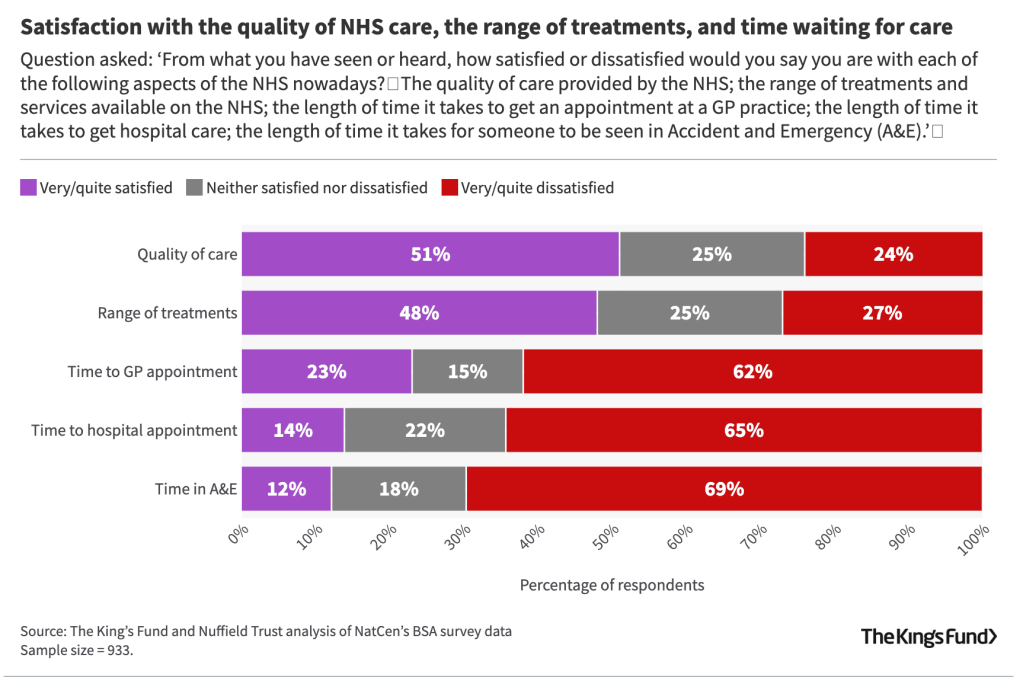
Dissatisfaction is rife across services – from dentistry, to GPs, to A&E, to hospital care, to social services. But it is the time spent waiting – in A&E or for GP or hospital appointments – that rankles most. Only 25 per cent are unhappy with the quality of care or the range of treatments available; around 50 per cent are satisfied.

The problem with NHS care is the quantity provided not the quality – as is also reflected in 75 per cent saying the NHS is understaffed. Produtivity and enhanced outcomes are important, but unless these lead to more responsive services, they may do little to shift public perceptions.

2. No tax, only spend

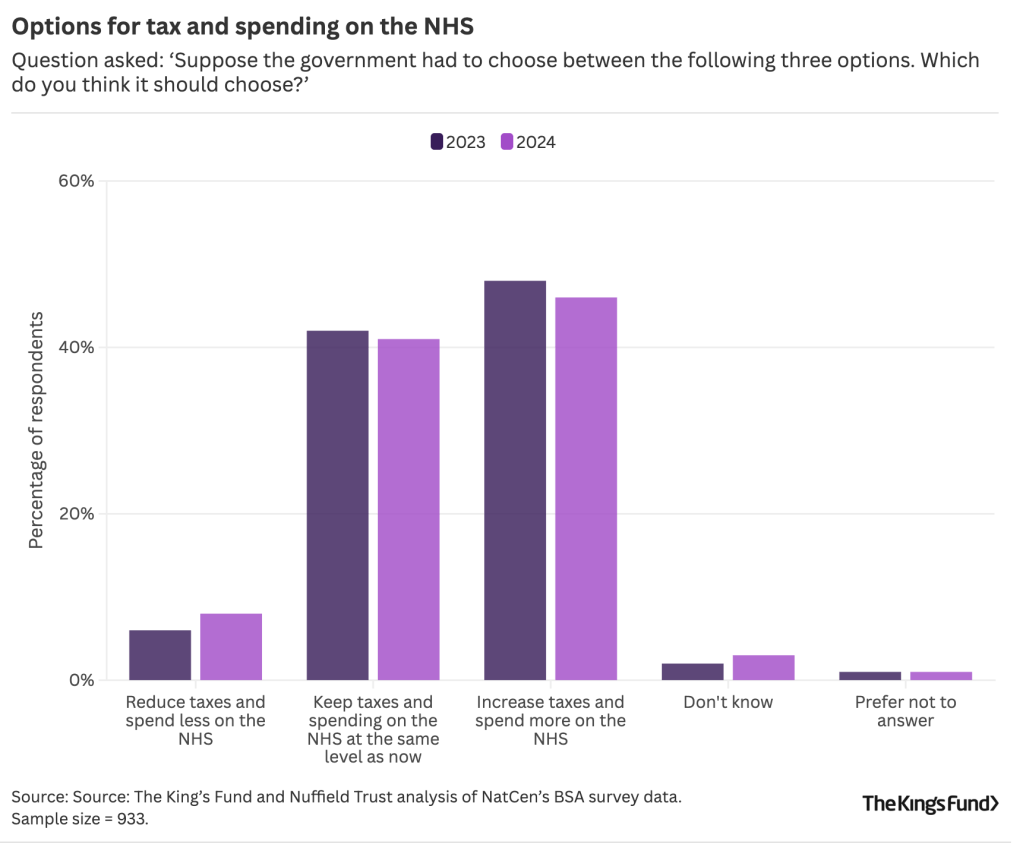
Nearly 70 per cent of people think that the government should spend more on the NHS, but only 46 per cent think taxes should go up to do this, a very slight fall from 2023. These views are not necessarily inconsistent with each other, or with the government’s policy, which has been to spend more on the NHS without raising personal taxes.

But I wish that British Social Attitudes would ask a follow up question, both on this specific issue and on their more general finding that the public wants to pay more tax for better public services, and has done for almost a decade. ‘Which taxes do people wish to see rise?’, they should ask or even ‘Do you think you should pay more tax?’ I suspect that there is far more enthusiasm for tax rises in the abstract than there is for the specific, let alone the personal. I may be wrong, but it would be useful to know.

3. Shaky foundations?

British Social Attitudes also asks about whether people sign up to three ‘founding principles’ of the NHS – universality, freedom at point of use, and funding through taxes. Bea Taylor from Nuffield Trust is quoted as saying, “support for the core principles of the NHS – free at the point of use, available to all and funded by taxation – endures despite the collapse in satisfaction.”

Well, up to a point. Support for the NHS being free of charge at the point of use has been sustained. But there are signs of change elsewhere. The proportion of people saying the NHS should be definitely available to everyone has fallen from 67 to 56 per cent since 2021, and the saying taxpayer funding definitely applies has fallen from 55 to 42 per cent. These are pretty substantial shifts.

The biggest gains have been both those opposing the propositions, and those feeling that the propositions ‘probably’ apply. It seems support for these core propositions, while still broadly intact, is less fervent than it once was – a change that could be attributed to anti-immigrant feeling (for the ‘universal’ principle), to a rise in Reform-driven debate about ‘insurance-based models’ (which the party is rather coy about), or simply to people thinking that something has to give.

As the Government prepares to launch its Ten Year Plan for the NHS, it will be interesting to see what that might be.

Makes no sense at all

In a small Midlands town at the weekend recently, I saw a stall for NONPOL, the ‘New Open Non-Political Organised Leadership’. This non-party party, whose leader Neil O’Neil won 166 votes in the 2024 General Election, presents party politics as a blight that distracts our leaders from common-sense solutions.

Disregarding the fact that many of these ‘common-sense’ solutions appeared on the flakier fringes of the paranoid right, it reminded me of how I used to rail against the idea of political parties. They made no sense, I thought, they were an impediment to true democracy and freedom of thought (too much classical education, you might say).

I didn’t like first-past-the-post voting either, whereby a party could – as Labour just have – win a huge majority of seats with only a plurality of votes. Monarchies and unelected second chambers I saw as ridiculous throwbacks. The idea of owning land seemed absurd, as did private property more generally. How could individuals lay claim to these things that pre-existed them and would live on for many years after?

All these opinions (and many more) were pretty average for a young person, and all were founded on reasoning from (not unreasonable) first principles. At one level, our system of government is deeply undemocratic, inherited political power is an absurdity, and the foundations of capitalist economics are hard to justify.

But these are no longer the principles that animate me. It’s not so much that I no longer believe what I once did; it’s more that other considerations – of what seems to work practically in creating a viable state – have gained more prominence. I’m sure others have had a similar experience. Some people call it ‘growing up’; teenage me would call it ‘selling out’; I prefer to think about it as adapting your perspectives as you see how things work.

Thinking about this made me think about the much-reported failure of younger generations to shift rightwards as they get older. This is often attributed to their inability to buy houses in early middle-age, and therefore to adopt the more conservative views that naturally accompany property ownership. That’s part of it, for sure, but there’s a bit more to it. All the things that seemed to work OK in the 1990s and 2000s, when I was in my twenties and thirties – capitalism, economic growth, government – have been rocked since 2008. The ensuing chaos has not given people a few years younger than me any reason to think that the system does actually work.

And I can’t help thinking, they may be right. But I hope the new government can prove them wrong.

Density – free riders and secret sauce

Russell Curtis, architect, On London contributor and one-man spatial think tank, published a new paper, Towards a Suburban Renaissance, on his blog last week. Reflecting on their generally low and static densities, Curtis argues that London’s suburbs could accommodate many more homes near stations, by gentle densification of existing residential streets – an upwards extension here, a replacement of a house with a low-rise block of flats there, a new build in a back garden there.

Without even encroaching on protected industrial land or open spaces, Curtis calculates that London could accommodate around 900,000 more homes in this way. Current completions are much lower than the current London Plan target of 52,000 homes a year, and both government ministers and London think tanks say that target should be set higher still. Realising even a small part of the potential that Curtis identifies would be a big boon.

You might think that in a city with a rampant housing crisis and record levels of homelessness, such a modest proposal would be enthusiastically debated by mayoral candidates in an election year. Or…you might not actually, because if you are the sort of person who reads On London, you are probably aware just how politically tricky suburban densification is in a contest where every Outer London vote counts.

Politics confounds any attempt to boost housing supply in the capital through suburban densification. The result is that any vacant site is developed to the max and everything else remains untouched, leading to a lumpy cityscape and eerie juxtapositions such as the transition from towers around East Croydon Station to the two-storey terraces of surrounding streets. Everybody can see the dysfunctional results of this approach, but the politics of changing tack are too tough: as Curtis has written for On London before, both the Mayor of London and Croydon Council have backed down from suburban density-friendly policies.

There are ways to open up the conversation, at least. The “Street Votes” proposal, developed by Policy Exchange and championed by the Nicholas Boys Smith, chair of government’s Office for Place, proposes empowering local communities to redevelop their own neighbourhoods, sharing in economic benefits and ensuring that redevelopment is seen locally as an enhancement rather than a blow to quality of place. A government consultation on making this idea a reality has recently closed, and Street Votes could make a difference where communities can see the potential benefits.

But I think there’s a bigger strategic issue too, about how we talk about density and amenity. I was thinking about this recently over lunch in a small village on the edge of London. Our hosts, heavily involved in the parish council, were discussing how they hoped to use tree preservation orders to scotch any danger of new homes being built on adjacent land.

Their other big campaign was to find a way of re-opening the local pub, which was shutting down owing to dwindling trade. They were prospective clients of my partner so I bit my lip, but in my mind’s eye I was shaking them by the lapels and shouting, “Don’t you see the connection? No more people means no more pub!” To which you might add, no more primary school, no more bus service, no more local shop…

When I look on borough planning consultation portals, I can always find an option to comment on loss of amenity from a development. It’s much harder to comment on loss of amenity from not developing. Across London’s and other cities’ suburban high streets, shops, restaurants and bars are struggling to survive in the face of changing consumer habits and constrained spending.

One answer to this is to shrug, feel a twinge of sadness and let the market find more economically viable uses for the space. Another is to try to make sure these services have enough customers to keep going. You don’t have to go to the pub every evening or ride the bus every day yourself, but you shouldn’t prevent the people who might do so from moving into the area and then complain when the landlord shuts up shop or Transport for London cuts service frequencies.

In urban areas we are all free riders, locked into relationships of mutual reliance on other citizens, and their use of public and private services. If we seal off our neighbourhoods from newcomers, we don’t preserve their character so much as undermine it. We need more homes in London to address the housing crisis for sure, but also to sustain the urban services, quality and vitality that bring people here in the first place. Density is the secret sauce of our cities. We need to sing its praises.

First published by OnLondon.

Missions Aspirational

You have to feel for Michael Gove. Rarely has a document been freighted with as much expectation as the levelling up white paper, which has been promised in one form or another since 2019. But even as the Department for Levelling Up, Housing and Communities was being given its new remit the spending shutters came down, ruling out new money – at least on the scale needed to radically alter hundreds of years of economic development.

Without new money the white paper sets direction rather than powering engines, though it does offer a few enticing hints of change. It promises, for example, to push devolution further and to bring some clarity and consistency to England’s idiosyncratic patchwork quilt of local government, and it celebrates the role of local policy-making. It even suggests that mayoral combined authorities and the Greater London Authority might bid for “sweeping further powers”, though it stops short of any significant transfer of fiscal powers.

And it does at least tell us what the government thinks “levelling up” is. At the core of the paper are 12 targets for 2030, heroically rebranded as “missions”. Advocates of mission-thinking as a way of galvanising action often point to John F Kennedy’s commitment to put a man on the moon by the end of the 1960s. Note that JFK didn’t make 11 other commitments at the same time. But most of these targets are laudable, even if the lack of detail on delivery makes them feel rather “aspirational”.

It is notable that most of them focus broadly on national improvements in social and economic conditions – job numbers, productivity and pay, violent crime, wellbeing, pride in place, school standards, adult training and home ownership – rather than explicitly on closing the gap between “LondonAndTheSouthEast” and other regions, which can of course be achieved by levelling up or by levelling down. Essentially the missions argue that all should rise together, though several qualify this by specifying that the worst-performing places should see the sharpest improvements.

Some targets are more explicit in their focus on narrowing gaps. Public transport across the country is to be “significantly closer to the standards of London” by 2030, which is a slightly ambivalent pledge given the cutbacks being considered by Transport for London in the absence of a long-term funding deal. It also does prompt a raised eyebrow – can other cities, let alone less densely populated towns, really support services like London’s?

The focus on narrowing the gap in healthy life expectancies also stands out, though the detail remains to be filled out in a separate white paper on health disparities later this year. In the meantime, the question of what geographies you use to judge success will be vital. As previously remarked here, the difference between places within the same borough can be every bit as stark as those between different regions.

There is a little more meat in the two economic missions. One pledges to improve pay, employment and productivity in every area of the UK – which should be good news for London, where productivity growth has stalled in recent years. The other proposes rebalancing public expenditure on research and development (R&D) outside the Greater South East. This could be one of the strongest measures in the white paper. Public spending on R&D is heavily focused on the “golden triangle” of London, Oxford and Cambridge, and there is a good argument that this concentration is failing on the grounds of economic efficiency as well as fairness.

Rebalancing investment to where it can make a real difference both directly and through attracting private investment rather than insisting it is spread evenly throughout the country, could make a real difference. The promise of £100 million for three new “innovation accelerators” in Greater Manchester, the West Midlands and Glasgow suggests that the need for focus is understood. Any switch of resources from London to other parts of the UK is likely to feel harsh, but a rebalancing of R&D spending is worth contemplating as a way of building up the knowledge economy in other cities.

Much less helpful is the white paper’s restatement of the government’s plan to divert funding for housing away from the areas of lowest housing affordability – that is, London and the South East. Doing so seems to fly in the face of its protestations that “levelling up is not about making every part of the UK the same, or pitting one part of the country against another. Nor does it mean dampening down the success of more prosperous areas”.

Less money for affordable housing in London is not likely to be good for London or the UK. London’s housing crisis is likely to worsen, with one of two results or a mix of them. Either the capital’s economy will suffer, with consequences for the rest of the country, or living in London will become more exclusive, further detaching the capital from the rest of the country. Investing to lever growth into other cities is a worthwhile endeavour. Removing support for infrastructure in places that most need it seems short-sighted and even spiteful.

Originally published by OnLondon.

Book Review: Red Metropolis by Owen Hatherley

Owen Hatherley’s book springs from an honourable impulse – to rescue London from lazy stereotyping as an elitist hothouse of privilege, distant from the more authentic social and economic struggles of the northern cities. He aims to rekindle pride in London’s rich heritage as a radical trailblazer of social progress, and for the most part he succeeds.

Hatherley’s previous books have covered everything from the ersatz urbanism of Blair-era ‘regeneration’ projects, to the communist architecture of eastern Europe, to the commodified nostalgia of Cameron’s austerity years. Most recently he has focused his gaze on London (he is also editor of the fascinating Alternative Guide to the London Boroughs, published by Open House last year). A self-described communist, Hatherley began writing Red Metropolis in December 2019, and describes the book as an “attempt to write myself out of the feeling of numb horror” caused by Labour’s defeat in that month’s general election.

Red Metropolis is a work in three acts, focusing in particular on London’s perennial housing crisis and on public housing, one area of social welfare that has consistently had a local dimension. The first part traces the history of London County Council (LCC) from the messy politics and patchy administration of the late 19th Century to 1965, the second records the ascendancy of the New Left in the Greater London Council of the 1980s, the third looks (sorrowfully) at the record of the three mayors of London since 2000. 

The LCC took over from the unelected Metropolitan Board of Works in 1889, and for nearly twenty years, under a shifting “progressive” leadership comprising liberals and various left groups that would later merge into the Labour Party, was a pioneer of municipal socialism. Directly employed labourers built council housing in the Boundary and Millbank estates, which Hatherley praises for their “high-quality materials, urbanity and spaciousness”, and the LCC’s borough allies (including Battersea, where John Archer, the first Black mayor of a borough, was elected in 1913) built smaller-scale schemes such as the Latchmere Estate. 

The Progressive alliance faltered and the Conservatives dominated the LCC for the next 25 years, but by the 1920s, the Labour Party had begun to build a power base (particularly in the “Five Red Boroughs” – Battersea, Bermondsey, Deptford, Poplar and Woolwich). In 1922, Poplar councillors, led by George Lansbury withheld rates from the LCC in order to fund social programmes, arguing that it was “Better to Break the Law than to Break the Poor”. Thirty were briefly jailed in an episode which is a precursor to the 1980s rate-setting protests and the legal challenges to the GLC’s “Fares Fair” policy.

Poplarism stirred up persistent debates within the Labour Party between advocates of constitutional change and those seeking more direct action. Herbert Morrison, who dominated the London Labour Party from the 1920s, and led the LCC from 1934 to 1940, was a vociferous opponent of the latter approach. Morrison has been a controversial figure in left politics, at times criticised (like his grandson Peter Mandelson) for his focus on “electability”, but also for his model of ‘bureaucratic nationalisation’, with professional managers in control rather than workers themselves. 

Hatherley is more generous in his assessment. Even though 1950s schemes such as the Alton Estate are more to his taste architecturally than the “staid and stiff brick tenements” of the 1930s, he argues that Morrison prefigured the post-war settlement by offering free healthcare, building housing, schools and parks, and by establishing London’s own nationalised transport board, and also praises the sometimes-maligned Abercrombie plans that were developed in the heat of the War. Like Robert Moses in New York, Morrison remade his city, and made plenty of enemies along the way.

LCC puritanism – they built estates without pubs and Morrison wanted lidos closed at night to stop “people fucking in them” –was roundly rejected by the “New Left” leadership of the Greater London Council in the 1980s. Hatherley brings to life the carnivalesque egalitarianism of County Hall under Ken Livingstone, its corporate wood-panelled corridors thronging with punks, Rastafarians, gay rights activists, artists, radical feminists and communards. One of the ironies of the past 30 years is how the anti-racist and gay rights campaigns led by the GLC, which led to vitriolic tabloid attacks at the time, have become entirely mainstream, while its economic programmes, such as the “People’s Plans” for reindustrialisation of London’s docks, look positively quaint.

The importance attached by the New Left to community-based politics and participation above all things led, Hatherley argues, to its rejection of Morrisonian housebuilding programmes. Partly as a result of this and partly because the city was still depopulating through the early to mid-1980s, the Livingstone-era GLC built little housing and what it did build was often “twee and flimsy” – pockets of suburban semis that can still be seen dotted around inner London. The antipathy towards grand schemes led to renowned architects such as Neave Brown in Camden and Ted Hollamby in Lambeth being pushed out of their local authority jobs. (In another nice irony, the communist Hollamby went on to work at London Docklands Development Corporation, the epitome of Thatcherite laissez-faire urban policy).

Despite this, Hatherley sees the GLC’s record as a “social democratic Paris Commune” as a guiding light for the Corbynista left in 2015-19: “so successful was it that London’s governing body had to be abolished out of existence.” But he identifies a wider legacy too: the GLC’s focus on cultural policy was foundational to London’s 21st Century character, and its abolition in 1986 alongside the ‘Big Bang’ of financial services deregulation, helped define the politics and economics of London today. 

Hatherley is less impressed with – and I think less fair to – the three Mayors in City Hall since 2000. He gives Ken Livingstone and Sadiq Khan some credit, for transport projects and policies in particular, but excoriates all three for their failure to tackle London’s housing crisis. In particular he sees them as in thrall to a faustian pact with private sector developers to build affordable housing through Section 106 agreements, designed to mitigate the impacts of new development and to reflect the value created by the grant of planning permission. This approach, he argues, has fanned London’s red-hot property market, encouraged speculation by landlords, and widened inequality in the capital.

The narrative is powerful, but some details are smudged. Hatherley writes that Livingstone failed to define what “affordable housing” meant; but the 2004 London Plan gives broad definitions, and supplementary guidance published in 2005 goes into some detail in defining “social”, “intermediate” and “low cost market” housing, and specifying in what proportions these should be built. He says that the 2012 Olympics resulted in more social housing being lost than was built; but even the social housing provision in the Olympic Village (around 700 homes), exceeds the number that were lost at Clays Lane, the housing co-op that was demolished on the north of the site. And he damns Sadiq Khan’s efforts with faint praise, saying there has been “some encouragement” of councils to build housing; but Mayors need to agree affordable housing funding with national government and Khan has allocated £1 billion of the capital grants he has secured to councils to build 11,000 social rented homes.

But these and a few others are errors of detail. The central accusation stands, against the local government leaders who did deals with private developers as well as against the three Mayors themselves. In recent years the “cross subsidy model” of affordable housing provision, which has also been adopted by councils themselves as well as housing associations, has come in for increasing criticism: it requires rising prices to work, so fuels the pressures that it seeks to address, and creates an industry of opaque and gameable viability assessments. 

What else could the Mayors have done? Housing was explicitly excluded from their functions until 2007 (the GLA was designed to have minimal overlap with borough powers), and control over capital grants for affordable housing was only handed over in 2011. Restrictions on councils’ ability to borrow against their rent rolls in order to build have also only been relaxed in recent years. Hatherley reports Alex Salmond suggesting that Ken Livingstone should have demanded the right to charge more Council Tax on the wealthy to build more social housing, but the right to reform Council Tax was in the Scottish Parliament’s gift from the outset. It was never on the table for London. Two reports from the London Finance Commission, under Boris Johnson and Sadiq Khan respectively, have sought more powers over property taxes for London but been studiously ignored.

The approach of the mayoral administrations could also do with some interregnal context. The abolition of the GLC (and other metropolitan counties) came near the high point of conflict between central and local government. As Thatcher was replaced by Major, more centrist borough leaders such as Haringey’s Toby Harris built consensus with businesses and across party lines – until 1995, there were separate membership organisations for Conservative and Labour boroughs. The 2000 version of Ken Livingstone was as much part of this détente as John Major and Tony Blair were. Even bust-ups such as the London Underground public private partnership were about the nature of private sector involvement in the running of the Tube, not the principle of it.

Red Metropolis is an informative, lively and punchy read, at once optimistic about London’s possibilities and angry at its realities. Hatherley brings to it his perceptive and humane architectural sense (equally damning of both the “chilly Piranesian grandeur” of County Hall and the “grub-like” City Hall), an ear for a quote, and an eye for the curiosities and ironies of London’s evolution. The captions under artless urban photographs (by the author and Daniel Trilling) provide a wry running commentary on the text, and on the persistent gaps between rhetoric and reality.

Hatherley closes by observing that, unlike the 1980s when the left captured Labour municipalities across the country but remained shut out from the commanding heights of the party, the Corbyn years saw the party’s leadership shift sharply to the left, without this being reflected in councils, which generally continued to be run by pragmatic/compromised (delete to taste) centrists. Even those, such as Haringey and Newham, that saw leadership changes during the “Momentum years” have failed to implement the Poplarist programmes that Hatherley would like to see. 

The final pages argue, uncontroversially, for more devolution, for decentralisation of government and for more openness to international examples, as well as for an end to growth and a more confrontational attitude towards central government. He believes that London government can acquire powers by staking claims – “Better Break the Law than Break the Poor” still. This is a high-risk strategy, though it did recently work when Mayor Boris Johnson decided to sack the Metropolitan Police Commissioner without the power to do so or reference to the Labour Home Secretary.

Red Metropolis is a salutary reminder of the sense of possibility that can and should infuse London politics, despite the conflicts and compromises that governing a city of nine million people involve. If London is in Henry James’ words “only magnificent”, this magnificence is partly the result of the striving and the strife so well described in this book.

[First published in OnLondon, 8 February 2021]

Good advices?

 [First published in Local Government Chronicle, 24 November 2020]

Choosing the right advisors is one of the most important decisions that political leaders make, as recent Downing Street dramas have illustrated. This is perhaps particularly true for the mayor of London, who unlike the prime minister or a council leader does not have the support of a party group, but only the watchful eye of a scrutinising London Assembly.

So, alongside City Hall’s expert staff, mayors need mates; their own people who can advise and represent them in such a huge city. The mayor of London can bring in 12 appointees, and the ways in which the three mayors to date have appointed and worked with their teams have been indicative both of their strengths and their weaknesses – as detailed in London’s Mayor at 20, a collection of essays, analyses and interviews looking back over the past two decades of the capital’s mayoralty.

When Ken Livingstone was elected in 2000, he came with a gang of advisors who had worked with him for many years – from the Greater London Council, from activism since then, from his parliamentary office. Most had worked with him when he had decided to run as an independent following Labour’s bungled attempt to fix candidate selection. Within weeks of his election, Ken had advertised posts as ‘policy advisors’, and many of these were filled by familiar faces.

The team were all broadly from the political left, albeit from different denominations; Simon Fletcher, Ken’s chief of staff and former parliamentary researcher, brokered agreement on priorities and positioning. The mayor used to describe advisors such as Neale Coleman, John Ross, Jude Woodward and Lee Jasper as being like ministers – with full authority to represent his views. The team was consistent through Ken’s two terms, with the mayor showing loyalty (and damaging his 2008 re-election campaign) when advisors became embroiled in newspaper allegations of cronyism.

Unlike his predecessor, Boris Johnson had no deep roots in London politics, and had only been an MP since 2001. There was no gang waiting in the wings when the ebullient loner was elected in 2008. Nick Boles, then Conservative MP for Grantham and founder of the Policy Exchange thinktank, worked with the new mayor to appoint deputy mayors.

The initial tranche proved shaky: one was prosecuted for fiddling expenses, another was found to have fabricated his CV, and a third senior advisor made comments on race issues that led to swift resignation. Tim Parker – a corporate restructuring guru appointed as chief of staff and first deputy mayor – left when it became clear that there wasn’t the scope or appetite for the application of his specialised skill set, and that Boris wanted to take decisions as mayor rather than acting as a media-friendly figurehead.

Other appointments were more stable, some becoming long-term Johnson allies. Munira Mirza, deputy mayor for culture and education, followed Johnson to Downing Street, as did chief of staff Eddie Lister, who is now temporarily filling the same role at 10 Downing Street. Lister, and Simon Milton the former Westminster City Council leader who preceded him at City Hall, took a relatively light-touch approach to policy co-ordination, leaving other deputy mayors, such as Stephen Greenhalgh, Kit Malthouse and Isabel Dedring, with space to develop policy positions, but also giving a looser sense of direction than under Livingstone.

If Sadiq Khan drew one lesson from Boris’s wobbly transition, it was not to make appointments too quickly. His deputy mayors were appointed painstakingly over his first six months in office. Senior local government figures such as James Murray and Jules Pipe, former mayor of Hackney, were appointed alongside former GLA officials Justine Simons and Shirley Rodrigues, and external figures such as human rights barrister Matthew Ryder, shadow transport minister Heidi Alexander and former Home Office special advisor Sophie Linden.

These appointments have been carefully judged, but the deputies are not close to Sadiq and his decision-making in the way that Ken’s were, or eventually Boris’s became. Less prominent are the inner circle of advisors who agree policy positioning: chief of staff David Bellamy, director of policy Nick Bowes, and communications and external affairs directors Leah Kreitzman, Paddy Hennessy and Jack Stenner.

The London mayoralty is an unusual role: it can be a springboard or a dead-end; it suits loners and mavericks, but requires constant coalition-building; it gives extensive powers of patronage and appointment, alongside singular accountability. It is a job to which the incumbent is elected alone, but not one which any mayor could hope to carry out alone. Appointing advisors and deputies is an early but critical decision, requiring trust and judgement. For a political loner like Boris Johnson it is a fraught business, and one that has given him a rocky start both as mayor of London and as prime minister.

You don\’t need a weatherman

At the end of \’manifesto week\’, it does seem as if a lacklustre election campaign has been overlaid on a significant shift in the centre of gravity of British political discourse. As John Prescott put it, what seems like an age ago, \”the plates are shifting\”.

There\’s been a lot of debate, mainly from the originator of the term, about whether Theresa May is a \’Red Tory\’. In an interview in today\’s Observer, Damian Green suggests something rather different. His old friend is not a great political theorist, he says, but a meteorologist, who can sense changes in the climate of public opinion and react to the modern world.

Many would argue that a leftward shift in public opinion is long overdue; the wonder is that it didn\’t happen earlier, given the crisis of financialised capitalism ten years ago, and the growing perception of inequality since then. We\’re through with shock, denial and anger, and are now ready for a new deal, which promises to tame and temper capitalism for the public good. Ten years may seem like a long time, but almost as many years passed between the crises of the late 1970s, and the emergence of purple period Thatcherism after the 1987 election.

And, of course, the shift in rhetoric and discourse may not signal an actual change in behaviour. Just as New Labour shrouded redistributive policies in veils of prudence, the Conservative government that most people expect to see elected in June may enact traditional Tory policies while paying lip service to kinder capitalism.

But the opinion polls published today give pause for thought. Labour still has a mountain to climb, but has narrowed the Conservatives lead from around 20 points to 13 or less. Labour has made much of the Conservative reforms of social care (a small shimmy in the right direction, imo), and perhaps this \’nasty party\’ framing is hitting home.

But I can\’t help wondering whether, in trying to colonise Labour territory, the Conservative manifesto hasn\’t scored a more significant own goal. In signalling a leftward shift, has the manifesto given voters permission to think what was once unthinkable, that free markets are not always the best guarantor of prosperity? And if you start thinking that way, you might even think a bit further: if you\’re going to clamp down on executive pay, why not think about setting ratios? If caps on fuel bills, then why not renationalisation? Just as Labour suffered, until John Major\’s goverment ran out of steam, from looking like a pale shadow of conservatism, why would people vote for a half-arsed version of the interventionist social democracy offered by Labour?