Glad it’s all over

A recent piece by the FT’s Gideon Rachman, on the re-awakening of the nuclear ams race, sent me back to the early 1980s, when the threat of nuclear war stalked the pop charts, even as unseen crises such as Able Archer 83 secretly brought the world to the brink.

Because I am a cheery soul, I already have a playlist on Spotify called ‘Nuclear‘, which draws together some of the irradiated pop dystopias that sold in such numbers 40 years ago. There are some absences (such as Sting’s ‘Russians’) largely on the grounds of my tastes, but the list does give a sense of how pervasive the nuclear threat was in popular culture – at a time when the charts were much more of a communal experience than they are today. I don’t detect the same looming anxiety about, say, climate change in today’s pop music. But I don’t listen to much modern pop music so what do I know?

And it wasn’t just music. In the UK alone, TV dramas such as Edge of Darkness (1985), A Very British Coup (1988) and, unforgettably, Threads (1984) all touched or centred on the politics and potential consequences of nuclear defence, nuclear diplomacy and nuclear war. There are, of course, US films such as War Games (1983) too, but there’s a blend of ghoulishness, glee, melancholy and cynical fatalism that seems peculiar to the UK dramas and pop songs.

I was a teenager in the early 1980s, so was perhaps particularly sensitive to this sense of dread that seemed draped over the world, just as I started taking an interest in it. Looking back, I suspect that spending long afternoons in darkened rooms listening to how different mixes of ‘Two Tribes’ by Frankie Goes to Hollywood incorporated civil defence warnings was not the most psychologically healthy of hobbies. (And I wonder whether the political apathy often attributed to ‘Generation X’ relates to us not confidently expecting to reach voting age, let alone maturity.)

But it wasn’t just morbid protogoths. The likelihood of nuclear war, “within the next year or two”, was a commonplace of discussion between my parents and their friends, sometimes overheard from upstairs as the dinner party drinking continued.

All that seems curiously distant now, only half-glimpsed through pop culture reflections, crowded out by more tangible 1980s markers such as Concorde and Sony walkmen. In his history of the Peloponnesian War, Thucydides commented that distant observers would judge Athens to have been far more powerful than it was owing to its wealth of monunmental buildings, but would not understand the power of Sparta, a great power that had a minimal (and mainly wooden) physical footprint.

In a similar way, the physical traces of this part of the Cold War are hard to find: missile and civil defence sites were buried or locked away, and most still are. You saw the women camped out at Greenham Common, but you never saw what they were protesting against. For most of us, the standoff was a strangely immaterial event, even a psychological one. But the songs and dramas of the 1980s can still give a sense of its power and how it was imprinted on our consciousness, like the ghostly shadows left by the nuclear blast at Hiroshima.

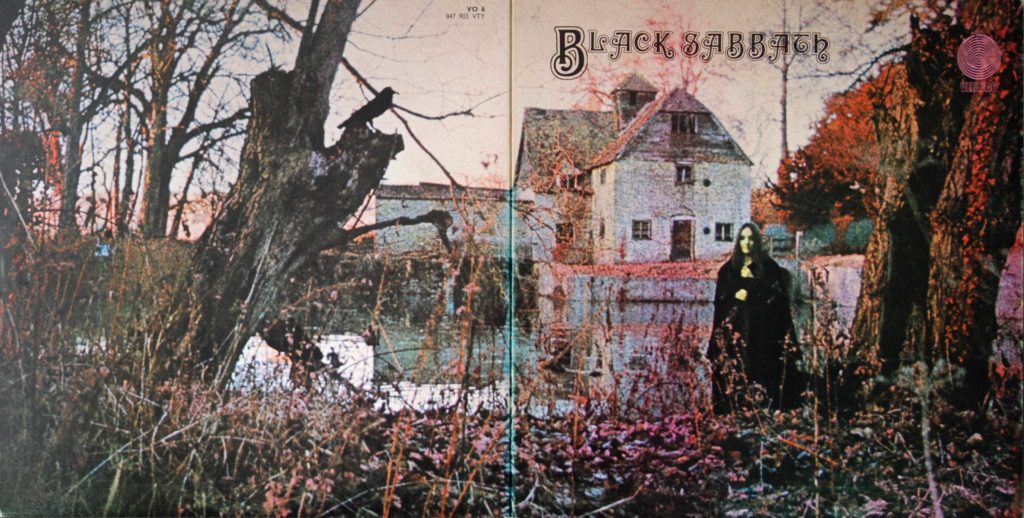
Long ago, I wandered in my mind – Black Sabbath, the midlands and me

I was probably sixteen, working in the kitchen of the village pub, when I first heard Black Sabbath.

“You like heavy metal,” said my boss, a hairy biker avant la lettre.

“I so do not,” I replied, thinking of Def Leppard, Iron Maiden and Bon Jovi.

“Nah, you do. You liked that Led Zeppelin tape I played. Now try this.”

What the…?

The churning, sludgy guitar sound, the desperate voice of a man struggling against the mire of the music and his mind. The sense of grubby doom, then suddenly tempo changes, keyboard washes and jazzy drums, and guitar solos that sounded like they had been recorded in a cave. I loved it all.

I grew up near Banbury. Not that close to Birmingham, but not that far either. The Mercian dankness could creep down the A41. Black Sabbath followed me when I started working at a greenhouse factory a few years later – pressing aluminium, not forging steel, but still. We had Radio 1 on all day (Kylie and Jason, Cliff Richard, Mike and the Mechanics), but Sabbath and Zeppelin ruled in the rattly old Mini Metro that I drove home. Those heavy guitar sounds are as much a part of those days as the styrofoam boxes of chips and beans from the food van at lunch.

As Quietus founder John Duran has argued, Black Sabbath’s was defiantly modernist music. It didn’t hark back to blues, to skiffle, to folk, to chanson, or to big band. It lived in its own world, a world of factories and factory closures, a world of managed decline and derelict mills.

And I think that’s the point. Black Sabbath’s early albums are constantly surprising, because they don’t know what they are meant to be. The perfect powerpop of Paranoid is sandwiched between lumbering leviathans War Pigs and Iron Man. Proggy epics such as Wheels of Confusion sit next to the blissed-out hippy bongos of Planet Caravan. Of course Black Sabbath didn’t know how to play classic heavy metal; they were too busy inventing it.

RIP Ozzy Osbourne

A terrible beauty is torn

I’ve been thinking about The Pogues quite a lot since Shane MacGowan’s death last week. Though I listen to them more rarely now, I was a huge fan in the 1980s and 1990s. They were a gateway drug to Irish folk music – Christy Moore, the Chieftans, the Dubliners – and a guttering light by which I started to explore my Irish heritage and adolescent rebel politics (I relished the rage of one schoolteacher who seethed that I was “the sort of person who probably thinks the Birmingham Six are innocent”).

Some MacGowan obituaries have inevitably focused on his lifestyle, which certainly threw out some meaty anecdotes, but most have also acknowledged the sheer quality of his songwriting at the Pogues’ peak. His literary and hellraising sensibilities slug it out in songs like Streams of Whiskey and the Sickbed of Cuchulainn; his sympathy for the oppressed shines through in The Old Main Drag, and his woosy romanticism gleams in Rainy Night in Soho and Fairytale of New York. He shifts perspective and tone – the estranged lovers in Fairytale, the old and young man in Pair of Brown Eyes, memories and narrative in The Broad Majestic Shannon – smoothly and artfully.

His is a London-Irish perspective. His view of the UK capital is brutally and raucously realist (staggering in Transmetropolitan “from a 5 pound bet in William Hills to a Soho sex-shop dream, From a fried egg in Valtaro’s to a Tottenham Court Road ice cream”). But his Ireland is romantic, pre-lapsarian, the land that his mother’s family talked of in his early years in Tipperary. The images in the Broad Majestic Shannon – “the cards being dealt and the rosary called, and the fiddle playing Sean Dun Na Ngall” – are out of time, and intentionally so. MacGowan’s Ireland has its own ghosts – “the best place on earth, but it’s dark and it’s old”, as Sit Down by The Fire has it – but its devils are all imported, mainly from Britain (the soldiers in Gentleman Soldier and The Recruiting Sergeant; the accursed “judges, coppers and screws who tortured the innocent” in Birmingham Six).

It may seem churlish so soon after MacGowan’s death, but it’s interesting to contrast his perspective with Philip Chevron’s. Chevron, the Pogues’ lead guitarist who died ten years ago, was Irish-born and -raised. His songs have a more ambivalent attitude to his country, its priest-ridden past and its underachieving present. In Thousands are Sailing, he observes the irony of the Irish diaspora: “wherever we go we celebrate the land that made us refugees, from fear of priests with empty plates, from guilt and weeping effigies.”

You can hear the disappointment in what the Republic had let itself become in the tumbling imagery of Faithful Departed (which gives this blog post its punning title), written by Chevron for his punk band The Radiators from Space but perhaps less dated-sounding in this version by Christy Moore. Like Thousands are Sailing, the song starts in dialogue with ghosts, but this time they are literary heroes (Yeats, Joyce, Brecht, Behan) rather than nameless Famine victims, as the song picks apart the “made to measure history” of the “grey, post-DeValera Ireland of the 1970s”, to quote Chevron’s own exposition of the song (allegedly from a Pogues blog, though I can’t find the original).

When I first heard the Pogues, I had never been to Ireland (just as, incidentally, MacGowan had never been to New York when he wrote The Pogues’ biggest hit). If the Ireland I imagined was MacGowan’s, the Ireland I found when I did start visiting in the 1990s was more like Chevron’s (though rapidly becoming less so). The magic of the Pogues is the way these perspectives played off each other, in a band blessed with two extraordinarly gifted singwriters.

Heaven is a place on earth

Band playing in Heaven

Is it “black metal” or “death metal”? I am never quite sure of the difference, but the air thrums with blast-beat drumming as we descend into Heaven. Tonight we’re here for the metal, but as we pass the security staff, I am briefly transported back to my 1990s, when optimism and alcoholic lemonade fuelled countless nights of terrible dancing and occasionally-effective eye-catching under the arches of Charing Cross.

Heaven is now a venerable London institution. The club, buried in the vaults under the station concourse, was a gay clubbing trailblazer when it opened in 1979. It was established by Jeremy Norman – entrepreneur, wine merchant and chairman of Burke’s Peerage – drawing on his experiences at New York’s The Saint and Studio 54. Through the Eighties and Nineties, Heaven hosted iconic gay nights such as Fruit Machine, alongside pioneering techno clubs like Paul Oakenfold’s Rage and gigs by everyone from New Order to Throbbing Gristle to Stereolab.

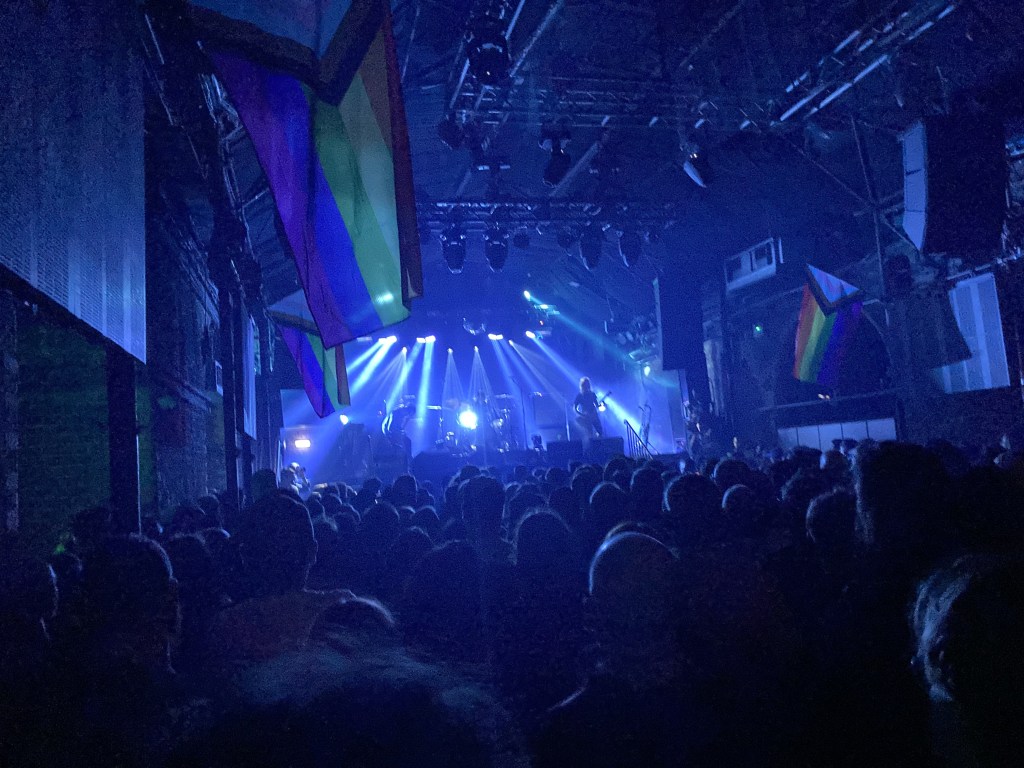
Owned today by Jeremy Joseph, promoter of G-A-Y, Heaven continues to mix it up. The cavernous vaults, which hold 1,000 people, have rainbow flags fluttering in the strobe lights as Flemish trio Wiegedood blast the crowd. The thing about death metal (or black metal) is you need to lean into it, like a stage diver trusting in the mosh pit.

Immerse yourself in the propulsive sound and let the melodies emerge – chiming chord progressions like Keith Levene’s on early Public Image Limited, or angular shreds of Sonic Youth noise. The lyrics are screamed in classic black metal (or death metal) style. Are they even in English or are they Flemish? It’s hard to tell, but given the band’s pledge, on their website, that their new album “focuses on the filthiest and most disgusting parts of human nature”, this may be a blessing.

As I buy a couple of cans of Red Stripe in between acts (a very fair £5.45 each, but decanted into disposable plastic glasses – boo!), Wiegedood bassist Levy Synaeve chats amiably with fans. For all the decibels and corpse-paint, metal audiences are some of the friendliest you could meet. The fashion may be divergent, the headbanging heavier and the flirting dialled down, but metal gigs can create the same euphoric sense of community and celebration as gay clubs.

Chicago’s Russian Circles are the headline act. They are “post-metal”, which seems to mean no vocals – probably a good thing, for reasons already stated – and  their music builds from languid harmonies, to motorik krautrock rhythms, to thundering slabs of guitar. It’s loud for sure, and Heaven’s sound system lets the bass re-arrange your internal organs without losing clarity and force higher in the register. But there is a lightness of touch to Russian Circles that eludes bellowing leviathans like Metallica. Their performance is captivating and enthralling.

Let’s be honest: I doubt anything I write will convert you to black (or death) metal, or post-metal, if you are not already a fan. But Heaven is place that bears (re)visiting, whether you prefer your repetitive beats from a DJ’s decks or a hairy Belgian’s drum-kit. It has the atmosphere and heritage absent from most purpose-built venues, but clean toilets, friendly staff and reasonably-priced drinks too.

After a fierce hour, Russian Circles leave the stage and the house lights come up. Heaven has to freshen up, apply lippy and re-open for its Monday stalwart, Popcorn. As we leave, I am almost tempted to turn round and join the queue to go back in. But I have a train to catch, and I’m not 25 any more.

Originally published by OnLondon

It started with a Zang

‘Video Killed the Radio Star’ by The Buggles was released in September 1979, a couple of months before The Clash asserted that “phoney Beatlemania has bitten the dust”. Both songs mark a watershed, but their tone couldn’t be more different. The Buggles song, fronted by producer Trevor Horn, is more playful and ambiguous than The Clash’s tub-thumping anthem – wistful about the past, but also avid for a future “rewritten by machine and new technology”.

The song could be a statement of intent. It sets the scene for a decade in which Trevor Horn’s ZTT Records was a persistent if mercurial innovator, blazing trails that sputtered out or reignited years later.

From the outset, the label (co-founded by Horn, Jill Sinclair and self-described ‘semiotician’ Paul Morley) was deeply “serious about the frivolous and frivolous about the serious” (to borrow one of Susan Sontag’s aphorisms from Notes on Camp). It was a pop label named after the sound of machine gun fire (‘Zang Tumb Tumb’), as transcribed by Italian Futurist (and Fascist) Filippo Marinetti. And one of its first big hits celebrated nuclear annihilation with a catchy but dumb-as-you-like chorus of “when two tribes go to war, one is all that you can score” over a Hi-NRG beat, with remixes sampling civil defence instructions for the disposal of corpses.

It’s astonishing to recall now how Frankie Goes to Hollywood, ZTT’s first big success, dominated the charts in 1984. They seemed to come out of nowhere, but their first three singles – tackling sex, war and love – soared to number one, aided by Paul Morley’s marketing talents and Radio 1 DJ Mike Read’s refusal to play ‘Relax’, and selling in numbers unknown to modern popcharts.

Frankie’s success can slightly overshadow other ZTT acts of the mid-80s. The Art of Noise (another futurist reference) and Propaganda, produced machine-music too poised and chilly to fit easily into 1980s compilation albums, but rediscovered and revered since. And Horn collaborated with fellow-Buggle Bruce Woolley on Grace Jones’ magisterial ‘Slave to the Rhythm’.

By the end of the decade, as Stock Aitken and Waterman’s version of electro-pop crowded the charts, ZTT were finding a new musical inflection point, trying to assemble a techno supergroup with Derrick May, and releasing records by Adamski, Seal and 808 State (it was the death of 808 State’s Andy Barker that got me thinking about ZTT). These were pioneering cross-over tracks but not populist novelties, as comfortable mimed on Top of the Pops as they were mixed with obscure Dutch white labels in a warehouse or disused airfield. The grandiloquent Morley/Horn touch can be detected in the spoken word into to ‘In Yer Face’, 808 State’s jackhammer second single, harking back to the Frankie’s riffing on Hitler and Castro speeches in ‘Two Tribes’ (amazing how much more accepted playing with Fascist and Nazi references was in the 1980s).

ZTT’s records pepper the critical touchpoints of 1980s and 1990s cultural history, as does their iconography of logos, Katherine Hammett t-shirts and album cover design, but the label’s legacy seems curiously weightless – compared to Manchester’s Factory Records, for example. Nobody could call Frankie Goes to Hollywood a one-hit wonder, but like many ZTT acts they burned brief and bright, then sputtered or stormed out in personal and legal disputes (808 State are a rare exception to this rule). Paul Morley describes this ephemerality as intentional. Interviewed by Barney Hoskins in 2013, he said:

“I’ve always been a bit pissed off with people like Weller and the Clash and Killing Joke, these people who say there can be some kind of polemic within pop. Well, Two Tribes was trying to prove to people that it’s impossible. I mean, we get to No 1 for nine weeks with an explicit, extravagant anti-war thing with the real government warning on there, and the next week it’s George Michael taking over at No 1, and that’s the end. Nine weeks, and nothing’s happened. I like that in a way.”

Slow Train Coming – apocalyptic glee and abandoned adoration

It was forty years ago today (or last Tuesday anyhow) that Bob Dylan unleashed on the world the stream of invective, religious chauvinism, misogyny and racism that is Slow Train Coming, the first of his born-again albums.  All these years later, Slow Train is still shocking and enthralling in equal measure; much against my better judgement, it’s one of my favourite Dylan albums.
Mark Knopfler’s guitar has rarely sounded better than it does casting shimmering chords and arpeggios around the punchy backbone of the Muscle Shoals Horns and Pick Withers’ drumming. Helena Springs and Dylan’s future wife Carolyn Dennis provide backing ballast to Dylan’s voice, which sounds unusually clear, lively, committed.
Most of the good stuff is on the first side. The loping Gotta Serve Somebody sets up the album’s basic Manichean thesis – the world is divided into the godly and the wicked, and you gotta choose your side. Three tracks later, the belligerently swaggering title track pours scorn on everything from food surpluses, to OPEC, to Alabama road safety regulation.
But it is the tracks that these two sandwich which draw me back to the album time and again.  Dylan starts Precious Angel thankful for his damascene conversion, but swiftly moves on to excoriating those who remain unredeemed. Then he switches to a chorus – “Shine your light, shine your light on me” –  that is sparkling and joyous, a sincere riposte to the woozy gospel posturing of Shine a Light on the Rolling Stones’ Exile on Main St a few years earlier.
One of the song’s joys is the way that, over six minutes, the pace picks up and Bob Dylan’s voice audibly warms and becomes more enthusiastic. By verse two, he directs his attention to his immediate circle:
“My so-called friends have fallen under a spell;
They look me squarely in the eye and they say, ‘Well all is well’.
Can they imagine the darkness that will fall from on high
When men will beg God to kill them, and they won’t be able to die?”
The pay-off stings like a slap in the face – talk about throwing shade – and the lines are sung with almost indecent glee. Dylan has not found a friend in Jesus but rather a harsh avenger.
The next track, I Believe In You, is very different in tone. Rather than triumphantly overseeing the apocalypse, Dylan is himself cast out, persecuted for his beliefs, for his love. The song mixes divine and secular imagery, sometimes seeming to address itself to a one-night stand, sometimes to an absent lover, sometimes to a forsaking deity. “Don’t!” – twice Dylan pleads not to be abandoned, his voice contorting into the yelp of wounded animal. Few Dylan songs sound so raw and direct, so adoring, with some of the eroticised longing that early medieval hymns direct at the bloodied body of Christ.
It’s the sound of someone utterly convinced of his righteousness, in love with his own new-found passion. It is as captivating as it is horrifying.

<!– /* Font Definitions */ @font-face {font-family:"Cambria Math"; panose-1:2 4 5 3 5 4 6 3 2 4; mso-font-charset:0; mso-generic-font-family:roman; mso-font-pitch:variable; mso-font-signature:-536870145 1107305727 0 0 415 0;} @font-face {font-family:Calibri; panose-1:2 15 5 2 2 2 4 3 2 4; mso-font-charset:0; mso-generic-font-family:swiss; mso-font-pitch:variable; mso-font-signature:-536859905 -1073732485 9 0 511 0;} /* Style Definitions */ p.MsoNormal, li.MsoNormal, div.MsoNormal {mso-style-unhide:no; mso-style-qformat:yes; mso-style-parent:""; margin:0cm; margin-bottom:.0001pt; mso-pagination:widow-orphan; font-size:12.0pt; font-family:"Calibri",sans-serif; mso-ascii-font-family:Calibri; mso-ascii-theme-font:minor-latin; mso-fareast-font-family:Calibri; mso-fareast-theme-font:minor-latin; mso-hansi-font-family:Calibri; mso-hansi-theme-font:minor-latin; mso-bidi-font-family:"Times New Roman"; mso-bidi-theme-font:minor-bidi; mso-ansi-language:EN-US; mso-fareast-language:EN-US;} .MsoChpDefault {mso-style-type:export-only; mso-default-props:yes; font-family:"Calibri",sans-serif; mso-ascii-font-family:Calibri; mso-ascii-theme-font:minor-latin; mso-fareast-font-family:Calibri; mso-fareast-theme-font:minor-latin; mso-hansi-font-family:Calibri; mso-hansi-theme-font:minor-latin; mso-bidi-font-family:"Times New Roman"; mso-bidi-theme-font:minor-bidi; mso-ansi-language:EN-US; mso-fareast-language:EN-US;} @page WordSection1 {size:612.0pt 792.0pt; margin:72.0pt 72.0pt 72.0pt 72.0pt; mso-header-margin:36.0pt; mso-footer-margin:36.0pt; mso-paper-source:0;} div.WordSection1 {page:WordSection1;} –>

London Sounds

[Originally published in OnLondon, 13 November 2017]

Richard Brown is research director at think tank Centre for London and before that he worked for Mayor Ken Livingstone and on the transformation of the Olympic Park. So he knows this city. He also knows a few of its tunes.

Why don’t we sing about our city? Writing here recently, Westminster North MP Karen Buck observed how few songs celebrate London, when so many reference postcodes, districts or neighbourhoods, from Gerry Rafferty’s Baker Street to Wiley’s Bow E3.

Given London’s uneasy relationship with the rest of the UK, the capital may simply be reticent, loath to sing its own praises. Like a tall person at a party, London stoops to blend in. Also, as discussed at a recent Centre for London seminar, London identity is a slippery concept; many Londoners identify far more closely with their neighbourhood than with the unexplored miles and unknowable millions of the metropolis.

Newcomers are less coy about celebrating the city, still conceiving it as a singularity, rather than as the patchwork of places that residents navigate, and it is striking how many “London” songs are written by new arrivals or even in anticipation of arrival. One of the earliest, Lord Kitchener’s London is the Place for Me, was written before he arrived in Tilbury on the SS Empire Windrush as it brought the first wave of West Indian migrants to London in 1948.

The Smiths’ London is about the journey south from Manchester, and the Pet Shop Boys’ song of the same name depicts the Eastern European migrant experience. The Pogues’ early hymns to London, including the bleary Dark Streets of London and the boisterously offensive Transmetropolitan, were written from an adopted stance of London Irish rootlessness. Even two of the best-known London songs – The Kinks’ Waterloo Sunset and Ralph McTell’s Streets of London – were originally composed for other cities, Liverpool and Paris respectively.

But many more songs are unambiguously about London, while never naming the city. Karen Buck picks out her erstwhile constituents The Clash, whose songs are an A-Z of punk reference points, but Woking imports The Jam were also prolific in the key of London: In The City and Strange Town celebrate the giddy excitement and the nervous alienation of coming up from the suburbs, while Down in The Tube Station at Midnight and That’s Entertainment take a more jaundiced view of late 1970s London, and its “smell of pubs, and Wormwood Scrubs, and too many right wing meetings”.

When I arrived in London in the 1990s, punk was long gone, except for postcards of theme-park mohicans on King’s Road. Alongside St Etienne’s electric ballads and Pulp’s class satires, Underworld’s early albums are powerfully evocative of London at that time. In Dirty Epic, sounding like a blissed-out Iain Sinclair, Karl Hyde invokes “the sainted rhythms of the midnight train to Romford”, capturing the queasy hedonism of London clubbing as acutely as Soft Cell’s Bedsitter or the Pet Shop Boys’ West End Girls did in the 1980s.

The capital looms, even when unmentioned, over all the later phases of Britpop, when Oasis, Pulp and Blur abandoned their regional roots to celebrate the capital’s offer of sex, drugs and existential angst, and – as 2000s war clouds gather – is a powerful presence in Damon Albarn’s subsequent work with The Good The Bad and The Queen. Songs like The Libertines’ Time for Heroes, and Plan B’s Ill Manors chart London’s history as a centre for protest and of rage. They don’t mention the city by name, but they don’t need to. Where London is mentioned, in Lily Allen’s LDN or Elvis Costello’s London’s Brilliant Parade, it is sardonically or even bitterly.

Even among these anonymous appearances, as the backdrop for stories of love and hate, success and failure, positive portrayals of London seem sparse, as Karen Buck argues. We don’t rhapsodise the city; even Noel Coward’s elegant wartime London Pride is a casual and minor key ode to a “grey city, stubbornly implanted, taken so for granted for a thousand years”. But perhaps that’s right: London’s glitter, so keenly serenaded by new arrivals, soon loses its lustre. It is replaced by a deeper, more clear-eyed but less articulate attachment, even a quiet sense of tainted civic pride, which infects and informs whole genres of music.

You can follow Richard Brown on Twitter and read more of his work on London via here.

In the valley of the shadow of Blackstar

Listening to David Bowie’s Blackstar, the weekend it was released, I pondered how unusual it was to hear an album devoid of context or explanation.  No interviews, live performances, chat show appearances, just a 40-minute album and the echo chamber of critics’ assessments. It was exhilarating but slightly disorientating.
24 hours later, of course, all that had changed.  Rather than being stripped of context, the album was suddenly overwhelmed, freighted with news of its creator’s death, a death that had been anticipated throughout the recording process, though surely never expected to follow so swiftly after the album’s release.
The fact of Bowie’s terminal illness is not so much a black star as a black hole, threatening to draw in and annihilate everything in its orbit.  Just as Station to Station is Bowie’s ‘cocaine album’, The White Album is the Beatles’ ‘break-up album’, or Here My Dear is Marvin Gaye’s ‘divorce album’, Blackstar will forever be Bowie’s ‘death album’.  It will be the one thing, the only thing, that everyone knows.
That’s understandable but a bit of a shame.  It risks painting David Bowie as Grandpa Simpson, stalked by death at every turn (a simile that is really an excuse to show one of my favourite clips).

But Blackstar is actually one of the best (the best, in my current view) of Bowie’s late albums – rich and rewarding repeated listening.  There seem to be playful references to the First World War, 1984, nadsat, the Titanic, polari, and sly humour, even in Lazarus, where Bowie sounds like he is relishing the bathos as he intones, “I was looking for your…ass.”
And a morbid tone is not unusual, for Bowie or other rock stars in their autumn years.  There’s plenty of death in The Next Day, released in 2013: “Here I am, not quite dying” begins the defiant chorus of the apocalyptic title song, and the elegaic Where Are We Now? picks up the theme as Bowie walks the dead through the streets of Berlin.  Bob Dylan went through what sounded like a terminal phase in the 1990s. Time Out of Mind, recorded when he was 56, was stuffed full of references to mortality (‘Trying to get to heaven before they close the door\’, ‘It’s not dark yet, but it’s getting there’, to pick two).  Since then, Dylan has moved on, and his more recent albums spend less time contemplating his own death, and more time gleefully planning his enemies’ (see Paid in Blood on Tempest). And the dour tone of REM’s 1992 Automatic for the People gave rise to endless rumours that Michael Stipe was terminally ill.
None of which is to belittle the sheer weight that impending mortality brings to bear on Blackstar, nor the unparalleled achievement (which sounds wrong, but I can’t immediately think of a better word) of releasing something so complete so close to death.  But it’s far from the whole story in an album that sounds by turns doleful, cryptic and almost indecently celebratory.

Control – can London play the right devolution tune?

[Originally published on LSE Policy Blog and Democratic Audit UK]

The Government’s sporadic and asymmetric approach to devolution reminds me of a story about the pioneering Mancunian music producer Martin Hannett. When Joy Division first presented themselves at his studio in 1979, Hannett told them to start playing, and then retreated into a cupboard, shutting the door behind him. The bewildered band played on for a few minutes, before sending Ian Curtis, their singer, to knock on the cupboard door and ask Hannett what was going on.

“You just carry on playing,” Hannett replied. “I’m staying in this f*cking cupboard, till I hear something I f*cking like, then I’ll tell you.” The Mayor of London and the boroughs have been playing devolutionary tunes since the London Finance Commission was set up in 2012, but are still awaiting any signal of Government approval.

Some omens have been promising. Last November, on the eve of the London Conference, there was a major devolution announcement. New powers would be devolved – over housing, planning, skills, health and social care – to the Greater Manchester Combined Authority, headed by a directly-elected Mayor.

At the Conference the next day, discussions were animated: what did the ‘Devo Manc’ announcement mean, had London been left behind, how could the capital catch up with the vanguard of the Northern Powerhouse? On a panel that afternoon, Greg Clark MP, then Minister for State for Cities, said that London shouldn’t wait to be handed more powers on a plate, but should come forward with tangible proposals, as the Greater Manchester authorities had done and as other city-regions were doing, for our own ‘city deal’.

What has happened since then, or indeed since the London Finance Commission’s report was published in May 2013? On fiscal devolution – the power to set, vary and collect taxes – the London Finance Commission proposed devolution of the full range of property taxes (including stamp duty, capital gains tax, council tax and business rates), and the relaxation of borrowing controls.

The current priority for London government is full control of business rates, enabling local authorities to vary the regime to incentivise growth in particular areas and sectors. As Government has already legislated for local authorities to retain a share of business rate growth (50 per cent generally; less in central London and other areas seeing exceptional growth), you could argue that the principle has been conceded, though there is little sign of appetite for more comprehensive fiscal devolution – to London or other English cities – from Whitehall.

The experience of Manchester and other cities suggests that administrative devolution of other powers and budgets may be more fertile territory. The Greater London Authority and London’s 33 local authorities have been working together, through their ‘Congress of Leaders’, to develop proposals for devolution.

The emerging proposals are presented as part of a package of public service reform; that is to say, as necessary enablers for more efficient delivery of public services in London. They will be submitted to the Government’s spending review this month, in the hope that changes will be announced in the Autumn Statement. The proposals cover:

  • devolution of budgets for employment support for long-term unemployed people;
  • tailoring further education and skills provision to London’s needs;
  • devolving budgets for business support, including for export promotion and SME growth;
  • giving London government a lead responsibility for co-ordinating the criminal justice system;
  • measures to improve co-ordination between health and social care, including new joint commissioning arrangements, borough-based allocation of budgets and devolution of capital budgets and assets; and
  • more flexibility on housing, including on local authority borrowing powers and cross-boundary deployment of s106 payments.

The case for these measures is strong, not least given the resilience and adaptability that local authorities have demonstrated during the years of fiscal austerity. The Chancellor of the Exchequer has already indicated that he wants to devolve skills budgets to London, and to give the Mayor more economic development powers, and city devolution has a more powerful champion following Greg Clark’s promotion to Secretary of State for Communities and Local Government. But it’s hard to get a reading on the direction of government policy, not least as progress towards health devolution – the biggest prize for London in terms of potential for better joint working with social services – has been slow-paced in Manchester. The cupboard door remains closed.

And there are other factors that may slow progress for London in particular. The argument that London already has enough powers is relatively easily dealt with. As the London Finance Commission argued, devolution to London should be alongside, not at the expense of, devolution to other cities. If London can meet its own housing and skills needs, for example, it will put less pressure on other UK cities.

Politics may be a more serious obstacle, as London approaches an election year. The Government may want to see what sort of mayor London elects in May 2016, before doing an extensive deal on devolution (though this is not in any case likely to involve the Scottish-style devolution being proposed by Labour outsider Gareth Thomas).

But the biggest stumbling block for London devolution, apart from Whitehall’s innate inertia and reluctance to cede control, may be sheer complexity. The city deals announced to date have placed a premium on effective governance, with a directly elected mayor being superimposed on joint working arrangements in Manchester. London already has a directly elected mayor, of course. In fact it has five, including not only the Mayor of London, but also the mayors of Hackney, Lewisham, Newham and Tower Hamlets. In addition to these, there are 28 council leaders, and the City of London’s august structures. Scrutiny in the London Assembly, and in each borough, enriches this heady mix.

So London’s governance arrangements are significantly more complicated than the ‘first among equals’ mayoral model proposed in Manchester, and likely to be adoptedin other English city-regions, despite the new joint machinery proposed to oversee devolved services (while retaining several ‘sovereignty’ over existing services). There is also growing appetite for more powers from London’s sub-regional partnerships – a third tier of governance. South London Partnership has established a formal joint committee to lobby for and exercise more powers, and similar groupings in other parts of London are pushing for a stronger subregional dimension to devolution.

All of which may suggest that – 50 years after London’s boroughs were established and 15 years after the Mayor and Assembly were elected – London’s governance is beginning to show its age. The Greater London Authority has accrued significantly more powers than were originally envisaged, and more of these are direct (for example, on housing, land and planning) rather than strategic roles.
For their part, the boroughs strongly resisted the suggestions floated by Ken Livingstone for their merger into ‘superboroughs’. But an emerging voluntaristic subregional geography suggests that they see the need for something that sits between one metropolis and 33 sovereign subdivisions, recognising that skills, employment, housing and health are no respecters of administrative boundaries.

London’s leaders and mayors have been galvanised by the potential for devolution to develop a powerful consensus for public service reform. As they play on, hoping that Government will hear a tune it likes, perhaps more radical thinking will be needed to secure the devolved powers that the capital needs.
Different drums

Michael Hann’s ‘top ten’ in the Guardian prompted me to re-listen to The Lemonheads’ cover of ‘Different Drum’.  With the giddying potency of cheap music, it transported me back to a surprisingly distant age. 
‘Different Drum’ was written by the Monkees’ Mike Nesmith, and was originally a hit in 1967 for Linda Rondstadt’s folk-rock band, the Stone Poneys.  The Lemonheads covered it in 1990, cloaking its chords in the same grunge-pop sensibility that they brought to ‘Mrs Robinson’ a couple of years later. 
The song is pretty archetypal 1960s fare, a belittling brush-off to a lover who wants to pin the free-spirited singer down, redeemed by a woozily beautiful chord progression.  Rondstadt\’s version is mildly subversive in that it is sung from a woman’s perspective, but the sentiments are all of their time.
But what struck me when I first heard The Lemonheads’ version, and what still resonates today, is the fact that singer Evan Dando didn’t try to flip the genders back.  Over squally guitars, he sings:
“Don’t get me wrong, it’s not that I’m knocking,
It’s just that I’m, I’m not in the market
For a boy who wants to love only me.”
It seems crazy to think how thrilling that sounded 25 years ago.  Yes, the (extremely handsome) Dando was rebuffing another man’s advances, but he was doing it gently, with slightly patronising affection not disgust.  What would now probably be twitter-ed out of court as borderline homophobic then felt like an incredible advance.
It may well be that legendary stoner Dando just couldn’t be bothered to switch genders, but his self-penned song, ‘Big Gay Heart’ (a slightly ham-fisted hand of friendship) suggests that he was trying to make a point, as was Kurt Cobain when he excoriated Nirvana’s homophobic and sexist fans, or sang “What else can I say, everyone is gay” on their last recorded track in 1993, as were Sonic Youth when they released ‘Androgynous Mind’ in 1994. 
It all feels absurdly marginal today, but these details seemed important then, like pin-pricks of light shining through the gloom.  Homosexuality may have been legal, but it felt furtive.  Society wasn’t networked as it is today, and gay pubs and clubs were faintly forbidding shuttered-off enclaves.  Even the Pet Shop Boys were theoretically straight, until Neil Tennant came out in 1994.
Many young gay people have always been lonely, and probably still are today, despite the establishment straining every sinew to be accommodating.  But it felt particularly alienating 25 years ago to be a provincial young gay man who wanted to be at ease with his sexuality, but couldn’t cope with the cultural baggage that seemed to come with it.  Before Rob Halford exposed the demented homoeroticism of metal culture (and before I discovered the long-closed Bell in King’s Cross), the choice looked plain: be gay and learn to love disco, or simulate straightness and stay indie.
Looking back, it’s clear that these were always false choices (in terms of music if not sexuality), but they felt fundamental at the time.  That’s why my memories of those small gestures of empathy from the godheads of grunge still have such force today, and why I spent long hours perusing the pages of Melody Maker to pick up gay overtones in lyrics, gay-friendly attitudes from musicians, anything to bring my worlds together.