<!– /* Font Definitions */ @font-face {font-family:Calibri; panose-1:2 15 5 2 2 2 4 3 2 4; mso-font-charset:0; mso-generic-font-family:auto; mso-font-pitch:variable; mso-font-signature:-520092929 1073786111 9 0 415 0;} @font-face {font-family:"Arial Unicode MS"; panose-1:2 11 6 4 2 2 2 2 2 4; mso-font-charset:0; mso-generic-font-family:auto; mso-font-pitch:variable; mso-font-signature:-134238209 -371195905 63 0 4129279 0;} /* Style Definitions */ p.MsoNormal, li.MsoNormal, div.MsoNormal {mso-style-unhide:no; mso-style-qformat:yes; mso-style-parent:""; margin:0cm; margin-bottom:.0001pt; mso-pagination:widow-orphan; font-size:12.0pt; font-family:"Times New Roman"; mso-fareast-font-family:"Times New Roman"; mso-ansi-language:EN-US;} a:link, span.MsoHyperlink {mso-style-unhide:no; color:blue; mso-themecolor:hyperlink; text-decoration:underline; text-underline:single;} a:visited, span.MsoHyperlinkFollowed {mso-style-noshow:yes; mso-style-priority:99; color:purple; mso-themecolor:followedhyperlink; text-decoration:underline; text-underline:single;} p.Body1, li.Body1, div.Body1 {mso-style-name:"Body 1"; mso-style-unhide:no; mso-style-parent:""; margin:0cm; margin-bottom:.0001pt; mso-pagination:widow-orphan; font-size:12.0pt; mso-bidi-font-size:10.0pt; font-family:Helvetica; mso-fareast-font-family:"Arial Unicode MS"; mso-bidi-font-family:"Times New Roman"; color:black;} .MsoChpDefault {mso-style-type:export-only; mso-default-props:yes; font-size:10.0pt; mso-ansi-font-size:10.0pt; mso-bidi-font-size:10.0pt;} @page WordSection1 {size:595.3pt 841.9pt; margin:2.0cm 2.0cm 2.0cm 2.0cm; mso-header-margin:35.45pt; mso-footer-margin:42.5pt; mso-paper-source:0;} div.WordSection1 {page:WordSection1;} –>
Author: richardfjbrown
Now the Party\’s over
Party conferences have always been an acquired taste, but this year\’s (even without the McBride and Farrage sideshows) have seemed particularly remote from reality, alien rituals conducted by an alien species. But is this just the latest chapter in the slow decline of mass party membership, or is something else at play?
The Guardian\’s John Harris, former chronicler of BritPop and historian of new Labour, has been worrying for some months at how the Conservative Party has lost touch with mainstream conservatism, continuing to promulgate the neoliberal nostrums of open markets and free trade, deaf to a crescendo of grumbling from its once core vote. Outside the capital, in \’Alarm Clock Britain\’ (or whichever new-minted de haut en bas descriptor the narrative-mongers have come up with), Harris finds that open markets and globalisation are not viewed as paragons of efficiency and creators of wealth, but as destroyers of jobs and harbingers of instability.
Harris\’s argument was echoed in Aditya Chakraborty\’s analysis of falling party membership (and the takeover of the Conservative Party by financiers), and in the Guardian\’s reportage from Aldi in Worcester, the front line of this new class war, where shoppers proclaimed themselves either terminally disillusioned with all politics, or tending towards UKIP.
My reading habits are admittedly partial, but I don\’t think this us just a left argument: Peter Oborne\’s broadsides at the metropolitan political class are aiming at the same territory. The politicians at their press conferences look increasingly like medieval clerics debating transubstantiation, while the peasants ponder plague and turnips. The detachment goes beyond silly shibboleths about who knows the price of a pint of milk, a loaf of bread, a litre of superstrength cider, or whatever 21st Century staple politicians have to pretend that they buy.
Once you start to look for it, you can see this rancorous detachment everywhere. You can see it in the \’below the lines\’ comments in newspapers. These may invite provocateurs, trolls and other people with nothing better to do with their time, but there is a toxic undercurrent of resentment too. Sometimes expressed through racism or xenophobia, but sometimes simply presenting as a profound hostility to the political class, and an establishment that is seen as interested only in feathering its own nests.
The sense of alienation is polymorphous, and perhaps hard to analyse clearly, but it\’s harder still to see where it is going. The crowds are not out on the streets in the UK, and the protests of the Occupy movement never went far beyond St Paul\’s Churchyard, so will disgruntled citizens flock to marginalised parties of the left and right that diverge from the shared internationalist outlook of the mainstream parties, as Seumas Milne has suggested? Will unrest and violence erupt, maybe targeted at immigarnts and other easy targets as it has been in Greece? Or is a more profound change underway? It seems almost absurd to pose the question, but is Disgusted of Droitwich a British manifestation of the discontent that erupted in Taksim and Tahrir?
Writing in the latest LRB, David Runciman argues that the oil shocks and decaying industrial capitalism of the 1970s gave birth to what we now call neoliberalism, though it was years if not decades before the baby was named or its moment of birth identified. Flip forward 35 years, and ask whether the crisis of the past five years is a blip in the narrative of neoliberalism triumphant, or the beginning of something new. If the latter, pace Yeats (it is National Poetry Day tomorrow, after all), \”what rough beast, its hour come round at last, slouches towards Bethlehem to be born?\”
Policy-based evidence making?
<!– /* Font Definitions */ @font-face {font-family:"Arial Unicode MS"; panose-1:2 11 6 4 2 2 2 2 2 4; mso-font-charset:0; mso-generic-font-family:auto; mso-font-pitch:variable; mso-font-signature:-134238209 -371195905 63 0 4129279 0;} @font-face {font-family:AppleColorEmoji; mso-font-charset:0; mso-generic-font-family:roman; mso-font-pitch:auto; mso-font-signature:0 0 0 0 0 0;} /* Style Definitions */ p.MsoNormal, li.MsoNormal, div.MsoNormal {mso-style-update:auto; mso-style-unhide:no; mso-style-qformat:yes; mso-style-parent:""; margin:0cm; margin-bottom:.0001pt; mso-pagination:widow-orphan; font-size:12.0pt; font-family:"Times New Roman"; mso-fareast-font-family:"Times New Roman"; mso-ansi-language:EN-US;} p.Body1, li.Body1, div.Body1 {mso-style-name:"Body 1"; mso-style-unhide:no; mso-style-parent:""; margin:0cm; margin-bottom:.0001pt; mso-pagination:widow-orphan; font-size:12.0pt; mso-bidi-font-size:10.0pt; font-family:Helvetica; mso-fareast-font-family:"Arial Unicode MS"; mso-bidi-font-family:"Times New Roman"; color:black;} .MsoChpDefault {mso-style-type:export-only; mso-default-props:yes; font-size:10.0pt; mso-ansi-font-size:10.0pt; mso-bidi-font-size:10.0pt;} @page WordSection1 {size:595.3pt 841.9pt; margin:2.0cm 2.0cm 2.0cm 2.0cm; mso-header-margin:35.45pt; mso-footer-margin:42.5pt; mso-paper-source:0;} div.WordSection1 {page:WordSection1;}
Cash on the barrelhead
Listening to Alison Munro, chief executive of the High Speed 2 rail project, protesting that costs hadn\’t risen on the radio this morning, I had a faint sense of deja vu. In between assuring us that \”there is no blank cheque\” (which usually means that the numbers involved have too many zeroes to even fit on a cheque), Ms Munro gave a masterclass in the popular sport of capital project obfuscation. Here are some of the most elegant gambits:
- \’The previous costs didn\’t give the full picture\’. Who on earth would expect the bill for a railway project to include trains? Or an Olympic budget to include policing costs? Of course these items were always seen as extra, even if not explicitly, so their inclusion does not represent a cost increase. Of course.
- \’The increase is in contingency\’. The apparent increase in the budget is therefore the result of prudence, not prodigality. Ministers have wisely allocated additional funding, sometimes squirelled away in departmental budgets, to allow for any cost overruns, whether from unforeseen circumstances, changes in specification or lax cost control.
At the beginning of a project, these contingency allowances are \’very unlikely\’ to be spent. As the project continues, they gradually shift and slide to form part of the budget, below which the project will therefore be delivered. In 2007, the revised Olympic budget of £9.3 billion included more than £2 billion contingency. In 2013, the Government announced that the eventual cost of £8.8 billion was £500 million under budget. (This explains, by the way, why Government is so reluctant to pass this saving to the National Lottery.)
- \’The original budget didn\’t include provision for Value Added Tax\’. Some government entities have VAT exemptions; others have to pay VAT but cannot reclaim it like businesses would, as they are not selling goods and services to the public. But surely, you might say, this is just a matter of one government agency adding 20 per cent to costs, so they can pass the money straight back to HM Treasury (who gave them the money in the first place)? Is this a budget change, is it sleight of hand? God (and the Chancellor) only know.
- \’The original figures were nominal values\’. Public bodies (and many private bodies too) initially present project costs in the prices that would theoretically have been paid had the whole project been built and paid for in a single year (2011 in the case of HS2) rather than over the actual period of time taken to build it, during which costs would inflate. The use of nominal values helps comparison of different proposals that would be delivered at different times, and revenues should inflate as much as costs do, but outturn costs that are double the nominal costs originally stated nonetheless add to confusion.
The net impact of these manoeuvres is that a project that was originally stated to cost less than £30 billion can rise to £42.6 billion through increases in contingency, add a further £7 billion for trains, and finally grow to £73 billion to take account of VAT and inflation. Each of these changes looks reasonable in itself, but taken together they make it look like Government is playing a game of fiscal Find-the-Lady, where virtually any number can be defined or redefined as the cost of a project. This probably does not do much to boost public confidence in politicians.
Against nature – skiing
Come together?
There\’s a piece by urban maven Richard Florida on The Atlantic Cities blog, summarising some research on the link between urban density and productivity. What is perhaps more interesting than the fact that there is a link (talented people and businesses benefit from \’agglomeration\’ and are drawn to the locations that support it) is the fact that this only works for cities with high levels of skills:
\”[the report] notes that density plays a bigger role in cities where levels of skill and human capital are higher. Metro areas with below average levels of human capital realize no productivity gains from density, the study finds, while doubling density in metros with above average human capital gain productivity benefits that are roughly twice the average. This \”negative net agglomeration effect\” found in less skilled metros leads the authors to conclude that the negative effects of congestion swamp the positive effects of urbanization in less skilled places.\”
That is to say, densification works for you if you live – put bluntly – in a middle-class professional city, but less well if you are in a low-skilled working class city. This seems to highlight something that is little remarked on by professional density fans like me, even if it is about people and communities within cities, rather than cities as economic entities. For all the benefits (viability of local services, lower car dependency, lower carbon impact) that high density urban living can offer, high density means different things for different classes: living in the Barbican and living in the Heygate Estate are different experiences, even if cast from the same concrete. Notting Hill is not Canning Town.
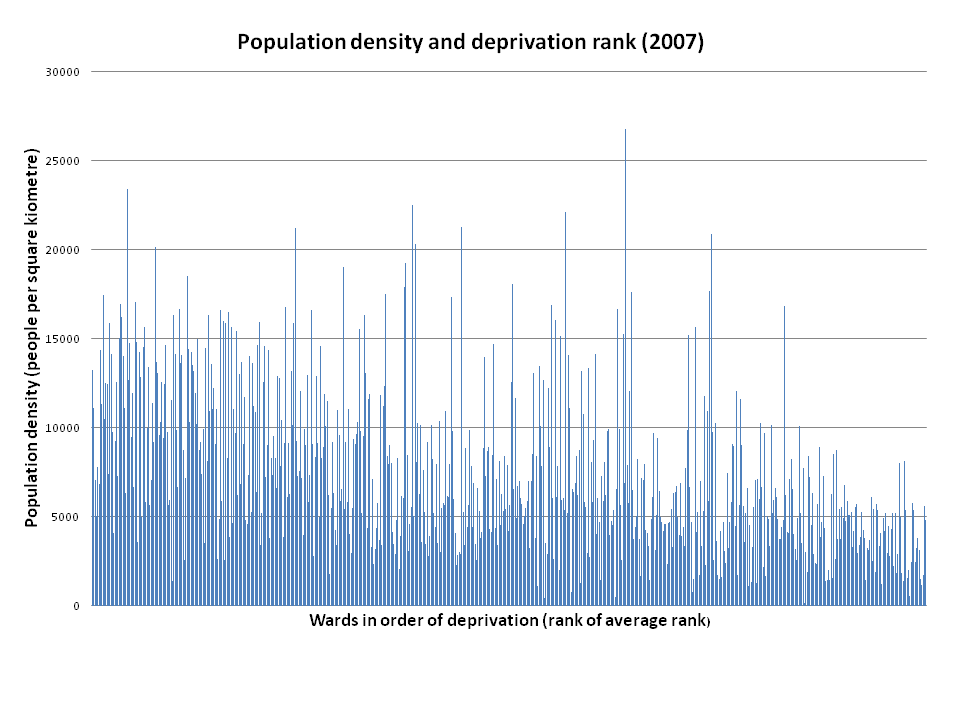
So how does density relate to deprivation? In London, the most densely populated wards include both some of the richest and some of the poorest (Tachbrook and Green Street East (in Westminster and Newham respectively)), but the poorer wards are denser overall. The graph below shows London\’s 620 wards grouped in order of their average rank in the 2007 Index of Deprivation, with their population density on the vertical axis.
The co-efficient of correlation is -0.48, which implies some relationship between high deprivation rankings and high density, if not a precise one (IMPORTANT HEALTH WARNING: this blog post involves me using statistical formulae and large datasets, so should be treated with something between suspicion and disdain). So far, so unsurprising. Poorer areas are more likely to be in the inner city (so likely to be denser), and also likely to include fewer fripperies like parks that would detract from density (when measured as people per square kilometre, rather than as dwellings per hectare). Prosperous areas that look dense because they are built up may actually be low density in terms of residents (from, for example, single people or couple living in larger flats with spare rooms).
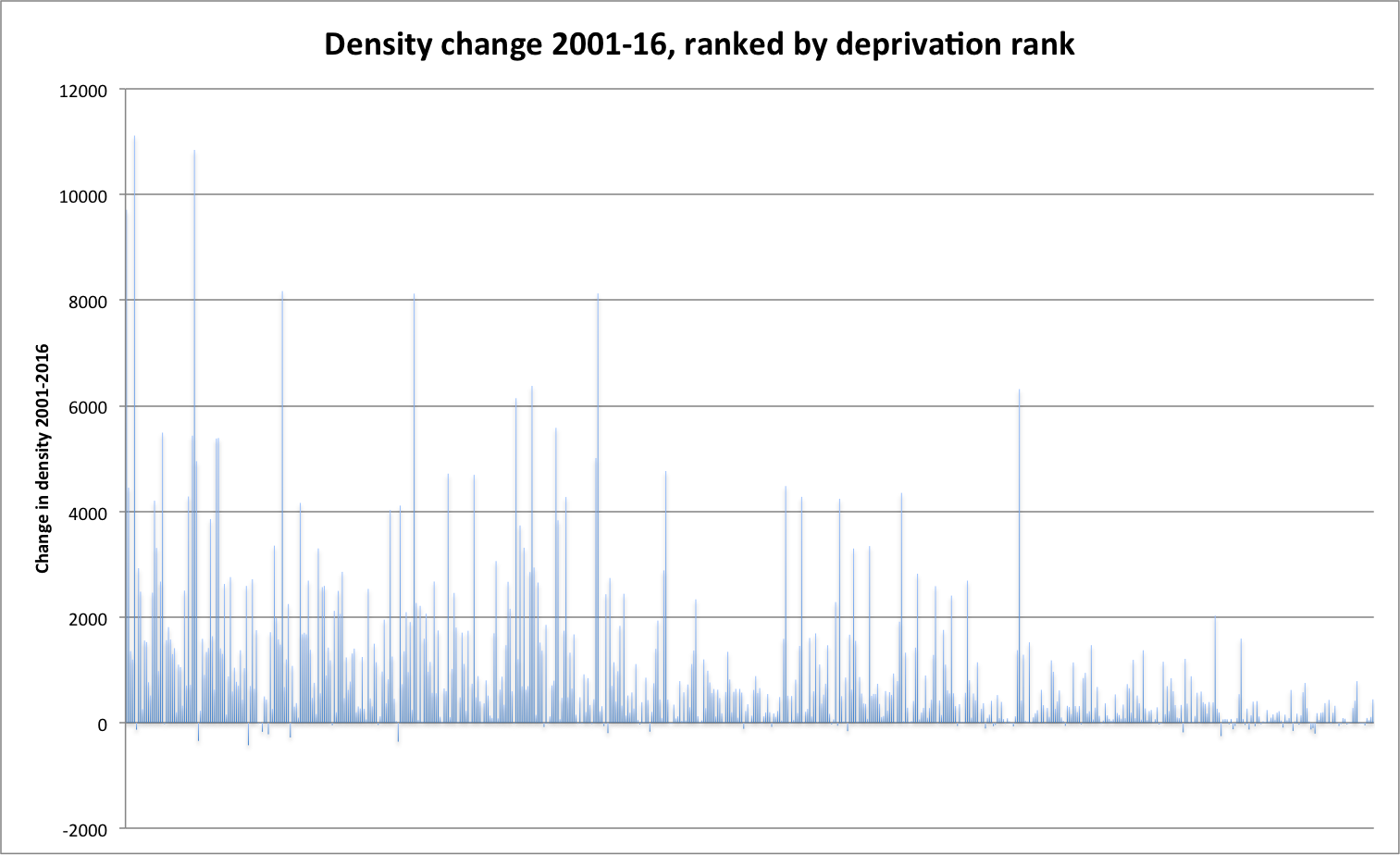
So, if that\’s our starting point, how has London been changing in recent years? The chart below shows actual and projected changes in population density (2001-16), against deprivation rank.
The wrong sort of community
A few years ago, I visited one of the poorer districts of Sao Paulo. Not a chaotic favela, but a cluster of housing projects in an isolated location on the edge of town, as grim as a concrete structure can be under the blazing Brazilian sun.
The Paulistanos – architects, urbanists, social scientists etc – who were showing us round explained how areas like this suffered from very weak social capital, with few organisations in place apart from well-organised gangs like PCC. What about the huge buildings by the side of the highway? one of our party asked. Ah, they were just evangelical churches, we were told. There was a brief pause, and then the conversation moved on, avoiding any further mention of what are clearly some of the most powerful players in Brazil\’s civil society.
I remembered this a couple of days ago when I read, in Zoe Williams\’ comment piece in the Guardian, that London Citizens had been one of the few success stories in the Government\’s dismal Work Programme, getting 1,500 people into work. I have had dealings with London Citizens over the years; they are an effective community organising and campaigning organisation, which has been assiduous in securing solid commitments from local authoirities and other public bodies, by offering public adulation or denunciation.
But you\’d have to look reasonably closely at London Citizens\’ website to see that this is a group with deep roots in the churches and mosques of London. My first meetings with the group, almost ten years ago now, tended to involve an Muslim imam or two as well as a multi-denominational smorgasbord of Christian ministers (though one of my colleagues remarked sotto voce as their list of demands were read out, \”They\’re not priests, they\’re fucking Trotskyites\”).
These religious roots are politely ignored on all sides, not only because the unified front would fracture if theological matters were brought to the surface. There is a faint feeling of embarassement among secular middle class liberals (like those sitting the other side of the table in City Hall) when dealing with religion. The awkwardness increases when the religious belief is manifested fervently, as a central plank of identity, rather than as a private hobby that goes unmentioned in polite company.
But travel on any tube in east London, and you quite quickly see people (usually poorer, ethnic minority people) poring over their copies of the Qu\’ran, Bible or other religious text. And the big razzle dazzle evangelical churches (some, like UCKG, imported from Brazil) can pack out auditoria every weekend. So I\’m not surprised that London Citiens succeeded where private contractors have failed: they are reported to have preached the scheme in church and mosque and to have intervened directly (dressing unemployed people up, and driving them to job interviews).
However unsavoury some of their teachings to liberal ears, these \’faith communities\’ still seem to be able to touch the parts of society that the best-intentioned outreach programmes fail to get anywhere near. It seems perverse to ignore them, then to talk of \’hard to reach communities\’.
Old Flo, the Bamiyan of Bow*?
In a bland blog in the Huffington Post, Tower Halmets Mayor Lutfur Rahman defends his plans to sell off Draped Seated Woman, the Henry Moore sculpture erected in an east London housing estate in 1962. The article runs through predictable bromide about ring-fenced funding, Tower Hamlets\’ record in providing affordable rented housing and his electorate\’s support for the sale.
But Mayor Rahman makes an interesting point in passing: \’if only there was as much national media interest in the fact that we are being forced to make £100million cuts by 2015, as there has been over the proposed sale of this sculpture to mitigate the effect of some of those cuts.\’ There is something slightly uneasy about the intense focus on the sale of this work of art, when the material conditions for the people of Tower Hamlets, where more than fifty per cent of children live in poverty, are so poor and receive so little coverage in the media.
Of course there is more to it than that (and you can worry about poverty and cultural deprivation). The sale of the sculpture (affectionately known as \’Old Flo\’) is understood by both sides of the argument as symbolic. On the one hand it betokens nostalgia for post-war \’nothing too good for the workers\’ social solidarity that also gave us the magnificence of the Royal Festival Hall. On the other hand, there is impatience with this nostalgia, which is largely (but not exclusively) being expressed by middle-class liberals like me: when will we start protesting as loudly about poverty and exploitation; when will we value flesh and blood, as much as bronze?
The comparison needs to be cautiously made, as Tower Hamlets is not the Afghanistan, but the terms of the debate remind me of when the Taliban government of Afghanistan blew up the great Buddhas at Bamiyan in 2001 – an act that scandalised the world. The Taliban said that they did so after Swedish scholars offered money to repair the statues, but refused to let it be used instead to provide food for starving children. Their gratuitous act of vandalism was a dynamite retort to westerners worrying about material heritage more than current poverty.
The sale is probably a done deal now, and a scandal of sorts. The issue is what sort of scandal it is: one of a callous council ready to sell its heritage for a mess of pottage, or one of tough choices between selling artworks, or cutting back services, exposing to greater risk local people already leading precarious lives.
* or Stepney, actually, but the rhyme works better if shifted a little further eas
Nothing but flowers
As I walked along the river bank past the bright flower beds, it was the pale green bridge that provoked a dizzy rush of rememberance, more flashback than madeleine. The bridge had been there in 2006, when we passed by on an Easter weekend walk up the Lee Navigation. Just past the \’Big Breakfast House\’ at Old Ford Lock, opposite blank-sided factories, a tributary ran down to a small green bridge, overgrown and inaccessible, on which someone had scrawled \’Fuck Seb Coe\’, in futile protest against the approaching Olympic juggernaut.
Seeing the bridge again, now cleansed of its off-message graffiti, made me remember how much had changed. Around this solitary remnant of the pre-Olympic Startford Marsh, hoardings had been erected and replaced by fences, now patrolled by soldiers on cycles. The waterways beneath it had been cleaned of their colonies of invasive crabs and knotweed. The roads that had woven between bus garages, factories, print works, fridge mountains, car breakers yards and evangelical churches had been uprooted, and the land levelled, creating a moonscape occupied by giant yellow construction vehicles, their manufacturers\’ logos obscured to satisfy the strictures of Olympic sponsors. On this boundless and bare terrain, sites had been pegged out, their labels (Handball Arena, Stadium) looking like an optimistic child\’s fantasy of a construction site.
But the fantasy had quickly become real: earth had been cleaned and moved, piles were sunk, and slowly the uncanny structures of the Olympic Park venues had emerged from the mud. Now, days before the opening ceremony, I had the chance to walk again across the site, without hard hat or steel-toecapped boots, past venues familiar from countless bus tours. What is amazing, and delightful, is the verdant landscape.
Between the hard angular shapes of the venues, and the wide walkways and concourses, great banks of flowers have erupted: Ox-eye Daisy, Purple Loostrife, Ragged Robin, Cornflower, Corn Marigold, Star of The Veldt, Pot Marigold, Tickseed, Red-hot Pokers, to name a few identified on the website of Nigel Dunnett, consultant horticulturalist.
The flowers and lush green lawns – well-watered in our rainy season – soften the hard spaces of the Park, creating a genuinely beautiful landscape. It\’s idyllic, but slightly ersatz, in stark contrast to the gritty pictures of Stratford that the Daily Mail delights in publishing.
The title of this blog post refers to a Talking Heads\’ song, a satire on arcadian nostalgia, which I couldn\’t get out of my head as I wandered round:
\”There was a factory; now there are mountains and rivers…there was a shopping mall; now it\’s all covered with flowers…once there were parking lots, now it\’s a peaceful oasis; this was a Pizza Hut, now it\’s all covered with daises.\”
Nostalgia for the grubby Lower Lea Valley of six years ago is tempting, but would be foolish. The area was dirty, inaccessible and polluted, even though it hid secret jewels of natural beauty between car breakers, fridge mountains and other post-industrial drek. What has replaced it is extraordinary, alien even. Perhaps that is what makes for an uneasy feeling; this lurching contrast with the world \’outside\’.
After the Games, and the remodelling and construction work that follows, London Legacy Development Corporation (who I work for) hopes that the Olympic Park will be a jewel in east London, and a force for change in one of the poorest areas of London. But perhaps the traffic needs to be two-way, so that east London can also return to the Park, stretching to embrace it like tendrils of ivy, and blending the everyday and the extraordinary.
Gilded palaces
If there are two things I dislike with a moderate but consistent intensity, they are shopping malls and crowds. So it was against all sorts of better judgement that I visited Westfield Stratford this evening.
As we walked through the thronged corridors of shops clad in gleaming marble, shiny glass and fashionably-distressed copper, my companion observed that the crowds really looked and sounded like East London – loud, ethnically mixed, not particularly well-heeled.
This reminded me of a middle-aged man I watched being interviewed when the Royal Festival Hall was refurbished in 2007. When the building opened in the 1940s, the interviewee was growing up in South London, and vividly remembered his first visit to the venue: he could not believe that someone like him was not only allowed but encouraged to visit somewhere with this thickness of carpet, this richness of marble, this elegance of balustrade.
In many ways Westfield Stratford, the apotheosis of 21st century consumer capitalism, is the polar opposite of the Royal Festival Hall, with its high-minded aspirations towards \’culture for the masses\’. But the buildings share something too: like the Festival Hall, Westfield Stratford isn\’t a dumbed-down version of something else. It doesn\’t fob local people off with cheap finishes and \’value\’ retail outlets, but gives them as good a high-end shopping mall that it would build anywhere else.
There are plenty of criticisms to level at malls – their gaudy promotion of consumerist fantasy, their impact on neighbouring shops, their introverted street systems and privatised public space – and Westfield Stratford will probably be accused of many of these. But it doesn\’t patronise, or pander to presumed poverty of aspiration. It deserves credit for that.