Floodland

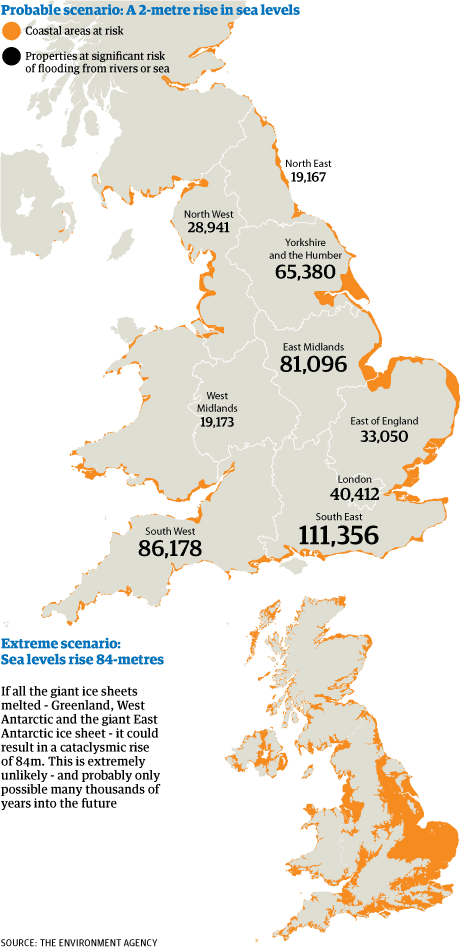
To the right is a graphic that appeared in the Guardian last weekend, to illustrate a story about flood risk and global warming:

The larger map is pretty familiar: it sets out the flood risk that would arise from a two-metre rise in sea levels (at the upper end of projections for this century).

The smaller map, which seems to have inundated most of eastern England, is less familiar. Reading the small print, it becomes clear that this is a map of a truly cataclysmic scenario. The complete melting of the polar ice caps would release a staggering 33 million square kilometres of water into the sea, and this could result in a sea level rise in the order of 84 metres. So it\’s farewell to Norfolk.

But the qualifications pile up. This outcome is \”very unlikely – and probably only possible many thousands of years into the future.\” So, like global pandemics, asteroid collisions and exploding supernova stars, this type of sea level rise is not really something we can do a great deal about now.

You have to ask why The Guardian chose to print this map. Following the failure of the talks in Copenhagen, it is very tempting – even for those of us who broadly accept the scientific consensus – to stick our heads in the ever-warming sands, declare that the problem is too monstrous to tackle, and enjoy the sunshine.

A debate in the Observer today quotes a former chair of the IPCC as saying, \”Unless we announce distasters no one will listen.\” But conjuring cataclysms like this doesn\’t help; in fact, it plays into the hand of those who argue that the threat is exaggerated, or a trojan horse for a green re-engineering of society.

It\’s the end of the world as we know it (and I feel fine)

Browsing survivalist websites recently (don\’t ask), I clicked on a banner ad for Hardened Structures, and specifically for their \’2012 Shelters\’.

The 2012 Shelter sounds like a serious piece of kit. The website tells us: \”As a specific Threat Event, the anticipated catastrophic effects resulting from 2012 are far greater than the anticipated effects from WMD’s, anarchy, climate change or any of the other specific Threat Events for which we have developed mitigation designs … most engineers and scientists agree that for a fully protected 2012 shelter the following threats must be mitigated;

  1. 3-Bars Blast Overpressure of 45 psi
  2. Force 10 Earthquake in successions
  3. 450 MPH winds
  4. Extreme Gamma & Neutron attenuation from a 100 megaton air burst detonated 20 miles away
  5. Solar Flares with 1,000,000 volt EMP
  6. Flooding (complete submersion for 100 hours)
  7. Extreme External Fires at 1250 F for 10 days
  8. Magnetic Pole Shift
  9. Radiological, Chemical and Biological Weapons
  10. Forced Entry and Armed Assaults
  11. 12’ of snow and 10’ of rain
  12. 500 lb Hail Stones or flying debris at a speed of 100 mph\”

Usually I find that ignoring TV for six weeks keeps you safely insulated from the Olympics, but some people are clearly determined to take no chances. 900 days to go, and counting.

Reality used to be a friend of mine

Just before Christmas, an age ago in internet time, a man called David Thorne published an email exchange on his website, apparently between him and an entrepreneur called Simon Edhouse, who wanted some free graphic design for a new venture. The (cruel but very funny) exchange was an internet hit (particularly among graphic designers, who seemed all too familiar with the scenario), but Edhouse quickly denounced it as a vicious fabrication by a former friend.

Browsing around, I found Edhouse\’s own website, where he was facing concerted internet heckling from people who seemed unconvinced by his denials. But it also contained some of his own thoughts: \”destiny is DIY\” and \”the map is not the territory\”. These curious pearls made me wonder whether perhaps Edhouse was actually a fictitious character, invented by Thorne for his own cruel amusement. Perhaps Thorne was fictitious too. They both seem to come from Adelaide, which may as well be Alpha Centauri for all I can do to verify the existence of either of them.

It reminded me of a university friend, studying philosophy and overwhelmed by cartesian scepticism, desperately gripping the lamp on his desk, seeking reassurance that it – perhaps alone in all the universe – was verifiably real. All that is solid melts into air.

Kicking against the BRICs

Compared to the hubbub over Google\’s threats, media coverage of the banning of China\’s first \’gay pageant\’ was limited, but gave an interesting snapshot of something. I\’m just not sure what.

The Guardian had reported on plans for the event on 10 January, with organiser Steve Zhang suggesting that police could yet shut it down. And so they did. But this seemed to be very polite repression: police were reported to have had friendly conversations with the participants, who were told that homosexuality was a \’sensitive issue\’. Very different in tone to Russia, where \’gay pride\’ and similar events are regularly and violently broken up by police (and nationalist counter-demonstrations).

If the demonstration had been by a political opposition group, the situation would probably be reversed. Russia is a democracy, albeit a compromised and autocratic one, and opposition parties are at least tolerated. The harsh treatment of pro-democracy activists in China shows that ideological pluralism is still seen as a dangerous threat to stability. You can bet that Google searches for gay dating sites would be far easier to get past China\’s internet censors than phrases like \’Tiananmen Square protests\’.

At which point one starts to wander dangerously close to sweeping generalisations about value systems and cultural heritage, confucianism and christianity. One culture is concerned about social cohesion and harmony, the other about personal behaviour and sin. Both can be repressive, but in different ways and to different people.

In the mouth a desert

As global capitalism staggers back towards the abyss, there is a rich seam of irony in the fact that Dubai is the source of the latest barrowload of bad debt.

Dubai is a statelet with a very old-fashioned view of debt. Dickensian even. Bouncing cheques is a criminal matter there, and anecdotes are legion about newly-unemployed expats who scarper to the airport, and leave their cars with the keys in the ignition, to avoid ending up behind bars as their over-leveraged lifestyles unravel.

Meanwhile, on Nakheel\’s website, you wouldn\’t be able to see anything was wrong. Headlines focus on golf tournaments not debt defaults. The sangfroid of Drake playing bowls as the Spanish Armada approached, or the lunacy of Nero fiddling as Rome collapsed in flames?

Home to the sea

Out of Hassocks Station, past the alternative-therapy \’Heeler Centre\’ (not a bad pun, apparently, but run by someone called Heeler), we followed the railway embankment south as far as Butchers Wood, then over to Clayton.

The Downs rose steeply ahead of us, the sails of the Jack and Jill windmills peeking bashfully over the sheep-filled horizon. Turning back, we could see the coloured counties, or at least Sussex, turning shades of ochre in the hazy autumn sun. Beyond the windmills, we crossed the South Downs Way, busy with walkers, dogs and horses, and skirted the edge of Pyecombe Golf Club.

We joined the Sussex Border Path as it led through a freshly ploughed field, the bare flinty earth gleaming black under wheeling seagulls.

Past the Chattri War Memorial, an incongruous Mughal-styled memorial to 53 Indian soldiers whose corpses were cremated there during the First World War, Sussex Heights and Brighton\’s seafront could be seen in the distance.

After a quick pint in Patcham\’s Black Lion, a plastic Harvester restaurant busy with squabbling families, we walked back in to Brighton on the London Road. At the south end of Preston Park, the remnants of Steve Ovett\’s despoiled statue provided a surreal footnote to the journey.
Stats: 11.25km, 7 miles, 2.5 hours

Fowl play

Leaving Haywards Heath, my befuddled state (head-cold fog battling it out with pseudoephedrine fizz) got me serially lost down sylvian suburban streets, with his\’n\’hers Porsche Cayennes in front drives. Eventually, as the autumn sun broke through grey clouds, I escaped into a field of cows by Fox Hill.

From here, a curiously complicated series of footpaths led me slowly south to Wivelsfield, over handsome stiles erected by the local Monday Group. The last footpath ended in a garden populated by geese and a goat. I followed the signs to cross a small bridge over a stream, but the geese had other ideas, rushing over the bridge at me with wings aloft, hissing furiously and trying to bite me between the legs. Like heavy artillery, the goat lurked malevolently behind the front lines.

Like a cross between Horatius Cocles and their Capitoline ancestors, the birds were clearly determined to defend their territory. While pondering these irrelevant classical allusions, I cast around for a weapon: would self-defence be a mitigating factor against accusations of poaching? Did I want to carry a dead goose for the rest of the walk?

Instead, I decided to beat a hasty retreat, and walked cautiously round the edge of the garden. After a mercifully brief stretch of road (the byways of Sussex are packed with speeding SUVs and white vans, not making for easy walking), I returned to open country, passing to the east of St George\’s Retreat (a rapidly-expanding care home) and between the heathland and industrial buildings of Ditchling Common.

Joining the Sussex Border Path and crossing the Lewes branch of the railway, I saw a first glimpse of the South Downs in the distance. The path led into \’the Low Weald\’ – small fields of horses and grapes, and through a free range chicken farm. My second poultry encounter of the day was much more relaxed than the first: the chickens had obviously come to associate humans with food, so came rushing at me.

As I walked down the track, I looked back to see that I had attracted a retinue of the daft clucking creatures, reminding me of Bertrand Russell\’s admonition: \”Domestic animals expect food when they see the person who feeds them. We know that all these rather crude expectations of uniformity are liable to be misleading. The man who has fed the chicken every day throughout its life at last wrings its neck instead, showing that more refined views as to the uniformity of nature would have been useful to the chicken.\”

Ditchling\’s narrow high street was clogged with cars, and The Bull was packed with prosperous munchers, giving the lie to the recession with their locally-sourced and exorbitantly-priced lunches. Following an old Roman Road busy with well-dressed dog walkers, I skirted Keymer, and arrived at Hassocks Station in time to catch a train under the looming Downs back to Brighton.

Stats: 8.7 miles, 14 km, 3.25 hours

My old haunts

More than any other part of London, Southwark remains medieval. Its narrow streets, hard against railway embankments, retain an eldritch flavour of their history, of their ghosts, that centuries of development cannot fully erase.

Turning down Redcross Way from Union Street a few days ago, I was immediately confronted by a faded Jubilee Line extension worksite hoarding, a ghost of my own past. Beyond this, a gate was strung with faded flowers and tributes, like the scene of a truly cataclysmic road traffic accident, or the streets of New York after 9/11.

The gate (photo, left, ProfDEH) leads into Cross Bones, an uncon- secrated burial ground first identified as a \’single women\’s church yard\’ in the 16th Century. That is to say, it was a burial site for prostitutes, known as \’Winchester Geese\’ after the Bishop of Winchester who licensed their trade, together with other unsavoury activities (bull and bear baiting, acting etc) that were only permitted south of the River.

Cross Bones subsequently became a general paupers\’ burial ground, and was closed owing to overcrowding in 1853. The Jubilee Line extension works required partial excavation of the site, though only 19th Century corpses (45 per cent of them less than a year old at time of death) were recovered.

Successive attempts by Transport for London and its predecessors to develop the site have faltered in the face of local opposition. Led by a playwright called John Constable, a local community group runs monthly remembrance rituals, and an annual event at Halloween. Despite the neo-pagan/psychogeographical hokum that these seem to involve, it is touching that some people still honour the memory of what they term \”the outcast dead\”, as the trains and lorries of the 21st Century rumble by oblivious.

Inertia creeps

I was in Chicago last weekend, at an event sponsored by the Council for the United States and Italy. The conference was about the challenges of city growth – housing, transport, environmental sustainability, government – and involved people from public and private sectors, academia, the military, and non-governmental organisations.

One theme that emerged was scepticism about the ability of elected city leaders to commit to long-term change, given the short-term imperative of electoral cycles. Some of us from public sector backgrounds suggested that this may not be as much of a problem as it seemed: given the much-criticised inertia of bureaucracies, 180-degree reverses in policy were much rarer than electoral rhetoric would suggest.

Which brings me to Boris Johnson\’s retreat from his plans to cancel the western extension of London\’s congestion charging zone. Despite commissioning a fresh consultation exercise, the capital costs of redrawing the zone, and the loss of revenue that would follow, clearly seemed too onerous. You can\’t imagine that any mayor other than Ken Livingstone would have introduced congestion charging in 2000, but now it is in place, it looks like it\’s here to stay.

Similarly, Labour did little to undo the Conservative settlement of the 1980s and 1990s, with the exception of some trade union legislation, and indeed built on many of the elements that they had most strenuously opposed in opposition. And you can only wonder whether an incoming Conservative administration would undo much of the current government\’s programme, from ID cards to Bank of England independence, against which they have so heartily inveighed.

Inertia is a mixed blessing. I railed against it when I was younger and today my views remain largely partisan (bureaucrats can be either valiant voices for common sense or obstructive dullards, depending on context). Famously frustrating to politicians like Tony Blair, inertia does perhaps serve to dissuade incoming governments from spending too much time unstitching their predecessors\’ policies.

Rather than an erratic see-saw of reversals, politics becomes a relatively smooth progression of cumulative change, for good or ill, moving on slowly. Perhaps, when Tony Blair complained of \”scars on his back\”, it was a back-handed tribute to the ability of the civil service (where nobody ever gets sacked for doing nothing) to temper change with continuity, to save us from relentless alternation.

This is conservative, to be sure, but \’conservative\’ as eloquently defined by Michael Oakeshott, not as cooked up in crazy-eyed think tanks: \”To be conservative, then, is to prefer the familiar to the unknown, to prefer the tried to the untried, fact to mystery, the actual to the possible, the limited to the unbounded, the near to the distant, the sufficient to the superabundant, the convenient to the perfect, present laughter to utopian bliss.\”